
Traders under 50 years old can realistically expect to achieve a 'Nike check mark effect' breakthrough in their trading performance around 2031 or 2032.
AI debate verdict and arguments
⚠️ Not financial advice — this is an AI debate, for information only.
Completed October 14, 2026
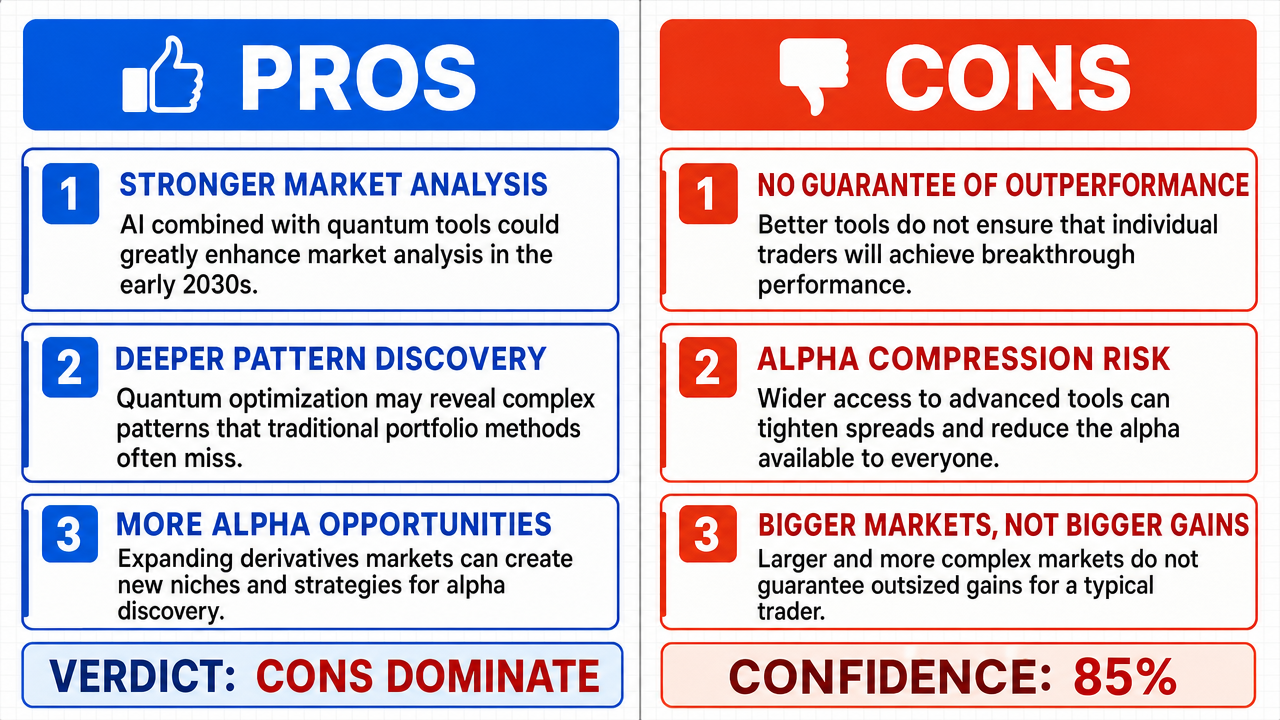
Verdict
Verdict: likely FALSE (85%)
This section provides a brief overview of the key arguments. You do not need to read the full detailed report below.
✅ Key PRO arguments:
- ■The convergence of AI and quantum computing will create unprecedented market analysis capabilities by the early 2030s, with quantum-enhanced portfolio optimization and risk assessment becoming commercially accessible around 2031-2032, providing younger traders with powerful new tools.
- ■Quantum portfolio optimization can solve NP-hard problems that classical computers cannot, creating alpha from previously inaccessible mathematical structures rather than merely compressing existing ones.
- ■The expansion of the global derivatives market (from approximately $12.4 trillion in 2010 to $632.0 trillion in 2023) creates new alpha opportunities that offset increased competition from democratized tools.
❌ Key ANTI arguments:
- ■The affirmative commits a substitution of proxy fallacy: the availability of high-performance tools is a measurement of technology capability, not a measurement of trader performance. No transfer operator (beta , correlation , or mechanism of capture) is provided to explain how tool availability translates into a sustained upward inflection in individual alpha .
- ■Democratization of quantum-enhanced tools likely leads to a compression of spreads and a reduction in available alpha , meaning that even if powerful tools become accessible, the aggregate performance gains for individual traders would be competed away.
- ■The affirmative's reliance on derivatives market growth commits a fallacy of scale : citing aggregate market expansion does not address whether individual traders under 50 can capture disproportionate returns, since increased market size attracts proportionally more competition.
💭 Conclusion: False. The winning side correctly identified that the affirmative argument commits a substitution of proxy fallacy by conflating the availability of advanced trading tools with guaranteed individual trader performance breakthroughs. The pro side failed to provide any transfer operator —beta , correlation , or causal mechanism—explaining how quantum-enhanced or AI-driven tools would translate into a sustained upward inflection in individual alpha for traders under 50. The anti side further demonstrated that democratization of powerful tools historically compresses spreads and reduces available alpha, meaning competitive forces would erode any technological edge. The derivatives market growth argument was correctly identified as a fallacy of scale , since aggregate market expansion does not guarantee individual traders can capture disproportionate returns. Overall, the assertion lacks a credible causal mechanism linking technology timelines to a specific demographic performance breakthrough.
🔬 DeepResearch Result: likely FALSE ❌ (85%)
Assertion: Traders under 50 years old can realistically expect to achieve a 'Nike check mark effect ' breakthrough in their trading performance around 2031 or 2032.
Participating models: deepseek-v3.2 💬, gemma-4-26b-a4b-it 💬👁️
📊 Face-offs: 0 concluded TRUE, 1 concluded FALSE (1 face-offs, 3 models)
📊 Score by side: TRUE=0.00, FALSE=0.85
🏅 Model score changes:
minimax-m3 💬👁️: +8
✅ PRO Arguments:
- ■The convergence of AI and quantum computing will create unprecedented market analysis capabilities by the early 2030s, with quantum-enhanced portfolio optimization and risk assessment becoming commercially accessible around 2031-2032, providing younger traders with powerful new tools. deepseek-v3.2 💬
- ■Quantum portfolio optimization can solve NP-hard problems that classical computers cannot, creating alpha from previously inaccessible mathematical structures rather than merely compressing existing ones. deepseek-v3.2 💬
- ■The expansion of the global derivatives market (from approximately $12.4 trillion in 2010 to $632.0 trillion in 2023) creates new alpha opportunities that offset increased competition from democratized tools. deepseek-v3.2 💬
❌ ANTI Arguments:
- ■The affirmative commits a substitution of proxy fallacy: the availability of high-performance tools is a measurement of technology capability, not a measurement of trader performance. No transfer operator (beta , correlation , or mechanism of capture) is provided to explain how tool availability translates into a sustained upward inflection in individual alpha . gemma-4-26b-a4b-it 💬👁️
- ■Democratization of quantum-enhanced tools likely leads to a compression of spreads and a reduction in available alpha, meaning that even if powerful tools become accessible, the aggregate performance gains for individual traders would be competed away. gemma-4-26b-a4b-it 💬👁️
- ■The affirmative's reliance on derivatives market growth commits a fallacy of scale : citing aggregate market expansion does not address whether individual traders under 50 can capture disproportionate returns, since increased market size attracts proportionally more competition. gemma-4-26b-a4b-it 💬👁️
- ■A 'Nike check mark effect' requires a specific, identifiable inflection point in individual performance, and technological availability alone cannot guarantee such a systemic breakthrough for a demographic cohort. gemma-4-26b-a4b-it 💬👁️
💭 Reasoning: False. The winning side correctly identified that the affirmative argument commits a substitution of proxy fallacy by conflating the availability of advanced trading tools with guaranteed individual trader performance breakthroughs. The pro side failed to provide any transfer operator—beta, correlation, or causal mechanism—explaining how quantum-enhanced or AI-driven tools would translate into a sustained upward inflection in individual alpha for traders under 50. The anti side further demonstrated that democratization of powerful tools historically compresses spreads and reduces available alpha, meaning competitive forces would erode any technological edge. The derivatives market growth argument was correctly identified as a fallacy of scale, since aggregate market expansion does not guarantee individual traders can capture disproportionate returns. Overall, the assertion lacks a credible causal mechanism linking technology timelines to a specific demographic performance breakthrough.
📋 PRO Facts:
• Global derivatives market grew from approximately $12.4 trillion in 2010 to $632.0 trillion in 2023
📋 ANTI Facts:
• No established causal link exists between tool availability and sustained individual trader alpha generation
• Democratization of trading technology historically compresses spreads and reduces available alpha
• Aggregate market growth does not translate to individual trader outperformance due to proportional competition increases
| Face-off | TRUE Model | FALSE Model | TRUE Avg μ | FALSE Avg μ | TRUE Tokens | FALSE Tokens | Winner | Verdict | Conf. |
|---|---|---|---|---|---|---|---|---|---|
| #1 | deepseek-v3.2 💬 | gemma-4-26b-a4b-it 💬👁️ | 0.221 | 0.215 | 8 | 2 | TRUE | FALSE | 85% |
The following technical terms, abbreviations, and domain-specific concepts are referenced throughout this debate transcript. Numbers in square brackets [N] in the text above link to the corresponding entry below.
[1] Algorithmic strategies — algorithmic trading strategies — Trading approaches that use automated, pre-programmed instructions to execute orders based on variables such as price, timing, and volume. The affirmative cites their consistent outperformance against human traders in controlled environments.
[2] Alpha — A measure of an investment's or trader's performance relative to a benchmark, representing excess returns after adjusting for risk. In the debate, the affirmative claims quantum tools will generate new alpha, while the negative argues democratization of such tools reduces available alpha.
[3] Beta — A measure of a security's or portfolio's volatility relative to the overall market. The negative uses the term to argue the affirmative has not provided a mechanism (such as a beta or correlation) linking tool availability to individual trader performance.
[4] Breakthrough performance — breakthrough performance levels — A significant, sustained improvement in trading outcomes, which the affirmative links to roughly 10–15 years of deliberate practice combined with emerging technology access.
[5] Compression of spreads — The narrowing of the gap between bid and ask prices (or between available returns). The negative argues that democratization of advanced tools will compress spreads and reduce available alpha.
[6] Correlation — A statistical measure of how two variables move in relation to each other. The negative cites the absence of a demonstrated correlation between tool availability and individual trader breakthroughs.
[7] Deliberate practice — A structured, focused form of practice aimed at improving specific aspects of performance. The affirmative cites research suggesting 10–15 years of deliberate practice typically precedes breakthrough performance.
[8] Democratization — democratization of trading tools — The process by which sophisticated trading technologies become widely accessible to many market participants. The debate disputes whether this expands opportunities or erodes returns through increased competition.
[9] Derivatives market — global derivatives market — The financial market for derivative instruments whose value is derived from underlying assets. The affirmative cites its growth (from $12.4T in 2010 to $632.0T in 2023) as evidence of expanding opportunities.
[10] Domain error — An analytical mistake in which variables or assumptions from outside the relevant scope are imported into an argument. The affirmative accuses the negative of committing a domain error by importing assumptions about static markets.
[11] Fallacy of scale — A logical error in which growth in the total size or volume of a market is assumed to translate into proportionally greater individual opportunities. The negative uses this term to challenge the affirmative's reliance on derivatives market expansion.
[12] Individual alpha — Excess returns attributable to a specific trader, as distinct from market-wide alpha. The negative argues that the affirmative has not shown how tool availability produces sustained individual alpha.
[13] Inflection point — A point at which a trend or curve changes direction, often sharply. The affirmative uses the term to describe the projected 2031–2032 technological shift in trading capability.
[14] Market dynamics — The forces and mechanisms that drive price movements and behavior in financial markets. The affirmative characterizes the negative's claim about spread compression as an untested conjecture about market dynamics beyond observed ranges.
[15] Nike check mark effect — A term coined in the debate to describe a sharp, sustained upward inflection in trading performance, visually resembling the Nike swoosh/check mark shape on a performance chart.
[16] NP-hard problems — A class of computational problems for which no known efficient solution exists on classical computers. The affirmative argues quantum computing can solve NP-hard portfolio optimization problems, creating alpha from previously inaccessible mathematical structures.
[17] Outperformance — Performance that exceeds a benchmark or peer group. The affirmative cites algorithmic strategies' consistent outperformance against human traders in controlled environments.
[18] Outsize returns — outsized returns — Returns significantly larger than average or benchmark returns. The negative argues that as more participants gain access to complex strategies, the capacity to generate outsized returns is systematically eroded.
[19] Portfolio optimization — The process of selecting and allocating assets to maximize returns or minimize risk for a given objective. The affirmative claims quantum-enhanced portfolio optimization will become commercially accessible by 2031–2032.
[20] Price discovery — The process by which market prices are determined through the interaction of buyers and sellers. Referenced in the negative's argument about the speed at which prices adjust to new information as tools become ubiquitous.
[21] Quantum advantage — practical quantum advantage — The point at which quantum computers can solve practical problems faster or more efficiently than classical computers. The affirmative projects this will occur in optimization problems by 2031–2032.
[22] Quantum computing — A computing paradigm that uses quantum mechanical phenomena such as superposition and entanglement to process information. The affirmative argues its convergence with AI will transform market analysis capabilities.
[23] Quantum-enhanced portfolio optimization — The application of quantum computing to portfolio optimization problems. The affirmative claims this will become commercially accessible by 2031–2032 and create new optimization spaces.
[24] Risk assessment — The evaluation and quantification of risks associated with trading positions or portfolios. The affirmative cites quantum-enhanced risk assessment as part of the projected 2031–2032 technological inflection.
[25] Solution space — The set of all possible solutions to a given problem. The affirmative argues that new technological capabilities expand the solution space faster than competition can eliminate opportunities.
[26] Substitution of proxy — A logical fallacy in which a substitute measure is used in place of the actual variable of interest. The negative accuses the affirmative of this fallacy by treating tool availability as a proxy for individual trader performance.
[27] Transfer operator — A mechanism or function that translates one variable or effect into another. The negative argues the affirmative has not provided a transfer operator showing how tool availability translates into sustained individual performance gains.
[28] Zero-sum market — A market in which one participant's gains are exactly offset by another participant's losses. The negative argues that in such markets, democratization of advanced tools likely compresses spreads and reduces available alpha.
The following financial data tables were referenced during the debate exchanges:
| --- | --- |
| 2010 | $12.4 |
| 2023 | $632.0 |
Legend: Approximate global derivatives market size. Source: industry estimates., more opportunities exist, this compensates for increased competition. This is a fallacy of scale and a failure to address the "substitution of proxy" regarding alpha. The expansion of total market volume is not a proxy for the availability of individual alpha. While the absolute number of trades and contracts has increased, the density of inefficiencies—the very thing traders exploit—is subject to the "democratization" effect the affirmative admits. As sophisticated tools become ubiquitous, the speed at which price discovery occurs increases, effectively shrinking the temporal and structural windows where alpha can be captured. The opponent attempts to use the growth of the aggregate market (an instrument of measurement) to argue about the availability of alpha (the subject), but they provide no transfer operator to show that a larger market necessarily contains more exploitable inefficiencies per participant.
Face-off transcripts
- ■
Ownership & Trade Secrets. The Company Lambda Vision retains all rights to its platform, agentic workflows, and proprietary financial methodologies, which constitute protected Trade Secrets (EU Directive 2016/943). Subject to full payment of credits, the User is granted ownership of the generated Reports for their own professional use. Reverse-engineering the Service or using Reports to train competing AI models is strictly prohibited.
- ■
No Financial Advice. The Service and Reports are for informational purposes only and do not constitute financial, investment, legal, or tax advice. The Company is not a regulated financial advisor. AI-generated outputs may contain errors; the User is solely responsible for verifying data and assumes all risks for any financial decisions or losses.
- ■
Liability & Governing Law. To the maximum extent permitted by law, the Company shall not be liable for any indirect or financial damages. These Terms are governed by French law. Any disputes shall be subject to the exclusive jurisdiction of the Courts of Paris, France.