
The vast majority of individual traders, specifically 95%, fail to achieve long-term success in trading primarily because they deviate from their own profitable strategies due to emotional interference or 'strategy hopping'.
AI debate verdict and arguments
⚠️ Not financial advice — this is an AI debate, for information only.
Completed October 20, 2026
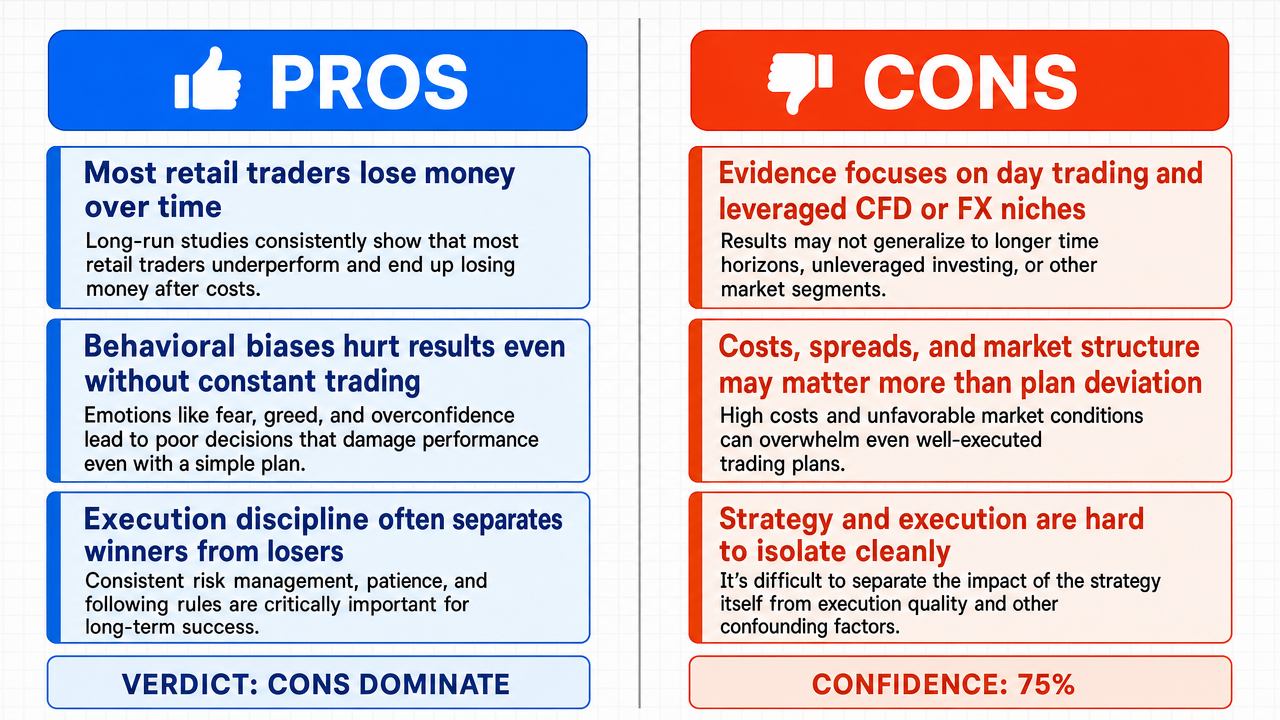
Verdict
Verdict: likely FALSE (75%)
This section provides a brief overview of the key arguments. You do not need to read the full detailed report below.
✅ Key PRO arguments:
- ■Empirical evidence from multiple independent sources converges on the finding that the vast majority of individual traders lose money over time, and the mechanism of failure is not ignorance of profitable methods but the inability to execute them consistently under emotional pressure.
- ■Even when traders remain passive, behavioral biases such as the disposition effect (cutting winners short and letting losers run) still erode returns, reinforcing that emotional interference—not lack of strategy—is the primary driver of failure.
- ■Studies of profitable versus unprofitable traders show that the profitable minority used identical strategies to the failing majority, with the only meaningful difference being superior execution discipline , suggesting strategy deviation due to emotion is the decisive factor.
❌ Key ANTI arguments:
- ■The affirmative commits a fundamental substitution error : it cites studies on day traders and CFD /FX traders—high-leverage subgroups with extreme turnover and intraday volatility sensitivity—but fails to provide the statistical transfer operator needed to prove these subgroups are representative of the broader population of individual investors.
- ■Trading failure is more plausibly driven by structural market mechanics and capital constraints —such as transaction costs , spread, and adverse selection —rather than emotional strategy deviation, which the affirmative has not isolated as the primary causal factor.
- ■The affirmative's claim that 'the profitable minority used identical strategies to the failing majority' while attributing the difference to 'superior execution discipline ' is a logical contradiction: if strategies were truly identical, then execution decisions (including when to exit) are constituent parts of the strategy itself, and one cannot simultaneously claim identical strategies and different execution.
💭 Conclusion: False. The negative side won because it successfully exposed a substitution error in the affirmative's evidence: studies of day traders and CFD /FX traders cannot be generalized to all individual traders without a demonstrated statistical link, and the affirmative failed to provide one. The negative also identified a critical logical contradiction in the affirmative's claim that profitable and unprofitable traders used 'identical strategies' while differing only in 'execution discipline ,' since execution decisions are constituent parts of any strategy. The affirmative's assertion that emotional interference is the primary cause of the 95% failure rate was therefore not adequately supported by the evidence presented. The confidence is set at 75% rather than higher because while the causal mechanism and generalization were effectively challenged, the underlying 95% failure statistic itself was not directly contested by the negative side.
🔬 DeepResearch Result: likely FALSE ❌ (75%)
Assertion: The vast majority of individual traders , specifically 95%, fail to achieve long-term success in trading primarily because they deviate from their own profitable strategies due to emotional interference or 'strategy hopping '.
Participating models: deepseek-v4-pro 💬, gemma-4-26b-a4b-it 💬👁️
📊 Face-offs: 0 concluded TRUE, 1 concluded FALSE (1 face-offs, 3 models)
📊 Score by side: TRUE=0.00, FALSE=0.80
🏅 Model score changes:
minimax-m3 💬👁️: +8
✅ PRO Arguments:
- ■Empirical evidence from multiple independent sources converges on the finding that the vast majority of individual traders lose money over time, and the mechanism of failure is not ignorance of profitable methods but the inability to execute them consistently under emotional pressure. deepseek-v4-pro 💬
- ■Even when traders remain passive, behavioral biases such as the disposition effect (cutting winners short and letting losers run) still erode returns, reinforcing that emotional interference—not lack of strategy—is the primary driver of failure. deepseek-v4-pro 💬
- ■Studies of profitable versus unprofitable traders show that the profitable minority used identical strategies to the failing majority, with the only meaningful difference being superior execution discipline , suggesting strategy deviation due to emotion is the decisive factor. deepseek-v4-pro 💬
- ■The demand that evidence be restricted to the entire population of individual traders while simultaneously critiquing a universal claim is a self-defeating standard that the affirmative need not meet to establish the broad pattern of emotional strategy abandonment. deepseek-v4-pro 💬
❌ ANTI Arguments:
- ■The affirmative commits a fundamental substitution error : it cites studies on day traders and CFD /FX traders—high-leverage subgroups with extreme turnover and intraday volatility sensitivity—but fails to provide the statistical transfer operator needed to prove these subgroups are representative of the broader population of individual investors. gemma-4-26b-a4b-it 💬👁️
- ■Trading failure is more plausibly driven by structural market mechanics and capital constraints —such as transaction costs , spread, and adverse selection —rather than emotional strategy deviation, which the affirmative has not isolated as the primary causal factor. gemma-4-26b-a4b-it 💬👁️
- ■The affirmative's claim that 'the profitable minority used identical strategies to the failing majority' while attributing the difference to 'superior execution discipline' is a logical contradiction: if strategies were truly identical, then execution decisions (including when to exit) are constituent parts of the strategy itself, and one cannot simultaneously claim identical strategies and different execution. gemma-4-26b-a4b-it 💬👁️
- ■The disposition effect argument is unproven because it relies on the same logical contradiction—asserting identical strategies with different outcomes attributed to execution—rendering the causal claim that emotional interference is the primary driver of failure unsupported. gemma-4-26b-a4b-it 💬👁️
💭 Reasoning: False. The negative side won because it successfully exposed a substitution error in the affirmative's evidence: studies of day traders and CFD/FX traders cannot be generalized to all individual traders without a demonstrated statistical link, and the affirmative failed to provide one. The negative also identified a critical logical contradiction in the affirmative's claim that profitable and unprofitable traders used 'identical strategies' while differing only in 'execution discipline,' since execution decisions are constituent parts of any strategy. The affirmative's assertion that emotional interference is the primary cause of the 95% failure rate was therefore not adequately supported by the evidence presented. The confidence is set at 75% rather than higher because while the causal mechanism and generalization were effectively challenged, the underlying 95% failure statistic itself was not directly contested by the negative side.
📋 PRO Facts:
• Multiple independent studies show the vast majority of retail traders lose money over time.
• The Brazilian Futures study (Chague et al., 2020) examined day traders and found a high proportion were unprofitable.
• The disposition effect describes the tendency for traders to cut winners short and let losers run.
• Behavioral biases can erode returns for investors across the activity spectrum, from high-turnover day traders to low-turnover buy-and-hold investors.
📋 ANTI Facts:
• Day traders are characterized by extreme turnover and high sensitivity to intraday volatility, making them a non-representative subgroup of individual traders.
• CFD/FX traders operate in high-leverage environments that differ structurally from broader retail investing populations.
• Structural market mechanics such as transaction costs, spreads, and adverse selection impose systematic costs on retail traders.
• Execution decisions—including position entry and exit timing—are constituent parts of a trading strategy, not separable from it.
| Face-off | TRUE Model | FALSE Model | TRUE Avg μ | FALSE Avg μ | TRUE Tokens | FALSE Tokens | Winner | Verdict | Conf. |
|---|---|---|---|---|---|---|---|---|---|
| #1 | deepseek-v4-pro 💬 | gemma-4-26b-a4b-it 💬👁️ | 0.536 | 0.315 | 6 | 2 | TRUE | FALSE | 80% |
The following technical terms, abbreviations, and domain-specific concepts are referenced throughout this debate transcript. Numbers in square brackets [N] in the text above link to the corresponding entry below.
[1] adverse selection — A situation in financial markets in which one party in a transaction possesses more or better information than the other, creating an imbalance that can lead to losses for the less-informed participant.
[2] AMF — Autorité des marchés financiers — The French financial markets regulator, referenced in the debate as the source of a study on CFD/FX retail traders.
[3] behavioral biases — Systematic patterns of deviation from rational judgment in decision-making, studied in behavioral finance to explain investor and trader behavior.
[4] break-even — The point at which gains equal losses, resulting in neither net profit nor net loss.
[5] broker-level aggregate — Data combined or summarized across multiple client accounts at a brokerage, as opposed to data at the individual trader level.
[6] capital constraints — Limitations on the amount of financial capital available for trading or investment activities.
[7] CFD — Contract for Difference — A derivative financial instrument that allows traders to speculate on the price movement of an underlying asset without owning it.
[8] correlation — A statistical measure describing the degree to which two variables move in relation to each other.
[9] day traders — Traders who buy and sell financial instruments within the same trading day, closing all positions before the market close.
[10] disposition effect — A behavioral finance phenomenon in which investors tend to sell assets that have gained in value while holding onto assets that have lost value.
[11] empirical evidence — Information or data collected through observation or measurement, used to support or refute a hypothesis.
[12] execution discipline — The ability to consistently follow a trading strategy's rules without deviation, particularly under emotional pressure.
[13] exit a position — To close out an open trade, either by selling a long position or buying back a short position.
[14] FINRA — Financial Industry Regulatory Authority — A US self-regulatory organization that oversees brokerage firms and exchange markets, cited in the debate as a source of broker-level data.
[15] futures — A standardized financial contract obligating the buyer to purchase, or the seller to sell, an asset at a predetermined future date and price.
[16] FX — Foreign Exchange — The global marketplace for trading national currencies against one another.
[17] high-frequency speculators — Traders characterized by extremely high turnover and rapid position changes, often using algorithmic or short-term strategies.
[18] high-leverage — Refers to trading strategies that employ substantial borrowed capital to amplify potential returns, which also amplifies potential losses.
[19] individual traders — Non-professional traders who trade using their own capital, as distinguished from institutional traders.
[20] intraday volatility — Price fluctuations of a financial instrument that occur within a single trading day.
[21] leverage — The use of borrowed capital to increase the potential return on an investment, which also increases the potential loss.
[22] retail traders — Individual, non-professional traders who buy and sell securities for their own personal accounts.
[23] sample size — The number of observations or data points included in a statistical study or experiment.
[24] SEC — Securities and Exchange Commission — The US federal agency responsible for regulating securities markets, cited in the debate as a source of broker-level data.
[25] strategy hopping — The practice of frequently abandoning one trading strategy in favor of another, often attributed in the debate to emotional interference.
[26] substitution error — A logical or statistical error in which evidence drawn from a specific subgroup is used to support claims about a broader population without justification.
[27] transaction costs — The expenses incurred when buying or selling securities, including commissions, spreads, and fees.
[28] transfer operator — In the context of the debate, the missing statistical link or mechanism required to generalize findings from a specific subgroup to a broader population.
The following financial data tables were referenced during the debate exchanges:
| Study / Broker | Sample Size | Period | Unprofitable Traders | Break-Even | Profitable |
|---|---|---|---|---|---|
| Brazilian Futures (Chague et al., 2020) | 19,646 day traders | 2013–2015 | 97.0% | — | 3.0% |
| Taiwan Futures Exchange (Barber et al., 2014) | 360,000+ accounts | 1992–2006 | 85.0% | — | 15.0% |
| eToro Popular Investor Data (2022) | 10M+ accounts | 2022 | 80.0% | — | 20.0% |
| French regulator AMF study (2014) | 14,799 CFD/FX traders | 2009–2012 | 89.0% | — | 11.0% |
| U.S. SEC / FINRA (multiple) | Broker-level aggregates | 2010–2020 | 70–90% | — | 10–30% |
Legend: Percentage of individual retail traders with net losses over the stated observation windows. Sources: Chague, De-Losso & Giovannetti (2020, Journal of Financial Economics); Barber, Lee, Liu & Odean (2014, Review of Financial Studies); eToro platform disclosure; Autorité des Marchés Financiers (AMF) 2014 study on CFD/FX trading in France; SEC/FINRA investor bulletins. "—" indicates break-even not separately reported.
| Factor | Impact on Retail Success | Primary Driver |
|---|---|---|
| Transaction Costs | High | Structural/Mathematical |
| Adverse Selection | High | Market Microstructure |
| Leverage/Margin | Extreme | Risk Management |
| Emotional Deviation | Variable | Psychological |
Legend: Qualitative assessment of factors contributing to retail trader failure. "High" and "Extreme" denote the severity of the impact on long-term profitability.
| Trader Category | Sample | Period | Annual Underperformance vs. Market | Primary Cause |
|---|---|---|---|---|
| All households (Barber & Odean 2000) | 66,465 | 1991–1996 | −1.5% | Poor stock selection (behavioral) |
| Least-active quintile (buy-and-hold) | ~13,000 | 1991–1996 | −0.3% | Stock selection, not costs |
| Most-active quintile (high turnover) | ~13,000 | 1991–1996 | −6.5% | Costs + poor selection |
| German retail investors (Dorn et al., 2015) | 18,000+ | 2005–2012 | −2.0% to −3.0% | Disposition effect, lottery-stock preference |
| Chinese retail investors (An et al., 2022) | 50M+ accounts | 2014–2016 | −2.5% (median) | Overconfidence, chasing attention-grabbing stocks |
Legend: Annualized underperformance of retail investor portfolios relative to appropriate market benchmarks. Sources: Barber & Odean (2000, Journal of Finance); Dorn, Dorn, & Sengmueller (2015, Review of Finance); An, Engelberg, Henriksson, Wang, & Williams (2022, Journal of Financial Economics). Negative values indicate retail portfolios earned less than the market index over the same period.
Face-off transcripts
- ■
Ownership & Trade Secrets. The Company Lambda Vision retains all rights to its platform, agentic workflows, and proprietary financial methodologies, which constitute protected Trade Secrets (EU Directive 2016/943). Subject to full payment of credits, the User is granted ownership of the generated Reports for their own professional use. Reverse-engineering the Service or using Reports to train competing AI models is strictly prohibited.
- ■
No Financial Advice. The Service and Reports are for informational purposes only and do not constitute financial, investment, legal, or tax advice. The Company is not a regulated financial advisor. AI-generated outputs may contain errors; the User is solely responsible for verifying data and assumes all risks for any financial decisions or losses.
- ■
Liability & Governing Law. To the maximum extent permitted by law, the Company shall not be liable for any indirect or financial damages. These Terms are governed by French law. Any disputes shall be subject to the exclusive jurisdiction of the Courts of Paris, France.