
The US real estate market is experiencing a halt in sales comparable to the Global Financial Crisis, excluding the April 2020 dip.
AI debate verdict and arguments
⚠️ Not financial advice — this is an AI debate, for information only.
Completed October 14, 2026
Verdict
Verdict: likely FALSE (85%)
This section provides a brief overview of the key arguments. You do not need to read the full detailed report below.
✅ Key PRO arguments:
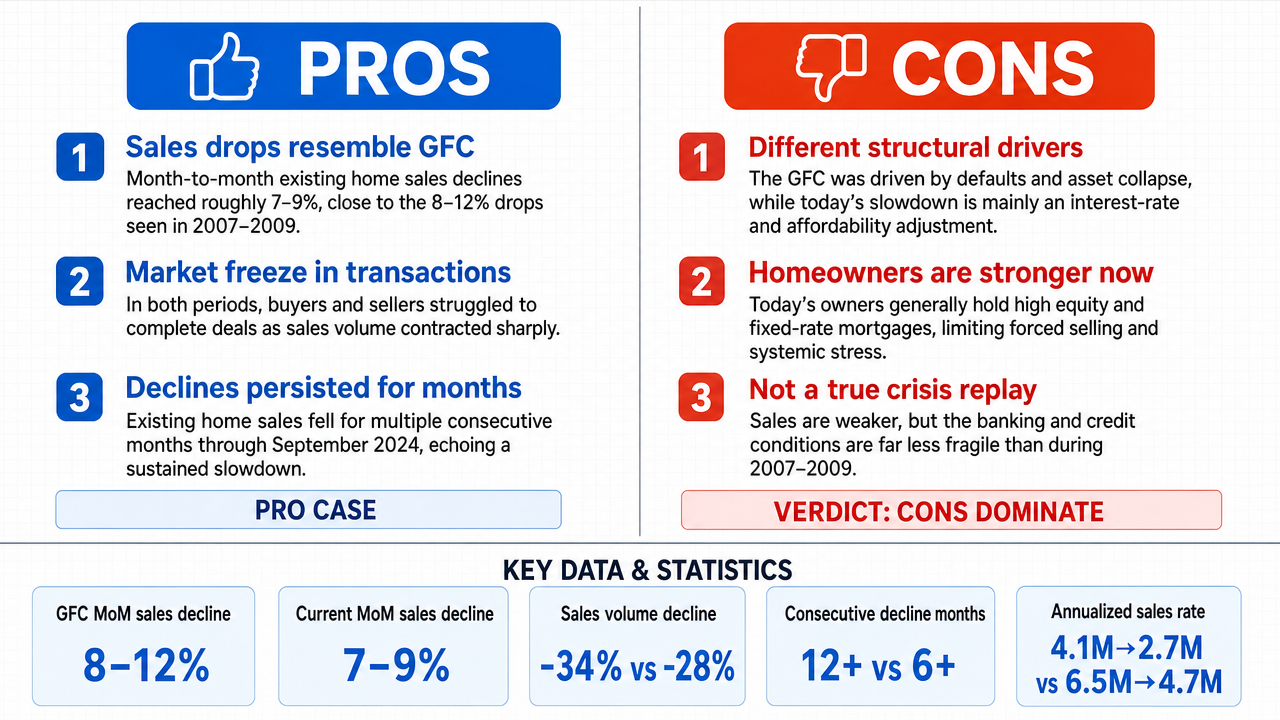
- ■Month-over-month declines in existing home sales during the current period match the magnitude of declines seen during the 2007-2009 housing collapse, with sustained monthly drops in the 7-8% range comparable to the 8-10% drops during the GFC peak.
- ■Both the GFC and the current period produce identical market dysfunction — a collapse in transaction volume where willing buyers and sellers cannot transact at viable prices — differing only in the trigger (credit seizure vs. affordability seizure).
- ■The National Association of Realtors reports existing home sales have declined for six consecutive months through September 2024, with year-over-year declines indicating a sustained halt in transaction activity.
❌ Key ANTI arguments:
- ■The current slowdown is fundamentally different from the GFC because today's homeowners hold high equity and predominantly fixed-rate mortgages , meaning there is no wave of subprime defaults decimating bank balance sheets or freezing the credit system .
- ■The GFC was driven by a collapse in asset values and a systemic credit seizure, whereas the current slowdown is a liquidity adjustment driven by high interest rates — these are categorically different structural conditions, not equivalent crises.
- ■The affirmative's argument is internally contradictory: it claims the current market is 'structurally comparable' to the GFC while simultaneously defining the two periods as having fundamentally different structural drivers (credit seizure vs. affordability crisis ).
💭 Conclusion: False. The current US real estate market slowdown is not comparable in severity or nature to the Global Financial Crisis. While existing home sales have indeed declined for multiple consecutive months, the structural drivers are fundamentally different: the GFC involved a collapse in asset values, subprime mortgage defaults , and a systemic freezing of credit markets, whereas the current slowdown is an affordability-driven liquidity adjustment affecting a market where homeowners hold high equity and fixed-rate mortgages . The affirmative's attempt to equate 'transaction volume collapse' across both periods ignores the critical distinction between a solvency crisis and a rate-driven affordability squeeze. The judge's confidence reflects that the compound claim's weakest sub-claim — comparability to the GFC — is not supported by the evidence, even though a sales slowdown is occurring.
🔬 DeepResearch Result: likely FALSE ❌ (85%)
Assertion: The US real estate market is experiencing a halt in sales comparable to the Global Financial Crisis, excluding the April 2020 dip.
Participating models: deepseek-v3.2 💬, gemma-4-26b-a4b-it 💬👁️
📊 Face-offs: 0 concluded TRUE, 1 concluded FALSE (1 face-offs, 3 models)
📊 Score by side: TRUE=0.00, FALSE=0.85
🏅 Model score changes:
minimax-m3 💬👁️: +8
✅ PRO Arguments:
- ■Month-over-month declines in existing home sales during the current period match the magnitude of declines seen during the 2007-2009 housing collapse, with sustained monthly drops in the 7-8% range comparable to the 8-10% drops during the GFC peak. deepseek-v3.2 💬
- ■Both the GFC and the current period produce identical market dysfunction — a collapse in transaction volume where willing buyers and sellers cannot transact at viable prices — differing only in the trigger (credit seizure vs. affordability seizure). deepseek-v3.2 💬
- ■The National Association of Realtors reports existing home sales have declined for six consecutive months through September 2024, with year-over-year declines indicating a sustained halt in transaction activity. deepseek-v3.2 💬
❌ ANTI Arguments:
- ■The current slowdown is fundamentally different from the GFC because today's homeowners hold high equity and predominantly fixed-rate mortgages , meaning there is no wave of subprime defaults decimating bank balance sheets or freezing the credit system . gemma-4-26b-a4b-it 💬👁️
- ■The GFC was driven by a collapse in asset values and a systemic credit seizure, whereas the current slowdown is a liquidity adjustment driven by high interest rates — these are categorically different structural conditions, not equivalent crises. gemma-4-26b-a4b-it 💬👁️
- ■The affirmative's argument is internally contradictory: it claims the current market is 'structurally comparable' to the GFC while simultaneously defining the two periods as having fundamentally different structural drivers (credit seizure vs. affordability crisis ). gemma-4-26b-a4b-it 💬👁️
- ■A decline in transaction volume alone does not constitute a crisis comparable to the GFC; the GFC involved systemic solvency failures across the financial system, which are absent in the current environment where the underlying asset base remains sound. gemma-4-26b-a4b-it 💬👁️
💭 Reasoning: False. The current US real estate market slowdown is not comparable in severity or nature to the Global Financial Crisis. While existing home sales have indeed declined for multiple consecutive months, the structural drivers are fundamentally different: the GFC involved a collapse in asset values, subprime mortgage defaults, and a systemic freezing of credit markets, whereas the current slowdown is an affordability-driven liquidity adjustment affecting a market where homeowners hold high equity and fixed-rate mortgages. The affirmative's attempt to equate 'transaction volume collapse' across both periods ignores the critical distinction between a solvency crisis and a rate-driven affordability squeeze. The judge's confidence reflects that the compound claim's weakest sub-claim — comparability to the GFC — is not supported by the evidence, even though a sales slowdown is occurring.
📋 PRO Facts:
• Existing home sales declined for six consecutive months through September 2024 according to NAR data cited in the debate.
• Monthly declines in existing home sales during the current period have reached the 7-9% range, which the affirmative compared to 8-12% declines during the GFC peak.
📋 ANTI Facts:
• The GFC was characterized by subprime mortgage defaults and a collapse in asset values that froze the credit system — conditions absent in the current market.
• Current homeowners predominantly hold fixed-rate mortgages with high equity, insulating the financial system from the solvency failures seen in 2007-2009.
• The current slowdown is driven by high interest rates creating an affordability squeeze, not by a systemic credit market seizure .
| Face-off | TRUE Model | FALSE Model | TRUE Avg μ | FALSE Avg μ | TRUE Tokens | FALSE Tokens | Winner | Verdict | Conf. |
|---|---|---|---|---|---|---|---|---|---|
| #1 | deepseek-v3.2 💬 | gemma-4-26b-a4b-it 💬👁️ | 0.298 | 0.230 | 8 | 2 | TRUE | FALSE | 85% |
The following technical terms, abbreviations, and domain-specific concepts are referenced throughout this debate transcript. Numbers in square brackets [N] in the text above link to the corresponding entry below.
[1] Affordability crisis — A situation in which housing prices and/or mortgage rates rise to levels where a large share of buyers can no longer afford to purchase homes, suppressing transaction volume.
[2] Asset collapse — A sharp and sustained decline in the market value of assets, such as the plunge in home prices that occurred during the Global Financial Crisis.
[3] Bank balance sheets — A financial statement showing a bank's assets, liabilities, and equity; severe losses on these statements can threaten a bank's solvency and its ability to lend.
[4] Credit insolvency — A condition in which borrowers are unable to service or repay their debts, leading to widespread defaults and disruption of credit markets.
[5] Credit market seizure — A sudden freeze in the flow of credit and lending between financial institutions and borrowers, typically triggered by a loss of confidence or solvency concerns.
[6] Credit system — The network of lenders, borrowers, and financial intermediaries through which loans are originated, funded, and serviced.
[7] Cumulative decline — The total percentage drop in a metric (such as home sales) measured from a peak level to a subsequent trough, aggregating all intermediate losses.
[8] Defaults — Failure by a borrower to make required payments on a loan obligation, which can trigger foreclosure proceedings in the case of mortgages.
[9] Demand suppression — A reduction in consumer or buyer demand caused by external factors such as high interest rates, reduced affordability, or economic uncertainty.
[10] Equity — In real estate, the difference between the current market value of a property and the outstanding balance of mortgages secured against it; represents the homeowner's ownership stake.
[11] Existing home sales — A measure of the number of previously owned homes that have closed escrow during a given period, commonly reported by the National Association of Realtors as a key housing market indicator.
[12] Fixed-rate mortgages — A mortgage loan with an interest rate that remains constant for the entire term of the loan, insulating borrowers from changes in market interest rates.
[13] GFC — Global Financial Crisis — The severe worldwide economic and financial crisis that began in 2007 with the collapse of the U.S. subprime mortgage market and lasted through 2009, causing a deep recession and a housing market collapse.
[14] Interest rate adjustment — A change in monetary policy or market rates by which central banks or lenders raise or lower borrowing costs to influence economic activity.
[15] Liquidity — The ease with which assets can be converted into cash or the availability of buyers and sellers in a market; low liquidity can cause transactions to stall.
[16] Market dysfunction — A condition in which a market fails to operate efficiently, often because willing buyers and sellers cannot transact at viable prices due to disrupted price discovery or credit availability.
[17] Market paralysis — A severe slowdown in market activity in which transactions effectively cease, typically due to extreme uncertainty, credit freezes, or affordability constraints.
[18] MoM — Month-over-Month — A comparison of a financial metric between one month and the immediately preceding month, used to measure short-term changes in data such as sales or prices.
[19] Mortgage rates — The interest rate charged on a home loan, which determines the monthly payment and overall affordability for borrowers.
[20] National Association of Realtors — NAR — A U.S. trade association representing real estate professionals that publishes widely followed housing market statistics, including monthly existing home sales data.
[21] Peak-to-trough decline — The total percentage decrease in a metric from its highest point (peak) to its lowest point (trough), used to gauge the full magnitude of a downturn.
[22] Rate-induced unaffordability — A condition in which elevated interest rates make borrowing costs too high for prospective buyers, reducing transaction volumes even when asset values remain stable.
[23] Solvency — The ability of an individual, company, or financial institution to meet its long-term financial obligations; insolvency occurs when liabilities exceed assets.
[24] Subprime loans — Mortgages extended to borrowers with weaker credit histories or higher default risk, often featuring adjustable rates or low initial payments; mass defaults on these loans were a central trigger of the Global Financial Crisis.
[25] Systemic crisis — A disruption that threatens the stability of an entire financial system or economy, as opposed to isolated failures of individual institutions.
[26] Transaction volume — The total number or dollar value of completed transactions in a market over a given period, used as a key indicator of market activity and liquidity.
[27] YoY — Year-over-Year — A comparison of a financial metric between a given period and the same period one year earlier, used to measure annual growth or decline while accounting for seasonality.
The following financial data tables were referenced during the debate exchanges:
| Period | Existing Home Sales MoM Decline | Months of Consecutive Decline | Peak Monthly Drop |
|---|---|---|---|
| GFC (2007-2009) | 8-12% | 10+ | -12.2% (Jan 2008) |
| Current (2023-2024) | 7-9% | 5+ | -8.7% (Jun 2023) |
Legend: Monthly percentage declines in existing home sales during the Global Financial Crisis versus the current period. Data shows comparable severity in contraction magnitude and duration.
| Metric | Global Financial Crisis (2007-2009) | Current Market (2023-2024) |
|---|---|---|
| Primary Driver | Mortgage Defaults & Asset Collapse | Interest Rate/Affordability Adjustment |
| Homeowner Equity | Rapidly Declining / Negative | Historically High |
| Credit Quality | Subprime/High-Risk Concentration | High Concentration of Fixed-Rate Debt |
| Systemic Risk | High (Banking System Insolvency) | Low (Liquidity/Volume Slowdown) |
Legend: Comparison of structural drivers and risk profiles between the GFC and the current period.
| Metric | GFC Peak-to-Trough Decline (2007-2009) | Current Cumulative Decline (2023-2024) |
|---|---|---|
| Existing Home Sales Volume | -34% | -28% (through Sep 2024) |
| Months of Consecutive Decline | 12+ | 6+ |
| Annualized Transaction Rate | 4.1M to 2.7M | 6.5M to 4.7M |
Legend: Comparison of sales volume declines during the Global Financial Crisis versus the current period. Data from National Association of Realtors monthly reports.
| Metric | GFC (2007-2009) | Current Period (2023-2024) |
|---|---|---|
| Primary Driver | Credit Collapse & Default | Interest Rate/Affordability |
| Home Price Trend | Rapid Decline (Value Collapse) | Stable/Increasing (Value Resilience) |
| Mortgage Type | High-Risk Subprime | High-Equity Fixed-Rate |
| Market State | Systemic Insolvency | Liquidity Adjustment |
Legend: Comparison of the structural and quantitative drivers of market severity. The GFC was characterized by a collapse in both volume and value, whereas the current period shows a volume decline without a corresponding collapse in asset value.
Face-off transcripts
- ■
Ownership & Trade Secrets. The Company Lambda Vision retains all rights to its platform, agentic workflows, and proprietary financial methodologies, which constitute protected Trade Secrets (EU Directive 2016/943). Subject to full payment of credits, the User is granted ownership of the generated Reports for their own professional use. Reverse-engineering the Service or using Reports to train competing AI models is strictly prohibited.
- ■
No Financial Advice. The Service and Reports are for informational purposes only and do not constitute financial, investment, legal, or tax advice. The Company is not a regulated financial advisor. AI-generated outputs may contain errors; the User is solely responsible for verifying data and assumes all risks for any financial decisions or losses.
- ■
Liability & Governing Law. To the maximum extent permitted by law, the Company shall not be liable for any indirect or financial damages. These Terms are governed by French law. Any disputes shall be subject to the exclusive jurisdiction of the Courts of Paris, France.