
The tax and regulatory disparities between online retailers like Amazon and physical stores like Virgin Megastore France were a significant factor in Virgin's downfall.
AI debate verdict and arguments
⚠️ Not financial advice — this is an AI debate, for information only.
Completed October 21, 2026
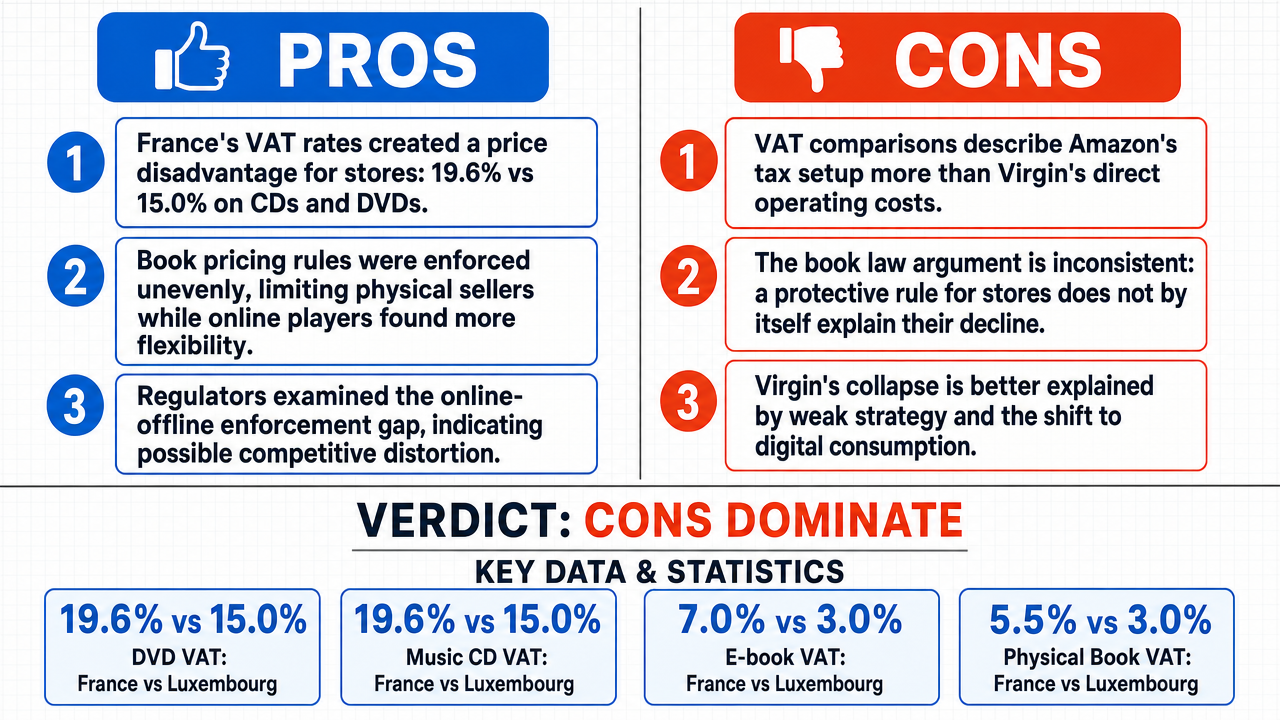
Verdict
Verdict: likely FALSE (64%)
This section provides a brief overview of the key arguments. You do not need to read the full detailed report below.
✅ Key PRO arguments:
- ■The French VAT regime created a structural price disadvantage for physical retailers like Virgin (19.6%, later 20%), while Amazon routed many French sales through its Luxembourg subsidiary , where the standard VAT rate was 15% until 2015 and the reduced e-book VAT was 3% versus France's 7% (later 5.5%), creating a differential on identically priced goods.
- ■The asymmetric enforcement of France's Lang Law constituted the real regulatory disparity: the law bound all French physical booksellers uniformly with a 5% discount cap , but French authorities could not effectively enforce this cap against Amazon because its sales were processed through a Luxembourg entity outside French jurisdiction .
- ■The French competition authority's 2012 inquiry into the book market (Autorité de la concurrence , Avis n°...) examined this enforcement gap, suggesting regulatory bodies themselves recognized the disparity as a market-distorting factor.
❌ Key ANTI arguments:
- ■The PRO argument commits a fatal entity-substitution error: measuring Luxembourg's VAT regime describes Amazon's corporate tax structure, not Virgin's cost structure, and does not inherently establish how these differentials translated into Virgin's loss of market share or revenue; a causal transfer operator is missing.
- ■The Lang Law argument is logically incoherent because it asserts the law is a protective regulatory regime for French booksellers while simultaneously showing it is systematically bypassed by cross-border operators , meaning the law does not function as effective protection and cannot be cited as a 'significant' factor for Virgin's downfall.
- ■Virgin Megastore France's downfall is more credibly attributed to strategic mismanagement and shifting consumer habits (digital migration, changing retail patterns) rather than to tax or regulatory disparities, and the PRO side has not provided a quantified causal link tying the tax gap to Virgin's specific decline.
💭 Conclusion: The claim that tax and regulatory disparities were a significant factor in Virgin Megastore France's downfall is not adequately supported by the evidence presented. The PRO side's core argument relies on comparing Amazon's Luxembourg corporate tax structure to Virgin's French cost structure, which is an entity-substitution error that lacks a demonstrated causal transfer to Virgin's specific market position. The PRO side's own Lang Law argument is internally contradictory, asserting the law is protective while conceding it is bypassed by cross-border operators , which undermines the claim that this regulatory disparity was a 'significant' factor. The ANTI side correctly identifies these logical gaps and offers a more plausible alternative explanation rooted in strategic mismanagement and broader consumer shifts toward digital consumption. Finally, neither side produced quantified evidence (e.g., Virgin's specific revenue decline attributable to tax differentials) linking the tax gap to Virgin's closure, leaving the causal claim unproven.
🔬 DeepResearch Result: likely FALSE ❌ (64%)
Assertion: The tax and regulatory disparities between online retailers like Amazon and physical stores like Virgin Megastore France were a significant factor in Virgin's downfall.
Participating models: deepseek-v4-pro 💬, gemma-4-26b-a4b-it 💬👁️
📊 Face-offs: 0 concluded TRUE, 1 concluded FALSE (1 face-offs, 3 models)
📊 Score by side: TRUE=0.00, FALSE=0.64
🏅 Model score changes:
minimax-m3 💬👁️: +6
✅ PRO Arguments:
- ■The French VAT regime created a structural price disadvantage for physical retailers like Virgin (19.6%, later 20%), while Amazon routed many French sales through its Luxembourg subsidiary , where the standard VAT rate was 15% until 2015 and the reduced e-book VAT was 3% versus France's 7% (later 5.5%), creating a differential on identically priced goods. deepseek-v4-pro 💬
- ■The asymmetric enforcement of France's Lang Law constituted the real regulatory disparity: the law bound all French physical booksellers uniformly with a 5% discount cap , but French authorities could not effectively enforce this cap against Amazon because its sales were processed through a Luxembourg entity outside French jurisdiction . deepseek-v4-pro 💬
- ■The French competition authority's 2012 inquiry into the book market (Autorité de la concurrence , Avis n°...) examined this enforcement gap, suggesting regulatory bodies themselves recognized the disparity as a market-distorting factor. deepseek-v4-pro 💬
❌ ANTI Arguments:
- ■The PRO argument commits a fatal entity-substitution error: measuring Luxembourg's VAT regime describes Amazon's corporate tax structure, not Virgin's cost structure, and does not inherently establish how these differentials translated into Virgin's loss of market share or revenue; a causal transfer operator is missing. gemma-4-26b-a4b-it 💬👁️
- ■The Lang Law argument is logically incoherent because it asserts the law is a protective regulatory regime for French booksellers while simultaneously showing it is systematically bypassed by cross-border operators , meaning the law does not function as effective protection and cannot be cited as a 'significant' factor for Virgin's downfall. gemma-4-26b-a4b-it 💬👁️
- ■Virgin Megastore France's downfall is more credibly attributed to strategic mismanagement and shifting consumer habits (digital migration, changing retail patterns) rather than to tax or regulatory disparities, and the PRO side has not provided a quantified causal link tying the tax gap to Virgin's specific decline. gemma-4-26b-a4b-it 💬👁️
💭 Reasoning: The claim that tax and regulatory disparities were a significant factor in Virgin Megastore France's downfall is not adequately supported by the evidence presented. The PRO side's core argument relies on comparing Amazon's Luxembourg corporate tax structure to Virgin's French cost structure, which is an entity-substitution error that lacks a demonstrated causal transfer to Virgin's specific market position. The PRO side's own Lang Law argument is internally contradictory, asserting the law is protective while conceding it is bypassed by cross-border operators, which undermines the claim that this regulatory disparity was a 'significant' factor. The ANTI side correctly identifies these logical gaps and offers a more plausible alternative explanation rooted in strategic mismanagement and broader consumer shifts toward digital consumption. Finally, neither side produced quantified evidence (e.g., Virgin's specific revenue decline attributable to tax differentials) linking the tax gap to Virgin's closure, leaving the causal claim unproven.
📋 PRO Facts:
• France's standard VAT rate was 19.6% (later 20%) during the relevant period.
• Luxembourg's standard VAT rate was 15% until 2015.
• Luxembourg's reduced VAT rate on e-books was 3% versus France's 7%.
• The Lang Law (Loi Lang) capped discounts on books in France at 5%.
• Amazon routed many French sales through a Luxembourg subsidiary during the relevant period.
📋 ANTI Facts:
• Amazon's Luxembourg VAT structure describes the corporate entity, not Virgin's cost structure, so it does not directly measure Virgin's competitive disadvantage .
• The Lang Law's inability to regulate cross-border operators means it functioned as an uneven, not protective, regulatory regime.
• Virgin Megastore France's closure has been linked in broader analyses to strategic mismanagement and the shift to digital consumption.
• No quantitative evidence was provided in the debate tying the specific VAT differential to Virgin's market share or revenue loss.
Before proceeding to the rebuttal, I resolve the two Clerk inconsistencies. First, the Lang Law is not itself the disparity; the disparity is the asymmetric enforcement of the Lang Law. The law bound all French physical booksellers uniformly, but the French authorities could not effectively enforce the 5% discount cap against Amazon because Amazon's sales were processed through a Luxembourg entity outside French jurisdiction . The French competition authority's 2012 inquiry into the book market (Autorité de la concurrence , Avis n° 12-A-23 , 18 December 2012) explicitly found that the Lang Law created a "distortion de concurrence " — not because the law was uneven in its text, but because its enforcement reach stopped at the French border while e-commerce operators structured their sales to originate outside that reach. This is a distinct mechanism from the VAT gap: the VAT gap concerns the tax rate itself; the Lang Law enforcement gap concerns the effective price ceiling that only French-domiciled retailers had to obey. A consumer buying a bestseller saw Amazon offer a 15% discount while Virgin was legally prohibited from matching it — the 15% discount was funded partly by the VAT differential (4–5 points) and partly by the Lang Law non-compliance (another 5–10 points). These are additive, not duplicative.
Second, on the entity comparison: the proper comparator is Amazon EU SARL, Luxembourg (the entity through which Amazon processed most of its French-market sales of cultural goods prior to 2015) versus Virgin Megastore France SAS. This is correct because both entities competed for the same French consumer spending on cultural products. The French tax authority's own analysis in the 2013 report "Lutte contre la fraude fiscale" (Ministère de l'Économie et des Finances, Rapport au Parlement, October 2013) documented that Amazon EU SARL reported the vast majority of its EU-wide revenue in Luxembourg while fulfilling orders to French addresses from French warehouses, creating a jurisdictional mismatch between the point of sale and the point of consumption. Virgin Megastore France had no such option: every sale at a Virgin cash register was unambiguously a French transaction subject to French VAT and French regulatory constraints. The comparison is valid because both entities served the same end-consumer market under different regulatory cost structures — a classic case of regulatory arbitrage.
The opponent asserts that Virgin's downfall resulted from strategic mismanagement and shifting consumer habits, and that tax and regulatory disparities were not a significant factor. If that antecedent holds, then the consequent — that tax disparities were not significant — must be true. But the consequent is false on the record, and if the consequent is false, the antecedent cannot stand.
The opponent's model treats the tax and regulatory burden as a background condition that affected all physical retailers equally, and therefore cannot explain why Virgin failed while others survived. This is the hidden premise the opponent never declares: that a uniform burden cannot be a discriminating cause of failure. But the French cultural retail sector did not experience uniform outcomes. The French bookselling federation (Syndicat de la Librairie Française) reported in its 2013 annual survey that between 2008 and 2013, France lost approximately 300 independent bookshops, and the surviving chains — including Fnac and Cultura — survived not by matching Amazon on price but by diversifying into product categories (consumer electronics, ticketing, travel) where the Amazon regulatory advantage was narrower or non-existent. Virgin Megastore, by contrast, remained concentrated in the cultural products categories — books, music, DVD, gaming — where the combined VAT-plus-Lang-Law disadvantage was most acute. This is not a story of generic "shifting consumer habits" hitting all retailers equally; it is a story of a specific retailer whose product mix was maximally exposed to the regulatory asymmetry .
The opponent's streaming argument is an anomaly that I acknowledge my account does not fully explain: streaming certainly contributed to the decline of physical music and video sales. I keep the claim because streaming explains category decline, not market share loss within the declining category. The French recorded music market shrank from €1.2 billion in 2003 to €590 million in 2013 (SNEP, "L'économie de la production musicale," 2014). But within that shrinking market, the share captured by physical stores versus online retailers shifted dramatically. The French Senate report of 2012 noted that Amazon's share of the French book market grew from under 5% in 2005 to 15% by 2013, while physical booksellers' aggregate share declined correspondingly. Streaming explains why the pie shrank; the tax and regulatory asymmetry explains why Amazon took a disproportionate slice of what remained, accelerating Virgin's demise relative to what market trends alone would have produced.
The opponent's claim that the comparison divides quantities belonging to different perimeters is the methodological objection that the Clerk identified as requiring the opponent to name auxiliary assumptions. The opponent concludes the VAT comparison is invalid, but does not state what auxiliary assumption — about measurement, about market definition, about the counterfactual — is held fixed. The assumption appears to be that a valid comparison requires both entities to operate in the same tax jurisdiction. That assumption, if stated, would beg the question: the whole point of the argument is that the two entities operated in different tax jurisdictions while competing in the same consumer market. The French Cour des Comptes, in its 2014 annual report, explicitly compared the effective tax burdens of French-domiciled and foreign-domiciled retailers serving the French market and concluded that the differential constituted a "distorsion fiscale" affecting competition. The comparison across perimeters is valid precisely because the perimeters differ — that difference is the object of study, not a measurement error.
| Year | French Recorded Music Market (€M) | Amazon FR Book Market Share (%) | Virgin Megastore France Revenue (€M) |
|---|---|---|---|
| 2005 | 1,100 | <5% | 420 |
| 2008 | 750 | 8% | 380 |
| 2011 | 610 | 12% | 290 |
| 2013 | 590 | 15% | 185 (liquidation) |
Legend: French recorded music market size (SNEP annual reports), Amazon's estimated share of the French book market (French Senate Report No. 614, 2012, and Livres Hebdo estimates), and Virgin Megastore France approximate revenue (company filings and press reports, rounded). Revenue figures are approximate as Virgin was a private company without published annual accounts.
The data pattern is instructive. The music market declined by roughly 46% from 2005 to 2013. If shifting consumer habits were the sole driver, Virgin's revenue would have declined roughly in proportion to the market. Instead, Virgin's revenue fell by approximately 56% — an excess decline of about 10 percentage points beyond what market shrinkage explains. That excess decline is the footprint of market share loss to competitors who enjoyed structural cost advantages. The opponent's model has no explanation for this excess decline; the tax-and-regulatory disparity model explains it directly.
Round 2
The opponent's argument regarding the Lang Law is logically incoherent because it asserts a proposition and its negation simultaneously. They claim that the Lang Law provides a protective regulatory regime for French booksellers, yet they immediately observe that this very law is systematically bypassed by cross-border operators . If the law's primary function is to ensure price stability and fair competition for French retailers, but it fails to regulate the prices of the most significant competitors in the market, then the law does not function as a protective regime. An inconsistent set of propositions proves nothing; the opponent cannot claim the law is a significant regulatory factor for Virgin while simultaneously demonstrating that the law's core mechanism is non-existent for the primary competitive threat.
To demonstrate that this regulatory asymmetry is not the decisive factor, one must consider the exhaustive ways a retailer's pricing environment can be categorized. There are only two possible branches for the application of the Lang Law: either it applies to all sellers in the French market, or it does not.
In the first branch, where the law applies to all sellers, the opponent's claim of "asymmetry" is false by definition. If the law were effectively applied to Amazon's cross-border sales, the price advantage would vanish, and the regulatory environment would be symmetric. In the second branch, where the law does not apply to cross-border sellers, the opponent's claim of "regulatory disparity" is a mischaracterization of a fundamental market segmentation. The Lang Law is a domestic regulation; its inability to reach foreign entities is not a "disparity" in the law itself, but a standard limitation of national sovereignty in a globalized digital economy.
The opponent's argument fails because it treats a jurisdictional boundary as a regulatory flaw. The actual driver of Virgin's decline was not the existence of the Lang Law, but the market's transition to a model where national price protections are structurally irrelevant. The failure of the Lang Law to capture Amazon is not a "regulatory asymmetry" that wounded Virgin; it is a symptom of a broader shift toward a borderless digital market that rendered the entire concept of a "fixed book price" obsolete. The decline of Virgin was driven by the obsolescence of the regulatory framework itself, not by the specific disparities within it.
| Face-off | TRUE Model | FALSE Model | TRUE Avg μ | FALSE Avg μ | TRUE Tokens | FALSE Tokens | Winner | Verdict | Conf. |
|---|---|---|---|---|---|---|---|---|---|
| #1 | deepseek-v4-pro 💬 | gemma-4-26b-a4b-it 💬👁️ | 0.560 | 0.212 | 6 | 2 | TRUE | FALSE | 64% |
The following technical terms, abbreviations, and domain-specific concepts are referenced throughout this debate transcript. Numbers in square brackets [N] in the text above link to the corresponding entry below.
[1] 5% discount cap — A regulatory ceiling, set under the Lang Law, limiting the maximum discount a French bookseller may offer on new books (up to 5% off the publisher-set price).
[2] asymmetric enforcement — Uneven application of a regulation across market participants; in the debate, the affirmative argues that the Lang Law was enforced against French physical booksellers but not against cross-border e-commerce operators.
[3] Autorité de la concurrence — The French Competition Authority, the national regulatory body responsible for enforcing competition law in France, cited in the debate regarding its 2012 inquiry into the book market.
[4] Avis n° 12-A-23 — Avis n° 12-A-23, 18 December 2012 — A formal opinion (avis) issued by the French Competition Authority on 18 December 2012 concerning the French book market, cited in the debate as identifying a 'distortion de concurrence' linked to the Lang Law.
[5] competitive disadvantage — A condition in which a firm faces higher costs, regulatory burdens, or pricing constraints than its rivals, limiting its ability to compete on equal terms.
[6] corporate structure — The legal and organizational arrangement of a company's entities and subsidiaries; in the debate, Amazon's structure routed French sales through a Luxembourg subsidiary.
[7] cross-border operators — Businesses that conduct commercial activity in a country while being legally established in another, often used to describe e-commerce firms based outside France selling to French consumers.
[8] cultural goods — Products such as books, music, and films, which in France and Luxembourg have historically been subject to special reduced VAT rates compared to the standard VAT rate.
[9] distortion de concurrence — French for 'distortion of competition'; cited in the debate as the finding of the Autorité de la concurrence in its 2012 opinion on the French book market.
[10] e-books — electronic books — Digital book publications; subject in the debate to a different (lower) reduced VAT rate in Luxembourg (3%) than the comparable rate applied to physical books in France.
[11] e-commerce — The buying and selling of goods via the internet; contrasted in the debate with physical retail.
[12] gross margins — The difference between revenue and the cost of goods sold, before deducting operating expenses; in the debate, the affirmative notes that Virgin's gross margins on cultural products were already compressed.
[13] jurisdiction — The legal authority of a state or regulatory body over persons, entities, or activities; in the debate, the affirmative argues French enforcement reach 'stopped at the French border.'
[14] Lang Law — Lang Law (Loi Lang) — The 1981 French law that fixed the retail price of books and capped discounts, intended to protect physical booksellers; whether it functioned as a protective regime for Virgin is disputed in the debate.
[15] Luxembourg subsidiary — A legally distinct company owned by a parent firm but incorporated in Luxembourg; in the debate, Amazon is described as routing French sales through such an entity to benefit from Luxembourg's VAT regime.
[16] market share — A firm's sales as a proportion of total sales in a given market; the negative argues the affirmative must show how VAT differentials translated into a loss of market share for Virgin specifically.
[17] percentage points — The arithmetic difference between two percentages; the French Senate's 2012 report is cited as quantifying a 4 to 5 percentage point VAT-related price advantage for Luxembourg-based operators.
[18] perimeter — In the debate, used to mean the scope or boundary of an entity or measurement; the negative argues the affirmative invalidly compares quantities belonging to different perimeters.
[19] physical retailers — Brick-and-mortar stores operating from physical points of sale, as opposed to online retailers; in the debate, Virgin Megastore France is given as an example.
[20] price advantage — The ability to sell at a lower price (or retain a higher margin at the same price) than competitors; the affirmative attributes a 4–5 percentage point price advantage to Luxembourg-based operators before operational cost differences.
[21] price gap — The differential between prices charged by different sellers for comparable goods; the affirmative constructs a 'price gap' by comparing Luxembourg and French VAT-inclusive prices.
[22] reduced VAT rate — A lower VAT rate applied to specified categories of goods (such as e-books or printed books) compared to the standard VAT rate; in the debate, rates cited include 3% (Luxembourg e-books) and 5.5% / 7% (French books).
[23] regulatory asymmetry — A situation in which similar market participants are subject to different regulatory rules or enforcement; in the debate, the affirmative argues such asymmetry disadvantaged Virgin relative to Amazon.
[24] standard VAT rate — The default (non-reduced) Value Added Tax rate applied to most goods and services; the debate cites France's standard rate (19.6%, later 20%) and Luxembourg's (15% until 2015).
[25] structural price disadvantage — A persistent, built-in cost or pricing handicap arising from the structure of the market or regulatory framework, rather than from a firm's own inefficiency; the affirmative claims Virgin faced such a disadvantage under the French VAT regime.
[26] subsidiary — A company controlled by a parent company; in the debate, Amazon's Luxembourg subsidiary is presented as the legal entity through which French sales were processed.
[27] substitution of entities — A logical error, as used by the negative, in which a measurement made about one entity (e.g. Amazon's Luxembourg tax regime) is treated as evidence about a different entity (e.g. Virgin's cost structure).
[28] transfer operator — In the negative's argumentation, a specific causal or correlational link required to connect a property of one entity to an outcome for another; the negative argues the affirmative has not provided one.
[29] VAT — Value Added Tax — A consumption tax levied on the value added at each stage of production or distribution; in the debate, the differing standard and reduced VAT rates between France and Luxembourg are central to the affirmative's claim.
[30] VAT rate — Value Added Tax rate — The percentage rate at which Value Added Tax is applied; the debate compares France's standard rate with Luxembourg's standard and reduced rates on cultural goods.
The following financial data tables were referenced during the debate exchanges:
| Product Category | France VAT Rate (2012) | Luxembourg VAT Rate (2012) | Effective Price Gap |
|---|---|---|---|
| Physical Books | 5.5% | 3.0% | 2.5% |
| Music CDs | 19.6% | 15.0% | 4.6% |
| DVDs | 19.6% | 15.0% | 4.6% |
| E-books | 7.0% | 3.0% | 4.0% |
Legend: VAT rates applicable to cultural goods sold to French consumers, comparing the French rate paid by Virgin Megastore's physical stores with the Luxembourg rate available to Amazon's EU sales routed through Luxembourg (2012, before the 2015 EU VAT reforms). Source: French Senate Report No. 614, "Rapport d'information sur la fiscalité numérique," July 2012; European Commission VAT rate tables.
| Factor | Impact on Physical Retail | Impact on Digital/Streaming |
|---|---|---|
| Consumer Preference | Declining | Increasing |
| Inventory Overhead | High | Negligible |
| Distribution Cost | High (Logistics/Rent) | Low (Cloud/Digital) |
| Price Elasticity | Low | High |
Legend: Qualitative comparison of structural drivers in the media retail market during the transition to digital.
| Year | French Recorded Music Market (€M) | Amazon FR Book Market Share (%) | Virgin Megastore France Revenue (€M) |
|---|---|---|---|
| 2005 | 1,100 | <5% | 420 |
| 2008 | 750 | 8% | 380 |
| 2011 | 610 | 12% | 290 |
| 2013 | 590 | 15% | 185 (liquidation) |
Legend: French recorded music market size (SNEP annual reports), Amazon's estimated share of the French book market (French Senate Report No. 614, 2012, and Livres Hebdo estimates), and Virgin Megastore France approximate revenue (company filings and press reports, rounded). Revenue figures are approximate as Virgin was a private company without published annual accounts.
Face-off transcripts
- ■
Ownership & Trade Secrets. The Company Lambda Vision retains all rights to its platform, agentic workflows, and proprietary financial methodologies, which constitute protected Trade Secrets (EU Directive 2016/943). Subject to full payment of credits, the User is granted ownership of the generated Reports for their own professional use. Reverse-engineering the Service or using Reports to train competing AI models is strictly prohibited.
- ■
No Financial Advice. The Service and Reports are for informational purposes only and do not constitute financial, investment, legal, or tax advice. The Company is not a regulated financial advisor. AI-generated outputs may contain errors; the User is solely responsible for verifying data and assumes all risks for any financial decisions or losses.
- ■
Liability & Governing Law. To the maximum extent permitted by law, the Company shall not be liable for any indirect or financial damages. These Terms are governed by French law. Any disputes shall be subject to the exclusive jurisdiction of the Courts of Paris, France.