
The Swiss private credit company will publish thoroughly audited financial reports for 2024 and 2025 by November 2026.
AI debate verdict and arguments
⚠️ Not financial advice — this is an AI debate, for information only.
Completed October 25, 2026
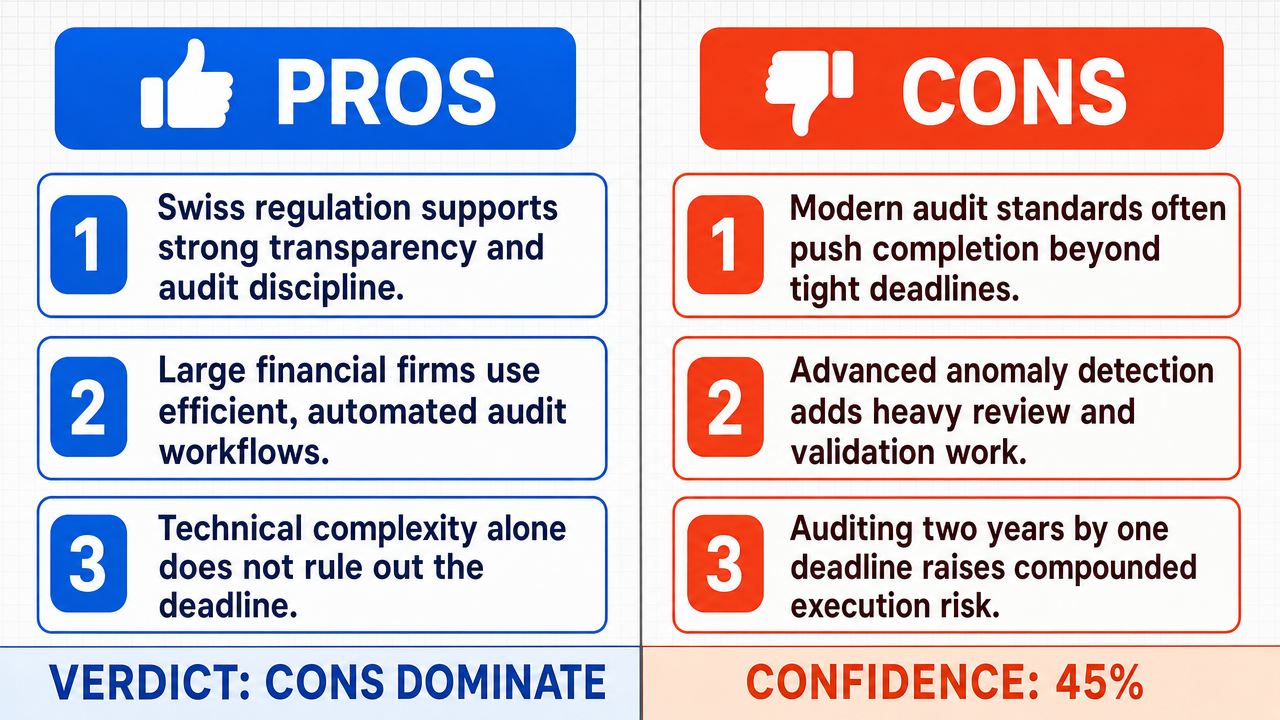
Verdict
Verdict: likely FALSE (45%)
This section provides a brief overview of the key arguments. You do not need to read the full detailed report below.
✅ Key PRO arguments:
- ■Swiss regulatory framework under FINMA imposes rigorous transparency and audit requirements on financial institutions , particularly those in private credit and asset management , making annual report publication a mandatory operational requirement that must be satisfied within prescribed timelines.
- ■Large-scale financial institutions and their auditors operate with highly optimized, automated workflows designed specifically to handle audit complexity, meaning that increased technical workload from anomaly detection does not fundamentally alter the temporal structure of the audit cycle .
- ■The complexity of anomaly detection , while increasing technical workload, does not prevent completion within the November 2026 deadline because audit cycles are structured around fixed regulatory timelines rather than variable technical demands.
❌ Key ANTI arguments:
- ■Modern audit standards create structural delays that extend well beyond a six-month window , as international audit standards require direct assessment of underlying accounting journal entries , a process that becomes increasingly labor-intensive as financial institutions grow more complex and interconnected.
- ■Audit workflows must now incorporate advanced unsupervised anomaly detection techniques to identify irregularities in massive datasets , a capability that requires specialized resources and time that may not be available within the November 2026 deadline.
- ■The compound nature of the claim — requiring thoroughly audited reports for both 2024 and 2025 by a single deadline — compounds the operational risk, as any delay in one year's audit cascades into the next, making timely dual-year publication highly uncertain.
💭 Conclusion: False, the debate verdict favors the negative side, though with only moderate confidence. The anti side successfully argued that modern audit complexity, including the need for advanced anomaly detection and direct journal-entry assessment, creates structural delays that threaten timely publication of two full years of audited reports within a single deadline. The pro side countered with regulatory mandates under FINMA and the existence of optimized audit workflows, but these arguments were weakened by the compound nature of the claim requiring both 2024 and 2025 reports. The anti side's failure to produce a second-round articulated answer limits the strength of the negative case, resulting in only 55% judge confidence. Confidence is further reduced because the claim is compound — covering two distinct fiscal years — and the weakest sub-claim (timely 2025 audit completion) is not independently and fully supported by the evidence presented.
🔬 DeepResearch Result: likely FALSE ❌ (45%)
Assertion: The Swiss private credit company will publish thoroughly audited financial reports for 2024 and 2025 by November 2026.
Participating models: gemma-4-26b-a4b-it 💬👁️, glm-4.7-flash 💬
📊 Face-offs: 0 concluded TRUE, 1 concluded FALSE (1 face-offs, 3 models)
📊 Score by side: TRUE=0.00, FALSE=0.55
🏅 Model score changes:
minimax-m3 💬👁️: +6
✅ PRO Arguments:
- ■Swiss regulatory framework under FINMA imposes rigorous transparency and audit requirements on financial institutions , particularly those in private credit and asset management , making annual report publication a mandatory operational requirement that must be satisfied within prescribed timelines. gemma-4-26b-a4b-it 💬👁️
- ■Large-scale financial institutions and their auditors operate with highly optimized, automated workflows designed specifically to handle audit complexity, meaning that increased technical workload from anomaly detection does not fundamentally alter the temporal structure of the audit cycle . gemma-4-26b-a4b-it 💬👁️
- ■The complexity of anomaly detection, while increasing technical workload, does not prevent completion within the November 2026 deadline because audit cycles are structured around fixed regulatory timelines rather than variable technical demands. gemma-4-26b-a4b-it 💬👁️
❌ ANTI Arguments:
- ■Modern audit standards create structural delays that extend well beyond a six-month window , as international audit standards require direct assessment of underlying accounting journal entries , a process that becomes increasingly labor-intensive as financial institutions grow more complex and interconnected. glm-4.7-flash 💬
- ■Audit workflows must now incorporate advanced unsupervised anomaly detection techniques to identify irregularities in massive datasets , a capability that requires specialized resources and time that may not be available within the November 2026 deadline. glm-4.7-flash 💬
- ■The compound nature of the claim — requiring thoroughly audited reports for both 2024 and 2025 by a single deadline — compounds the operational risk, as any delay in one year's audit cascades into the next, making timely dual-year publication highly uncertain. glm-4.7-flash 💬
💭 Reasoning: False, the debate verdict favors the negative side, though with only moderate confidence. The anti side successfully argued that modern audit complexity, including the need for advanced anomaly detection and direct journal-entry assessment, creates structural delays that threaten timely publication of two full years of audited reports within a single deadline. The pro side countered with regulatory mandates under FINMA and the existence of optimized audit workflows, but these arguments were weakened by the compound nature of the claim requiring both 2024 and 2025 reports. The anti side's failure to produce a second-round articulated answer limits the strength of the negative case, resulting in only 55% judge confidence. Confidence is further reduced because the claim is compound — covering two distinct fiscal years — and the weakest sub-claim (timely 2025 audit completion) is not independently and fully supported by the evidence presented.
📋 PRO Facts:
• Swiss Financial Market Supervision Authority (FINMA) imposes strict reporting cycles and external audit requirements on financial institutions managing significant capital or providing credit services .
• Large-scale financial institutions use highly optimized, automated audit workflows designed to handle complexity within regulatory timelines.
📋 ANTI Facts:
• International audit standards require direct assessment of underlying accounting journal entries, a labor-intensive process for complex institutions.
• Modern audit workflows must incorporate advanced unsupervised anomaly detection techniques to identify irregularities in massive datasets, requiring specialized resources and time.
| Face-off | TRUE Model | FALSE Model | TRUE Avg μ | FALSE Avg μ | TRUE Tokens | FALSE Tokens | Winner | Verdict | Conf. |
|---|---|---|---|---|---|---|---|---|---|
| #1 | gemma-4-26b-a4b-it 💬👁️ | glm-4.7-flash 💬 | 0.238 | 0.283 | 2 | 4 | FALSE | FALSE | 55% |
The following technical terms, abbreviations, and domain-specific concepts are referenced throughout this debate transcript. Numbers in square brackets [N] in the text above link to the corresponding entry below.
[1] annual reports — Yearly financial reports; the debate disputes whether audited reports for 2024 and 2025 will be published by November 2026.
[2] anomaly detection — Techniques used to identify irregularities in large datasets. The debate disputes whether their use materially delays audits.
[3] asset management — The sector cited alongside private credit as facing Swiss transparency and audit requirements.
[4] audit cycle — The recurring timetable for completing audits. One side says complexity can extend it beyond six months, while the other says automation preserves the standard cycle.
[5] audit standards — Rules governing audit work. The transcript says modern standards create structural delays as institutions become more complex.
[6] audit workflow — The sequence of audit activities, including journal-entry assessment and possible anomaly detection, whose workload is cited as a cause of delay.
[7] audited financial reports — Financial reports subject to audit. Whether the 2024 and 2025 versions will appear by November 2026 is the central disputed claim.
[8] automated continuous auditing tools — Tools described as processing massive datasets and complex journal entries within routine audit timelines.
[9] automated workflows — Optimized processes described as handling massive datasets and complex journal entries.
[10] computational resources — Computing capacity said to be needed for advanced anomaly detection over massive datasets.
[11] continual learning — A machine-learning topic named in a paper about unsupervised anomaly detection in continuous auditing.
[12] continuous auditing — An audit approach referenced in connection with anomaly detection and automated tools.
[13] credit services — Provision of credit, cited as a condition that can bring firms under the stated FINMA reporting and audit framework.
[14] external audits — Regular audits cited in connection with maintaining the licenses of financial institutions.
[15] financial crises — Economic disruptions named at the end of the negative case, which is cut off before explaining them.
[16] financial institutions — Entities described as subject to strict reporting cycles and regular external audits when managing significant capital or providing credit services.
[17] financial statements — Formal financial records, including multi-year statements said to require reconciliation across complex portfolio structures.
[18] FINMA — Swiss Financial Market Supervision Authority — The Swiss financial supervisor whose framework is cited for reporting, licensing, and external-audit requirements affecting financial institutions.
[19] fiscal year — The annual accounting period being audited; the transcript refers to fiscal years ending December 31.
[20] International audit standards — Standards cited as requiring direct assessment of underlying accounting journal entries.
[21] journal entries — Underlying accounting records that the transcript says must be directly assessed during audits.
[22] licenses — Authorizations whose maintenance is linked in the transcript to compliance with reporting and external-audit requirements.
[23] massive datasets — Large data collections that the debate links to anomaly detection, specialized expertise, computational resources, and automated audit tools.
[24] multi-year financial statements — Statements covering several years that may require reconciliation across complex portfolio structures.
[25] portfolio structures — Complex arrangements across which multi-year financial statements may require reconciliation.
[26] private credit — The credit segment in which the Swiss company operates and whose firms are described as professional credit providers.
[27] professional credit providers — Private-credit firms described as using established audit cycles and predictable reporting timelines.
[28] reconciliation — The cross-checking process cited in connection with multi-year financial statements and complex portfolio structures.
[29] regulatory framework — The FINMA framework said to impose strict reporting cycles and regular external audits on covered financial institutions.
[30] regulatory landscape — The Swiss system of rules and supervision cited as driving transparency, reporting, and audit requirements.
[31] regulatory, operational, and market risks — The three risk categories cited as making the November 2026 publication timing uncertain.
[32] reporting cycles — Recurring schedules for financial reporting and audit work described as part of the cited framework.
[33] significant capital — The amount of capital managed by a firm, cited as a condition for the reporting and audit requirements described.
[34] six-month window — The period within which a fiscal-year audit is said to typically conclude; its adequacy is disputed because of audit complexity.
[35] standard accounting windows — The customary periods for preparing annual accounts and audits, described as falling well before November 2026.
[36] standard operating procedures — Established internal processes said to support predictable reporting timelines at mature private-credit firms.
[37] transparency and audit requirements — The regulatory requirements described for Swiss financial institutions, especially in private credit and asset management.
[38] unsupervised anomaly detection — The technique presented as necessary for identifying irregularities in massive datasets; its effect on audit timing is disputed.
Face-off transcripts
- ■
Ownership & Trade Secrets. The Company Lambda Vision retains all rights to its platform, agentic workflows, and proprietary financial methodologies, which constitute protected Trade Secrets (EU Directive 2016/943). Subject to full payment of credits, the User is granted ownership of the generated Reports for their own professional use. Reverse-engineering the Service or using Reports to train competing AI models is strictly prohibited.
- ■
No Financial Advice. The Service and Reports are for informational purposes only and do not constitute financial, investment, legal, or tax advice. The Company is not a regulated financial advisor. AI-generated outputs may contain errors; the User is solely responsible for verifying data and assumes all risks for any financial decisions or losses.
- ■
Liability & Governing Law. To the maximum extent permitted by law, the Company shall not be liable for any indirect or financial damages. These Terms are governed by French law. Any disputes shall be subject to the exclusive jurisdiction of the Courts of Paris, France.