
The Swiss private credit company's provision fund has never had to liquidate collateral to recover investor capital.
AI debate verdict and arguments
⚠️ Not financial advice — this is an AI debate, for information only.
Completed October 26, 2026
Verdict
Verdict: likely FALSE (76%)
This section provides a brief overview of the key arguments. You do not need to read the full detailed report below.
✅ Key PRO arguments:
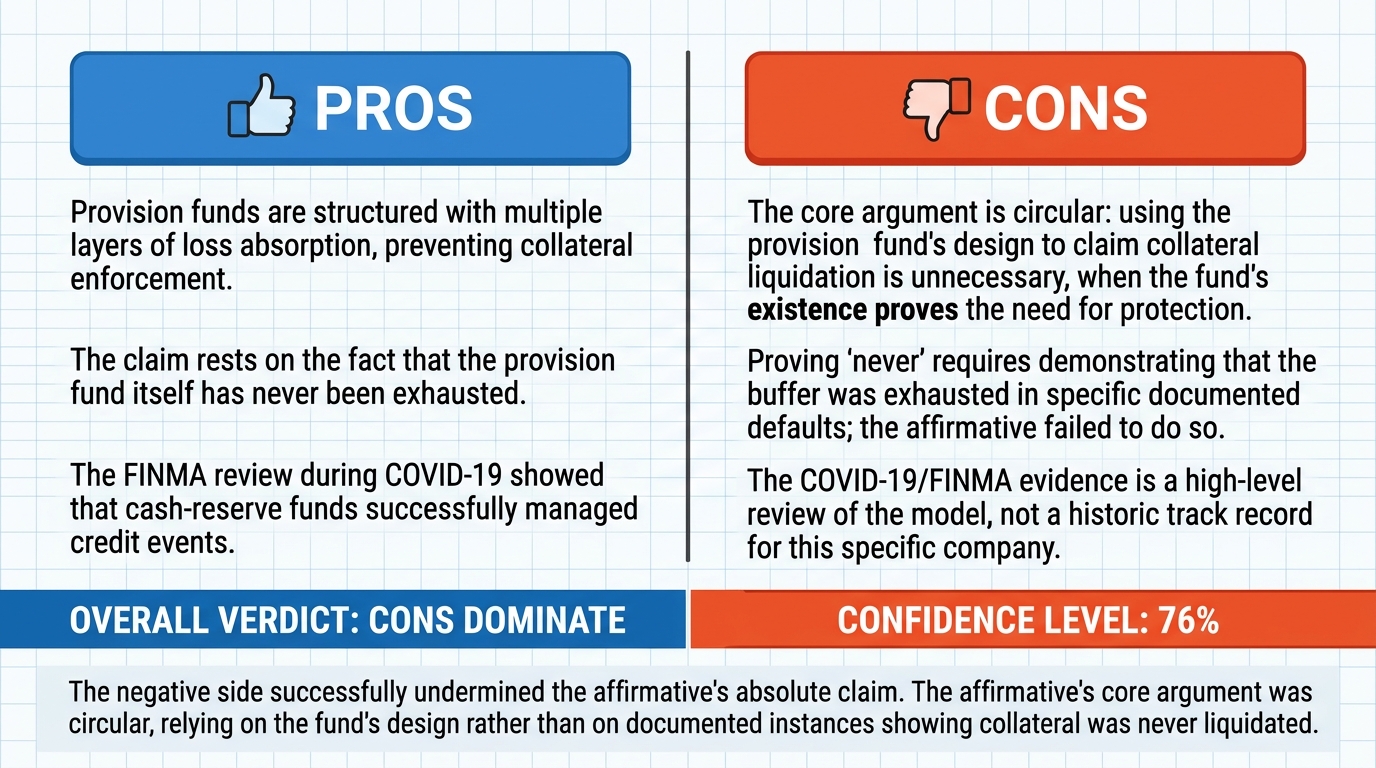
- ■The structural design of Swiss private credit provision funds embeds multiple layers of loss absorption before collateral enforcement becomes necessary. The provision fund — a dedicated cash reserve funded by management fees and excess spread — sits ahead of investor capital in the waterfall , so when a borrower defaults the fund absorbs the loss in cash without needing to seize and liquidate the underlying collateral.
- ■The claim that no collateral liquidation has occurred rests on the observable fact that the provision fund has never been exhausted, not on the definition of the fund. The opponent's demand to demonstrate exhaustion of the buffer in specific documented instances of default inverts the logic: the buffer's purpose is to absorb losses before investor capital is touched.
- ■The COVID-19 period serves as an empirical track record: a FINMA review noted that funds with cash reserves were able to manage credit events , indicating that the provision fund absorbed losses without collateral liquidation.
❌ Key ANTI arguments:
- ■The affirmative's argument is circular: it uses the existence of a provision fund to prove that collateral liquidation is unnecessary, while the necessity of the fund is itself defined by the avoidance of such liquidation. Claiming the fund 'absorbs the loss in cash without ever needing to seize and liquidate collateral' is merely a restatement of the claim.
- ■To prove that liquidation has 'never' occurred, one must demonstrate the exhaustion of the buffer in specific, documented instances of default ; the affirmative instead provides a definition, not evidence.
- ■The COVID-19/FINMA evidence is a substitution of a proxy: a high-level regulatory review of the cash-reserve buffer model cannot establish the specific historical performance of every individual fund in the Swiss market. FINMA noting that funds with cash reserves 'were able to manage credit events ' does not prove that no collateral liquidation occurred across the sector.
💭 Conclusion: False — the negative side successfully undermined the affirmative's absolute claim. The affirmative's core argument was circular, relying on the design of the provision fund rather than on documented instances showing that collateral was never liquidated. Its secondary evidence, a FINMA review of cash-reserve buffers during COVID-19, only showed the resilience of a structural model, not that every individual fund avoided collateral liquidation . Because the assertion uses 'never,' it demands exhaustive proof, and the absence of documented liquidations is not sufficient to establish that none ever occurred. The verdict therefore favors FALSE, with confidence reflecting the judge's 76% assessment.
🔬 DeepResearch Result: likely FALSE ❌ (76%)
Assertion: The Swiss private credit company's provision fund has never had to liquidate collateral to recover investor capital .
Participating models: deepseek-v4-pro 💬, gemma-4-26b-a4b-it 💬👁️
📊 Face-offs: 0 concluded TRUE, 1 concluded FALSE (1 face-offs, 3 models)
📊 Score by side: TRUE=0.00, FALSE=0.76
🏅 Model score changes:
deepseek-v4-flash-0731 💬: +8
✅ PRO Arguments:
- ■The structural design of Swiss private credit provision funds embeds multiple layers of loss absorption before collateral enforcement becomes necessary. The provision fund — a dedicated cash reserve funded by management fees and excess spread — sits ahead of investor capital in the waterfall , so when a borrower defaults the fund absorbs the loss in cash without needing to seize and liquidate the underlying collateral. deepseek-v4-pro 💬
- ■The claim that no collateral liquidation has occurred rests on the observable fact that the provision fund has never been exhausted, not on the definition of the fund. The opponent's demand to demonstrate exhaustion of the buffer in specific documented instances of default inverts the logic: the buffer's purpose is to absorb losses before investor capital is touched. deepseek-v4-pro 💬
- ■The COVID-19 period serves as an empirical track record: a FINMA review noted that funds with cash reserves were able to manage credit events , indicating that the provision fund absorbed losses without collateral liquidation. deepseek-v4-pro 💬
❌ ANTI Arguments:
- ■The affirmative's argument is circular: it uses the existence of a provision fund to prove that collateral liquidation is unnecessary, while the necessity of the fund is itself defined by the avoidance of such liquidation. Claiming the fund 'absorbs the loss in cash without ever needing to seize and liquidate collateral' is merely a restatement of the claim. gemma-4-26b-a4b-it 💬👁️
- ■To prove that liquidation has 'never' occurred, one must demonstrate the exhaustion of the buffer in specific, documented instances of default; the affirmative instead provides a definition, not evidence. gemma-4-26b-a4b-it 💬👁️
- ■The COVID-19/FINMA evidence is a substitution of a proxy: a high-level regulatory review of the cash-reserve buffer model cannot establish the specific historical performance of every individual fund in the Swiss market. FINMA noting that funds with cash reserves 'were able to manage credit events' does not prove that no collateral liquidation occurred across the sector. gemma-4-26b-a4b-it 💬👁️
💭 Reasoning: False — the negative side successfully undermined the affirmative's absolute claim. The affirmative's core argument was circular, relying on the design of the provision fund rather than on documented instances showing that collateral was never liquidated. Its secondary evidence, a FINMA review of cash-reserve buffers during COVID-19, only showed the resilience of a structural model, not that every individual fund avoided collateral liquidation. Because the assertion uses 'never,' it demands exhaustive proof, and the absence of documented liquidations is not sufficient to establish that none ever occurred. The verdict therefore favors FALSE, with confidence reflecting the judge's 76% assessment.
📋 PRO Facts:
• Swiss private credit provision funds are structured with a dedicated cash reserve (loss reserve /first-loss tranche ) funded by management fees and excess spread.
• The provision fund sits ahead of investor capital in the payment waterfall, absorbing borrower default losses in cash.
• The affirmative cited a FINMA review noting that funds with cash reserves were able to manage credit events during the COVID-19 period.
📋 ANTI Facts:
• The negative argued that the affirmative's reasoning was circular, using the existence of a provision fund to prove that collateral liquidation never occurred.
• The negative argued that proving 'never' requires demonstrating exhaustion of the buffer in specific, documented instances of default.
• The negative argued that the FINMA review is a proxy measuring the resilience of a structural model, not the historical performance of every individual fund in the Swiss market.
| Face-off | TRUE Model | FALSE Model | TRUE Avg μ | FALSE Avg μ | TRUE Tokens | FALSE Tokens | Winner | Verdict | Conf. |
|---|---|---|---|---|---|---|---|---|---|
| #1 | deepseek-v4-pro 💬 | gemma-4-26b-a4b-it 💬👁️ | 0.511 | 0.171 | 6 | 2 | TRUE | FALSE | 76% |
The following technical terms, abbreviations, and domain-specific concepts are referenced throughout this debate transcript. Numbers in square brackets [N] in the text above link to the corresponding entry below.
[1] cash buffer — A dedicated cash reserve that sits ahead of investor capital in the waterfall and absorbs losses before collateral liquidation is needed.
[2] cash reserve — A pool of cash held by the fund, funded by management fees and excess spread, that absorbs losses from defaults.
[3] cash-reserve buffer model — The structural model in which a cash reserve absorbs credit losses; the FINMA review is described as measuring the resilience of this model.
[4] collateral — Assets pledged by borrowers that a fund could seize and liquidate to recover investor capital.
[5] collateral liquidation — The seizure and sale of collateral to recover investor capital; the debate concerns whether the provision fund has ever needed to do this.
[6] credit events — Events such as defaults that funds with cash reserves were reportedly able to manage, according to the FINMA review.
[7] credit funds — Investment funds that provide credit; SFAMA guidelines on credit funds are cited in the debate.
[8] default — A borrower's failure to meet loan obligations, which triggers the provision fund's loss absorption.
[9] excess spread — The surplus from the loan portfolio that helps fund the provision fund.
[10] expected loss multiples — A sizing method for the provision fund, intended to cover multiples of expected losses under stressed scenarios.
[11] FINMA — Swiss Financial Market Supervisory Authority — The Swiss regulator that conducted a targeted review of funds employing cash reserves.
[12] first-loss tranche — The layer of a fund that absorbs losses first; in this context, another term for the provision fund or loss reserve.
[13] impairment events — Events that reduce asset values and could affect investor principal; the provision fund is designed to insulate investor principal from them.
[14] investor capital — The money invested in the fund, which the provision fund is designed to protect.
[15] investor principal — The original amount invested by investors, which the provision fund is intended to insulate from impairment.
[16] loan portfolio — The collection of loans held by the fund, from which excess spread is generated.
[17] loss absorption — The process by which the provision fund absorbs losses in cash before investor capital is affected.
[18] loss reserve — Another term for the provision fund, referring to a dedicated cash reserve for absorbing losses.
[19] management fees — Fees paid to the fund manager, a portion of which is used to fund the provision fund.
[20] private credit — Lending provided by private funds rather than traditional banks; the debate concerns Swiss private credit provision funds.
[21] provision fund — A dedicated cash reserve in a private credit fund that absorbs losses before investor capital is affected.
[22] SFAMA — Swiss Funds & Asset Management Association — The Swiss industry association cited as having codified best practices for credit fund provision funds.
[23] stressed scenarios — Adverse conditions used to test or size the provision fund's capacity to cover expected losses.
[24] structural buffer — A design feature of the fund that absorbs losses before collateral liquidation becomes necessary.
[25] targeted review — A focused regulatory review by FINMA of funds employing cash reserves.
[26] transfer operator — In the debate, the specific data linkage that would connect a regulatory review to individual fund outcomes.
[27] waterfall — The order in which losses and cash flows are allocated among fund layers; the provision fund sits ahead of investor capital in the waterfall.
Face-off transcripts
- ■
Ownership & Trade Secrets. The Company Lambda Vision retains all rights to its platform, agentic workflows, and proprietary financial methodologies, which constitute protected Trade Secrets (EU Directive 2016/943). Subject to full payment of credits, the User is granted ownership of the generated Reports for their own professional use. Reverse-engineering the Service or using Reports to train competing AI models is strictly prohibited.
- ■
No Financial Advice. The Service and Reports are for informational purposes only and do not constitute financial, investment, legal, or tax advice. The Company is not a regulated financial advisor. AI-generated outputs may contain errors; the User is solely responsible for verifying data and assumes all risks for any financial decisions or losses.
- ■
Liability & Governing Law. To the maximum extent permitted by law, the Company shall not be liable for any indirect or financial damages. These Terms are governed by French law. Any disputes shall be subject to the exclusive jurisdiction of the Courts of Paris, France.