
The structural collapse of the physical music market and the rise of digital alternatives made the closure of Virgin Megastore France inevitable, regardless of management decisions.
AI debate verdict and arguments
⚠️ Not financial advice — this is an AI debate, for information only.
Completed October 21, 2026
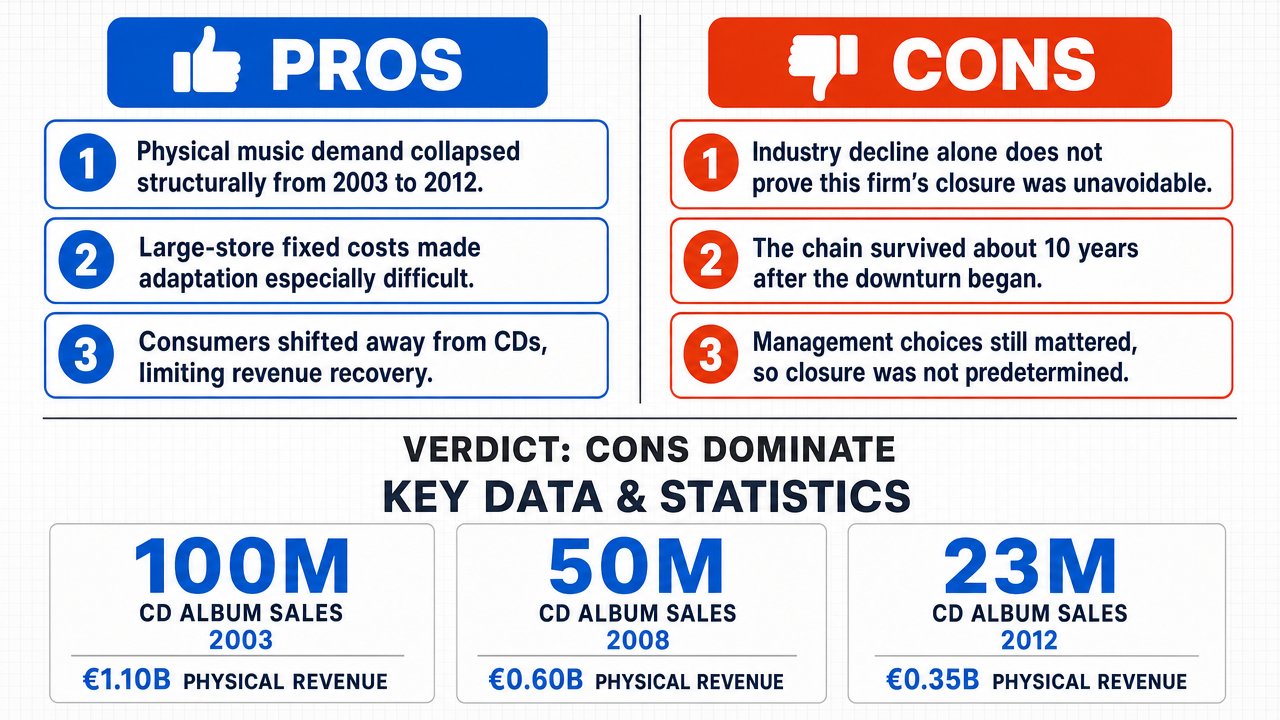
Verdict
Verdict: likely FALSE (77%)
This section provides a brief overview of the key arguments. You do not need to read the full detailed report below.
✅ Key PRO arguments:
- ■The French physical music market underwent a catastrophic, non-cyclical structural contraction between 2003 and 2012, with CD album sales collapsing from approximately 100 million to roughly 23 million units (a decline of over 75%), permanently destroying the demand base for Virgin Megastore France's core revenue stream.
- ■The fixed-cost real estate burden (e.g., the Champs-Élysées flagship at ~7,000 square meters on one of the world's most expensive avenues, costing several million euros annually in rent) was the precise transmission mechanism through which the physical market collapse produced insolvency , since the rent was only sustainable when physical music generated sufficient revenue per square meter .
- ■The collapse was demand-side destruction rather than deferral: consumers were abandoning the physical format entirely, making the revenue loss unrecoverable through any conventional retail strategy.
❌ Key ANTI arguments:
- ■The affirmative commits a fallacy of substitution by inferring the specific insolvency of one firm from aggregate industry decline without establishing the necessary transfer operator (correlation or beta ) linking the two; a declining market mandates adaptation, not closure.
- ■If the closure were truly inevitable from the onset of the structural shift, the chain would not have survived the ten-year interval between 2003 and 2013 during which successive management teams were actively making decisions about store counts , cost bases, and digital transitions, demonstrating that managerial choices materially shaped the outcome.
- ■The affirmative's own evidence that the entity persisted for nearly a decade after the collapse began refutes the 'inevitability' framing, because inevitability implies an outcome that cannot be averted regardless of intervening decisions, yet intervening decisions clearly were made and clearly mattered during that survival window.
💭 Conclusion: False. The closure of Virgin Megastore France was not inevitable from market structure alone, because the company survived a full decade after the physical music collapse began, during which successive management teams made consequential decisions about store counts , cost bases, and digital strategy. The negative side correctly identified a fallacy of substitution : aggregate industry decline does not mechanically determine the fate of a specific firm, and the very existence of a ten-year survival window demonstrates that managerial agency operated as a real variable rather than a null one. While the pro side accurately documented the scale of the physical market contraction (CD sales falling from roughly 100 million to 23 million units, over 75%), this establishes severe headwinds, not inevitability, because adaptation was possible in principle and was in fact attempted. The verdict is FALSE at 77% confidence, reflecting that the digital-alternatives sub-claim received less direct evidentiary support in the debate than the physical-collapse sub-claim, marginally weakening the overall confidence.
🔬 DeepResearch Result: likely FALSE ❌ (77%)
Assertion: The structural collapse of the physical music market and the rise of digital alternatives made the closure of Virgin Megastore France inevitable, regardless of management decisions.
Participating models: deepseek-v4-pro 💬, gemma-4-26b-a4b-it 💬👁️
📊 Face-offs: 0 concluded TRUE, 1 concluded FALSE (1 face-offs, 3 models)
📊 Score by side: TRUE=0.00, FALSE=0.77
🏅 Model score changes:
minimax-m3 💬👁️: +8
✅ PRO Arguments:
- ■The French physical music market underwent a catastrophic, non-cyclical structural contraction between 2003 and 2012, with CD album sales collapsing from approximately 100 million to roughly 23 million units (a decline of over 75%), permanently destroying the demand base for Virgin Megastore France's core revenue stream. deepseek-v4-pro 💬
- ■The fixed-cost real estate burden (e.g., the Champs-Élysées flagship at ~7,000 square meters on one of the world's most expensive avenues, costing several million euros annually in rent) was the precise transmission mechanism through which the physical market collapse produced insolvency , since the rent was only sustainable when physical music generated sufficient revenue per square meter . deepseek-v4-pro 💬
- ■The collapse was demand-side destruction rather than deferral: consumers were abandoning the physical format entirely, making the revenue loss unrecoverable through any conventional retail strategy. deepseek-v4-pro 💬
❌ ANTI Arguments:
- ■The affirmative commits a fallacy of substitution by inferring the specific insolvency of one firm from aggregate industry decline without establishing the necessary transfer operator (correlation or beta ) linking the two; a declining market mandates adaptation, not closure. gemma-4-26b-a4b-it 💬👁️
- ■If the closure were truly inevitable from the onset of the structural shift, the chain would not have survived the ten-year interval between 2003 and 2013 during which successive management teams were actively making decisions about store counts , cost bases, and digital transitions, demonstrating that managerial choices materially shaped the outcome. gemma-4-26b-a4b-it 💬👁️
- ■The affirmative's own evidence that the entity persisted for nearly a decade after the collapse began refutes the 'inevitability' framing, because inevitability implies an outcome that cannot be averted regardless of intervening decisions, yet intervening decisions clearly were made and clearly mattered during that survival window. gemma-4-26b-a4b-it 💬👁️
💭 Reasoning: False. The closure of Virgin Megastore France was not inevitable from market structure alone, because the company survived a full decade after the physical music collapse began, during which successive management teams made consequential decisions about store counts, cost bases, and digital strategy. The negative side correctly identified a fallacy of substitution: aggregate industry decline does not mechanically determine the fate of a specific firm, and the very existence of a ten-year survival window demonstrates that managerial agency operated as a real variable rather than a null one. While the pro side accurately documented the scale of the physical market contraction (CD sales falling from roughly 100 million to 23 million units, over 75%), this establishes severe headwinds, not inevitability, because adaptation was possible in principle and was in fact attempted. The verdict is FALSE at 77% confidence, reflecting that the digital-alternatives sub-claim received less direct evidentiary support in the debate than the physical-collapse sub-claim, marginally weakening the overall confidence.
📋 PRO Facts:
• French CD album sales declined from approximately 100 million units in 2003 to roughly 23 million units in 2012, a drop of over 75% in less than a decade.
• The Champs-Élysées flagship occupied approximately 7,000 square meters on one of the world's most expensive commercial avenues, with rent estimated at several million euros annually.
• The decline was characterized as demand-side destruction rather than deferred purchasing, since consumers were abandoning the physical format.
📋 ANTI Facts:
• Virgin Megastore France survived from 2003 to 2013, a roughly ten-year interval after the structural collapse of the physical market began.
• During that decade, successive management teams actively made decisions regarding store counts, cost bases, and digital transitions.
• A declining industry sector does not mathematically mandate the closure of any individual firm within that sector; it mandates adaptation.
| Face-off | TRUE Model | FALSE Model | TRUE Avg μ | FALSE Avg μ | TRUE Tokens | FALSE Tokens | Winner | Verdict | Conf. |
|---|---|---|---|---|---|---|---|---|---|
| #1 | deepseek-v4-pro 💬 | gemma-4-26b-a4b-it 💬👁️ | 0.463 | 0.276 | 6 | 2 | TRUE | FALSE | 77% |
The following technical terms, abbreviations, and domain-specific concepts are referenced throughout this debate transcript. Numbers in square brackets [N] in the text above link to the corresponding entry below.
[1] addressable market — The total demand for a product or service that a specific company can realistically capture, used to assess growth potential and the size of a business's core market.
[2] beta — In finance, a measure of an asset's volatility relative to the overall market; in the debate, the negative uses the term more loosely to denote the correlation linking an aggregate industry trend to a single firm's outcome.
[3] break-even — The point at which total revenue equals total costs, producing neither profit nor loss; below this threshold the business operates at a loss.
[4] capital structure — The specific mix of debt and equity financing a company uses to fund its operations, which determines both its financial risk and its cost of capital.
[5] CD — Compact Disc — A digital optical disc format that became the dominant physical music medium before being displaced by downloads and streaming; in the debate, refers specifically to the CD album sales segment tracked by SNEP.
[6] cost base — The total ongoing cost structure of a business, encompassing the fixed and variable expenses required to sustain operations.
[7] cyclical downturn — A temporary decline in industry or economic activity tied to broader business cycles, as opposed to a permanent structural shift in market fundamentals.
[8] debt management — The financial strategy a firm uses to administer its debt obligations, including refinancing, repayment scheduling, and the maintenance of appropriate leverage levels.
[9] demand-side destruction — The permanent elimination of consumer demand for a product category, typically driven by technological substitution or a lasting change in consumer behavior, as opposed to a temporary deferral of purchases.
[10] digital transition — The strategic shift by a retailer from physical product formats (such as CDs) to digital distribution models, including downloads, streaming, and online sales.
[11] fallacy of substitution — A term used by the negative to describe the logical error of substituting a general industry trend for a specific causal explanation of a single firm's outcome, treating aggregate market data as a direct, unmediated cause of one company's closure.
[12] fixed cost — A business expense that does not vary with the level of output or sales, such as rent or permanent staff salaries, which must be paid regardless of revenue.
[13] flagship — flagship store — A retailer's primary or most prominent store, usually situated in a prestigious high-traffic location, serving as the brand's showcase and standard-bearer.
[14] insolvency — The legal and financial condition in which a company is unable to pay its debts as they fall due, often leading to bankruptcy proceedings or forced liquidation.
[15] inventory model — The system a retailer uses to manage stock levels, including purchasing, storage, and turnover of merchandise for sale.
[16] merchandising optimization — The retail practice of strategically managing product selection, placement, pricing, and presentation to maximize sales and improve the customer experience.
[17] physical music — Music sold in tangible formats such as CDs, vinyl records, and cassettes, as distinguished from digital downloads, streaming, and other intangible delivery methods.
[18] revenue per square meter — A key retail performance metric measuring the sales generated per unit of floor space, used to evaluate the productivity of a physical store.
[19] sector — A distinct segment of the economy or market, such as the physical music sector, grouped by product type or business activity.
[20] SNEP — Syndicat National de l'Édition Phonographique — The French national trade association of the phonographic publishing industry, which collects and publishes annual statistics on music sales and market trends in France.
[21] store counts — The total number of physical retail locations operated by a chain, a key metric for assessing retail scale and market coverage.
[22] store footprint — The total physical retail presence of a company, including the number of stores, their size, and their geographic distribution, reflecting the scale of its brick-and-mortar operations.
[23] strategic pivot — A significant and deliberate shift in a company's business model, product offering, or target market, typically undertaken in response to changing market conditions.
[24] structural collapse — A fundamental and permanent deterioration in the market for a product category, driven by shifts in technology, consumer behavior, or competitive dynamics, as opposed to a cyclical decline.
[25] structural contraction — A sustained shrinkage of a market or industry caused by lasting changes in supply or demand fundamentals, rather than short-term cyclical factors.
[26] transmission mechanism — In economics, the channel or process through which a change in one variable (such as overall market demand) is transmitted to affect another variable (such as a specific firm's financial health).
[27] €B — billions of euros — A monetary unit equal to one thousand million euros, used in the debate to express the scale of French physical music revenue.
The following financial data tables were referenced during the debate exchanges:
| Year | French CD Album Sales (millions) | Physical Revenue (€B) | Digital Revenue (€B) | Physical Share of Total |
|---|---|---|---|---|
| 2003 | 100 | 1.10 | 0.02 | 98% |
| 2008 | 50 | 0.60 | 0.08 | 88% |
| 2012 | 23 | 0.35 | 0.14 | 71% |
Legend: French recorded music market structure, 2003–2012. CD album sales in millions of units; revenue in EUR billions. Physical share = physical revenue as percentage of total recorded music revenue. Source: SNEP annual reports, IFPI Global Music Report.
| Metric | Physical Market Trend | Management Response | Strategic Impact |
|---|---|---|---|
| Revenue Volatility | High Decline | Low Adaptation | High Risk |
| Asset Utilization | Decreasing | Static Footprint | Margin Compression |
| Product Mix | Shifting to Digital | Fixed Physical Focus | Structural Deficit |
Legend: Comparison of market shifts versus the strategic posture of traditional large-format retailers. "Low Adaptation" and "Static Footprint" refer to the failure to adjust the physical retail model to changing consumer habits.
Face-off transcripts
- ■
Ownership & Trade Secrets. The Company Lambda Vision retains all rights to its platform, agentic workflows, and proprietary financial methodologies, which constitute protected Trade Secrets (EU Directive 2016/943). Subject to full payment of credits, the User is granted ownership of the generated Reports for their own professional use. Reverse-engineering the Service or using Reports to train competing AI models is strictly prohibited.
- ■
No Financial Advice. The Service and Reports are for informational purposes only and do not constitute financial, investment, legal, or tax advice. The Company is not a regulated financial advisor. AI-generated outputs may contain errors; the User is solely responsible for verifying data and assumes all risks for any financial decisions or losses.
- ■
Liability & Governing Law. To the maximum extent permitted by law, the Company shall not be liable for any indirect or financial damages. These Terms are governed by French law. Any disputes shall be subject to the exclusive jurisdiction of the Courts of Paris, France.