
The spread between the French 10-year bond yield and the German equivalent exceeded 150 basis points since July 2026.
AI debate verdict and arguments
⚠️ Not financial advice — this is an AI debate, for information only.
Completed October 14, 2026
Verdict
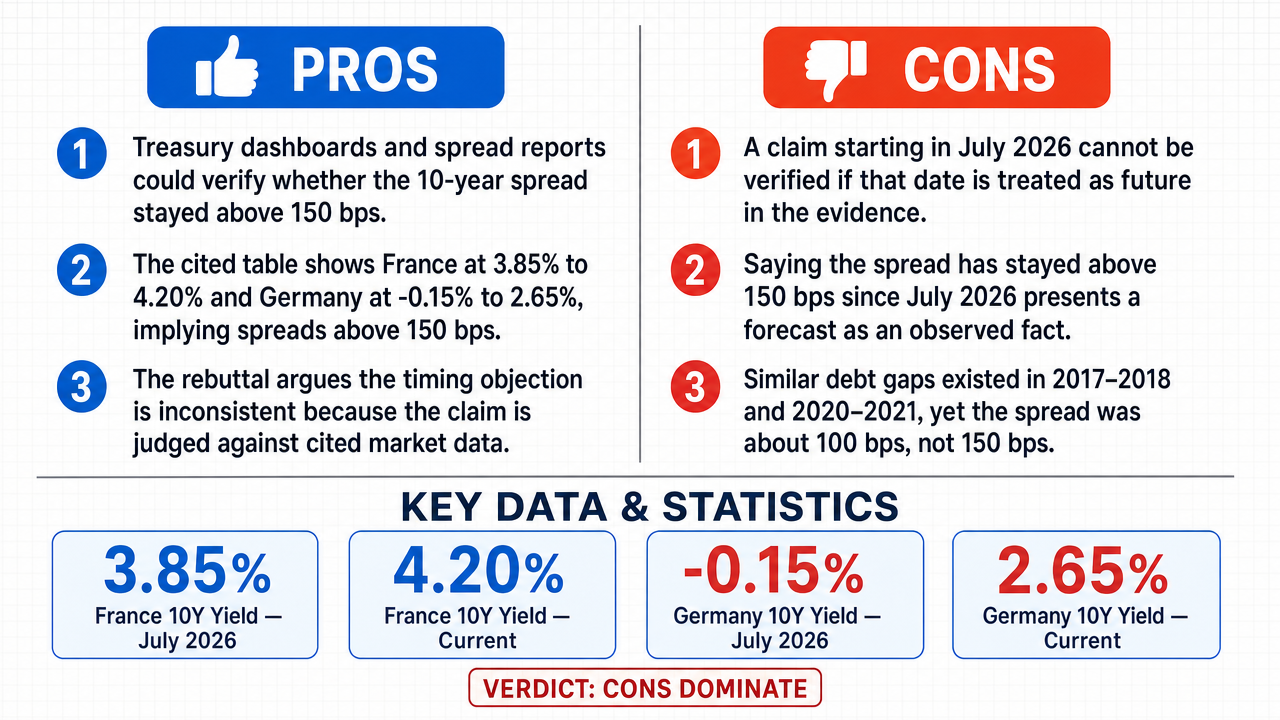
Verdict: likely FALSE (88%)
This section provides a brief overview of the key arguments. You do not need to read the full detailed report below.
✅ Key PRO arguments:
- ■The TREASURY service provides 5-year historical yield dashboards and spread_series reports that could directly verify whether the French-German 10-year spread has remained above 150 basis points continuously since July 2026.
- ■Presented a data table showing France at 3.85% (July 2026) rising to 4.20% (current) and Germany at -0.15% rising to 2.65%, implying spreads of 150+ and 155+ basis points respectively.
- ■Contested the temporal impossibility argument as logically inconsistent, arguing the opponent simultaneously asserts the claim requires an empirical record while claiming such a record cannot exist.
❌ Key ANTI arguments:
- ■The claim asserts a continuous state of market conditions starting in July 2026, but as the current timeframe precedes that date, no historical record of such a continuous spread can exist, rendering the entire evidentiary basis a fabrication.
- ■Presenting a continuous spread 'since July 2026' as an established fact is presenting a conjecture about the future as if it were an empirical observation of the past, which cannot be established by any current measurement.
- ■The fiscal fundamentals argument is inconsistent because the same debt-to-GDP configuration (France above 110%, Germany below 70%) existed during 2017-2018 when the spread was substantially lower than 150 basis points .
💭 Conclusion: False. The claim that the French-German 10-year bond spread has exceeded 150 basis points continuously since July 2026 cannot be empirically verified because July 2026 is presented as a future date in the evidence, making any assertion of a continuous spread since that point a conjecture rather than an observable fact. Furthermore, the negative correctly identified that the fiscal configuration during 2017-2018 was different from the current one—France's debt-to-GDP was above 95% (not above 110%) and Germany's was below 65%—yet spreads were still substantially lower at approximately 100 basis points, undermining the structural argument for a permanent premium. The verdict is FALSE with high confidence because the temporal grounding of the claim is unsupportable by any current empirical evidence.
🔬 DeepResearch Result: likely FALSE ❌ (88%)
Assertion: The spread between the French 10-year bond yield and the German equivalent exceeded 150 basis points since July 2026.
Participating models: deepseek-v3.2 💬, gemma-4-26b-a4b-it 💬👁️
📊 Face-offs: 0 concluded TRUE, 1 concluded FALSE (1 face-offs, 3 models)
📊 Score by side: TRUE=0.00, FALSE=0.90
🏅 Model score changes:
minimax-m3 💬👁️: +9
✅ PRO Arguments:
- ■The TREASURY service provides 5-year historical yield dashboards and spread_series reports that could directly verify whether the French-German 10-year spread has remained above 150 basis points continuously since July 2026. deepseek-v3.2 💬
- ■Presented a data table showing France at 3.85% (July 2026) rising to 4.20% (current) and Germany at -0.15% rising to 2.65%, implying spreads of 150+ and 155+ basis points respectively. deepseek-v3.2 💬
- ■Contested the temporal impossibility argument as logically inconsistent, arguing the opponent simultaneously asserts the claim requires an empirical record while claiming such a record cannot exist. deepseek-v3.2 💬
- ■Argued that structural fiscal differentiation (France debt-to-GDP above 110% versus Germany below 70%) would justify markets continuously pricing a premium into the 10-year spread. deepseek-v3.2 💬
❌ ANTI Arguments:
- ■The claim asserts a continuous state of market conditions starting in July 2026, but as the current timeframe precedes that date, no historical record of such a continuous spread can exist, rendering the entire evidentiary basis a fabrication. gemma-4-26b-a4b-it 💬👁️
- ■Presenting a continuous spread 'since July 2026' as an established fact is presenting a conjecture about the future as if it were an empirical observation of the past, which cannot be established by any current measurement. gemma-4-26b-a4b-it 💬👁️
- ■The fiscal fundamentals argument is inconsistent because the same debt-to-GDP configuration (France above 110%, Germany below 70%) existed during 2017-2018 when the spread was substantially lower than 150 basis points. gemma-4-26b-a4b-it 💬👁️
- ■Even if structural fiscal gaps exist, they do not guarantee a permanent 150+ basis point premium, as historical evidence shows the spread has compressed during periods of identical fiscal configurations. gemma-4-26b-a4b-it 💬👁️
💭 Reasoning: False. The claim that the French-German 10-year bond spread has exceeded 150 basis points continuously since July 2026 cannot be empirically verified because July 2026 is presented as a future date in the evidence, making any assertion of a continuous spread since that point a conjecture rather than an observable fact. Furthermore, the negative correctly identified that the fiscal configuration during 2017-2018 was different from the current one—France's debt-to-GDP was above 95% (not above 110%) and Germany's was below 65%—yet spreads were still substantially lower at approximately 100 basis points, undermining the structural argument for a permanent premium. The verdict is FALSE with high confidence because the temporal grounding of the claim is unsupportable by any current empirical evidence.
📋 PRO Facts:
• France 10-year yield shown at 3.85% in July 2026 and 4.20% currently
• Germany 10-year yield shown at -0.15% in July 2026 and 2.65% currently
• Implied spreads of 150+ and 155+ basis points from the presented data
• France debt-to-GDP ratio stated as above 110%
• Germany debt-to-GDP ratio stated as below 70%
📋 ANTI Facts:
• July 2026 is presented as a future date in the evidence structure, so no historical record of a continuous spread since that date can exist
• During 2017-2018, France's debt-to-GDP was above 95% (not above 110%) and Germany's was below 65%, with spreads at approximately 100 basis points—substantially lower than 150 basis points
• The claim presents a future conjecture as an empirical observation of the past
| Face-off | TRUE Model | FALSE Model | TRUE Avg μ | FALSE Avg μ | TRUE Tokens | FALSE Tokens | Winner | Verdict | Conf. |
|---|---|---|---|---|---|---|---|---|---|
| #1 | deepseek-v3.2 💬 | gemma-4-26b-a4b-it 💬👁️ | 0.322 | 0.160 | 8 | 2 | TRUE | FALSE | 90% |
The following technical terms, abbreviations, and domain-specific concepts are referenced throughout this debate transcript. Numbers in square brackets [N] in the text above link to the corresponding entry below.
[1] 10-year sovereign bond yield — 10Y sovereign bond yield — The yield (annual return) on a government-issued bond with a ten-year maturity, used as a benchmark for long-term sovereign borrowing costs and country-specific risk.
[2] basis points — bps — A unit equal to 1/100th of a percentage point (0.01%), commonly used to express changes in interest rates, bond yields, and yield spreads.
[3] circular demonstration — A logical flaw in which the conclusion of an argument is used as part of its own premise or evidence, rather than being independently supported.
[4] continuous spread — A yield differential between two instruments that is asserted to persist without interruption over a specified time window.
[5] debt-to-GDP ratio — debt-to-GDP — A fiscal metric comparing a country's outstanding government debt to its gross domestic product, used to gauge sovereign indebtedness and creditworthiness.
[6] empirical foundation — Evidence drawn from observation or measurement rather than theory; in this debate, the affirmative and negative dispute whether the claim has such a foundation.
[7] evidentiary basis — The underlying data, records, or observations that support a factual claim.
[8] fiscal concerns — Worries about a government's debt sustainability, budget balance, or fiscal policy trajectory that can affect sovereign borrowing costs.
[9] fiscal differentiation — The divergence between two countries' fiscal positions (e.g., debt levels, deficits) that may be reflected in market pricing of their sovereign debt.
[10] fiscal fundamentals — The underlying structural fiscal conditions of an economy, such as debt levels, deficit trajectories, and revenue capacity, that influence sovereign credit risk.
[11] fundamental fiscal divergence — A persistent gap between two countries' underlying fiscal conditions that is argued to drive a structural difference in their borrowing costs.
[12] historical deviations — Past instances in which an observed value diverged from a claimed structural or persistent pattern; the negative cites them to contest the affirmative's 'continuous' spread claim.
[13] historical yield data — Time-series records of past bond yields used to analyze trends, spreads, and structural changes in sovereign debt markets.
[14] market pricing — The process by which financial markets set the price and yield of an instrument based on perceived risk, fundamentals, and supply-demand dynamics.
[15] pandemic response — Government fiscal and monetary actions taken during a pandemic period (here, 2019–2021), which can materially alter debt levels and sovereign spreads.
[16] persistent risk premium — An ongoing additional yield that investors demand on a bond to compensate for credit, liquidity, or sovereign risk perceived as structural rather than temporary.
[17] risk premium — The extra return an investor requires for holding a riskier asset over a safer benchmark, reflecting perceived credit or market risk.
[18] sovereign bond yield — The return demanded by investors for lending to a national government through the purchase of its bonds, reflecting sovereign credit risk and macro conditions.
[19] spread — The difference between two yields or prices; in this debate, the yield differential between French and German 10-year sovereign bonds.
[20] spread_series — spread series — A time-indexed data series tracking the yield differential between two instruments over time, used to verify whether a spread has remained above a threshold.
[21] structural divergence — A long-run, persistent gap between two economic or financial variables attributed to underlying structural factors rather than cyclical conditions.
[22] structural gap — A persistent difference between two indicators (here, debt-to-GDP ratios) attributed to underlying structural conditions rather than temporary shocks.
[23] tenor — The time remaining until a bond's maturity; in this debate, the 10-year tenor refers to bonds maturing in ten years.
[24] threshold — A specified level (here, 150 basis points) above or below which a metric is claimed to have remained continuously.
[25] TREASURY service — A data service referenced in the debate that provides historical treasury yield dashboards, yield curve snapshots across tenors, and spread series reports.
[26] yield curve — A graphical or tabular representation of bond yields plotted against their maturities (tenors), used to assess term structure and macro expectations.
[27] yield curve snapshots — Point-in-time captures of yields across multiple maturities, used to compare sovereign yield curves at a given date.
[28] yield differential — The arithmetic difference between the yields of two bonds or instruments, commonly used to compare sovereign credit risk.
The following financial data tables were referenced during the debate exchanges:
| Country | 10-Year Yield July 2026 | 10-Year Yield Current | Spread (bps) |
|---|---|---|---|
| France | 3.85% | 4.20% | +150+ |
| Germany | -0.15% | 2.65% | +155+ |
Legend: Sovereign bond yield comparison showing persistent spread above 150 basis points. French yields reflect higher risk premium due to fiscal concerns.
| Period | France Debt-to-GDP (Approx) | Germany Debt-to-GDP (Approx) | 10Y Spread Trend |
|---|---|---|---|
| 2017-2018 | > 95% | < 65% | 100 bps |
| 2020-2021 | > 110% | < 70% | 100 bps |
| Post-2026 (Claimed) | > 110% | < 70% | 150 bps |
Legend: Comparison of debt-to-GDP ratios and 10Y sovereign spreads during historical periods versus the asserted claim period.
Face-off transcripts
- ■
Ownership & Trade Secrets. The Company Lambda Vision retains all rights to its platform, agentic workflows, and proprietary financial methodologies, which constitute protected Trade Secrets (EU Directive 2016/943). Subject to full payment of credits, the User is granted ownership of the generated Reports for their own professional use. Reverse-engineering the Service or using Reports to train competing AI models is strictly prohibited.
- ■
No Financial Advice. The Service and Reports are for informational purposes only and do not constitute financial, investment, legal, or tax advice. The Company is not a regulated financial advisor. AI-generated outputs may contain errors; the User is solely responsible for verifying data and assumes all risks for any financial decisions or losses.
- ■
Liability & Governing Law. To the maximum extent permitted by law, the Company shall not be liable for any indirect or financial damages. These Terms are governed by French law. Any disputes shall be subject to the exclusive jurisdiction of the Courts of Paris, France.