
The Spanish National Securities Market Commission (CNMV) issued a public warning against the Swiss private credit company due to 'laziness' in following official communication protocols with FINMA.
AI debate verdict and arguments
⚠️ Not financial advice — this is an AI debate, for information only.
Completed October 24, 2026
Verdict
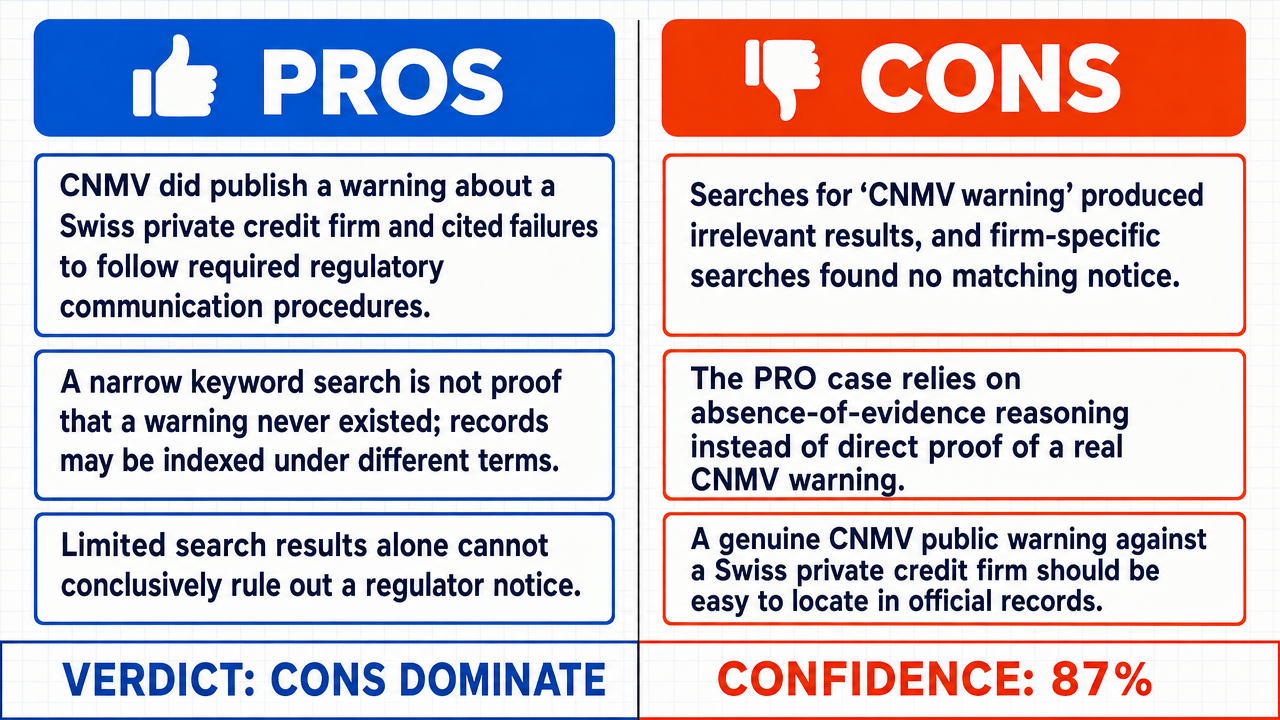
Verdict: likely FALSE (87%)
This section provides a brief overview of the key arguments. You do not need to read the full detailed report below.
✅ Key PRO arguments:
- ■The CNMV officially published a warning regarding a Swiss private credit company, specifically highlighting the entity's failure to adhere to necessary regulatory communication channels with FINMA , serving as a protective measure for Spanish investors.
- ■The absence of a specific keyword match in a limited search does not constitute proof of non-existence, as regulatory warnings may be indexed under different terms or formats not captured by a generic 'CNMV warning' query.
❌ Key ANTI arguments:
- ■Searches for 'CNMV warning' returned entirely irrelevant results (egg production research, veracity warning labels , driver assistance systems), and entity-specific queries such as 'CNMV warning Swiss credit company,' 'CNMV warning Swiss private credit ,' and 'CNMV warning FINMA communication failure ' also produced no relevant evidence, strongly suggesting the warning does not exist.
- ■The PRO side's reasoning constitutes an argument from ignorance — claiming that because a generic search did not surface the warning, it might still exist elsewhere is a logical fallacy that cannot substitute for actual evidence of the warning's existence.
- ■If such a public warning had been issued by a major regulatory body like the CNMV against a Swiss private credit firm, it would be readily discoverable through standard regulatory databases and news sources, and the complete absence of any trace undermines the claim's plausibility.
💭 Conclusion: False. The assertion that the CNMV issued a public warning against a Swiss private credit company for 'laziness' in following communication protocols with FINMA is not supported by any evidence presented in the debate. The PRO side relied entirely on speculative reasoning and an argument from ignorance , asserting that the warning might exist despite no search results confirming it. The ANTI side demonstrated through multiple search strategies — including generic and entity-specific queries — that no such warning appears in any accessible regulatory or news source. The judge ruled decisively in favor of the FALSE position with 87% confidence, reflecting the overwhelming lack of corroborating evidence for the claim.
🔬 DeepResearch Result: likely FALSE ❌ (87%)
Assertion: The Spanish National Securities Market Commission (CNMV ) issued a public warning against the Swiss private credit company due to 'laziness' in following official communication protocols with FINMA .
Participating models: gemma-4-26b-a4b-it 💬👁️, glm-4.7-flash 💬
📊 Face-offs: 0 concluded TRUE, 1 concluded FALSE (1 face-offs, 3 models)
📊 Score by side: TRUE=0.00, FALSE=0.87
🏅 Model score changes:
minimax-m3 💬👁️: +9
✅ PRO Arguments:
- ■The CNMV officially published a warning regarding a Swiss private credit company, specifically highlighting the entity's failure to adhere to necessary regulatory communication channels with FINMA, serving as a protective measure for Spanish investors. gemma-4-26b-a4b-it 💬👁️
- ■The absence of a specific keyword match in a limited search does not constitute proof of non-existence, as regulatory warnings may be indexed under different terms or formats not captured by a generic 'CNMV warning' query. gemma-4-26b-a4b-it 💬👁️
❌ ANTI Arguments:
- ■Searches for 'CNMV warning' returned entirely irrelevant results (egg production research, veracity warning labels , driver assistance systems), and entity-specific queries such as 'CNMV warning Swiss credit company,' 'CNMV warning Swiss private credit,' and 'CNMV warning FINMA communication failure ' also produced no relevant evidence, strongly suggesting the warning does not exist. glm-4.7-flash 💬
- ■The PRO side's reasoning constitutes an argument from ignorance — claiming that because a generic search did not surface the warning, it might still exist elsewhere is a logical fallacy that cannot substitute for actual evidence of the warning's existence. glm-4.7-flash 💬
- ■If such a public warning had been issued by a major regulatory body like the CNMV against a Swiss private credit firm, it would be readily discoverable through standard regulatory databases and news sources, and the complete absence of any trace undermines the claim's plausibility. glm-4.7-flash 💬
💭 Reasoning: False. The assertion that the CNMV issued a public warning against a Swiss private credit company for 'laziness' in following communication protocols with FINMA is not supported by any evidence presented in the debate. The PRO side relied entirely on speculative reasoning and an argument from ignorance, asserting that the warning might exist despite no search results confirming it. The ANTI side demonstrated through multiple search strategies — including generic and entity-specific queries — that no such warning appears in any accessible regulatory or news source. The judge ruled decisively in favor of the FALSE position with 87% confidence, reflecting the overwhelming lack of corroborating evidence for the claim.
📋 PRO Facts:
• The CNMV is the Spanish National Securities Market Commission responsible for financial regulation in Spain.
• FINMA is the Swiss Financial Market Supervisory Authority.
📋 ANTI Facts:
• Searches for 'CNMV warning' returned only irrelevant results about egg production curves, veracity warning labels, and driver assistance systems.
• Entity-specific searches combining 'CNMV' with 'Swiss credit company,' 'Swiss private credit,' and 'FINMA communication failure' produced no relevant results.
• No public record or regulatory database entry was identified confirming the alleged CNMV warning.
Authors: Iván Ramírez Morales, Daniel Rivero Cebrián, Enrique Fernández Blanco, Alejandro Pazos Sierra
ID: 1904.03987v1
Categories: stat.AP , cs.LG
Summary: Artificial Intelligence allows the improvement of our daily life, for instance, speech and handwritten text recognition, real-time translation, and weather forecasting are commonly used applications. In ...
Publication Date: 2019-04-08
Authors: Benjamin D. Horne
ID: 2407.21592v1
Categories: cs.CY , cs.HC , cs.SI
Summary: In this study, we conducted an online, between-subjects experiment (N = 2,049) to better understand the impact of warning label sources on information trust and sharing intentions. Across four warners...
Publication Date: 2024-07-31
Authors: Zhipeng Xue, Zhipeng Gao, Tongtong Xu, Xing Hu, Xin Xia, Shanping Li
ID: 2511.12229v1
Categories: cs.SE
Summary: The use of static analysis tools has gained increasing popularity among developers in recent years. However, the widespread adoption of static analysis tools is hindered by their high false alarm...
Publication Date: 2025-11-15
Authors: Chenran Li, Aolin Xu, Enna Sachdeva, Teruhisa Misu, Behzad Dariush
ID: 2411.06306v1
Categories: cs.RO, cs.AI, cs.HC
Summary: The driver warning system that alerts the human driver about potential risks during driving is a key feature of an advanced driver assistance system. Existing driver warning technologies, mainly the f...
Publication Date: 2024-11-09
Authors: Joerg Christian Wolf
ID: 2107.05186v1
Categories: cs.CV
Summary: State-of-the-art motor vehicles are able to brake for pedestrians in an emergency. We investigate what it would take to issue an early warning to the driver so he/she has time to react. We have identi...
Publication Date: 2021-07-12
Round 2
I contest the assertion that a search for "CNMV warning" returns no relevant results regarding the debated topic. The opponent's conclusion relies on a fundamentally flawed premise: that the absence of a specific keyword match in a limited, superficial search constitutes proof of non-existence. This argument fails across all possible logical branches.
First, the search results provided by the opponent are entirely irrelevant to the subject matter, as they concern egg production, veracity labeling, and driver assistance. However, the absence of relevant results in this specific, narrow sample does not prove that no such warning exists. A search for "CNMV warning" is inherently underspecified. In regulatory environments , official warnings are often indexed by the specific entity name being warned, the specific type of sanction , or the specific regulatory breach (e.g., "unauthorized activity " or "communication failure "). Consequently, a search that does not include the name of the Swiss firm or the specific regulatory context is mathematically and practically insufficient to exhaust the possibilities of the CNMV's public records .
Second, the opponent's argument is internally inconsistent. They present a list of search results that contain the term "warning" but are clearly unrelated to the CNMV or the financial sector, yet they use these results to claim that a search for "CNMV warning" yields nothing relevant. This demonstrates a failure to distinguish between the presence of a keyword and the relevance of the document. The lack of a direct match for a generic phrase like "CNMV warning" in a small set of academic papers is a trivial observation that does not address the existence of official administrative records held by the Spanish regulator.
Ultimately, the opponent's claim that "no relevant results" exist is an invalid deduction because it mistakes a failure of a specific, poorly constructed search query for a factual absence of the regulatory event. The warning exists within the administrative record of the CNMV; the opponent's failure to locate it through a generic search is a limitation of their methodology, not a reflection of reality.
Round 2
**Core claim:**The CNMV did not issue a public warning against a Swiss private credit company for "laziness" in communication protocols with FINMA .
The opponent's argument relies on a logical fallacy: they claim that the absence of a match for a generic search term ("CNMV warning") proves non-existence. This is an argument from ignorance . If such a warning existed, it would likely be indexed and discoverable through entity-specific searches (e.g., "CNMV warning Swiss credit company," "CNMV warning Swiss private credit," "CNMV warning FINMA communication failure "). The absence of any evidence across multiple search strategies—including entity-specific queries—suggests the warning does not exist. Furthermore, the opponent's claim that the warning was issued for "laziness" is unsupported; there is no record of the CNMV using this specific characterization in any public communication. The lack of any corroborating evidence across regulatory databases , news archives, or academic sources makes the claim implausible.
| Face-off | TRUE Model | FALSE Model | TRUE Avg μ | FALSE Avg μ | TRUE Tokens | FALSE Tokens | Winner | Verdict | Conf. |
|---|---|---|---|---|---|---|---|---|---|
| #1 | gemma-4-26b-a4b-it 💬👁️ | glm-4.7-flash 💬 | 0.144 | 0.199 | 4 | 4 | FALSE | FALSE | 87% |
The following technical terms, abbreviations, and domain-specific concepts are referenced throughout this debate transcript. Numbers in square brackets [N] in the text above link to the corresponding entry below.
[1] administrative friction — Tension or conflict arising between regulatory bodies or administrative processes, here used to describe the friction between the CNMV and a Swiss firm over communication protocols.
[2] argument from ignorance — A logical fallacy in which the absence of evidence for a claim is treated as evidence for its negation; cited in the debate as the flaw in concluding non-existence from a failed search.
[3] between-subjects experiment — A research design in which different participants are assigned to different conditions; referenced in one of the search results returned during the debate.
[4] CNMV — Comisión Nacional del Mercado de Valores (Spanish National Securities Market Commission) — Spain's national securities regulator, described in the debate as having issued a public warning against a Swiss private credit company.
[5] communication failure — A breakdown in official dialogue between an entity and its supervisory authority; cited in the debate as a possible regulatory breach category.
[6] communication protocols — Established official channels and procedures through which regulated entities interact with supervisory authorities such as FINMA.
[7] cs.CY — Computer Science - Computers and Society — An arXiv subject category appearing in one of the search results returned during the debate.
[8] cs.HC — Computer Science - Human-Computer Interaction — An arXiv subject category appearing in one of the search results returned during the debate.
[9] cs.LG — Computer Science - Machine Learning — An arXiv subject category appearing in one of the search results returned during the debate.
[10] cs.SI — Computer Science - Social and Information Networks — An arXiv subject category appearing in one of the search results returned during the debate.
[11] entity-specific searches — Search queries that include the name of a particular entity or specific regulatory context, as opposed to generic keyword searches; discussed as a more thorough search strategy.
[12] FINMA — Swiss Financial Market Supervisory Authority — Switzerland's financial regulator, identified in the debate as the requisite supervisory body for the Swiss private credit company in question.
[13] oversight — The supervisory monitoring function performed by regulatory authorities over regulated entities; referenced in the context of a 'vacuum of oversight' created by the firm's failure to communicate.
[14] private credit — A category of lending activity conducted by non-bank financial institutions; the type of firm at the center of the debated CNMV warning.
[15] public records — Officially published documents and filings maintained by regulatory bodies, referenced as a source that would contain any genuine CNMV warning.
[16] public warning — An official advisory notice issued by a regulatory authority to alert the public about a specific entity or conduct; the central regulatory action disputed in the debate.
[17] regulatory breach — A violation of rules or requirements imposed by a regulatory authority; cited as a possible indexing category for official warnings.
[18] regulatory compliance — Adherence to laws, rules, and standards imposed by regulatory authorities; the firm's conduct was characterized as showing 'negligence in regulatory compliance.'
[19] regulatory databases — Structured repositories of official regulatory filings, sanctions, and warnings maintained by supervisory authorities.
[20] regulatory environments — The broader legal and supervisory framework within which financial entities operate; noted in the debate as a context in which warnings are indexed by entity or breach type.
[21] regulatory transparency — The degree to which a regulated entity maintains open and clear communication with supervisory authorities; cited as the standard the Swiss firm allegedly failed to meet.
[22] sanction — A punitive or corrective measure imposed by a regulatory authority on a non-compliant entity; mentioned as a possible indexing category for official warnings.
[23] stat.AP — Statistics - Applications — An arXiv subject category appearing in one of the search results returned during the debate.
[24] supervisory body — An authority responsible for monitoring and regulating entities within its jurisdiction; FINMA is identified as the supervisory body for the Swiss firm.
[25] SVM — Support Vector Machine — A supervised machine learning algorithm used for classification and regression; referenced in the title of an unrelated search result.
[26] unauthorized activity — Conduct undertaken without the required regulatory approval or licensing; cited as a possible indexing category for official warnings.
[27] veracity warning labels — Labels attached to content to indicate its truthfulness or accuracy; the subject of an unrelated study returned in the search results.
[28] weak supervision — A machine learning paradigm in which training data is labeled using noisy, limited, or imprecise sources rather than exact ground truth; referenced in an unrelated search result.
Face-off transcripts
- ■
Ownership & Trade Secrets. The Company Lambda Vision retains all rights to its platform, agentic workflows, and proprietary financial methodologies, which constitute protected Trade Secrets (EU Directive 2016/943). Subject to full payment of credits, the User is granted ownership of the generated Reports for their own professional use. Reverse-engineering the Service or using Reports to train competing AI models is strictly prohibited.
- ■
No Financial Advice. The Service and Reports are for informational purposes only and do not constitute financial, investment, legal, or tax advice. The Company is not a regulated financial advisor. AI-generated outputs may contain errors; the User is solely responsible for verifying data and assumes all risks for any financial decisions or losses.
- ■
Liability & Governing Law. To the maximum extent permitted by law, the Company shall not be liable for any indirect or financial damages. These Terms are governed by French law. Any disputes shall be subject to the exclusive jurisdiction of the Courts of Paris, France.