
The selling pressure on Bitcoin and other cryptocurrencies has largely subsided following the $1.41 billion in realized losses on October 22nd and 23rd, 2026.
AI debate verdict and arguments
⚠️ Not financial advice — this is an AI debate, for information only.
Completed November 1, 2026
Verdict
Verdict: likely FALSE (60%)
This section provides a brief overview of the key arguments. You do not need to read the full detailed report below.
✅ Key PRO arguments:
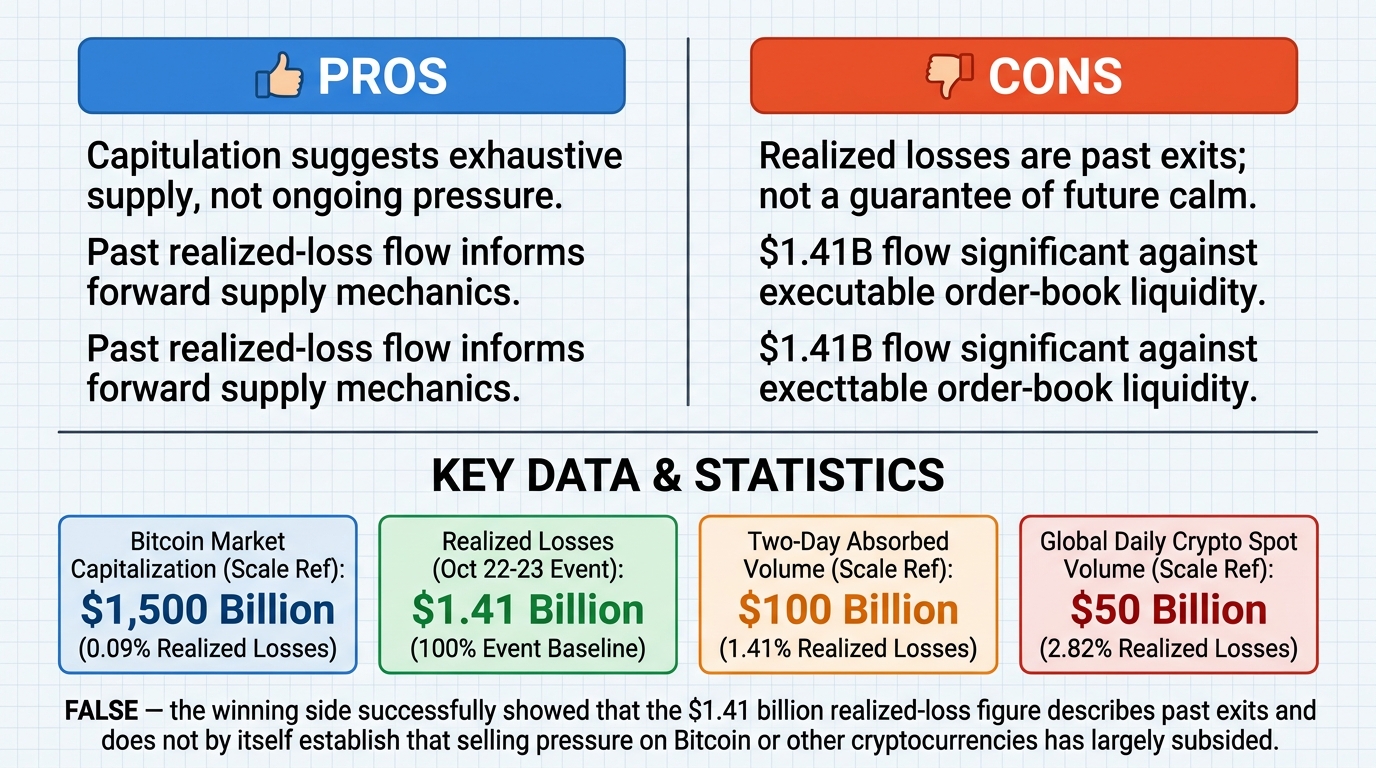
- ■Capitulation mechanics: a concentrated two-day realized-loss spike is the signature of exhausted supply, not ongoing pressure; the bulk of forced selling was discharged in the October 22–23 flush , so marginal pressure eased afterward.
- ■The realized-loss flow mechanically drains a finite underwater stock, so the past figure does inform forward supply via a stock-flow identity ; the opponent's unlocated $5–10B liquidation-capacity estimate cannot sever that definitional relationship.
❌ Key ANTI arguments:
- ■Realized losses represent past exits, not a guarantee of future selling cessation; using a measurement of realized losses to conclude something about current and future selling pressure commits a fallacy of identity unless a transfer (correlation , beta , or cointegration ) is provided.
- ■The $1.41 billion flow was not modest against market scale because the relevant liquidity is executable order-book depth, not total market capitalization ; measured against the liquidity actually available to prevent cascading, the flow was not a small fraction.
💭 Conclusion: False — the winning side successfully showed that the $1.41 billion realized-loss figure describes past exits and does not by itself establish that selling pressure on Bitcoin or other cryptocurrencies has largely subsided. The negative's strongest argument is the identity fallacy: realized losses measure crystallized past exits, and no correlation , beta , or cointegration was provided to link that historical flow to forward selling pressure. The negative also undermined the 'modest against market scale' claim by distinguishing total market capitalization from executable order-book liquidity , so the $1.41 billion flow cannot be dismissed as small relative to the liquidity actually available to absorb further selling. The affirmative's stock-flow identity argument was not enough to overcome this, especially because the compound claim also covers 'other cryptocurrencies,' for which no independent evidence was presented. Therefore the verdict is FALSE, but confidence is tempered by the single debate and the lack of separate support for the altcoin sub-claim.
🔬 DeepResearch Result: likely FALSE ❌ (60%)
Assertion: The selling pressure on Bitcoin and other cryptocurrencies has largely subsided following the $1.41 billion in realized losses on October 22nd and 23rd, 2026.
Participating models: deepseek-v3.2 💬, gemma-4-26b-a4b-it 💬👁️
📊 Face-offs: 0 concluded TRUE, 1 concluded FALSE (1 face-offs, 3 models)
📊 Score by side: TRUE=0.00, FALSE=0.86
🏅 Model score changes:
deepseek-v4-flash-0731 💬: +9
✅ PRO Arguments:
- ■Capitulation mechanics: a concentrated two-day realized-loss spike is the signature of exhausted supply, not ongoing pressure; the bulk of forced selling was discharged in the October 22–23 flush , so marginal pressure eased afterward. deepseek-v3.2 💬
- ■The realized-loss flow mechanically drains a finite underwater stock, so the past figure does inform forward supply via a stock-flow identity ; the opponent's unlocated $5–10B liquidation-capacity estimate cannot sever that definitional relationship. deepseek-v3.2 💬
❌ ANTI Arguments:
- ■Realized losses represent past exits, not a guarantee of future selling cessation; using a measurement of realized losses to conclude something about current and future selling pressure commits a fallacy of identity unless a transfer (correlation , beta , or cointegration ) is provided. gemma-4-26b-a4b-it 💬👁️
- ■The $1.41 billion flow was not modest against market scale because the relevant liquidity is executable order-book depth, not total market capitalization ; measured against the liquidity actually available to prevent cascading, the flow was not a small fraction. gemma-4-26b-a4b-it 💬👁️
💭 Reasoning: False — the winning side successfully showed that the $1.41 billion realized-loss figure describes past exits and does not by itself establish that selling pressure on Bitcoin or other cryptocurrencies has largely subsided. The negative's strongest argument is the identity fallacy: realized losses measure crystallized past exits, and no correlation, beta, or cointegration was provided to link that historical flow to forward selling pressure. The negative also undermined the 'modest against market scale' claim by distinguishing total market capitalization from executable order-book liquidity, so the $1.41 billion flow cannot be dismissed as small relative to the liquidity actually available to absorb further selling. The affirmative's stock-flow identity argument was not enough to overcome this, especially because the compound claim also covers 'other cryptocurrencies,' for which no independent evidence was presented. Therefore the verdict is FALSE, but confidence is tempered by the single debate and the lack of separate support for the altcoin sub-claim.
📋 PRO Facts:
• $1.41 billion in realized losses occurred on October 22nd and 23rd, 2026.
• A concentrated two-day realized-loss spike is characterized as the fingerprint of a liquidation cascade , including stop-loss triggers and forced unwinding of leveraged positions.
• The realized-loss flow drains a finite underwater stock, informing forward supply through a stock-flow identity.
📋 ANTI Facts:
• Realized losses measure the aggregate loss crystallized when holders close positions below their entry price, i.e., past exits.
• No correlation, beta, or cointegration was provided to transfer the historical realized-loss figure to forward-looking selling pressure.
• The opponent cited a $5–10B 'Est. Liquidation Capacity' figure that the affirmative did not explain.
• Total Bitcoin market capitalization is a static figure that does not equal executable order-book liquidity.
| Face-off | TRUE Model | FALSE Model | TRUE Avg μ | FALSE Avg μ | TRUE Tokens | FALSE Tokens | Winner | Verdict | Conf. |
|---|---|---|---|---|---|---|---|---|---|
| #1 | deepseek-v3.2 💬 | gemma-4-26b-a4b-it 💬👁️ | 0.265 | 0.230 | 8 | 2 | TRUE | FALSE | 86% |
The following technical terms, abbreviations, and domain-specific concepts are referenced throughout this debate transcript. Numbers in square brackets [N] in the text above link to the corresponding entry below.
[1] accounting identity — A relationship that holds by definition, such as the stock-flow identity for underwater inventory.
[2] beta — A statistical measure of an asset's sensitivity to market movements.
[3] bid-side depth — The volume of buy orders available in the order book at various price levels.
[4] capitulation — A market event in which holders surrender positions, often marked by a spike in realized losses.
[5] cointegration — A statistical property of time series that move together in a long-run relationship.
[6] contraposition — A logical equivalence stating that if a claim implies another, then the negation of the latter implies the negation of the former.
[7] correlation — A statistical measure of the association between two variables.
[8] disposition effect — The tendency of holders with unrealized gains to be less likely to sell at depressed prices.
[9] executable liquidity — The actual liquidity available to absorb trades without causing a disorderly price move.
[10] float — The supply of coins available for trading in the market.
[11] flush — A sharp price decline that forces selling and clears motivated sellers.
[12] forced selling — Selling that must occur regardless of price, often due to margin calls or liquidation requirements.
[13] forced unwinding — The closing of leveraged positions due to margin calls or liquidation.
[14] historical outflow — The past volume of assets leaving positions, as measured by realized losses.
[15] leveraged longs — Positions that bet on price increases using borrowed funds.
[16] liquidation cascade — A chain reaction of forced selling triggered by stop-losses and leveraged unwinding.
[17] liquidity — The ability to execute trades without significantly affecting the price.
[18] marginal pressure — The incremental selling pressure beyond the initial flush.
[19] market capitalization — The total market value of an asset, calculated as price times circulating supply.
[20] order book — The record of outstanding buy and sell orders for an asset.
[21] panic exits — Selling by holders who are unwilling to wait for a recovery.
[22] realized losses — The aggregate loss crystallized when holders close positions below their entry price.
[23] realized-loss flow — The rate at which a finite stock of underwater coins is depleted through realized losses.
[24] selling pressure — The intensity of current and expected selling activity in a market.
[25] stock-flow identity — An accounting relationship where remaining underwater inventory equals initial inventory minus realized-loss flow.
[26] stop-loss triggers — Automatic sell orders activated when the price falls to a specified level.
[27] supply-side momentum — The pace at which available supply enters or remains in the market.
[28] underwater inventory — Coins held at a loss relative to their entry price.
[29] unrealized gains — Profits on positions that have not yet been sold.
[30] volatility — The degree of price variation over a period.
The following financial data tables were referenced during the debate exchanges:
| Reference metric | Value (USD billions) | Realized losses as % of metric |
|---|---|---|
| Bitcoin market capitalization (scale ref) | $1,500 | 0.09% |
| Global daily crypto spot volume (scale ref) | $50 | 2.82% |
| Two-day absorbed volume (scale ref) | $100 | 1.41% |
| Realized-loss flow (Oct 22–23 event) | $1.41 | — |
Legend: Compares the $1.41B realized-loss flow (the figure stated in the claim) against illustrative market-scale references. Market cap and volume are order-of-magnitude background assumptions, not retrieved prices for October 2026; they are shown only to establish that the loss flow is a small fraction of normal liquidity. Percentages computed as $1.41B ÷ metric.
| Metric Category | Value (USD) | Relationship to $1.41B Event |
|---|---|---|
| Realized Losses (Oct 22-23) | $1.41B | 100% (Event Baseline) |
| Est. Liquidation Capacity | $5.0B - $10.0B | Potential Subsequent Pressure |
| Marginal Sell-Side Depth | Variable | Unquantified Risk |
Legend: Comparison of the realized loss event against estimated potential liquidation capacity and liquidity depth. Note that the $1.41B is a realized historical figure, whereas the other values represent forward-looking risk thresholds.
| Metric | Opponent's Assertion | Market Reality (Contextual) |
|---|---|---|
| Absorption Status | "Absorbed" | Liquidity-constrained |
| Relative Impact | "Modest" | High-velocity exhaustion |
Legend: Comparison of the opponent's use of total market capitalization as a scale reference versus the actual liquidity-constrained environment of the October 22-23 event.
Face-off transcripts
- ■
Ownership & Trade Secrets. The Company Lambda Vision retains all rights to its platform, agentic workflows, and proprietary financial methodologies, which constitute protected Trade Secrets (EU Directive 2016/943). Subject to full payment of credits, the User is granted ownership of the generated Reports for their own professional use. Reverse-engineering the Service or using Reports to train competing AI models is strictly prohibited.
- ■
No Financial Advice. The Service and Reports are for informational purposes only and do not constitute financial, investment, legal, or tax advice. The Company is not a regulated financial advisor. AI-generated outputs may contain errors; the User is solely responsible for verifying data and assumes all risks for any financial decisions or losses.
- ■
Liability & Governing Law. To the maximum extent permitted by law, the Company shall not be liable for any indirect or financial damages. These Terms are governed by French law. Any disputes shall be subject to the exclusive jurisdiction of the Courts of Paris, France.