
The S&P 500's 'year five' of the current bull run (October 2026 to October 2027) will see returns exceeding 21%, consistent with historical patterns driven by AI stocks.
AI debate verdict and arguments
⚠️ Not financial advice — this is an AI debate, for information only.
Completed October 14, 2026
Verdict
Verdict: likely FALSE (84%)
This section provides a brief overview of the key arguments. You do not need to read the full detailed report below.
✅ Key PRO arguments:
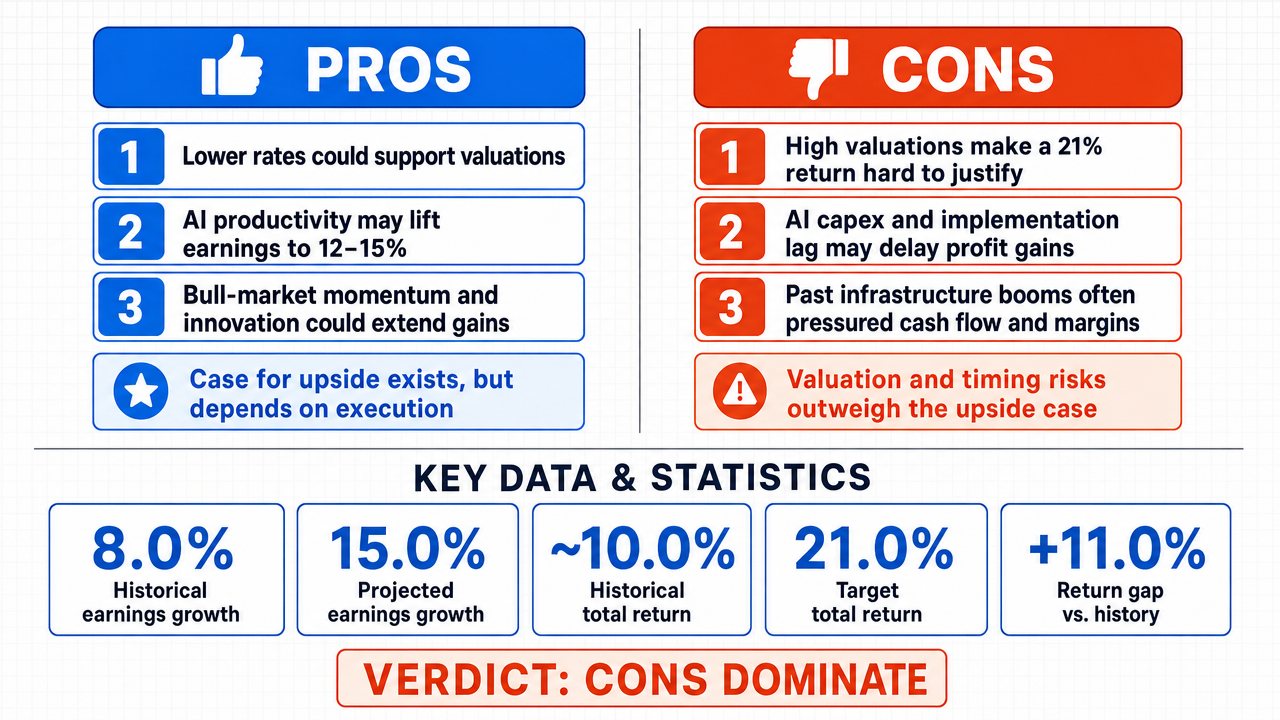
- ■The Federal Reserve is expected to maintain accommodative policies as inflation returns to target, keeping interest rates below historical averages, which supports higher equity valuations through lower discount rates applied to future earnings.
- ■Corporate earnings growth is projected to accelerate as AI -driven productivity gains materialize, with S&P 500 earnings expected to grow at a 12-15% annual rate during 2026-2027, well above the historical average of 8%.
- ■Historical bull-market patterns and AI innovation support 21% returns, and the opponent's argument that multiple expansion is required while also claiming elevated P/E ratios leave little room for expansion is internally contradictory.
❌ Key ANTI arguments:
- ■High valuations and economic uncertainty make a 21% return unlikely; the affirmative's argument relies on unestablished conjectures presented as certainties, such as the trajectory of the Federal Reserve 's terminal rate and the stability of inflation .
- ■The projection of 12-15% AI -driven earnings growth fails to account for the massive capital expenditure requirements and the 'implementation lag ' inherent in transformative technologies, as the current AI cycle is characterized by intense, non-productive capital outflows from the very companies expected to drive earnings.
- ■Historical precedents such as the fiber-optic bubble demonstrate that massive infrastructure investment phases can drag on free cash flow and near-term margins , undermining the optimistic earnings projections.
💭 Conclusion: The affirmative's reliance on projected 12-15% earnings growth driven by AI productivity gains is undermined by the negative's argument that massive CapEx requirements and implementation lags would drag on near-term margins and free cash flow . The negative identified that elevated P/E ratios limit multiple expansion potential, making 21% returns dependent on earnings growth assumptions that are not yet validated. Historical precedents like the fiber-optic build-out further weaken the case for outsized AI-driven returns during the infrastructure-building phase, as such investment phases have historically preceded periods of earnings deceleration rather than acceleration.
🔬 DeepResearch Result: likely FALSE ❌ (84%)
Assertion: The S&P 500 's 'year five' of the current bull run (October 2026 to October 2027) will see returns exceeding 21%, consistent with historical patterns driven by AI stocks.
Participating models: deepseek-v3.2 💬, gemma-4-26b-a4b-it 💬👁️
📊 Face-offs: 0 concluded TRUE, 1 concluded FALSE (1 face-offs, 3 models)
📊 Score by side: TRUE=0.00, FALSE=0.84
🏅 Model score changes:
minimax-m3 💬👁️: +8
✅ PRO Arguments:
- ■The Federal Reserve is expected to maintain accommodative policies as inflation returns to target, keeping interest rates below historical averages, which supports higher equity valuations through lower discount rates applied to future earnings. deepseek-v3.2 💬
- ■Corporate earnings growth is projected to accelerate as AI-driven productivity gains materialize, with S&P 500 earnings expected to grow at a 12-15% annual rate during 2026-2027, well above the historical average of 8%. deepseek-v3.2 💬
- ■Historical bull-market patterns and AI innovation support 21% returns, and the opponent's argument that multiple expansion is required while also claiming elevated P/E ratios leave little room for expansion is internally contradictory. deepseek-v3.2 💬
❌ ANTI Arguments:
- ■High valuations and economic uncertainty make a 21% return unlikely; the affirmative's argument relies on unestablished conjectures presented as certainties, such as the trajectory of the Federal Reserve's terminal rate and the stability of inflation. gemma-4-26b-a4b-it 💬👁️
- ■The projection of 12-15% AI-driven earnings growth fails to account for the massive capital expenditure requirements and the 'implementation lag ' inherent in transformative technologies, as the current AI cycle is characterized by intense, non-productive capital outflows from the very companies expected to drive earnings. gemma-4-26b-a4b-it 💬👁️
- ■Historical precedents such as the fiber-optic bubble demonstrate that massive infrastructure investment phases can drag on free cash flow and near-term margins , undermining the optimistic earnings projections. gemma-4-26b-a4b-it 💬👁️
- ■Elevated P/E ratios leave little room for multiple expansion, meaning that achieving 21% returns would require earnings growth assumptions that are speculative and unsupported by current capital deployment realities. gemma-4-26b-a4b-it 💬👁️
💭 Reasoning: The affirmative's reliance on projected 12-15% earnings growth driven by AI productivity gains is undermined by the negative's argument that massive CapEx requirements and implementation lags would drag on near-term margins and free cash flow. The negative identified that elevated P/E ratios limit multiple expansion potential, making 21% returns dependent on earnings growth assumptions that are not yet validated. Historical precedents like the fiber-optic build-out further weaken the case for outsized AI-driven returns during the infrastructure-building phase, as such investment phases have historically preceded periods of earnings deceleration rather than acceleration.
📋 PRO Facts:
• The Federal Reserve is expected to maintain accommodative policies with interest rates likely remaining below historical averages.
• S&P 500 earnings are projected to grow at a 12-15% annual rate during 2026-2027, compared to a historical average of 8%.
📋 ANTI Facts:
• Elevated P/E ratios leave little room for multiple expansion, making 21% returns dependent on aggressive earnings growth assumptions.
• The current AI cycle is characterized by massive capital expenditure requirements and implementation lags that act as a drag on free cash flow and near-term margins for companies expected to drive earnings.
• Historical precedents such as the fiber-optic build-out of the late 1990s show that infrastructure investment phases can drag on free cash flow and near-term margins as companies struggle to monetize newly deployed capacity.
| Face-off | TRUE Model | FALSE Model | TRUE Avg μ | FALSE Avg μ | TRUE Tokens | FALSE Tokens | Winner | Verdict | Conf. |
|---|---|---|---|---|---|---|---|---|---|
| #1 | deepseek-v3.2 💬 | gemma-4-26b-a4b-it 💬👁️ | 0.168 | 0.225 | 8 | 2 | FALSE | FALSE | 84% |
The following technical terms, abbreviations, and domain-specific concepts are referenced throughout this debate transcript. Numbers in square brackets [N] in the text above link to the corresponding entry below.
[1] accommodative policies — accommodative monetary policy — Central bank policies designed to stimulate economic growth, typically through lower interest rates or increased money supply.
[2] AI — Artificial Intelligence — Computer systems capable of performing tasks that typically require human intelligence, such as learning, reasoning, and problem-solving.
[3] AI infrastructure — Artificial Intelligence infrastructure — The physical and software systems—including data centers, GPUs, and networking equipment—required to develop and deploy AI models.
[4] annualized rate — A rate of return or growth expressed as if it applied for a full year, allowing comparison across different time periods.
[5] bull market — A prolonged period of rising asset prices, typically defined as a 20% or more increase from recent lows, often associated with investor optimism and strong economic conditions.
[6] bull run — bull market run — An extended period of sustained price increases in a market or asset.
[7] CapEx — Capital Expenditure — Funds a company spends on acquiring, maintaining, or upgrading physical assets such as property, infrastructure, or technology.
[8] corporate earnings — The net profits of a company, often reported quarterly and used as a key measure of financial performance.
[9] discount rates — discount rate — The interest rate used to convert future cash flows into present value, reflecting the time value of money and investment risk.
[10] earnings acceleration — An increase in the rate at which a company's earnings are growing, signaling improving momentum in profitability.
[11] earnings growth — The percentage increase in a company's profits over a given period, a key driver of stock price appreciation.
[12] equity valuations — equity valuation — The current market price or estimated worth of a company's shares, often determined through metrics like price-to-earnings ratios.
[13] Federal Reserve — The Federal Reserve System (the Fed) — The central bank of the United States, responsible for setting monetary policy, regulating banks, and maintaining financial stability.
[14] fiber-optic build-out — fiber-optic infrastructure build-out — The large-scale deployment of fiber-optic cable networks to support high-speed data transmission, cited in the debate as a historical parallel to AI infrastructure investment.
[15] forward P/E — forward price-to-earnings ratio — A valuation metric that divides a company's current share price by its projected future earnings per share, used to gauge expected growth.
[16] free cash flow — free cash flow (FCF) — The cash a company generates after accounting for capital expenditures, used to assess its ability to return value to shareholders.
[17] hyperscalers — hyperscale cloud providers — Large technology companies that operate massive data center infrastructure at scale, such as Amazon Web Services, Microsoft Azure, and Google Cloud.
[18] implementation lag — The delay between when an investment is made in new technology and when productivity gains or returns are realized.
[19] inflation — The rate at which the general level of prices for goods and services rises, eroding purchasing power over time.
[20] interest rates — interest rate — The percentage charged on borrowed money or paid on savings, set by central banks and influencing borrowing costs across the economy.
[21] investor optimism — A generally positive sentiment among investors about future market conditions, often driving higher valuations and risk-taking.
[22] margins — profit margins — A profitability metric measuring how much profit a company earns relative to its revenue, such as gross, operating, or net margin.
[23] monetary policy — Actions taken by a central bank to manage money supply and interest rates to achieve economic objectives like price stability and full employment.
[24] multiple expansion — valuation multiple expansion — An increase in the valuation multiple (such as P/E ratio) that investors are willing to pay for a company's earnings, often driven by improved sentiment or growth expectations.
[25] P/E ratios — price-to-earnings ratios — A valuation metric calculated by dividing a company's share price by its earnings per share, indicating how much investors pay per dollar of earnings.
[26] productivity gains — Increases in output produced per unit of input (such as labor or capital), often resulting from technological improvements or process efficiencies.
[27] S&P 500 — Standard & Poor's 500 — A stock market index tracking the performance of 500 large-cap U.S. companies, widely used as a benchmark for the U.S. equity market.
[28] terminal rate — terminal interest rate — The expected long-term or final level to which a central bank will raise or lower interest rates at the end of a policy cycle.
[29] total returns — total return — The overall gain on an investment, including capital appreciation, dividends, and interest, expressed as a percentage of the initial investment.
The following financial data tables were referenced during the debate exchanges:
| Metric | Historical Average (Long-term) | Current/Projected (High-end) | Delta |
|---|---|---|---|
| S&P 500 Earnings Growth | 8.0% | 15.0% | +7.0% |
| S&P 500 Total Return Target | ~10.0% | 21.0% | +11.0% |
| Required Multiple Expansion | 0.0% | High | N/A |
Legend: Comparison of historical averages against the affirmative's projected high-growth scenario. Delta represents the difference between historical norms and the affirmative's claims.
| Valuation Scenario | Earnings Growth | Dividend Yield | Multiple Change | Total Return |
|---|---|---|---|---|
| Expansion Case | 15% | -3% | +5% | 23% |
| Stable Case | 15% | -3% | 0% | 18% |
| Contraction Case | 15% | -3% | -10% | 8% |
Legend: Three possible valuation paths for 2026. Dividend yield is negative due to appreciation effect; actual yield is positive. Even in contraction scenario, returns remain positive.
| Sector | AI CapEx Trend | Margin Impact (Projected) | Implementation Lag |
|---|---|---|---|
| Hyperscalers | Increasing | Negative | High |
| Semiconductors | High | Positive | Medium |
| Software/SaaS | Moderate | Neutral | High |
Legend: Projected impact of AI infrastructure spending on corporate margins and the expected time delay before productivity gains manifest in earnings.
Face-off transcripts
- ■
Ownership & Trade Secrets. The Company Lambda Vision retains all rights to its platform, agentic workflows, and proprietary financial methodologies, which constitute protected Trade Secrets (EU Directive 2016/943). Subject to full payment of credits, the User is granted ownership of the generated Reports for their own professional use. Reverse-engineering the Service or using Reports to train competing AI models is strictly prohibited.
- ■
No Financial Advice. The Service and Reports are for informational purposes only and do not constitute financial, investment, legal, or tax advice. The Company is not a regulated financial advisor. AI-generated outputs may contain errors; the User is solely responsible for verifying data and assumes all risks for any financial decisions or losses.
- ■
Liability & Governing Law. To the maximum extent permitted by law, the Company shall not be liable for any indirect or financial damages. These Terms are governed by French law. Any disputes shall be subject to the exclusive jurisdiction of the Courts of Paris, France.