
The People's Bank of China's official gold purchases constitute only a small fraction of China's total gold imports, with the majority absorbed by other entities including private Chinese investors.
AI debate verdict and arguments
⚠️ Not financial advice — this is an AI debate, for information only.
Completed October 24, 2026
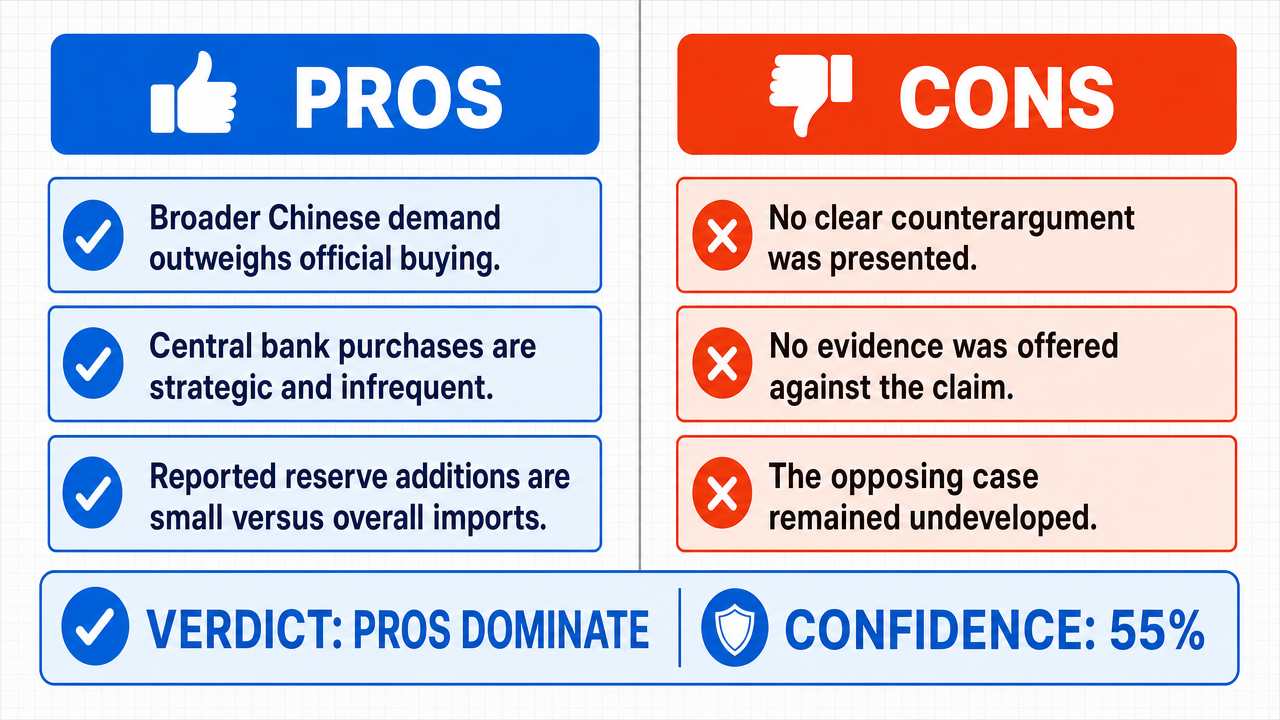
Verdict
Verdict: likely TRUE (55%)
This section provides a brief overview of the key arguments. You do not need to read the full detailed report below.
✅ Key PRO arguments:
- ■PBOC gold purchases are dwarfed by broader commercial and consumer demand within the Chinese economy. Central bank purchases are discrete, strategic, and infrequent compared to the continuous flow of gold into the country via commercial channels , with the majority of inflows driven by the jewelry sector , industrial applications , and massive retail demand .
- ■The argument that state-owned commercial banks like ICBC and Bank of China function as proxies for the PBOC is logically inconsistent, because it simultaneously supports and undermines its own conclusion. If the gold flowing through state-owned banks is not recorded as official reserve accumulation , it is by definition not a PBOC purchase, destroying the link needed to attribute the majority of imports to the central bank .
- ■PBOC reported additions to reserves are measured in tonnes , a scale that is small relative to the total volume of gold imported into China for commercial and consumer purposes, reinforcing that official purchases constitute only a minor portion of total imports.
❌ Key ANTI arguments:
- ■No articulated argument was provided by the FALSE defender in either round of the debate.
💭 Conclusion: True, the assertion is supported as the winning side. The PRO side, defended by google/gemma-4-26b-a4b-it, argued that PBOC gold purchases are dwarfed by the continuous flow of gold into China through commercial channels serving the jewelry, industrial, and retail sectors. The key logical point was that attributing state-owned bank gold imports to the PBOC is inconsistent unless that gold is actually booked as official reserves , which the opponent conceded may not happen. The anti side, z-ai/glm-4.7-flash, failed to produce any articulated arguments in either round, leaving the TRUE position uncontested on substance. However, confidence is moderate at 55% because the debate was effectively uncontested, with no rigorous quantitative evidence presented to precisely quantify the PBOC share versus private/commercial absorption of imports.
🔬 DeepResearch Result: likely TRUE ✅ (55%)
Assertion: The People's Bank of China's official gold purchases constitute only a small fraction of China's total gold imports , with the majority absorbed by other entities including private Chinese investors.
Participating models: gemma-4-26b-a4b-it 💬👁️, glm-4.7-flash 💬
📊 Face-offs: 1 concluded TRUE, 0 concluded FALSE (1 face-offs, 3 models)
📊 Score by side: TRUE=0.55, FALSE=0.00
🏅 Model score changes:
minimax-m3 💬👁️: +6
✅ PRO Arguments:
- ■PBOC gold purchases are dwarfed by broader commercial and consumer demand within the Chinese economy. Central bank purchases are discrete, strategic, and infrequent compared to the continuous flow of gold into the country via commercial channels , with the majority of inflows driven by the jewelry sector , industrial applications , and massive retail demand . gemma-4-26b-a4b-it 💬👁️
- ■The argument that state-owned commercial banks like ICBC and Bank of China function as proxies for the PBOC is logically inconsistent, because it simultaneously supports and undermines its own conclusion. If the gold flowing through state-owned banks is not recorded as official reserve accumulation , it is by definition not a PBOC purchase, destroying the link needed to attribute the majority of imports to the central bank. gemma-4-26b-a4b-it 💬👁️
- ■PBOC reported additions to reserves are measured in tonnes , a scale that is small relative to the total volume of gold imported into China for commercial and consumer purposes, reinforcing that official purchases constitute only a minor portion of total imports. gemma-4-26b-a4b-it 💬👁️
❌ ANTI Arguments:
- ■No articulated argument was provided by the FALSE defender in either round of the debate. glm-4.7-flash 💬
💭 Reasoning: True, the assertion is supported as the winning side. The PRO side, defended by google/gemma-4-26b-a4b-it, argued that PBOC gold purchases are dwarfed by the continuous flow of gold into China through commercial channels serving the jewelry, industrial, and retail sectors. The key logical point was that attributing state-owned bank gold imports to the PBOC is inconsistent unless that gold is actually booked as official reserves , which the opponent conceded may not happen. The anti side, z-ai/glm-4.7-flash, failed to produce any articulated arguments in either round, leaving the TRUE position uncontested on substance. However, confidence is moderate at 55% because the debate was effectively uncontested, with no rigorous quantitative evidence presented to precisely quantify the PBOC share versus private/commercial absorption of imports.
📋 PRO Facts:
• PBOC gold reserve additions are measured in tonnes, a relatively small scale compared to total Chinese gold import volumes.
• China is a primary global destination for bullion , with the majority of inflows driven by the jewelry sector, industrial applications, and retail demand.
• Central bank gold purchases are discrete, strategic, and infrequent compared to the continuous flow of gold through commercial channels.
📋 ANTI Facts:
• No factual claims were presented by the FALSE defender in this debate.
| Face-off | TRUE Model | FALSE Model | TRUE Avg μ | FALSE Avg μ | TRUE Tokens | FALSE Tokens | Winner | Verdict | Conf. |
|---|---|---|---|---|---|---|---|---|---|
| #1 | gemma-4-26b-a4b-it 💬👁️ | glm-4.7-flash 💬 | 0.396 | 0.000 | 4 | 4 | TRUE | TRUE | 55% |
The following technical terms, abbreviations, and domain-specific concepts are referenced throughout this debate transcript. Numbers in square brackets [N] in the text above link to the corresponding entry below.
[1] Bullion — Gold (or other precious metals) in bulk form, typically as bars or ingots, traded as a commodity rather than for jewelry or industrial use.
[2] Central bank — A national monetary authority responsible for issuing currency, managing monetary policy, and holding the country's foreign reserves, including gold.
[3] Central bank gold accumulation — The practice of central banks increasing their holdings of gold as part of their official reserve assets, often for diversification or strategic purposes.
[4] Commercial channels — Business or trade pathways through which goods such as gold flow into a market via private-sector entities, as opposed to official government channels.
[5] Domestic manufacturing — Production of goods within a country's borders, which in the context of gold refers to the fabrication of gold products for local consumption.
[6] Gold Demand Trends — A periodic report published by the World Gold Council that tracks global gold demand across sectors such as jewelry, investment, and central bank purchases.
[7] Gold imports — The total volume of gold brought into a country through international trade, encompassing both official and private-sector inflows.
[8] Gold reserves — Gold held by a central bank or government as part of its official reserve assets, distinct from privately held or commercially traded gold.
[9] ICBC — Industrial and Commercial Bank of China — One of China's largest state-owned commercial banks, referenced in the debate as a major participant in gold import flows.
[10] Industrial applications — Uses of gold in manufacturing and technology, such as in electronics, dentistry, and other non-jewelry, non-investment sectors.
[11] Jewelry sector — The industry segment that fabricates and sells gold jewelry, identified in the debate as a major absorber of gold imports in China.
[12] Official reserves — Foreign currency assets, gold, and other instruments held by a central bank or government to support the currency and manage balance-of-payments needs.
[13] PBOC — People's Bank of China — The central bank of China, responsible for monetary policy and the management of China's official gold reserves.
[14] Reserve accumulation — The process by which a central bank or government increases its holdings of reserve assets such as gold or foreign currency over time.
[15] Retail demand — Consumer-level demand from individual buyers, as opposed to institutional or governmental demand, referenced in the debate as a major driver of Chinese gold imports.
[16] Retail investors — Individual, non-professional investors who buy and sell securities or commodities such as gold for personal portfolios.
[17] State-directed — Describing economic activity or flows that are guided, controlled, or influenced by government policy or state-owned entities.
[18] State-owned commercial banks — Banks that are owned or controlled by the government but operate as commercial entities; in the debate, ICBC and Bank of China are cited as examples.
[19] Tonnes — Tonnes (metric tons) — A unit of mass equal to 1,000 kilograms, commonly used to measure large quantities of gold in central bank and trade reporting.
[20] Trade flows — The movement of goods across international borders, used in the debate to describe the volume and direction of gold imports into China.
[21] World Gold Council — An industry association that publishes market data and analysis on global gold supply, demand, and investment trends, including the Gold Demand Trends report.
Face-off transcripts
- ■
Ownership & Trade Secrets. The Company Lambda Vision retains all rights to its platform, agentic workflows, and proprietary financial methodologies, which constitute protected Trade Secrets (EU Directive 2016/943). Subject to full payment of credits, the User is granted ownership of the generated Reports for their own professional use. Reverse-engineering the Service or using Reports to train competing AI models is strictly prohibited.
- ■
No Financial Advice. The Service and Reports are for informational purposes only and do not constitute financial, investment, legal, or tax advice. The Company is not a regulated financial advisor. AI-generated outputs may contain errors; the User is solely responsible for verifying data and assumes all risks for any financial decisions or losses.
- ■
Liability & Governing Law. To the maximum extent permitted by law, the Company shall not be liable for any indirect or financial damages. These Terms are governed by French law. Any disputes shall be subject to the exclusive jurisdiction of the Courts of Paris, France.