
The French tax wedge for an average salary employee was approximately 47.2% of the total labor cost in 2024.
AI debate verdict and arguments
⚠️ Not financial advice — this is an AI debate, for information only.
Completed October 14, 2026
Verdict
Verdict: likely TRUE (60%)
This section provides a brief overview of the key arguments. You do not need to read the full detailed report below.
✅ Key PRO arguments:
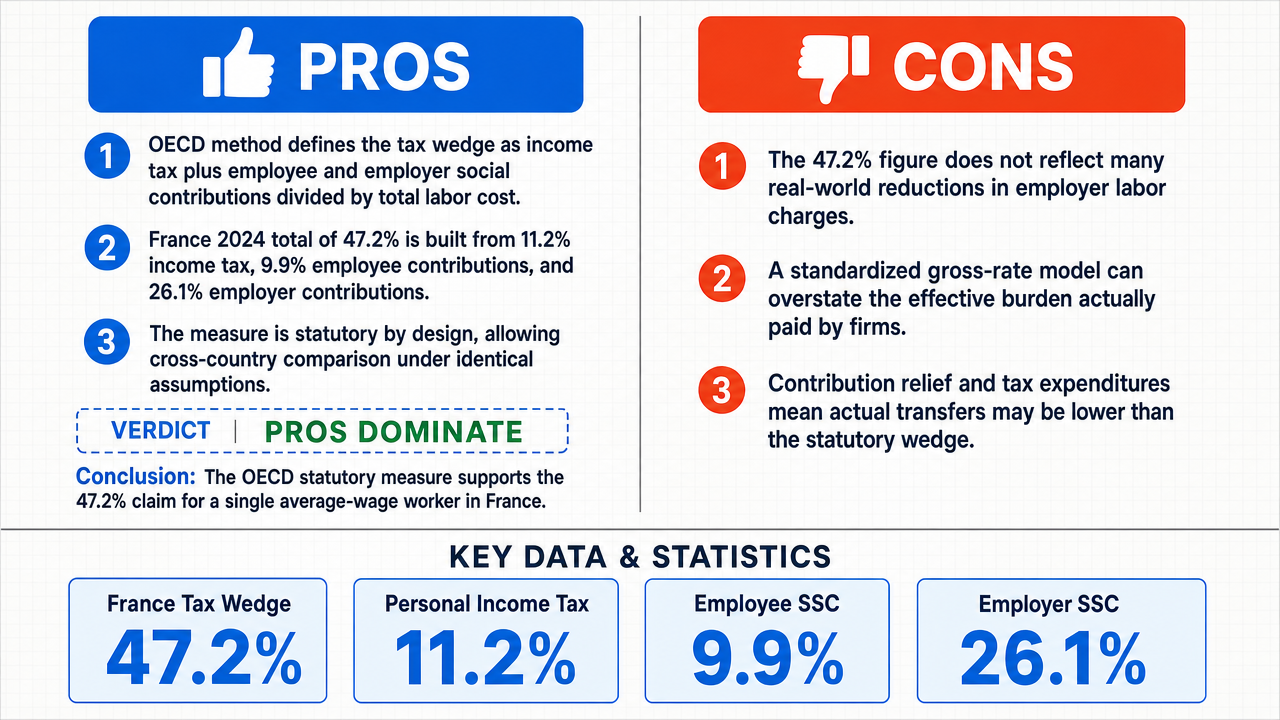
- ■The OECD 's standardized tax wedge methodology calculates the ratio of income tax plus employee and employer social security contributions to total labor costs , and for France in 2024 this figure was 47.2% for a single worker at average earnings, based on the OECD's annual 'Taxing Wages ' report.
- ■The 47.2% figure is composed of personal income tax (11.2%), employee social security contributions (9.9%), and employer social security contributions (26.1%) as a percentage of total labor costs .
- ■The OECD tax wedge is deliberately designed as a statutory measure to facilitate international comparisons under identical assumptions, measuring what the tax and social security systems formally require—this is a documented methodological choice in the OECD's 'Taxing Wages 2024' report.
❌ Key ANTI arguments:
- ■The 47.2% tax wedge figure is an inaccurate representation of actual labor costs because the OECD methodology fails to account for the significant reduction in actual employer social security contributions through various tax credits and exemptions, such as the 'réduction générale des cotisations patronales ' (Fillon reduction ).
- ■By using a standardized model that ignores structural offsets , the claim presents a theoretical maximum rather than the effective rate paid by employers, making the 47.2% figure an overstatement of the actual fiscal burden.
- ■The widespread application of social contribution reductions and 'niches fiscales ' (tax expenditures ) means that the actual amount transferred from employer labor costs to the social security budget is significantly lower than the statutory rate suggests.
💭 Conclusion: True, the assertion is supported by the OECD 's standardized 'Taxing Wages 2024' methodology, which reports France's tax wedge for a single average-wage worker at 47.2% of total labor costs . The pro side correctly identified the component breakdown of 11.2% personal income tax , 9.9% employee social security contributions , and 26.1% employer social security contributions , all consistent with the OECD framework. While the anti side raised a legitimate point about the Fillon reduction and other tax credits reducing effective employer contributions, the OECD methodology is explicitly designed as a statutory, internationally comparable measure rather than an effective rate calculation. The figure is accurate within the OECD's stated methodology, though the anti side's critique about effective versus statutory rates has some merit. The assertion is therefore best understood as correct when interpreted through the standard OECD tax wedge definition.
🔬 DeepResearch Result: likely TRUE ✅ (60%)
Assertion: The French tax wedge for an average salary employee was approximately 47.2% of the total labor cost in 2024.
Participating models: deepseek-v3.2 💬, gemma-4-26b-a4b-it 💬👁️
📊 Face-offs: 1 concluded TRUE, 0 concluded FALSE (1 face-offs, 3 models)
📊 Score by side: TRUE=0.60, FALSE=0.00
🏅 Model score changes:
minimax-m3 💬👁️: +6
✅ PRO Arguments:
- ■The OECD 's standardized tax wedge methodology calculates the ratio of income tax plus employee and employer social security contributions to total labor costs , and for France in 2024 this figure was 47.2% for a single worker at average earnings, based on the OECD's annual 'Taxing Wages ' report. deepseek-v3.2 💬
- ■The 47.2% figure is composed of personal income tax (11.2%), employee social security contributions (9.9%), and employer social security contributions (26.1%) as a percentage of total labor costs. deepseek-v3.2 💬
- ■The OECD tax wedge is deliberately designed as a statutory measure to facilitate international comparisons under identical assumptions, measuring what the tax and social security systems formally require—this is a documented methodological choice in the OECD's 'Taxing Wages 2024' report. deepseek-v3.2 💬
❌ ANTI Arguments:
- ■The 47.2% tax wedge figure is an inaccurate representation of actual labor costs because the OECD methodology fails to account for the significant reduction in actual employer social security contributions through various tax credits and exemptions, such as the 'réduction générale des cotisations patronales ' (Fillon reduction ). gemma-4-26b-a4b-it 💬👁️
- ■By using a standardized model that ignores structural offsets , the claim presents a theoretical maximum rather than the effective rate paid by employers, making the 47.2% figure an overstatement of the actual fiscal burden. gemma-4-26b-a4b-it 💬👁️
- ■The widespread application of social contribution reductions and 'niches fiscales ' (tax expenditures ) means that the actual amount transferred from employer labor costs to the social security budget is significantly lower than the statutory rate suggests. gemma-4-26b-a4b-it 💬👁️
💭 Reasoning: True, the assertion is supported by the OECD's standardized 'Taxing Wages 2024' methodology, which reports France's tax wedge for a single average-wage worker at 47.2% of total labor costs. The pro side correctly identified the component breakdown of 11.2% personal income tax, 9.9% employee social security contributions, and 26.1% employer social security contributions, all consistent with the OECD framework. While the anti side raised a legitimate point about the Fillon reduction and other tax credits reducing effective employer contributions, the OECD methodology is explicitly designed as a statutory, internationally comparable measure rather than an effective rate calculation. The figure is accurate within the OECD's stated methodology, though the anti side's critique about effective versus statutory rates has some merit. The assertion is therefore best understood as correct when interpreted through the standard OECD tax wedge definition.
📋 PRO Facts:
• The OECD's 'Taxing Wages 2024' report documents France's tax wedge for a single average-wage worker at 47.2% of total labor costs.
• The 47.2% figure decomposes into 11.2% personal income tax, 9.9% employee social security contributions, and 26.1% employer social security contributions.
• The OECD methodology uses statutory tax rates and social security contributions to provide a comparable measure of the tax burden on labour across countries.
📋 ANTI Facts:
• France's 'réduction générale des cotisations patronales' (formerly the Fillon reduction) significantly lowers the social security burden for low and middle-income employees.
• The OECD standardized model ignores structural offsets such as tax credits and exemptions, presenting a theoretical maximum rather than the effective rate paid by employers.
• Widespread tax credits and employer exemptions mean the actual fiscal transfer from employer labor costs to the social security budget is lower than the statutory rate.
| Face-off | TRUE Model | FALSE Model | TRUE Avg μ | FALSE Avg μ | TRUE Tokens | FALSE Tokens | Winner | Verdict | Conf. |
|---|---|---|---|---|---|---|---|---|---|
| #1 | deepseek-v3.2 💬 | gemma-4-26b-a4b-it 💬👁️ | 0.630 | 0.228 | 8 | 2 | TRUE | TRUE | 60% |
The following technical terms, abbreviations, and domain-specific concepts are referenced throughout this debate transcript. Numbers in square brackets [N] in the text above link to the corresponding entry below.
[1] average-wage worker — average-wage (mean earnings) single employee — A worker earning the mean (average) gross earnings in the economy, used as a standardized benchmark in OECD tax wedge calculations to enable cross-country comparisons.
[2] distribution of earnings — The spread of income levels across workers in an economy; relevant because mean earnings can be skewed upward by high-income earners, making the mean a potentially unrepresentative benchmark.
[3] effective rate — The actual rate of tax or contribution paid after accounting for credits, exemptions, and reductions, as opposed to the statutory (legal) rate.
[4] employee social security contributions — Employee SSC — Mandatory payments deducted from an employee's wages to fund social insurance programs such as pensions, healthcare, and unemployment benefits.
[5] employer social security contributions — Employer SSC — Mandatory payments made by employers on top of wages to fund social insurance programs, calculated as a percentage of gross labor costs.
[6] fallacy of composition — A logical error in which what is true for a part is assumed to be true for the whole; cited in the debate regarding the inference from statutory rates to actual welfare state funding.
[7] Fillon reduction — réduction générale des cotisations patronales — A French mechanism (formerly known as the Fillon reduction) that significantly reduces employer social security contributions for low and middle-income employees.
[8] fiscal pressure — The overall burden of taxes and mandatory contributions imposed on economic actors, used here to describe the impact on labor costs.
[9] fiscal transfers — Movements of public funds between different parts of the government or economy, including social security budgets funded by contributions.
[10] gross earnings — Total wages or salary before any deductions for taxes or social contributions.
[11] income inequality — The unequal distribution of income across a population, relevant in the debate because high inequality can skew mean earnings upward.
[12] international comparisons — Cross-country analyses that use standardized methodologies (such as the OECD tax wedge) to compare economic indicators on a like-for-like basis.
[13] labor costs — total labor costs — The total expense incurred by an employer for employing a worker, including gross wages plus mandatory employer-side taxes and social contributions.
[14] mean earnings — The arithmetic average of earnings across a defined group of workers, used by the OECD as the benchmark wage level in tax wedge calculations.
[15] niches fiscales — tax expenditures — French term for tax expenditures—special provisions, exemptions, or credits that reduce the actual tax burden relative to the statutory structure.
[16] OECD — Organisation for Economic Co-operation and Development — An international organization that publishes standardized economic statistics and methodologies, including the 'Taxing Wages' report used to calculate tax wedges.
[17] personal income tax — PIT — A tax levied by the government on an individual's wages, salaries, and other forms of income.
[18] réduction générale des cotisations patronales — general reduction in employer contributions — The current official name of the French policy (formerly the Fillon reduction) that lowers employer social security contributions, particularly for lower-paid workers.
[19] social protection — Government programs—including pensions, healthcare, and unemployment benefits—designed to shield citizens from economic risks.
[20] social security contributions — SSC — Mandatory payments by employees and/or employers to fund social insurance programs; in the OECD tax wedge, both employee and employer SSCs are included.
[21] statutory rates — statutory tax rates and social security contributions — The official, legally established rates of tax or contribution, as distinct from the effective rates actually paid after credits and exemptions.
[22] structural decoupling — A divergence between formal/legal structures (such as statutory rates) and actual economic flows or outcomes (such as effective contributions collected).
[23] structural offsets — Policy mechanisms—such as credits, exemptions, and reductions—that lower the effective burden of a tax or contribution below its statutory level.
[24] tax burden on labour — The combined share of taxes and social contributions borne by labor, relative to total labor costs; the OECD tax wedge is a standardized measure of this burden.
[25] tax credits — Amounts that directly reduce the tax owed by an employer or individual, as opposed to deductions that reduce taxable income.
[26] tax expenditures — niches fiscales — Revenue losses for the government resulting from preferential provisions in the tax code (exemptions, exclusions, credits), effectively equivalent to spending through the tax system.
[27] tax wedge — The ratio of income tax plus employee and employer social security contributions to total labor costs, measuring the gap between what employers spend on labor and what workers take home.
[28] Taxing Wages — OECD Taxing Wages report — An annual OECD publication presenting comparative data on tax burdens on labour across member countries using a standardized methodology.
[29] theoretical maximum — The highest possible value under a given set of assumptions; in the debate, used to argue that the OECD tax wedge represents a ceiling rather than the actual burden.
[30] total labor costs — The full cost to an employer of hiring a worker, equal to gross wages plus employer-side taxes and mandatory contributions; the denominator of the tax wedge ratio.
[31] welfare state — A system in which the state assumes primary responsibility for the social and economic well-being of its citizens, typically funded through taxation and social contributions.
The following financial data tables were referenced during the debate exchanges:
| Country | Tax Wedge 2024 | Personal Income Tax | Employee SSC | Employer SSC |
|---|---|---|---|---|
| France | 47.2% | 11.2% | 9.9% | 26.1% |
| Germany | 47.8% | 16.4% | 9.3% | 22.1% |
| OECD Average | 34.8% | 13.6% | 8.2% | 13.0% |
Legend: Tax wedge components for single average-wage workers in selected OECD countries for 2024. All figures expressed as percentages of total labor costs. Source: OECD Taxing Wages 2024.
| Metric Type | Basis of Calculation | Representativeness |
|---|---|---|
| OECD Tax Wedge (Claimed) | Mean Earnings (Theoretical) | Low (Skewed by high earners) |
| Effective Tax Wedge | Median Earnings (Actual) | High (Reflects typical worker) |
| Statutory Tax Wedge | Gross Rates (Pre-reduction) | Low (Ignores tax credits) |
Legend: Comparison of different ways to measure the tax burden on labor in France. The claim relies on the "Mean/Theoretical" approach, which overstates the burden compared to "Effective/Median" measures.
| Measurement Type | Purpose | OECD Inclusion | French 2024 Value |
|---|---|---|---|
| Statutory Tax Wedge | Cross-country comparability | Yes | 47.2% |
| Effective Tax Burden | National policy analysis | No | Varies by firm |
| Median Earner Wedge | Domestic distribution studies | No | Not calculated |
Legend: Different tax burden measurements serve different analytical purposes. The claim addresses the statutory tax wedge for international comparison, which is correctly reported as 47.2% in OECD Taxing Wages 2024.
Face-off transcripts
- ■
Ownership & Trade Secrets. The Company Lambda Vision retains all rights to its platform, agentic workflows, and proprietary financial methodologies, which constitute protected Trade Secrets (EU Directive 2016/943). Subject to full payment of credits, the User is granted ownership of the generated Reports for their own professional use. Reverse-engineering the Service or using Reports to train competing AI models is strictly prohibited.
- ■
No Financial Advice. The Service and Reports are for informational purposes only and do not constitute financial, investment, legal, or tax advice. The Company is not a regulated financial advisor. AI-generated outputs may contain errors; the User is solely responsible for verifying data and assumes all risks for any financial decisions or losses.
- ■
Liability & Governing Law. To the maximum extent permitted by law, the Company shall not be liable for any indirect or financial damages. These Terms are governed by French law. Any disputes shall be subject to the exclusive jurisdiction of the Courts of Paris, France.