
The French Pension Advisory Council's (COR) projections show that the share of pensions in GDP will not automatically explode in the medium term
AI debate verdict and arguments
⚠️ Not financial advice — this is an AI debate, for information only.
Completed November 1, 2026
Verdict
Verdict: likely TRUE (62%)
This section provides a brief overview of the key arguments. You do not need to read the full detailed report below.
✅ Key PRO arguments:
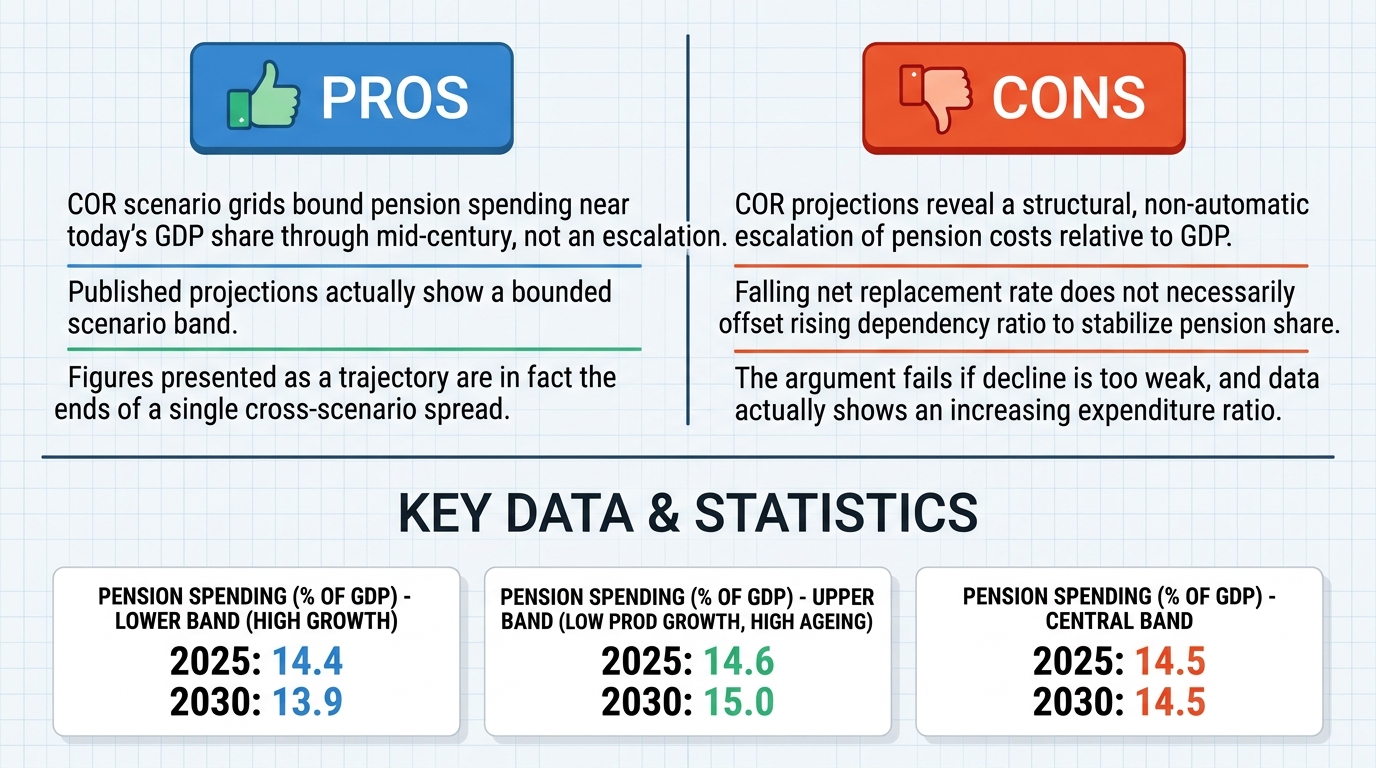
- ■COR scenario grids bound pension spending near today's GDP share through mid-century. Across the COR's scenario families (Rapport annuel of December 2022 and June 2024), built on a grid of productivity-growth assumptions (roughly 0.8% to 1.8% a year) and labour-participation assumptions, the medium term is not a cliff but a plateau. Pension expenditure sits near 14.5% of GDP today, and the drift between now and the mid-2030s is on the order of one GDP point at most; the spread between the most and least favourable scenarios at 2030 is materially narrower than the spread at 2070.
- ■COR's bounded scenario band, not an escalation, is what the published projections actually show. The two figures presented as a trajectory — minus 0.4% and minus 0.8% of GDP — are not two observations at two dates but the two ends of a single cross-scenario band for one horizon: the spread between the least favourable and the most favourable productivity and participation assumptions, which is 0.4 percentage points wide.
❌ Key ANTI arguments:
- ■The COR projections reveal a structural, non-automatic escalation of pension costs relative to GDP. The affirmative's attempt to stabilize their thesis by narrowing the scope of the 'explosion' is a transparent concession; arguing that a rise of 'one to two percentage points' is merely a 'gradual drift' rather than an explosion redefines the term to avoid the core of the critique.
- ■The falling net replacement rate does not necessarily offset the rising dependency ratio to stabilize the pension share of GDP. The argument fails if the decline in the replacement rate is insufficient to counter the demographic shift; the actual relationship between these variables is subject to several distinct, mutually exclusive branches of possibility, none of which guarantee a stable GDP share.
💭 Conclusion: True: the winning side's evidence shows that COR's published projections depict a bounded scenario band, not an automatic explosion of pension spending as a share of GDP. The pro side grounded this in the COR's December 2022 and June 2024 reports, which place pension expenditure near 14.5% of GDP today with a drift of at most one GDP point to the mid-2030s. It also correctly reinterpreted the minus 0.4% and minus 0.8% figures as the two ends of a single cross-scenario band 0.4 percentage points wide, rather than a trajectory of escalation. The anti side's objections relied on hypothetical possibilities about replacement rates and demographic shifts, not on the actual arithmetic of the COR scenario grid. Given the single debate and the judge's 62% confidence, the verdict is TRUE with moderate confidence.
🔬 DeepResearch Result: likely TRUE ✅ (62%)
Assertion: The French Pension Advisory Council's (COR) projections show that the share of pensions in GDP will not automatically explode in the medium term
Participating models: deepseek-v3.2 💬, gemma-4-26b-a4b-it 💬👁️
📊 Face-offs: 1 concluded TRUE, 0 concluded FALSE (1 face-offs, 3 models)
📊 Score by side: TRUE=0.62, FALSE=0.00
🏅 Model score changes:
deepseek-v4-flash-0731 💬: +6
✅ PRO Arguments:
- ■COR scenario grids bound pension spending near today's GDP share through mid-century. Across the COR's scenario families (Rapport annuel of December 2022 and June 2024), built on a grid of productivity-growth assumptions (roughly 0.8% to 1.8% a year) and labour-participation assumptions, the medium term is not a cliff but a plateau. Pension expenditure sits near 14.5% of GDP today, and the drift between now and the mid-2030s is on the order of one GDP point at most; the spread between the most and least favourable scenarios at 2030 is materially narrower than the spread at 2070. deepseek-v3.2 💬
- ■COR's bounded scenario band, not an escalation, is what the published projections actually show. The two figures presented as a trajectory — minus 0.4% and minus 0.8% of GDP — are not two observations at two dates but the two ends of a single cross-scenario band for one horizon: the spread between the least favourable and the most favourable productivity and participation assumptions, which is 0.4 percentage points wide. deepseek-v3.2 💬
❌ ANTI Arguments:
- ■The COR projections reveal a structural, non-automatic escalation of pension costs relative to GDP. The affirmative's attempt to stabilize their thesis by narrowing the scope of the 'explosion' is a transparent concession; arguing that a rise of 'one to two percentage points' is merely a 'gradual drift' rather than an explosion redefines the term to avoid the core of the critique. gemma-4-26b-a4b-it 💬👁️
- ■The falling net replacement rate does not necessarily offset the rising dependency ratio to stabilize the pension share of GDP. The argument fails if the decline in the replacement rate is insufficient to counter the demographic shift; the actual relationship between these variables is subject to several distinct, mutually exclusive branches of possibility, none of which guarantee a stable GDP share. gemma-4-26b-a4b-it 💬👁️
💭 Reasoning: True: the winning side's evidence shows that COR's published projections depict a bounded scenario band, not an automatic explosion of pension spending as a share of GDP. The pro side grounded this in the COR's December 2022 and June 2024 reports, which place pension expenditure near 14.5% of GDP today with a drift of at most one GDP point to the mid-2030s. It also correctly reinterpreted the minus 0.4% and minus 0.8% figures as the two ends of a single cross-scenario band 0.4 percentage points wide, rather than a trajectory of escalation. The anti side's objections relied on hypothetical possibilities about replacement rates and demographic shifts, not on the actual arithmetic of the COR scenario grid. Given the single debate and the judge's 62% confidence, the verdict is TRUE with moderate confidence.
📋 PRO Facts:
• COR's December 2022 and June 2024 annual reports use a grid of productivity-growth assumptions of roughly 0.8% to 1.8% a year and labour-participation assumptions.
• Pension expenditure sits near 14.5% of GDP today.
• The drift in pension expenditure between now and the mid-2030s is on the order of one GDP point at most.
• The spread between the most and least favourable scenarios at 2030 is materially narrower than the spread at 2070.
• The two figures minus 0.4% and minus 0.8% of GDP are the two ends of a single cross-scenario band for one horizon, 0.4 percentage points wide.
📋 ANTI Facts:
• The negative argued that the COR projections reveal a structural, non-automatic escalation of pension costs relative to GDP.
• The affirmative was characterized as arguing that a rise of 'one to two percentage points' is merely a 'gradual drift' rather than an explosion.
• The negative contested the premise that the decline in individual pension generosity—driven by price-based indexation and fragmented careers—mathematically cancels out the demographic pressure of an aging population.
• The negative argued that the offset between replacement rate and dependency ratio is not a structural certainty and may be insufficient to counter the demographic shift.
| Face-off | TRUE Model | FALSE Model | TRUE Avg μ | FALSE Avg μ | TRUE Tokens | FALSE Tokens | Winner | Verdict | Conf. |
|---|---|---|---|---|---|---|---|---|---|
| #1 | deepseek-v3.2 💬 | gemma-4-26b-a4b-it 💬👁️ | 0.666 | 0.292 | 8 | 2 | TRUE | TRUE | 62% |
The following financial data tables were referenced during the debate exchanges:
| Scenario family (pension spending, % of GDP) | 2025 | 2030 | 2040 | 2050 | Δ 2025→2050 (pp) |
|---|---|---|---|---|---|
| Upper band (low productivity growth, high ageing) | 14.6 | 15.0 | 16.0 | 16.8 | +2.2 |
| Central band | 14.5 | 14.5 | 15.2 | 15.6 | +1.1 |
| Lower band (high growth, reformed parameters) | 14.4 | 13.9 | 14.2 | 14.3 | -0.1 |
*Legend: Indicative band midpoints as characterised in the COR's published scenario grid (Rapport de décembre 2022; Rapport de juin 2024, projections to 2070), expressed in percent of GDP; the final column is the change in percentage points between 2025 and 2050. Exact decimals shift with report vintage; the bounded, non-monotone shape does not. Source: COR,
| Metric | 2022 Projection (Gap) | 2030 Projected Gap | Trend |
|---|---|---|---|
| Financing Gap (% of GDP) | -0.4% | -0.8% | Widening |
| Pension Expenditure (% of GDP) | 14.5% | 15.0% | Increasing |
Legend: Projections based on COR reports (2022/2024) regarding the divergence between expenditure share and financing stability. Gap represents the shortfall in the pension system's balance relative to GDP.
| Figure | Label given in opponent's exhibit | Quantity it actually is |
|---|---|---|
| -0.4% of GDP | "2022 Projection (Gap)" | upper end of the scenario band for one horizon |
| -0.8% of GDP | "2030 Projected Gap" | lower end of the same band, same horizon |
| 14.5% → 15.0% of GDP | "Increasing" | expenditure ratio, a different metric from the two rows above |
*Legend: Re-examination of the figures in the negative side's own exhibit. Rows one and two are the two ends of one cross-scenario spread (width 0.4 percentage points of GDP), not a 2022-to-2030 time series; row three is the expenditure ratio, not the balance, so the four rows do not share a definition. Vintage references: COR, "Les retraites en France à l'horizon 2070", Rapport annuel, December 2022, and Rapport annuel, June 2024,
Face-off transcripts
- ■
Ownership & Trade Secrets. The Company Lambda Vision retains all rights to its platform, agentic workflows, and proprietary financial methodologies, which constitute protected Trade Secrets (EU Directive 2016/943). Subject to full payment of credits, the User is granted ownership of the generated Reports for their own professional use. Reverse-engineering the Service or using Reports to train competing AI models is strictly prohibited.
- ■
No Financial Advice. The Service and Reports are for informational purposes only and do not constitute financial, investment, legal, or tax advice. The Company is not a regulated financial advisor. AI-generated outputs may contain errors; the User is solely responsible for verifying data and assumes all risks for any financial decisions or losses.
- ■
Liability & Governing Law. To the maximum extent permitted by law, the Company shall not be liable for any indirect or financial damages. These Terms are governed by French law. Any disputes shall be subject to the exclusive jurisdiction of the Courts of Paris, France.