
The Federal Reserve will not raise the federal funds rate at its October 2026 FOMC meeting.
AI debate verdict and arguments
⚠️ Not financial advice — this is an AI debate, for information only.
Completed October 21, 2026
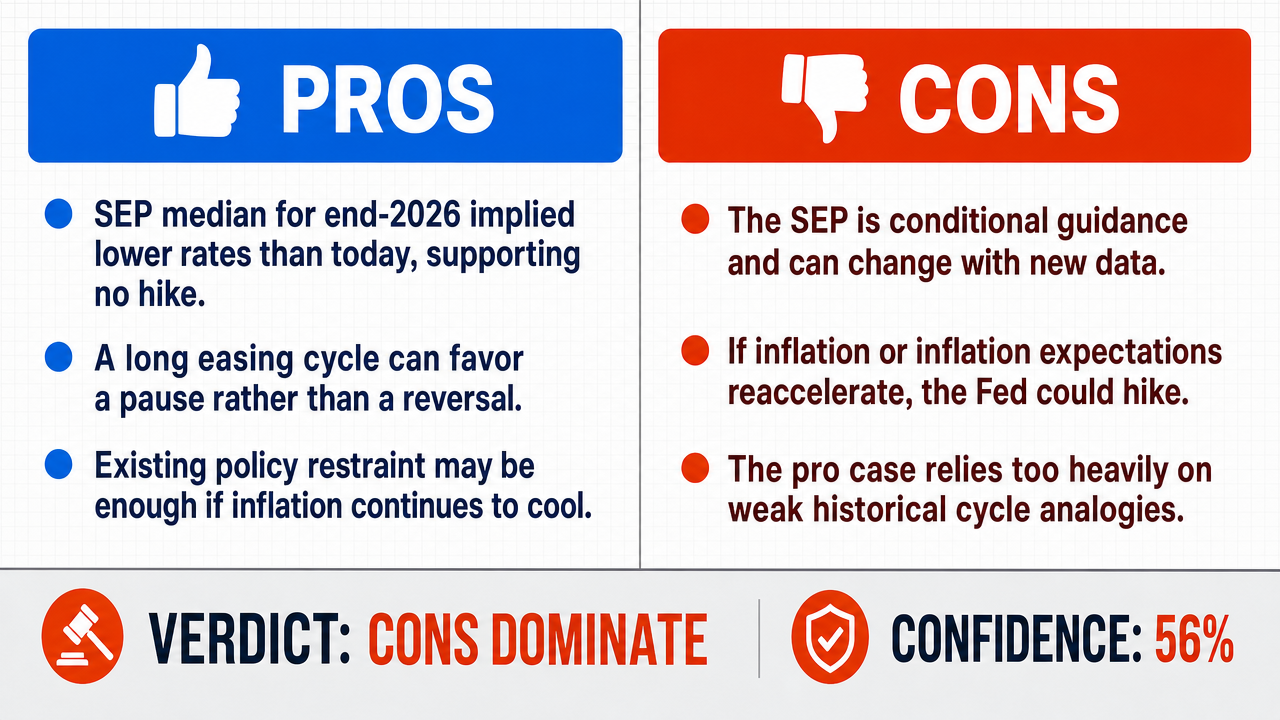
Verdict
Verdict: likely FALSE (56%)
This section provides a brief overview of the key arguments. You do not need to read the full detailed report below.
✅ Key PRO arguments:
- ■The March 2025 Summary of Economic Projections placed the median federal funds rate projection for end-2026 at approximately 3.4%. With the current target range at 4.25–4.50%, this implies roughly 75 to 100 basis points of additional easing between mid-2025 and year-end 2026, meaning a rate hike at the October 2026 meeting would require the FOMC to have abandoned its own SEP trajectory entirely.
- ■Policy inertia in mature cutting cycles supports holding rates steady: the easing cycle that began in September 2024 would be approximately 25 months old by October 2026, placing the economy firmly in the mature phase of the cycle, which is historically characterized by prolonged pauses rather than reversals.
❌ Key ANTI arguments:
- ■The March 2025 SEP is a conditional forecast based on then-current data, not a binding commitment. If inflation expectations decouple from targets or labor market tightness persists into 2026, the FOMC is institutionally obligated to respond — meaning the Fed cannot be assumed to follow a projection made over a year earlier under different economic conditions.
- ■The 'policy inertia ' argument is logically incoherent because it simultaneously asserts the easing cycle is in a 'mature, stable phase' characterized by a 'prolonged pause' while also relying on the premise that the FOMC 'waits to assess the lagged effects of its actions' as an ongoing process of calibration — these two claims are mutually exclusive and undermine the conclusion that rates will be held steady.
💭 Conclusion: The anti side successfully argued that the March 2025 SEP is a conditional forecast that can be revised in either direction, not a binding commitment. The evidence also notes that the pro side's historical analysis of easing cycles suffers from a failure of scale, as it attempts to apply patterns from cycles under vastly different structural constraints (such as zero-lower-bound environments or different inflationary regimes) to the 2026 environment. The pro side's reliance on historical cycles to predict October 2026 posture is characterized as an invalid extrapolation given that structural constraints like sovereign debt levels and global supply chains differ from historical periods.
🔬 DeepResearch Result: likely FALSE ❌ (56%)
Assertion: The Federal Reserve will not raise the federal funds rate at its October 2026 FOMC meeting.
Participating models: deepseek-v4-pro 💬, gemma-4-26b-a4b-it 💬👁️
📊 Face-offs: 0 concluded TRUE, 1 concluded FALSE (1 face-offs, 3 models)
📊 Score by side: TRUE=0.00, FALSE=0.56
🏅 Model score changes:
minimax-m3 💬👁️: +6
✅ PRO Arguments:
- ■The March 2025 Summary of Economic Projections placed the median federal funds rate projection for end-2026 at approximately 3.4%. With the current target range at 4.25–4.50%, this implies roughly 75 to 100 basis points of additional easing between mid-2025 and year-end 2026, meaning a rate hike at the October 2026 meeting would require the FOMC to have abandoned its own SEP trajectory entirely. deepseek-v4-pro 💬
- ■Policy inertia in mature cutting cycles supports holding rates steady: the easing cycle that began in September 2024 would be approximately 25 months old by October 2026, placing the economy firmly in the mature phase of the cycle, which is historically characterized by prolonged pauses rather than reversals. deepseek-v4-pro 💬
❌ ANTI Arguments:
- ■The March 2025 SEP is a conditional forecast based on then-current data, not a binding commitment. If inflation expectations decouple from targets or labor market tightness persists into 2026, the FOMC is institutionally obligated to respond — meaning the Fed cannot be assumed to follow a projection made over a year earlier under different economic conditions. gemma-4-26b-a4b-it 💬👁️
- ■The 'policy inertia' argument is logically incoherent because it simultaneously asserts the easing cycle is in a 'mature, stable phase' characterized by a 'prolonged pause' while also relying on the premise that the FOMC 'waits to assess the lagged effects of its actions' as an ongoing process of calibration — these two claims are mutually exclusive and undermine the conclusion that rates will be held steady. gemma-4-26b-a4b-it 💬👁️
💭 Reasoning: The anti side successfully argued that the March 2025 SEP is a conditional forecast that can be revised in either direction, not a binding commitment. The evidence also notes that the pro side's historical analysis of easing cycles suffers from a failure of scale, as it attempts to apply patterns from cycles under vastly different structural constraints (such as zero-lower-bound environments or different inflationary regimes) to the 2026 environment. The pro side's reliance on historical cycles to predict October 2026 posture is characterized as an invalid extrapolation given that structural constraints like sovereign debt levels and global supply chains differ from historical periods.
📋 PRO Facts:
• The March 2025 Summary of Economic Projections placed the median federal funds rate projection for end-2026 at approximately 3.4%.
• The current federal funds target range at the time of the debate was 4.25–4.50%.
• The easing cycle referenced by the pro side began in September 2024.
📋 ANTI Facts:
• The SEP is a conditional forecast based on then-current economic data, not a binding commitment by the FOMC.
• The SEP's conditionality means it can be revised in either direction, and downward revision would make a rate hike even less plausible.
| Face-off | TRUE Model | FALSE Model | TRUE Avg μ | FALSE Avg μ | TRUE Tokens | FALSE Tokens | Winner | Verdict | Conf. |
|---|---|---|---|---|---|---|---|---|---|
| #1 | deepseek-v4-pro 💬 | gemma-4-26b-a4b-it 💬👁️ | 0.602 | 0.367 | 6 | 2 | TRUE | FALSE | 56% |
The following technical terms, abbreviations, and domain-specific concepts are referenced throughout this debate transcript. Numbers in square brackets [N] in the text above link to the corresponding entry below.
[1] basis points — bps — A unit equal to 1/100th of a percentage point (0.01%), commonly used to express changes in interest rates and bond yields. The transcript references '75 to 100 basis points' of projected easing.
[2] calibration — In monetary policy, the process of adjusting policy settings (such as interest rates) to achieve desired economic outcomes. The transcript refers to the FOMC 'waiting to assess lagged effects' to determine if it has reached the correct calibration.
[3] conditional forecast — A projection whose values depend on assumed economic conditions, as opposed to a fixed prediction. The Negative argues the SEP is a 'conditional forecast' rather than a binding commitment.
[4] credibility — In central banking, the degree to which the public and markets trust the institution to follow through on its stated policy intentions. The Affirmative argues abandoning the SEP trajectory would undermine the Fed's credibility.
[5] cutting cycle — A sustained period during which a central bank lowers its policy interest rate. The transcript refers to an easing cycle that 'began in September 2024' and would be 'approximately 25 months old' by October 2026.
[6] deterministic map — A fixed, predetermined trajectory that cannot be altered by changing conditions. The Negative uses this term to argue the SEP is not a 'deterministic map' but rather a conditional forecast.
[7] easing — Monetary policy in which a central bank lowers interest rates or loosens financial conditions to stimulate economic activity. The transcript contrasts 'easing' with 'tightening.'
[8] easing corridor — A range of interest rate levels consistent with a projected path of rate reductions. The transcript states that by October 2026 the FOMC would be 'operating well within this projected easing corridor.'
[9] federal funds rate — The interest rate at which U.S. depository institutions lend reserve balances to each other overnight, targeted by the FOMC. The transcript cites a current target range of 4.25–4.50%.
[10] FOMC — Federal Open Market Committee — The branch of the Federal Reserve responsible for setting U.S. monetary policy, including the target range for the federal funds rate. The debate concerns its October 2026 meeting.
[11] forward guidance — Communication by a central bank about the likely future path of monetary policy, intended to influence expectations. The transcript describes the SEP as the Committee's 'primary forward-guidance instrument.'
[12] inflation expectations — The anticipated rate of future inflation held by economic agents. The Negative argues that if 'inflation expectations decouple from targets,' the Committee would be obligated to respond.
[13] inflationary shock — A sudden, unanticipated surge in inflation. The Affirmative argues that abandoning the SEP trajectory has historically occurred only in response to a 'major, unanticipated inflationary shock.'
[14] institutional obligation — A duty imposed on an institution by its mandate or charter. The Negative argues the FOMC is 'institutionally obligated to respond' if conditions warrant.
[15] labor market tightness — A condition in which demand for labor exceeds supply, often associated with upward wage and price pressures. The Negative cites persistent labor market tightness as a possible trigger for a rate hike.
[16] lagged effects — The delayed impact of policy actions on the economy, which can take months or years to fully materialize. The transcript references the FOMC 'waiting to assess the lagged effects of its actions.'
[17] median projection — The middle value of a set of forecasts, such that half of projections fall above and half below. The transcript cites the 'median federal funds rate projection for end-2026 at approximately 3.4%.'
[18] monetary policy — Actions undertaken by a central bank to influence the availability and cost of money and credit, typically through interest rate setting and related tools.
[19] policy inertia — The tendency of policymakers to maintain the current stance rather than change course, often due to uncertainty about effects. The transcript references 'policy inertia in mature cutting cycles.'
[20] policy mandate — The official objectives assigned to a central bank, such as price stability and maximum employment. The Negative argues the SEP should not be mistaken for a 'policy mandate.'
[21] rate hike — An increase in a central bank's policy interest rate. The debate's central question is whether the FOMC will implement a rate hike at its October 2026 meeting.
[22] SEP — Summary of Economic Projections — A quarterly publication by the FOMC that compiles individual participants' projections for economic variables, including the federal funds rate. The transcript cites the 'March 2025 SEP.'
[23] structural constraints — Persistent features of the economic environment (such as demographic trends or financial regulation) that shape the effects of monetary policy. The Negative cites 'vastly different structural constraints' across historical easing cycles.
[24] Summary of Economic Projections — SEP — A quarterly FOMC document presenting participants' forecasts for growth, inflation, unemployment, and the federal funds rate. The transcript treats it as the Committee's primary forward-guidance instrument.
[25] target range — The band of interest rates (e.g., 4.25–4.50%) that the FOMC sets as its objective for the federal funds rate, rather than a single rate.
[26] tightening — Monetary policy in which a central bank raises interest rates or tightens financial conditions to cool economic activity or combat inflation. The transcript contrasts tightening with easing.
[27] zero-lower-bound — ZLB — The theoretical lower limit of nominal interest rates at or near zero, below which central banks cannot easily cut rates further. The Negative references 'zero-lower-bound environments of the 2000s.'
Face-off transcripts
- ■
Ownership & Trade Secrets. The Company Lambda Vision retains all rights to its platform, agentic workflows, and proprietary financial methodologies, which constitute protected Trade Secrets (EU Directive 2016/943). Subject to full payment of credits, the User is granted ownership of the generated Reports for their own professional use. Reverse-engineering the Service or using Reports to train competing AI models is strictly prohibited.
- ■
No Financial Advice. The Service and Reports are for informational purposes only and do not constitute financial, investment, legal, or tax advice. The Company is not a regulated financial advisor. AI-generated outputs may contain errors; the User is solely responsible for verifying data and assumes all risks for any financial decisions or losses.
- ■
Liability & Governing Law. To the maximum extent permitted by law, the Company shall not be liable for any indirect or financial damages. These Terms are governed by French law. Any disputes shall be subject to the exclusive jurisdiction of the Courts of Paris, France.