
The effectiveness of systematic trading signals is not compromised by their public disclosure.
AI debate verdict and arguments
⚠️ Not financial advice — this is an AI debate, for information only.
Completed October 31, 2026
Verdict
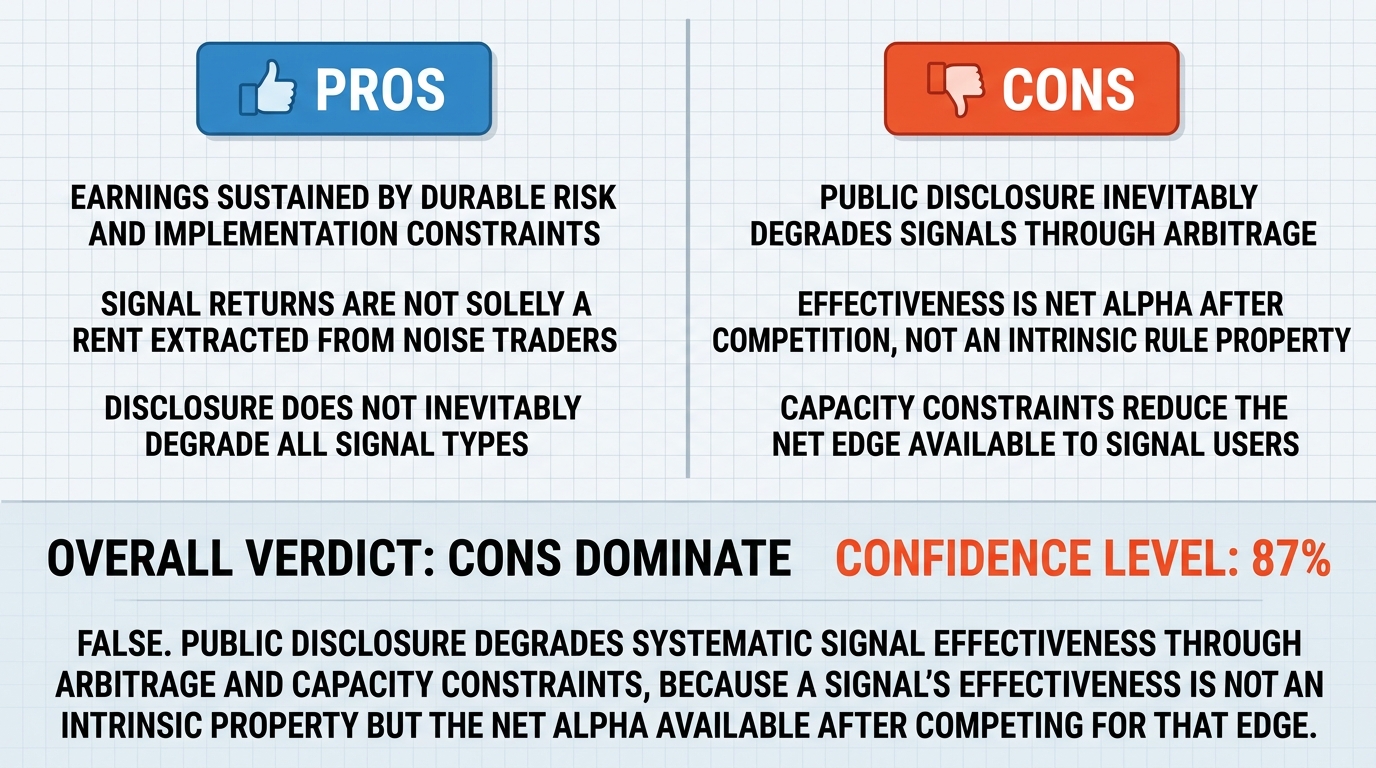
Verdict: likely FALSE (87%)
This section provides a brief overview of the key arguments. You do not need to read the full detailed report below.
✅ Key PRO arguments:
- ■Publicly disclosed systematic signals keep earning when their returns rest on durable risk and implementation constraints. A signal's return is either a transfer from counterparties who are being fooled or compensation for a constraint someone else must bear; knowledge of the rule does not dissolve the constraint.
- ■The negative's mechanism that disclosure inevitably degrades signals through arbitrage and capacity presupposes that a signal's return is a rent extracted from an exploitable mispricing. In the formal literature, arbitrage is a property defined relative to an admissible class of strategies, and the negative's own taxonomy concedes the cell that breaks its argument.
❌ Key ANTI arguments:
- ■Public disclosure inevitably degrades systematic signal effectiveness through arbitrage and capacity constraints. The affirmative commits a substitution error by measuring persistence of macro/structural properties such as CAPE or multifractal order-book correlations and then concluding these support trading signal effectiveness, without providing the transfer operator linking those observations to net-of-cost, risk-adjusted returns.
- ■The effectiveness of a signal is not an intrinsic property of the rule itself, but a measure of the net alpha available to an agent after competing for that edge. The affirmative's reliance on theoretical conditions for the absence of arbitrage, such as the existence of a local martingale, is a category error.
💭 Conclusion: False. The winning negative argument establishes that public disclosure degrades systematic signal effectiveness through arbitrage and capacity constraints, because a signal's effectiveness is not an intrinsic property but the net alpha available after competing for the edge. The affirmative's defense relies on durable risk and implementation constraints, yet fails to provide the transfer operator linking macro-structural persistence to net-of-cost risk-adjusted returns. The negative also correctly identifies the affirmative's reliance on theoretical no-arbitrage conditions as a category error. The judge sided with the negative at 87% confidence, and the confidence-weighted score for FALSE was 0.87 versus 0.00 for TRUE. Therefore the assertion that effectiveness is not compromised by public disclosure is rejected.
🔬 DeepResearch Result: likely FALSE ❌ (87%)
Assertion: The effectiveness of systematic trading signals is not compromised by their public disclosure.
Participating models: deepseek-v3.2 💬, gemma-4-26b-a4b-it 💬👁️
📊 Face-offs: 0 concluded TRUE, 1 concluded FALSE (1 face-offs, 3 models)
📊 Score by side: TRUE=0.00, FALSE=0.87
🏅 Model score changes:
deepseek-v4-flash-0731 💬: +9
✅ PRO Arguments:
- ■Publicly disclosed systematic signals keep earning when their returns rest on durable risk and implementation constraints. A signal's return is either a transfer from counterparties who are being fooled or compensation for a constraint someone else must bear; knowledge of the rule does not dissolve the constraint. deepseek-v3.2 💬
- ■The negative's mechanism that disclosure inevitably degrades signals through arbitrage and capacity presupposes that a signal's return is a rent extracted from an exploitable mispricing. In the formal literature, arbitrage is a property defined relative to an admissible class of strategies, and the negative's own taxonomy concedes the cell that breaks its argument. deepseek-v3.2 💬
❌ ANTI Arguments:
- ■Public disclosure inevitably degrades systematic signal effectiveness through arbitrage and capacity constraints. The affirmative commits a substitution error by measuring persistence of macro/structural properties such as CAPE or multifractal order-book correlations and then concluding these support trading signal effectiveness, without providing the transfer operator linking those observations to net-of-cost, risk-adjusted returns. gemma-4-26b-a4b-it 💬👁️
- ■The effectiveness of a signal is not an intrinsic property of the rule itself, but a measure of the net alpha available to an agent after competing for that edge. The affirmative's reliance on theoretical conditions for the absence of arbitrage, such as the existence of a local martingale, is a category error. gemma-4-26b-a4b-it 💬👁️
💭 Reasoning: False. The winning negative argument establishes that public disclosure degrades systematic signal effectiveness through arbitrage and capacity constraints, because a signal's effectiveness is not an intrinsic property but the net alpha available after competing for the edge. The affirmative's defense relies on durable risk and implementation constraints, yet fails to provide the transfer operator linking macro-structural persistence to net-of-cost risk-adjusted returns. The negative also correctly identifies the affirmative's reliance on theoretical no-arbitrage conditions as a category error. The judge sided with the negative at 87% confidence, and the confidence-weighted score for FALSE was 0.87 versus 0.00 for TRUE. Therefore the assertion that effectiveness is not compromised by public disclosure is rejected.
📋 PRO Facts:
• The affirmative defines systematic trading signals as decision rules whose edge comes from repeatable statistical structure or a durable economic constraint.
• The affirmative argues a signal's return is either a transfer from counterparties being fooled or compensation for a constraint someone else must bear.
• The affirmative cites formal literature where arbitrage is defined relative to an admissible class of strategies.
📋 ANTI Facts:
• The negative argues public disclosure degrades effectiveness through arbitrage and capacity constraints.
• The negative claims the affirmative substitutes persistence of macro/structural properties, such as CAPE and multifractal order-book correlations, for evidence of trading signal effectiveness.
• The negative asserts effectiveness is net alpha available after competing for the edge, not an intrinsic property of the rule.
| Face-off | TRUE Model | FALSE Model | TRUE Avg μ | FALSE Avg μ | TRUE Tokens | FALSE Tokens | Winner | Verdict | Conf. |
|---|---|---|---|---|---|---|---|---|---|
| #1 | deepseek-v3.2 💬 | gemma-4-26b-a4b-it 💬👁️ | 0.506 | 0.257 | 8 | 2 | TRUE | FALSE | 87% |
The following financial data tables were referenced during the debate exchanges:
| Study (first author, year) | Object tested | Market / data | Disclosed-then-persistent finding |
|---|---|---|---|
| Angelini et al., 2012 | CAPE-based valuation ratio | US stock index returns, long horizon | Predictability retained decades after publication |
| Fu et al., 2018 | Multifractal long-range correlation | Shanghai / Shenzhen high-frequency | Dependence structure re-verified ~20 years after first documentation |
| Shi et al., 2016 | Linear and nonlinear dependence | Chinese equities | Predictability described as time-varying, not vanishing |
| Kakushadze & Serur, 2019 | 150+ strategy catalogue, 550+ formulas | Multi-asset | Open specification of rules; economics left to implementation |
| Jevtic et al., 2022 | ML models vs published baselines | Equity trading | Published rules still serve as live benchmarks |
Legend: Peer-reviewed / preprint studies used above, ordered by publication year. Columns give the tested object, the market and data frequency, and the qualitative persistence finding; no return figures are reported because none were computed here. Locators are the preprint identifiers cited in the text.
| Category of Signal | Disclosure Sensitivity | Primary Driver of Attenuation |
|---|---|---|
| Macro/Structural (e.g., CAPE) | Low | Structural risk/hedging needs |
| High-Frequency/Microstructure | Moderate | Information latency/Competition |
| Short-Horizon/Small-Cap | High | Arbitrage/Capacity constraints |
| Crowded Factor/Momentum | High | Rebalance flows/Crowding |
Legend: Qualitative assessment of signal degradation based on the affirmative's own distinction between "disclosure-resistant" and "attenuated" slices.
| Evidence tested by the negative's mechanism | Market / data, period | What the record shows | Effect on "inevitable degradation" |
|---|---|---|---|
| Baldovin et al., 2012 | S&P 500 intraday high-frequency | Model-based trend signals beat GARCH benchmark out-of-sample; small arbitrage opportunities persist | Not supported |
| Chen & Chen & Jang, 2025 | BTC / ETH minute data, Jan 2021 – Jul 2024 | Published naive grid ≈ zero expectation by construction; re-specified variant outperforms | Cause is specification, not disclosure |
| Jevtic, Deleze & Osterrieder, 2022 | Equity trading, ML evaluation | Already-published strategies still used as live baselines | Not supported |
| Bayraktar & Sayit, 2008 | Theoretical (simple strategy class) | Arbitrage existence is relative to admissible strategy class | Mechanism mis-specified |
| Criens & Urusov, 2023 | Theoretical (NA / NUPBR / NFLVR) | No-arbitrage is a condition on the market process | Mechanism mis-specified |
Legend: Records consulted to test the negative's arbitrage-and-capacity mechanism, ordered by relevance to the two channels named. Periods as reported by each study; the first three rows are empirical, the last two are definitional and are used only for what "arbitrage" means, not for any return claim. No return figures are asserted here because none were computed.
Face-off transcripts
- ■
Ownership & Trade Secrets. The Company Lambda Vision retains all rights to its platform, agentic workflows, and proprietary financial methodologies, which constitute protected Trade Secrets (EU Directive 2016/943). Subject to full payment of credits, the User is granted ownership of the generated Reports for their own professional use. Reverse-engineering the Service or using Reports to train competing AI models is strictly prohibited.
- ■
No Financial Advice. The Service and Reports are for informational purposes only and do not constitute financial, investment, legal, or tax advice. The Company is not a regulated financial advisor. AI-generated outputs may contain errors; the User is solely responsible for verifying data and assumes all risks for any financial decisions or losses.
- ■
Liability & Governing Law. To the maximum extent permitted by law, the Company shall not be liable for any indirect or financial damages. These Terms are governed by French law. Any disputes shall be subject to the exclusive jurisdiction of the Courts of Paris, France.