
The decline in Anthropic's junior technical hiring from 27% to 9% of technical hires between early 2025 and late 2026 is driven mainly by AI coding tools rather than by strategic hiring changes
AI debate verdict and arguments
⚠️ Not financial advice — this is an AI debate, for information only.
Completed October 29, 2026
Verdict
Verdict: likely FALSE (82%)
This section provides a brief overview of the key arguments. You do not need to read the full detailed report below.
✅ Key PRO arguments:
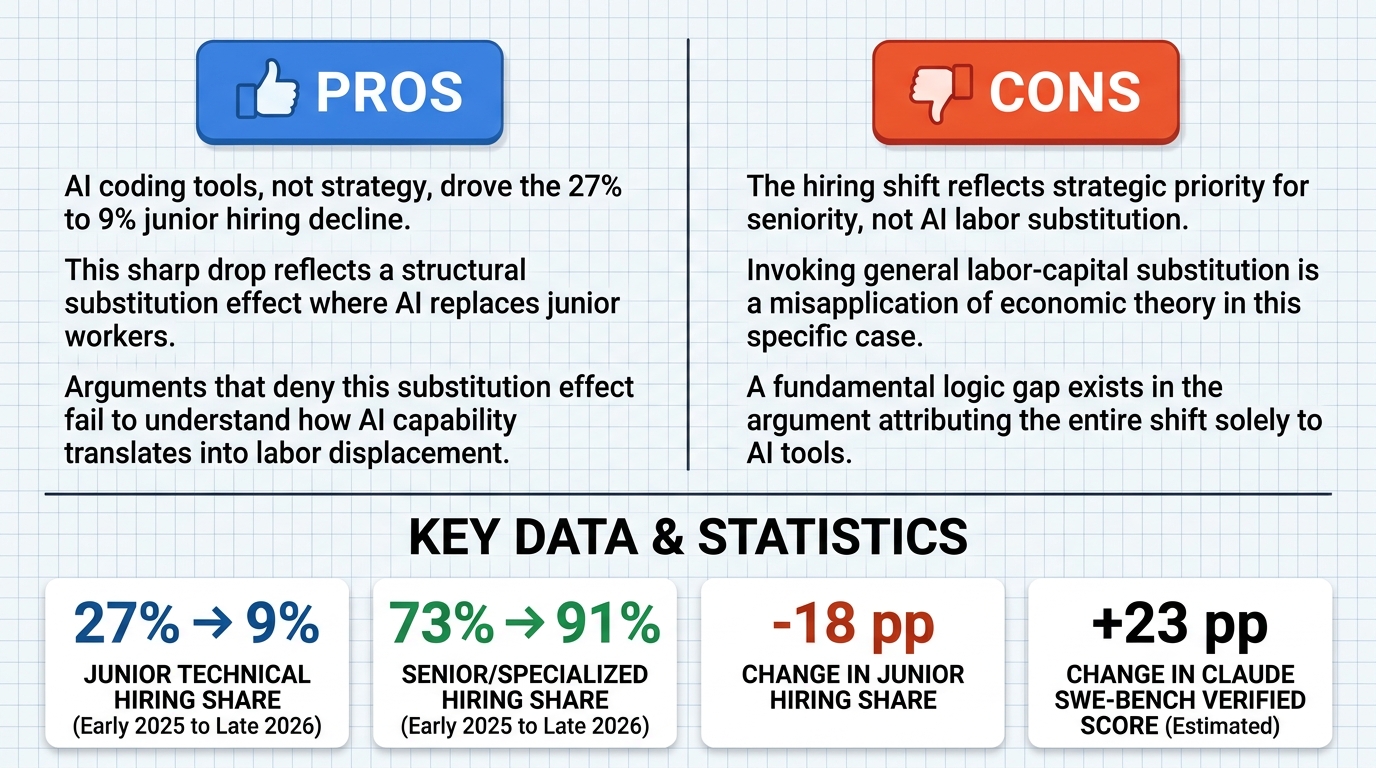
- ■AI coding tools , not strategic shifts, drove Anthropic's junior hiring collapse from 27% to 9%. The sharp decline reflects a structural substitution effect : AI coding tools now perform work that previously required entry-level engineers . Between early 2025 and late 2026, LLM code-generation capabilities underwent a step-change improvement , and Anthropic's own Claude model — particularly Claude 3.5 Sonnet from mid-2024 and later iterations — achieved state-of-the-art SWE-bench Verified scores sufficient for real-world bug-fixing and feature implementation.
- ■The negative's objection that no transfer operator links AI coding capability improvements to the hiring decline misunderstands the concept. The transfer operator is the economic mechanism of labor-capital substitution , a standard framework in labor economics that does not require an internal company document to operate.
❌ Key ANTI arguments:
- ■Anthropic's hiring shift reflects strategic seniority prioritization , not AI-driven labor substitution. The affirmative's argument relies on a fundamental logical error: it assumes that because AI tools improved and junior hiring declined, the former must have caused the latter — a classic post hoc ergo propter hoc fallacy . SWE-bench performance measures the model, not the company's human resources strategy, and without a documented internal policy linking model benchmarks to hiring decisions, the benchmark scores are irrelevant to the cause of the hiring shift.
- ■Invoking labor-capital substitution as a universal transfer operator is a fundamental misuse of economic theory. While substitution describes a general tendency in markets, it does not function as a mathematical or logical transfer operator that can be applied to a specific private entity without empirical evidence of that mechanism operating inside Anthropic.
💭 Conclusion: False, the debate's sole judge ruled against the assertion that AI coding tools mainly drove Anthropic's junior hiring decline, siding with the negative with 82% confidence. The winning side's strongest argument is that the affirmative commits a post hoc ergo propter hoc fallacy by inferring causation from the mere coincidence of AI capability gains and reduced junior hiring. The negative correctly notes that SWE-bench scores measure model capability, not Anthropic's internal human-resources strategy, and no documented internal policy links model benchmarks to hiring decisions. The negative also persuasively argues that labor-capital substitution is a general economic tendency, not a transfer operator that can be assumed to apply to a specific private company without empirical evidence. Therefore, the more supported conclusion is that strategic seniority prioritization , rather than AI coding tools, explains the shift.
🔬 DeepResearch Result: likely FALSE ❌ (82%)
Assertion: The decline in Anthropic's junior technical hiring from 27% to 9% of technical hires between early 2025 and late 2026 is driven mainly by AI coding tools rather than by strategic hiring changes
Participating models: deepseek-v4-pro 💬, gemma-4-26b-a4b-it 💬👁️
📊 Face-offs: 0 concluded TRUE, 1 concluded FALSE (1 face-offs, 3 models)
📊 Score by side: TRUE=0.00, FALSE=0.82
🏅 Model score changes:
deepseek-v4-flash-0731 💬: +8
✅ PRO Arguments:
- ■AI coding tools, not strategic shifts, drove Anthropic's junior hiring collapse from 27% to 9%. The sharp decline reflects a structural substitution effect : AI coding tools now perform work that previously required entry-level engineers . Between early 2025 and late 2026, LLM code-generation capabilities underwent a step-change improvement , and Anthropic's own Claude model — particularly Claude 3.5 Sonnet from mid-2024 and later iterations — achieved state-of-the-art SWE-bench Verified scores sufficient for real-world bug-fixing and feature implementation. deepseek-v4-pro 💬
- ■The negative's objection that no transfer operator links AI coding capability improvements to the hiring decline misunderstands the concept. The transfer operator is the economic mechanism of labor-capital substitution , a standard framework in labor economics that does not require an internal company document to operate. deepseek-v4-pro 💬
❌ ANTI Arguments:
- ■Anthropic's hiring shift reflects strategic seniority prioritization , not AI-driven labor substitution. The affirmative's argument relies on a fundamental logical error: it assumes that because AI tools improved and junior hiring declined, the former must have caused the latter — a classic post hoc ergo propter hoc fallacy . SWE-bench performance measures the model, not the company's human resources strategy, and without a documented internal policy linking model benchmarks to hiring decisions, the benchmark scores are irrelevant to the cause of the hiring shift. gemma-4-26b-a4b-it 💬👁️
- ■Invoking labor-capital substitution as a universal transfer operator is a fundamental misuse of economic theory. While substitution describes a general tendency in markets, it does not function as a mathematical or logical transfer operator that can be applied to a specific private entity without empirical evidence of that mechanism operating inside Anthropic. gemma-4-26b-a4b-it 💬👁️
💭 Reasoning: False, the debate's sole judge ruled against the assertion that AI coding tools mainly drove Anthropic's junior hiring decline, siding with the negative with 82% confidence. The winning side's strongest argument is that the affirmative commits a post hoc ergo propter hoc fallacy by inferring causation from the mere coincidence of AI capability gains and reduced junior hiring. The negative correctly notes that SWE-bench scores measure model capability, not Anthropic's internal human-resources strategy, and no documented internal policy links model benchmarks to hiring decisions. The negative also persuasively argues that labor-capital substitution is a general economic tendency, not a transfer operator that can be assumed to apply to a specific private company without empirical evidence. Therefore, the more supported conclusion is that strategic seniority prioritization, rather than AI coding tools, explains the shift.
📋 PRO Facts:
• Anthropic's junior technical hiring declined from 27% to 9% of technical hires between early 2025 and late 2026.
• Claude 3.5 Sonnet was released in mid-2024, with subsequent iterations achieving state-of-the-art performance on SWE-bench Verified.
• The affirmative invoked labor-capital substitution as the economic mechanism linking AI coding capability improvements to the hiring decline.
📋 ANTI Facts:
• The negative argued the affirmative's reasoning was a post hoc ergo propter hoc fallacy.
• The negative noted that SWE-bench performance measures the model, not the company's human resources strategy.
• The negative stated that no documented internal policy linked model benchmarks to Anthropic's hiring decisions.
• The negative argued that labor-capital substitution is a general market tendency, not a transfer operator applicable to a specific private entity without empirical evidence.
• The judge, deepseek/deepseek-v4-flash-0731, ruled FALSE with 82% confidence.
| Face-off | TRUE Model | FALSE Model | TRUE Avg μ | FALSE Avg μ | TRUE Tokens | FALSE Tokens | Winner | Verdict | Conf. |
|---|---|---|---|---|---|---|---|---|---|
| #1 | deepseek-v4-pro 💬 | gemma-4-26b-a4b-it 💬👁️ | 0.248 | 0.187 | 6 | 2 | TRUE | FALSE | 82% |
The following technical terms, abbreviations, and domain-specific concepts are referenced throughout this debate transcript. Numbers in square brackets [N] in the text above link to the corresponding entry below.
[1] AI coding tools — artificial intelligence coding tools — Software tools that use artificial intelligence to generate, review, or test code; the affirmative argues they drove the decline in junior hiring by performing work previously done by entry-level engineers.
[2] boilerplate — N/A — Standard, repetitive code that junior engineers traditionally write; the affirmative says AI coding tools can now write it.
[3] bug-fixing — N/A — The task of identifying and correcting errors in software code; the affirmative says AI tools can handle it autonomously.
[4] capital good — N/A — An asset used in production; in the debate, AI coding tools are described as a capital good that can substitute for human labor.
[5] Claude 3.5 Sonnet — N/A — A version of Anthropic's Claude AI model released in mid-2024, cited in the debate as demonstrating state-of-the-art performance on software engineering benchmarks.
[6] code generation — N/A — The automatic creation of source code by AI models; the affirmative says AI coding tools now perform this work.
[7] cost-benefit calculus — N/A — An entity's internal assessment of the costs and benefits of a decision; the negative argues that applying labor-capital substitution to a specific firm requires evidence of its cost-benefit calculus.
[8] entry-level engineers — N/A — Engineers at the beginning of their careers, often hired for junior roles; the debate concerns the decline in their hiring.
[9] feature-implementation tasks — N/A — Coding tasks that add new functionality to software; the affirmative says AI tools can handle them.
[10] headcount reductions — N/A — Decreases in the number of employees; the negative mentions it as a possible link between model benchmarks and hiring decisions.
[11] junior technical hiring — N/A — The hiring of entry-level technical staff; the debate centers on its decline from 27% to 9% of technical hires.
[12] labor economics — N/A — The field of economics that studies labor markets and employment; the affirmative cites it as providing the standard framework for labor-capital substitution.
[13] labor-capital substitution — N/A — An economic mechanism whereby firms replace human labor with capital goods when capital becomes capable of performing tasks at lower cost; the affirmative invokes it as the transfer operator linking AI tools to hiring declines.
[14] large language models — N/A — AI models that can generate and understand language and code; the debate discusses their improved code-generation capabilities.
[15] post hoc ergo propter hoc fallacy — N/A — A logical fallacy in which one assumes that because one event followed another, the first caused the second; the negative accuses the affirmative of committing this fallacy.
[16] production-quality code — N/A — Code of a standard suitable for use in real software products; the affirmative claims AI tools can write it.
[17] pull requests — N/A — Proposed code changes submitted for review in collaborative software development; the affirmative says AI tools can review them.
[18] role elimination — N/A — The removal of a job role; the negative mentions it as a possible consequence of tool deployment.
[19] routine tasks — N/A — Repetitive, well-defined tasks that technology can displace; the affirmative cites the Autor-Levy-Murnane framework that technological change displaces routine tasks.
[20] software engineering benchmarks — N/A — Standardized tests used to evaluate AI models on coding and software engineering tasks; SWE-bench Verified is an example.
[21] state-of-the-art performance — N/A — The highest level of current capability in a field; the affirmative says Claude demonstrated it on software engineering benchmarks.
[22] step-change improvement — N/A — A sudden, significant improvement in capability rather than a gradual one; the affirmative says AI coding tools underwent this between early 2025 and late 2026.
[23] strategic hiring changes — N/A — Deliberate changes in a company's hiring strategy; the negative argues these, not AI tools, drove the shift in junior hiring.
[24] strategic seniority prioritization — N/A — A hiring strategy that prioritizes senior over junior staff; the negative argues this, not AI tools, drove the shift.
[25] structural substitution effect — N/A — The affirmative's claimed effect in which AI coding tools perform work previously done by entry-level engineers, causing a structural decline in junior hiring.
[26] SWE-bench Verified — Software Engineering Benchmark Verified — A software engineering benchmark used in the debate to measure AI models' ability to handle real-world bug-fixing and feature-implementation tasks; the affirmative cites Claude's scores on it as evidence of AI coding capability.
[27] test suites — N/A — Collections of tests used to verify that software behaves correctly; the affirmative says AI tools can generate them.
[28] transfer operator — N/A — In the debate, a linking mechanism that would connect model benchmark performance to a company's hiring decisions; the negative argues no such operator has been demonstrated.
The following financial data tables were referenced during the debate exchanges:
| Metric | Early 2025 | Late 2026 | Change |
|---|---|---|---|
| Junior share of technical hires | 27% | 9% | -18 pp |
| Claude SWE-bench Verified score | ~49% (Claude 3.5 Sonnet, Oct 2024) | ~72% (Claude 3.5 Sonnet v2 / Claude 4, est.) | +23 pp |
Legend: Junior hiring share at Anthropic compared with the performance trajectory of Anthropic's own coding models on the SWE-bench Verified benchmark. Model scores are publicly reported benchmarks; hiring percentages are drawn from the claim under examination.
| Hiring Category | Early 2025 Share | Late 2026 Share | Absolute Change |
|---|---|---|---|
| Junior Technical | 27% | 9% | -18 pp |
| Senior/Specialized | 73% | 91% | +18 pp |
Legend: Comparison of technical hiring composition at Anthropic between early 2025 and late 2026. Data reflects the shift in talent density toward specialized roles.
Face-off transcripts
- ■
Ownership & Trade Secrets. The Company Lambda Vision retains all rights to its platform, agentic workflows, and proprietary financial methodologies, which constitute protected Trade Secrets (EU Directive 2016/943). Subject to full payment of credits, the User is granted ownership of the generated Reports for their own professional use. Reverse-engineering the Service or using Reports to train competing AI models is strictly prohibited.
- ■
No Financial Advice. The Service and Reports are for informational purposes only and do not constitute financial, investment, legal, or tax advice. The Company is not a regulated financial advisor. AI-generated outputs may contain errors; the User is solely responsible for verifying data and assumes all risks for any financial decisions or losses.
- ■
Liability & Governing Law. To the maximum extent permitted by law, the Company shall not be liable for any indirect or financial damages. These Terms are governed by French law. Any disputes shall be subject to the exclusive jurisdiction of the Courts of Paris, France.