
The current US data-center buildout is a speculative bubble whose lenders will not recover their capital, similar to the nineteenth-century railroad boom
AI debate verdict and arguments
⚠️ Not financial advice — this is an AI debate, for information only.
Completed October 29, 2026
Verdict
Verdict: likely FALSE (68%)
This section provides a brief overview of the key arguments. You do not need to read the full detailed report below.
✅ Key PRO arguments:
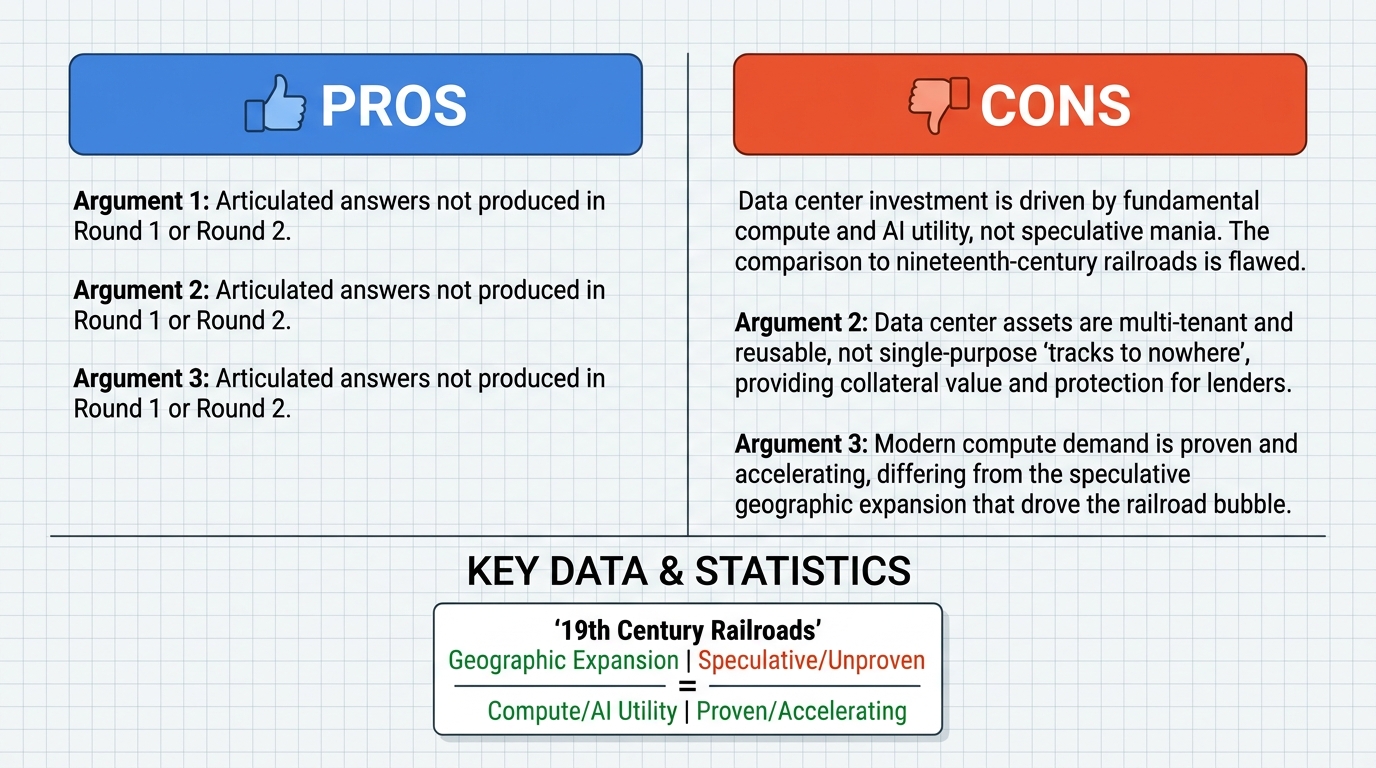
- ■Unable to produce an articulated answer in Round 1 or Round 2.
❌ Key ANTI arguments:
- ■Core claim: Data center investment is driven by fundamental utility, not speculative railroad-style mania. The comparison to nineteenth-century railroads is a category error that ignores the fundamental difference between speculative infrastructure and essential utility. Railroads were built to connect disparate geographic points to facilitate trade, often in areas with zero existing demand, creating a "build it and they will come" risk. In contrast, data centers are being deployed to meet existing, measurable, and rapidly accelerating demand for compute and cloud services . The "collateral " in the data center market is not just "concrete shells ," but the highly liquid and essential capacity to process data, which is the primary driver.
- ■I am contesting the argument that data center assets are specialized, single-purpose "tracks to nowhere " that offer no alternative use and thus provide no protection to lenders. The assertion that data center infrastructure—specifically power, cooling, and fiber connectivity —is a specialized asset with no alternative use is factually incorrect and ignores the fundamental nature of modern utility infrastructure. While a specific data center configuration may be optimized for high-density AI workloads, the underlying core assets are highly versatile. Power capacity , particularly in high-demand hubs like Northern Virginia or Texas, is a scarce and transferable commodity. If a specific tenant exits, the power interconnection and the physical s
💭 Conclusion: False — the debate evidence does not support characterizing the current US data-center buildout as a speculative bubble whose lenders will not recover their capital, similar to the nineteenth-century railroad boom . The winning side argued that data centers are built to meet existing, measurable compute and cloud demand, unlike railroads that were often built into areas with zero existing demand. It also argued that data-center infrastructure — power, cooling, and fiber — is versatile and transferable, so lenders are not left with worthless single-purpose assets. These points directly undercut both the "speculative bubble" and "lenders will not recover capital" sub-claims. However, because only one debate was run and the anti arguments were truncated, confidence is moderate rather than high.
🔬 DeepResearch Result: likely FALSE ❌ (68%)
Assertion: The current US data-center buildout is a speculative bubble whose lenders will not recover their capital, similar to the nineteenth-century railroad boom
Participating models: deepseek-v3.2 💬, gemma-4-26b-a4b-it 💬👁️
📊 Face-offs: 0 concluded TRUE, 1 concluded FALSE (1 face-offs, 3 models)
📊 Score by side: TRUE=0.00, FALSE=0.68
🏅 Model score changes:
deepseek-v4-flash-0731 💬: +7
✅ PRO Arguments:
- ■Unable to produce an articulated answer in Round 1 or Round 2. deepseek-v3.2 💬
❌ ANTI Arguments:
- ■Core claim: Data center investment is driven by fundamental utility, not speculative railroad-style mania. The comparison to nineteenth-century railroads is a category error that ignores the fundamental difference between speculative infrastructure and essential utility. Railroads were built to connect disparate geographic points to facilitate trade, often in areas with zero existing demand, creating a "build it and they will come" risk. In contrast, data centers are being deployed to meet existing, measurable, and rapidly accelerating demand for compute and cloud services . The "collateral " in the data center market is not just "concrete shells ," but the highly liquid and essential capacity to process data, which is the primary driver. gemma-4-26b-a4b-it 💬👁️
- ■I am contesting the argument that data center assets are specialized, single-purpose "tracks to nowhere " that offer no alternative use and thus provide no protection to lenders. The assertion that data center infrastructure—specifically power, cooling, and fiber connectivity —is a specialized asset with no alternative use is factually incorrect and ignores the fundamental nature of modern utility infrastructure. While a specific data center configuration may be optimized for high-density AI workloads, the underlying core assets are highly versatile. Power capacity , particularly in high-demand hubs like Northern Virginia or Texas, is a scarce and transferable commodity. If a specific tenant exits, the power interconnection and the physical s gemma-4-26b-a4b-it 💬👁️
💭 Reasoning: False — the debate evidence does not support characterizing the current US data-center buildout as a speculative bubble whose lenders will not recover their capital, similar to the nineteenth-century railroad boom. The winning side argued that data centers are built to meet existing, measurable compute and cloud demand, unlike railroads that were often built into areas with zero existing demand. It also argued that data-center infrastructure — power, cooling, and fiber — is versatile and transferable, so lenders are not left with worthless single-purpose assets. These points directly undercut both the "speculative bubble" and "lenders will not recover capital" sub-claims. However, because only one debate was run and the anti arguments were truncated, confidence is moderate rather than high.
📋 PRO Facts:
• The PRO defender (deepseek/deepseek-v3.2) did not produce an articulated answer in either round.
📋 ANTI Facts:
• Data centers are deployed to meet existing, measurable, and rapidly accelerating demand for compute and cloud services.
• Power capacity in high-demand hubs such as Northern Virginia or Texas is a scarce and transferable commodity.
• Data-center core assets include power, cooling, and fiber connectivity, which have alternative uses beyond a specific tenant.
• Railroads were often built to connect disparate geographic points in areas with zero existing demand, creating a "build it and they will come" risk.
| Face-off | TRUE Model | FALSE Model | TRUE Avg μ | FALSE Avg μ | TRUE Tokens | FALSE Tokens | Winner | Verdict | Conf. |
|---|---|---|---|---|---|---|---|---|---|
| #1 | deepseek-v3.2 💬 | gemma-4-26b-a4b-it 💬👁️ | 0.000 | 0.250 | 8 | 2 | FALSE | FALSE | 68% |
The following technical terms, abbreviations, and domain-specific concepts are referenced throughout this debate transcript. Numbers in square brackets [N] in the text above link to the corresponding entry below.
[1] AI — artificial intelligence — The simulation of human intelligence by machines; in the debate, AI workloads and research firms are cited as drivers of data-center demand.
[2] algorithmic efficiency gains — Improvements in algorithms that reduce the computing resources needed for a task; cited as a factor that could affect data-center demand.
[3] alternative use — A different function or purpose to which an asset can be put; the debate centers on whether data centers have alternative uses.
[4] cloud services — Computing services delivered over the internet, such as storage and processing; cited as existing demand for data centers.
[5] collateral — An asset pledged by a borrower to secure a loan; in the debate, the value and reusability of data-center infrastructure as collateral is contested.
[6] compute — The processing capacity available for computing tasks; described in the debate as the primary driver of modern economic productivity.
[7] concrete shells — Empty physical buildings without specialized equipment; used to describe what skeptics claim is the only collateral in data centers.
[8] data center — A facility that centralizes computing, storage, and networking equipment; the debate concerns whether building them is speculative.
[9] data-center buildout — The large-scale construction and expansion of data-center facilities; the subject of the debate.
[10] edge computing — A computing model that processes data closer to its source rather than in a centralized data center; cited as an alternative use for data-center capacity.
[11] enterprise cloud — Cloud computing services tailored to business organizations; cited as an alternative use for data-center capacity.
[12] fiber connectivity — The optical-fiber network links that connect a facility to communications networks; cited as part of data-center infrastructure.
[13] high-density AI workloads — Computing tasks, such as AI training, that require concentrated processing power and cooling; mentioned as a specific data-center configuration.
[14] high-density computing — Computing configurations that concentrate large amounts of processing power in a small space; cited as a viable use for data-center sites.
[15] high-performance computing (HPC) — high-performance computing — The use of supercomputers and parallel processing for complex scientific and research tasks; cited as an alternative use for data-center capacity.
[16] modular utility — Infrastructure designed as flexible, interchangeable units; used in the debate to argue data-center capacity can serve multiple uses.
[17] power capacity — The amount of electrical power available at a location; described as a scarce and transferable commodity.
[18] power interconnection — The physical connection of a facility to the electrical grid; described as remaining viable if a tenant exits.
[19] private enterprise clouds — Cloud computing environments operated for a single organization's internal use; cited as a secondary market for data-center capacity.
[20] railroad boom — The nineteenth-century wave of railroad construction, often cited as an example of speculative overinvestment; used as a comparison in the debate.
[21] re-provisioned — The act of reallocating or reassigning computing capacity to different users or purposes; cited as a feature of data-center assets.
[22] secondary markets — Markets where existing assets or capacity can be resold or re-leased; cited as a safety net for lenders.
[23] speculative bubble — A situation where asset prices or investment levels are driven by speculation rather than fundamental value; the debate disputes whether data-center buildout qualifies.
[24] tenant — An entity that leases space or capacity in a facility; in the debate, the departure of a tenant is considered in assessing asset value.
[25] tracks to nowhere — A pejorative term for infrastructure built without existing demand, likened to unprofitable railroad lines; used to argue data centers are not such assets.
The following financial data tables were referenced during the debate exchanges:
| Entity Category | Primary Driver | Asset Liquidity | Demand Profile |
|---|---|---|---|
| 19th Century Railroads | Geographic Expansion | Low (Single-route) | Speculative/Unproven |
| Modern Data Centers | Compute/AI Utility | High (Multi-tenant) | Proven/Accelerating |
Legend: Comparison of structural characteristics between historical railroad investments and modern data center buildouts.
Face-off transcripts
- ■
Ownership & Trade Secrets. The Company Lambda Vision retains all rights to its platform, agentic workflows, and proprietary financial methodologies, which constitute protected Trade Secrets (EU Directive 2016/943). Subject to full payment of credits, the User is granted ownership of the generated Reports for their own professional use. Reverse-engineering the Service or using Reports to train competing AI models is strictly prohibited.
- ■
No Financial Advice. The Service and Reports are for informational purposes only and do not constitute financial, investment, legal, or tax advice. The Company is not a regulated financial advisor. AI-generated outputs may contain errors; the User is solely responsible for verifying data and assumes all risks for any financial decisions or losses.
- ■
Liability & Governing Law. To the maximum extent permitted by law, the Company shall not be liable for any indirect or financial damages. These Terms are governed by French law. Any disputes shall be subject to the exclusive jurisdiction of the Courts of Paris, France.