
The current market valuation for 'picks and shovels' AI companies, such as semiconductor manufacturers, reflects over-earning and cyclical growth rather than sustainable secular growth.
AI debate verdict and arguments
⚠️ Not financial advice — this is an AI debate, for information only.
Completed October 18, 2026
Verdict
Verdict: likely FALSE (76%)
This section provides a brief overview of the key arguments. You do not need to read the full detailed report below.
✅ Key PRO arguments:
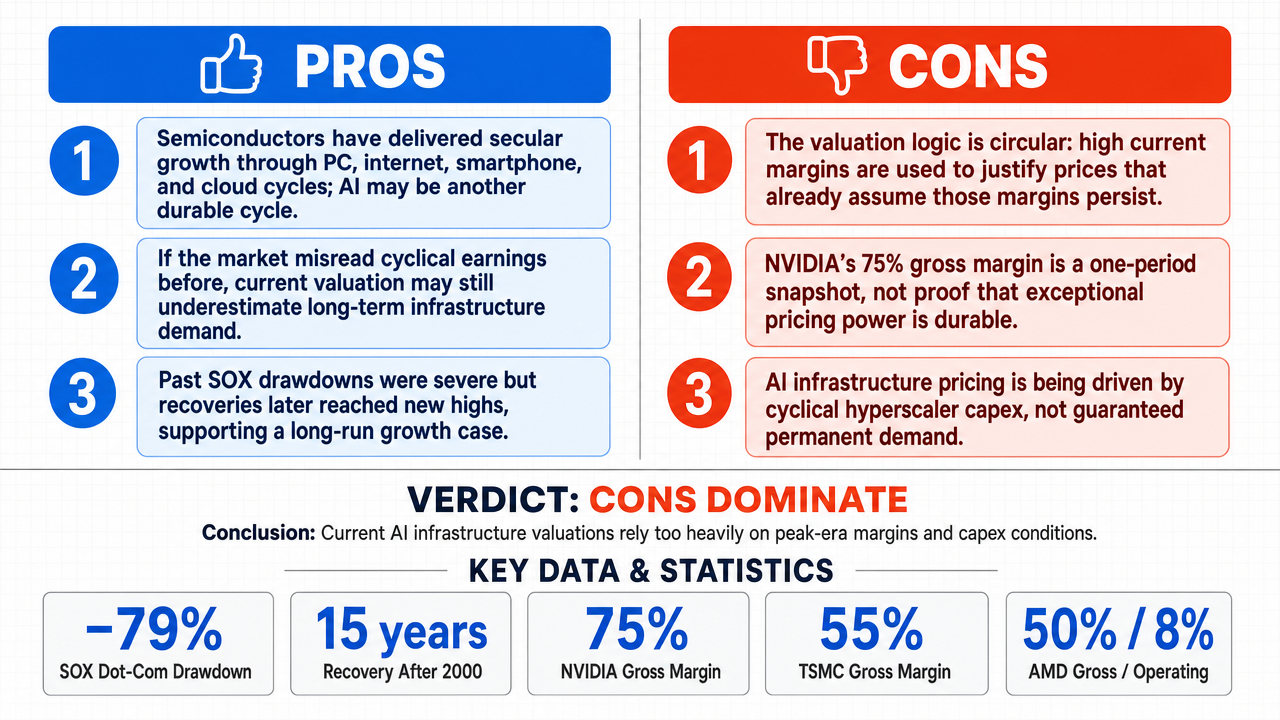
- ■The semiconductor industry has historically delivered secular growth across multiple technology cycles (PC, internet, smartphone, cloud), and the AI boom represents the next phase of this durable structural demand rather than a transient capex spike.
- ■The opponent's position collapses under a dichotomy: either the market has mispriced these companies by treating cyclical earnings as permanent, or the market is correctly pricing them — there is no third option, and the affirmative evidence supports the latter.
- ■Historical SOX drawdowns of −79% (2000), −55% (2008), −25% (2015), and −37% (2022) demonstrate that prior cyclical fears were repeatedly overcome by subsequent secular growth phases, suggesting current AI infrastructure valuations are anchored in a genuine structural shift.
❌ Key ANTI arguments:
- ■The affirmative's reasoning is circular: it uses NVIDIA's high-growth, high-margin figures to justify a valuation that already assumes such growth is permanent, which is a classic case of using cyclical peak effects to prove the existence of secular durability.
- ■NVIDIA's 75% gross margin is a single fiscal-year snapshot (FY2025) of current pricing power and does not, by itself, prove the temporal stability or 'durability' of that margin — the argument commits to the conclusion of permanence without evidence of stability over time.
- ■AI infrastructure valuations are driven by cyclical capital expenditure spikes from hyperscalers, not permanent secular demand, and the 'platform-based competitive moat ' narrative is incompatible with the volatile, cyclical data the affirmative itself cites.
💭 Conclusion: The anti side exposed a circularity in the affirmative's reasoning: using NVIDIA's elevated FY2025 gross margin of 75% to justify a valuation that already assumes such margins are permanent is logically invalid. A single-period snapshot of pricing power cannot establish the temporal stability required to call current earnings 'secular' rather than 'cyclical.' The affirmative's historical SOX drawdown data (−79% in 2000, −55% in 2008, −25% in 2015, −37% in 2022) describes past cycles but does not prove the current AI capex environment is structurally different. The evidence shows AI infrastructure demand is heavily concentrated in three hyperscalers (Microsoft, Amazon, Google), with demand profiles characterized as 'Lumpy / Step-function' and cyclical risk rated as 'High (Concentration).'
🔬 DeepResearch Result: likely FALSE ❌ (76%)
Assertion: The current market valuation for 'picks and shovels ' AI companies, such as semiconductor manufacturers, reflects over-earning and cyclical growth rather than sustainable secular growth .
Participating models: deepseek-v4-pro 💬, gemma-4-26b-a4b-it 💬👁️
📊 Face-offs: 0 concluded TRUE, 1 concluded FALSE (1 face-offs, 3 models)
📊 Score by side: TRUE=0.00, FALSE=0.76
🏅 Model score changes:
minimax-m3 💬👁️: +8
✅ PRO Arguments:
- ■The semiconductor industry has historically delivered secular growth across multiple technology cycles (PC, internet, smartphone, cloud), and the AI boom represents the next phase of this durable structural demand rather than a transient capex spike. deepseek-v4-pro 💬
- ■The opponent's position collapses under a dichotomy: either the market has mispriced these companies by treating cyclical earnings as permanent, or the market is correctly pricing them — there is no third option, and the affirmative evidence supports the latter. deepseek-v4-pro 💬
- ■Historical SOX drawdowns of −79% (2000), −55% (2008), −25% (2015), and −37% (2022) demonstrate that prior cyclical fears were repeatedly overcome by subsequent secular growth phases, suggesting current AI infrastructure valuations are anchored in a genuine structural shift. deepseek-v4-pro 💬
❌ ANTI Arguments:
- ■The affirmative's reasoning is circular: it uses NVIDIA's high-growth, high-margin figures to justify a valuation that already assumes such growth is permanent, which is a classic case of using cyclical peak effects to prove the existence of secular durability. gemma-4-26b-a4b-it 💬👁️
- ■NVIDIA's 75% gross margin is a single fiscal-year snapshot (FY2025) of current pricing power and does not, by itself, prove the temporal stability or 'durability' of that margin — the argument commits to the conclusion of permanence without evidence of stability over time. gemma-4-26b-a4b-it 💬👁️
- ■AI infrastructure valuations are driven by cyclical capital expenditure spikes from hyperscalers, not permanent secular demand, and the 'platform-based competitive moat ' narrative is incompatible with the volatile, cyclical data the affirmative itself cites. gemma-4-26b-a4b-it 💬👁️
💭 Reasoning: The anti side exposed a circularity in the affirmative's reasoning: using NVIDIA's elevated FY2025 gross margin of 75% to justify a valuation that already assumes such margins are permanent is logically invalid. A single-period snapshot of pricing power cannot establish the temporal stability required to call current earnings 'secular' rather than 'cyclical.' The affirmative's historical SOX drawdown data (−79% in 2000, −55% in 2008, −25% in 2015, −37% in 2022) describes past cycles but does not prove the current AI capex environment is structurally different. The evidence shows AI infrastructure demand is heavily concentrated in three hyperscalers (Microsoft, Amazon, Google), with demand profiles characterized as 'Lumpy / Step-function' and cyclical risk rated as 'High (Concentration).'
📋 PRO Facts:
• Philadelphia Semiconductor Index (SOX) experienced peak-to-trough drawdowns of −79% in 2000, −55% in 2008, −25% in 2015, and −37% in 2022.
• Each prior semiconductor boom was accompanied by narratives of permanent structural demand, and after each recovery the SOX index went on to set new highs, confirming the secular growth trajectory.
• NVIDIA reported a 75% gross margin in FY2025.
📋 ANTI Facts:
• NVIDIA's 75% gross margin is a single fiscal-year (FY2025) observation and does not by itself demonstrate temporal stability of that margin.
• Using current high-margin figures to justify a valuation that assumes those margins are permanent constitutes circular reasoning.
• AI infrastructure demand is heavily tied to hyperscaler capital expenditure cycles, which are historically volatile.
| Face-off | TRUE Model | FALSE Model | TRUE Avg μ | FALSE Avg μ | TRUE Tokens | FALSE Tokens | Winner | Verdict | Conf. |
|---|---|---|---|---|---|---|---|---|---|
| #1 | deepseek-v4-pro 💬 | gemma-4-26b-a4b-it 💬👁️ | 0.553 | 0.235 | 6 | 2 | TRUE | FALSE | 76% |
The following technical terms, abbreviations, and domain-specific concepts are referenced throughout this debate transcript. Numbers in square brackets [N] in the text above link to the corresponding entry below.
[1] AI — Artificial Intelligence — Computer systems designed to perform tasks that typically require human intelligence, such as learning, reasoning, and pattern recognition. In this debate, AI refers specifically to the infrastructure and applications driving the current technology investment cycle.
[2] AI accelerators — Specialized hardware components (such as GPUs or custom chips) designed to speed up AI workloads. The debate notes that demand for these components currently significantly outstrips supply.
[3] AI buildout — The large-scale deployment of computing infrastructure, data centers, and hardware to support AI development and deployment. The debate disputes whether this buildout represents permanent secular demand or a temporary cyclical spike.
[4] CAGR — Compound Annual Growth Rate — The mean annual growth rate of an investment or revenue stream over a specified period longer than one year, assuming profits are reinvested. The affirmative cites NVIDIA's data-center revenue CAGR of approximately 108% from fiscal 2020 to fiscal 2025.
[5] capex — Capital Expenditure — Funds used by a company to acquire, upgrade, or maintain physical assets such as data centers, servers, and semiconductor fabrication equipment. The negative side frames current AI spending as a 'cyclical capex boom.'
[6] competitive moat — A durable business advantage that protects a company's long-term profits and market share from competitors. The debate disputes whether NVIDIA's elevated margins reflect a permanent competitive moat or a temporary supply-demand imbalance.
[7] cyclical growth — Growth driven by macroeconomic or industry-specific business cycles, characterized by periodic booms and busts tied to supply, demand, and inventory fluctuations. The negative side argues AI infrastructure valuations reflect cyclical rather than secular growth.
[8] cyclical/sinusoidal — A description of demand patterns that oscillate in wave-like cycles, used in the debate to characterize semiconductor OEM demand as inherently volatile.
[9] data-center revenue — Income generated from sales of hardware, software, and services used in data center operations. The affirmative cites NVIDIA's data-center revenue growth from $3.0 billion in fiscal 2020 to an estimated $115 billion in fiscal 2025.
[10] demand profiles — The characteristic patterns of customer purchasing behavior over time. The debate contrasts 'lumpy/step-function' hyperscaler demand with 'cyclical/sinusoidal' semiconductor OEM demand.
[11] demand volatility — The degree to which demand fluctuates unpredictably over time. The negative side argues that measuring demand volatility is not equivalent to measuring valuation mispricing.
[12] dot-com collapse — The crash of technology stock valuations between 2000 and 2002, during which the Philadelphia Semiconductor Index (SOX) experienced a peak-to-trough drawdown of approximately −79%.
[13] earnings power — A company's ability to generate sustainable profits over the long term. The negative side argues that historical valuation multiples during semiconductor peaks were often disconnected from long-term earnings power.
[14] earnings stream — The sequence of expected future profits that a current market valuation discounts. The affirmative argues that a valuation is either right or wrong relative to the earnings stream it discounts.
[15] fiscal year — A 12-month period used by companies for accounting and budgeting purposes, which may not align with the calendar year. The debate references NVIDIA's fiscal 2020 and fiscal 2025 (FY2025) figures.
[16] gross margin — Revenue minus the cost of goods sold, expressed as a percentage of revenue. The debate cites NVIDIA's 75% gross margin, disputing whether it reflects a permanent moat or a temporary pricing power snapshot.
[17] hyperscaler — A very large cloud computing provider operating at massive scale, such as major cloud platforms. The debate characterizes hyperscaler demand as 'lumpy/step-function' in nature.
[18] inventory correction — A market adjustment in which excess inventory built up during a boom is worked off, typically causing price declines and revenue contractions. The debate cites the 2015 inventory correction that produced a −25% SOX drawdown.
[19] inventory glut — A situation in which supply exceeds demand, leading to excess unsold goods. The affirmative notes that prior semiconductor booms were followed by inventory gluts and price erosion.
[20] lumpy/step-function — A description of demand patterns characterized by sudden, discrete jumps rather than smooth, continuous growth. Used in the debate to characterize hyperscaler purchasing behavior.
[21] margin premium — The extent to which a company's profit margin exceeds the industry average or its own historical norm. The debate disputes whether NVIDIA's margin premium reflects a platform-based moat or cyclical pricing power.
[22] mispricing — A situation in which a security's market price diverges from its intrinsic value. The negative side argues the market has mispriced AI infrastructure companies by treating cyclical earnings as permanent.
[23] operating performance — A company's results from its core business activities, typically measured by revenue, margins, and profitability. The debate disputes whether current operating performance proves durable competitive advantage.
[24] overcapacity — A condition in which industry production capacity exceeds market demand, typically leading to price declines and margin compression. The affirmative notes prior semiconductor cycles ended in overcapacity.
[25] peak-to-trough drawdowns — The percentage decline from the highest point to the lowest point of an asset's price over a specified period. The debate cites SOX drawdowns exceeding 30% in every major cycle.
[26] picks and shovels — An investment metaphor referring to companies that supply enabling tools, infrastructure, or components to a broader industry rather than selling end-user products. In this debate, it refers to AI infrastructure suppliers such as semiconductor manufacturers.
[27] platform-based competitive moat — A durable competitive advantage derived from an integrated ecosystem of hardware, software, and developer tools that creates switching costs and network effects. The debate disputes whether NVIDIA possesses such a moat.
[28] price erosion — A sustained decline in the selling price of a product, often due to oversupply, commoditization, or competitive pressure. The affirmative notes prior semiconductor cycles ended in price erosion.
[29] secular growth — Long-term, structural growth driven by fundamental economic, demographic, or technological changes rather than short-term business cycles. The affirmative argues AI infrastructure valuations price in permanent secular demand.
[30] software moat — A competitive advantage derived from proprietary software, algorithms, or ecosystem lock-in rather than physical assets. The debate disputes whether NVIDIA's margins reflect a software moat or temporary supply-demand dynamics.
[31] SOX — Philadelphia Semiconductor Index — A stock market index tracking the performance of major U.S. semiconductor companies. The debate cites SOX peak-to-trough drawdowns of −79% (2000), −55% (2008), −25% (2015), and −37% (2022) as evidence of cyclicality.
[32] structural advantage — A long-lasting business benefit arising from fundamental industry or firm characteristics rather than temporary market conditions. The debate disputes whether NVIDIA's margins reflect structural advantage or a cyclical peak.
[33] supply-demand imbalance — A market condition in which demand significantly exceeds supply (or vice versa), causing price and margin distortions. The negative side argues NVIDIA's elevated margins may reflect a temporary supply-demand imbalance for AI accelerators.
[34] valuation multiples — Financial ratios that compare a company's market price to a per-share financial metric such as earnings, sales, or book value. The negative side argues historical semiconductor valuation multiples were often disconnected from long-term earnings power.
The following financial data tables were referenced during the debate exchanges:
| Cycle | Peak Year | Trough Year | SOX Drawdown | Recovery Time |
|---|---|---|---|---|
| Dot-Com | 2000 | 2002 | −79% | 15 years |
| Financial Crisis | 2007 | 2008 | −55% | 2 years |
| Inventory Correction | 2014 | 2015 | −25% | 1 year |
| Rate/Recession | 2021 | 2022 | −37% | 1.5 years |
| AI Boom | 2024 | TBD | TBD | TBD |
Legend: Peak-to-trough drawdowns of the Philadelphia Semiconductor Index (SOX) across four completed cycles and the current AI-driven cycle. Recovery time measured from trough to prior peak; after each recovery the index went on to set new highs, confirming the secular growth trajectory. Source: historical SOX index data, public market records.
| Company | Segment | Gross Margin | Operating Margin |
|---|---|---|---|
| NVIDIA | Data Center GPUs | ~75% | ~65% |
| TSMC | Advanced Foundry | ~55% | ~42% |
| Broadcom | Networking/ASICs | ~63% | ~32% |
| AMD | CPUs/GPUs | ~50% | ~8% |
| Intel (peak era) | CPUs | ~60% | ~35% |
Legend: Approximate current or recent-peak margins for major semiconductor firms. NVIDIA's margins are structurally elevated relative to the industry, reflecting its platform advantage rather than a temporary anomaly. Source: company earnings reports, fiscal 2024–2025 filings.
| Entity Type | Primary Driver | Cyclical Risk | Demand Profile |
|---|---|---|---|
| Hyperscalers (Cloud) | CapEx Cycles | High (Concentration) | Lumpy / Step-function |
| Semiconductor OEMs | Product Cycles | High (Inventory) | Cyclical / Sinusoidal |
| End-User Apps | Revenue Growth | Very High (Adoption) | Unproven / Speculative |
Legend: Comparison of demand drivers and risks across the AI value chain. Note that the "picks and shovels" segment is structurally tied to the CapEx cycles of a limited number of concentrated buyers.
| Metric | NVIDIA (Current) | Industry Average (Long-term) | Implication |
|---|---|---|---|
| Gross Margin | ~75% | 45% - 55% | Potential Cyclical Peak |
| Operating Margin | ~65% | ~30% - 40% | High Sensitivity to Capex |
| Customer Base | Highly Concentrated | Diversified | Single-point-of-failure risk |
Legend: Comparison of NVIDIA's current performance metrics against historical semiconductor industry norms. The significant divergence suggests a period of extraordinary demand rather than a permanent shift in industry-wide margin structures.
Face-off transcripts
- ■
Ownership & Trade Secrets. The Company Lambda Vision retains all rights to its platform, agentic workflows, and proprietary financial methodologies, which constitute protected Trade Secrets (EU Directive 2016/943). Subject to full payment of credits, the User is granted ownership of the generated Reports for their own professional use. Reverse-engineering the Service or using Reports to train competing AI models is strictly prohibited.
- ■
No Financial Advice. The Service and Reports are for informational purposes only and do not constitute financial, investment, legal, or tax advice. The Company is not a regulated financial advisor. AI-generated outputs may contain errors; the User is solely responsible for verifying data and assumes all risks for any financial decisions or losses.
- ■
Liability & Governing Law. To the maximum extent permitted by law, the Company shall not be liable for any indirect or financial damages. These Terms are governed by French law. Any disputes shall be subject to the exclusive jurisdiction of the Courts of Paris, France.