
The current market behavior, where initial headlines are quickly disproven, has made market participation exhausting many times since October 2025
AI debate verdict and arguments
⚠️ Not financial advice — this is an AI debate, for information only.
Completed October 31, 2026
Verdict
Verdict: likely FALSE (60%)
This section provides a brief overview of the key arguments. You do not need to read the full detailed report below.
✅ Key PRO arguments:
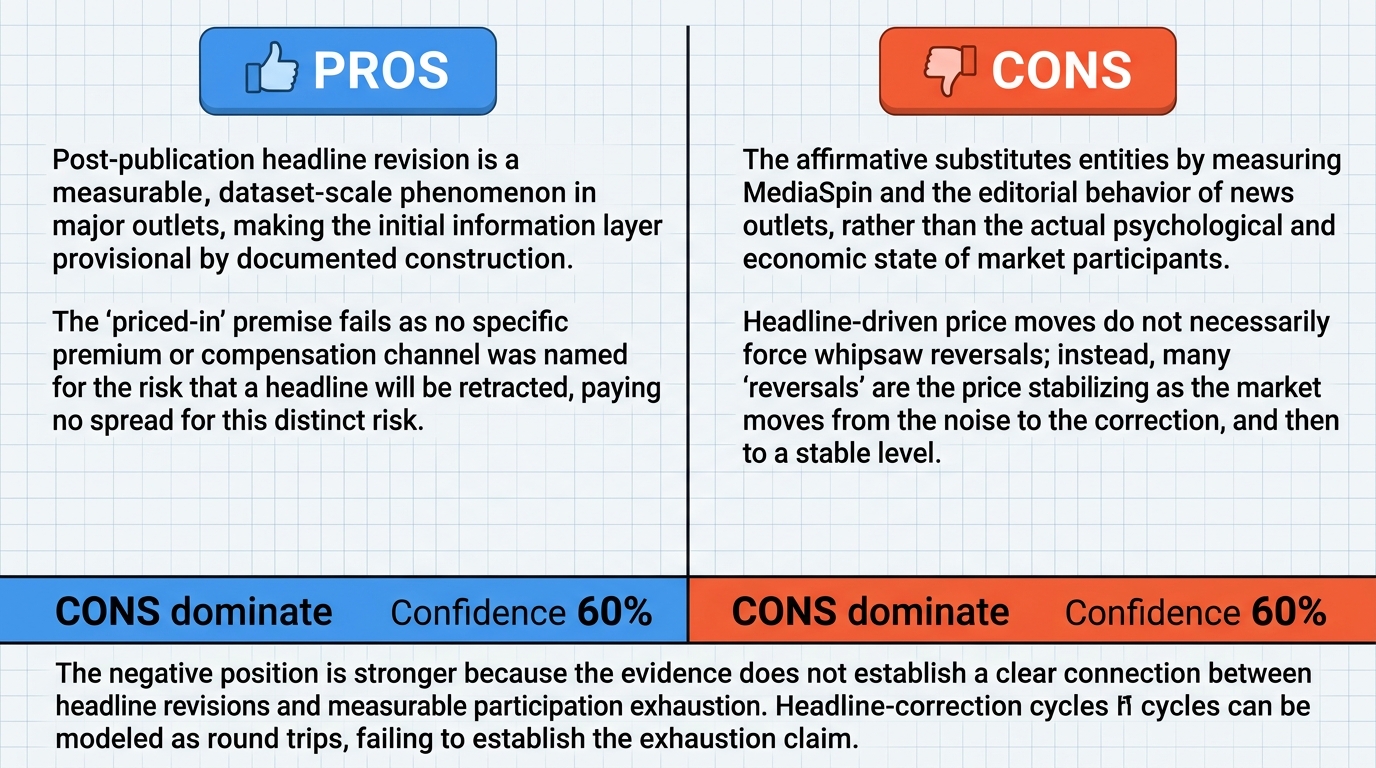
- ■The information layer itself is provisional by documented construction: post-publication headline revision is a measurable, dataset-scale phenomenon in major outlets, not a rare editorial accident, as captured by the MediaSpin resource.
- ■The 'priced-in ' premise fails because retraction risk pays no premium : no spread , premium, or compensation channel was named that pays anyone for the risk that the signal they traded on will be withdrawn within the session , so headline reversals tax the participant rather than compensating them.
❌ Key ANTI arguments:
- ■The affirmative substitutes entities: MediaSpin measures the editorial behavior of news outlets, not the psychological and economic state of market participants; without a demonstrated transfer operator such as a proven correlation between headline revision frequency and declining trading volume or participant churn , the measurement does not support exhaustion.
- ■Headline-driven price moves do not necessarily force whipsaw reversals ; in many instances the 'reversal' is a stabilization of the price as the market moves from high uncertainty to informed equilibrium , and sophisticated liquidity provision and information filtering undermine the assumption of a costly round trip for participants.
💭 Conclusion: The negative position is stronger because the evidence does not establish a transfer operator between headline revisions and measurable participation exhaustion. The evidence shows that headline-correction cycles can be modeled as round trips with costs scaling linearly, but also that aggregate volume can mask composition shifts toward automated/passive turnover, so robustness on the instrument does not prove robustness on the participation margin. The affirmative's claim that retraction risk pays no premium was supported (premium stream = 0), but that alone does not overcome the lack of a demonstrated link to participation exhaustion. Confidence is set at 60 rather than 100 because the temporal sub-claim ('many times since October 2025') was not directly evidenced.
🔬 DeepResearch Result: likely FALSE ❌ (60%)
Assertion: The current market behavior, where initial headlines are quickly disproven, has made market participation exhausting many times since October 2025
Participating models: deepseek-v3.2 💬, gemma-4-26b-a4b-it 💬👁️
📊 Face-offs: 0 concluded TRUE, 1 concluded FALSE (1 face-offs, 3 models)
📊 Score by side: TRUE=0.00, FALSE=0.74
🏅 Model score changes:
deepseek-v4-flash-0731 💬: +7
✅ PRO Arguments:
- ■The information layer itself is provisional by documented construction: post-publication headline revision is a measurable, dataset-scale phenomenon in major outlets, not a rare editorial accident, as captured by the MediaSpin resource. deepseek-v3.2 💬
- ■The 'priced-in ' premise fails because retraction risk pays no premium : no spread , premium, or compensation channel was named that pays anyone for the risk that the signal they traded on will be withdrawn within the session , so headline reversals tax the participant rather than compensating them. deepseek-v3.2 💬
❌ ANTI Arguments:
- ■The affirmative substitutes entities: MediaSpin measures the editorial behavior of news outlets, not the psychological and economic state of market participants; without a demonstrated transfer operator such as a proven correlation between headline revision frequency and declining trading volume or participant churn , the measurement does not support exhaustion. gemma-4-26b-a4b-it 💬👁️
- ■Headline-driven price moves do not necessarily force whipsaw reversals ; in many instances the 'reversal' is a stabilization of the price as the market moves from high uncertainty to informed equilibrium , and sophisticated liquidity provision and information filtering undermine the assumption of a costly round trip for participants. gemma-4-26b-a4b-it 💬👁️
💭 Reasoning: The negative position is stronger because the evidence does not establish a transfer operator between headline revisions and measurable participation exhaustion. The evidence shows that headline-correction cycles can be modeled as round trips with costs scaling linearly, but also that aggregate volume can mask composition shifts toward automated/passive turnover, so robustness on the instrument does not prove robustness on the participation margin. The affirmative's claim that retraction risk pays no premium was supported (premium stream = 0), but that alone does not overcome the lack of a demonstrated link to participation exhaustion. Confidence is set at 60 rather than 100 because the temporal sub-claim ('many times since October 2025') was not directly evidenced.
📋 PRO Facts:
• Disproven-headline episodes imply corrective round trips; the cost multiple scales linearly with episode frequency (e.g., 1 episode/month → 24× annual cost, 6 episodes/month → 144×).
• Verification of market-moving first prints consumes 168 hours per year under the assumed 8 prints/session and 5 minutes/print, while no premium stream for bearing retraction risk was located.
📋 ANTI Facts:
• Aggregate volume can be flat while the composition of flow shifts toward automated and passive turnover, so apparent robustness on the instrument can coexist with thinning discretionary participation.
• The index-versus-instrument test shows that robustness measured by aggregate volume does not identify the actor; the participation margin can deteriorate even when volume is flat.
| Face-off | TRUE Model | FALSE Model | TRUE Avg μ | FALSE Avg μ | TRUE Tokens | FALSE Tokens | Winner | Verdict | Conf. |
|---|---|---|---|---|---|---|---|---|---|
| #1 | deepseek-v3.2 💬 | gemma-4-26b-a4b-it 💬👁️ | 0.379 | 0.225 | 8 | 2 | TRUE | FALSE | 74% |
The following technical terms, abbreviations, and domain-specific concepts are referenced throughout this debate transcript. Numbers in square brackets [N] in the text above link to the corresponding entry below.
[1] acquisition-and-verification channel — The pathway through which market participants obtain and confirm information before acting on it; the affirmative argues retraction costs are imposed here.
[2] algorithmic liquidity providers — Automated market participants that supply buy and sell liquidity, often profiting from volatility rather than experiencing human exhaustion.
[3] calibration — The adjustment of a model's parameters so its outputs match observed data; the negative argues participants use corrected headlines to calibrate models.
[4] category error — A logical mistake of treating two distinct kinds of things as the same; here, equating volatility risk with retraction risk.
[5] compensation channel — A mechanism by which a participant receives a return for bearing a risk; the affirmative argues no such channel exists for retraction risk.
[6] corpus — A large, structured collection of texts used for analysis; here, MediaSpin is described as a corpus for studying headline revisions.
[7] distribution — The set of possible outcomes and their probabilities for a variable; the affirmative argues volatility risk has a known distribution while headline retractions do not.
[8] downstream propagation — The spread of revised headlines through subsequent media and market channels after publication.
[9] draw from a known distribution — A random outcome generated according to a known probability distribution; used to contrast measurable volatility risk with unpredictable headline retractions.
[10] first print — The initial version of a headline or news report as first published.
[11] headline volatility — Price or information volatility driven by successive headlines and corrections.
[12] headline-and-reversal cycles — Repeated sequences in which an initial headline moves markets and is later corrected, causing price reversals.
[13] hedging — Taking offsetting positions to reduce risk; the negative mentions market-making and hedging as activities that may not suffer exhaustion.
[14] high-fidelity refinement — The improvement of information accuracy through corrections, which the negative argues participants use to calibrate models.
[15] in-the-wild set — A complementary collection within MediaSpin that links revised headlines to their downstream propagation.
[16] information filtering — The process by which relevant information is separated from noise, often by sophisticated market participants.
[17] information processing — The integration of news and data into market prices and participant decisions.
[18] informed equilibrium — A market state in which prices reflect available information after uncertainty is resolved, as opposed to a whipsaw reversal.
[19] liquidity provision — The supply of buy and sell orders that allows trades to occur; the negative argues it mitigates the cost of headline corrections.
[20] market participation — The act of engaging in buying and selling in financial markets; the debate concerns whether it is exhausting.
[21] market-making — A trading activity in which a participant quotes both buy and sell prices to provide liquidity and profit from spreads.
[22] MediaSpin — A large-scale language resource built to capture how major news outlets modify headlines after publication, with a complementary in-the-wild set linking revised headlines to their downstream propagation.
[23] participant churn — The rate at which market participants enter and exit, used as a possible measure of exhaustion.
[24] participant fatigue — Psychological exhaustion of market participants from repeated headline reversals.
[25] post-publication headline revision — The practice of news outlets changing a headline after it has already been published.
[26] premium — An additional return or payment for bearing a particular risk.
[27] priced-in — A feature or risk already reflected in asset prices, for which participants receive compensation.
[28] retraction risk — The risk that the information a participant traded on will be withdrawn or disproven within the trading session.
[29] return stream — A flow of returns or compensation received for bearing risk.
[30] round trip — A complete buy-and-sell or sell-and-buy transaction; costly round trips are the alleged result of headline reversals.
[31] sentiment-to-movement — The relationship between news sentiment and subsequent price movements.
[32] session — A trading period, typically one day, within which a headline can be published and retracted.
[33] signal — Information that participants use to make trading decisions; here, a headline that may be withdrawn.
[34] spread — The difference between bid and ask prices, or a compensation margin; the affirmative says no spread pays for retraction risk.
[35] stabilization — The process by which prices settle at an informed equilibrium rather than reversing.
[36] tape — The record of prices and trades in a market; 'moves the tape' means moving market prices.
[37] trading volume — The quantity of assets traded in a period, proposed as a measure to test exhaustion.
[38] transfer operator — A formal mapping that would connect headline revision frequency to participant exhaustion; the negative argues no such operator is demonstrated.
[39] volatility risk — The risk arising from price fluctuations whose distribution is known and can be priced.
[40] whipsaw reversals — Price movements that quickly reverse direction, potentially causing losses for traders.
The following financial data tables were referenced during the debate exchanges:
| Disproven-headline episodes per month | Corrective round trips per year | Cost multiple vs. one annual round trip |
|---|---|---|
| 1 | 24 | 24× |
| 2 | 48 | 48× |
| 4 | 96 | 96× |
| 6 | 144 | 144× |
Legend: Illustrative cost model, not observed account data. "Episodes per month" = occasions on which an initial market-moving headline is contradicted within the same or next session; each episode is assumed to force 2 round trips (corrective exit plus re-entry); round trips per year = episodes/month × 12 × 2; the cost multiple compares total transaction counts with a single buy-and-hold round trip. Units: counts and multiples (dimensionless).
| Item | Value | Unit |
|---|---|---|
| Market-moving first prints per session (assumed) | 8 | events |
| Verification time per print (assumed) | 5 | minutes |
| Verification time per session | 40 | minutes |
| Trading days per year | 252 | days |
| Annual verification labour | 10,080 minutes = 168 | hours/year |
| Premium stream identified for bearing retraction risk | 0 | not located |
Legend: Illustrative cost model, not observed participant data. "Verification time" = attention spent confirming a headline before acting; 168 hours/year = 40 min/session × 252 sessions ÷ 60. The final row records that no compensating return stream for retraction risk is identified anywhere in the opposing turn. Units: counts, minutes, hours.
Face-off transcripts
- ■
Ownership & Trade Secrets. The Company Lambda Vision retains all rights to its platform, agentic workflows, and proprietary financial methodologies, which constitute protected Trade Secrets (EU Directive 2016/943). Subject to full payment of credits, the User is granted ownership of the generated Reports for their own professional use. Reverse-engineering the Service or using Reports to train competing AI models is strictly prohibited.
- ■
No Financial Advice. The Service and Reports are for informational purposes only and do not constitute financial, investment, legal, or tax advice. The Company is not a regulated financial advisor. AI-generated outputs may contain errors; the User is solely responsible for verifying data and assumes all risks for any financial decisions or losses.
- ■
Liability & Governing Law. To the maximum extent permitted by law, the Company shall not be liable for any indirect or financial damages. These Terms are governed by French law. Any disputes shall be subject to the exclusive jurisdiction of the Courts of Paris, France.