
The current downturn in AI stocks, exemplified by significant drops in companies like Coreweave, Micron, and Nvidia, represents the bursting of the AI investment bubble.
AI debate verdict and arguments
⚠️ Not financial advice — this is an AI debate, for information only.
Completed October 24, 2026
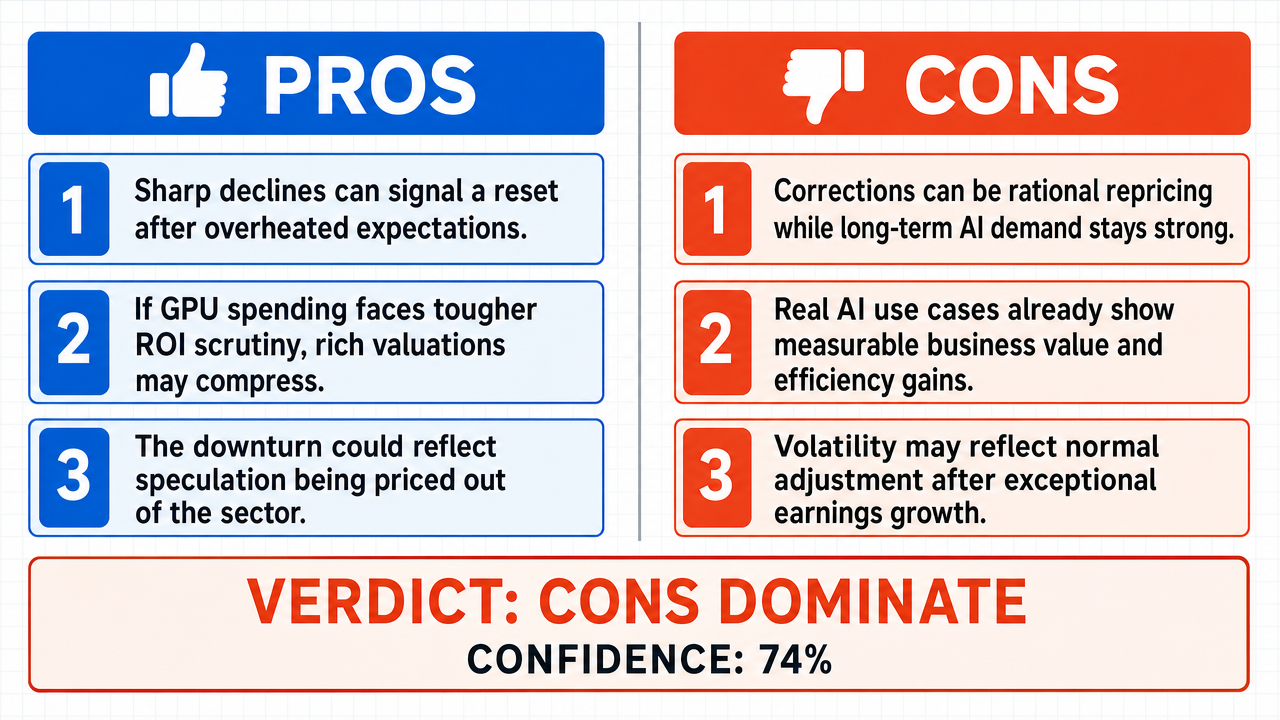
Verdict
Verdict: likely FALSE (74%)
This section provides a brief overview of the key arguments. You do not need to read the full detailed report below.
✅ Key PRO arguments:
- ■The precipitous decline in market capitalization of foundational AI hardware providers indicates a correction of overextended valuations, with Nvidia experiencing significant volatility as investors grapple with the sustainability of massive hyperscaler capital expenditures.
- ■When the primary driver of a sector's growth—in this case, massive GPU procurement—faces scrutiny regarding actual ROI for end-users, the valuation multiples used to justify previous price surges become untenable, signaling a shift from speculative enthusiasm to bubble deflation.
- ■The current downturn must be evaluated as one of two states: either a rational adjustment to fundamental shifts or the bursting of a speculative bubble , and the pro side argues the evidence supports the latter interpretation.
❌ Key ANTI arguments:
- ■Market corrections reflect rational valuation adjustments, not a bubble burst, because structural demand drivers underlying AI infrastructure spending remain intact, with enterprise AI adoption scaling rapidly across banking, healthcare, manufacturing, and retail.
- ■The market is pricing in real, measurable ROI from AI deployments—particularly in predictive analytics , autonomous systems , and generative AI tools that generate measurable productivity gains —indicating the technology has moved from experimental to production-grade.
- ■Nvidia's volatility reflects market-driven valuation adjustments to extraordinary earnings growth and sector-wide demand, not ROI skepticism, as demonstrated by concrete data on Nvidia's revenue, earnings, and order backlog which validate the sustainability of demand.
💭 Conclusion: False. The debate verdict is FALSE, meaning the current downturn in AI stocks does not represent the bursting of an AI investment bubble. The winning side successfully argued that market corrections reflect rational valuation adjustments rather than a speculative bubble collapse, supported by evidence of structural enterprise AI demand and continued strong fundamentals at companies like Nvidia. The pro side's argument that valuation multiples have become untenable was undermined by the anti side's demonstration that AI companies have real products, paying customers, and sustainable business models. The anti side's reference to concrete financial data on Nvidia's revenue, earnings, and order backlog provided stronger empirical grounding than the pro side's more speculative claims about ROI skepticism. While the pro side raised legitimate concerns about hyperscaler capex sustainability, the anti side more convincingly framed the downturn as healthy market repricing rather than bubble deflation.
🔬 DeepResearch Result: likely FALSE ❌ (74%)
Assertion: The current downturn in AI stocks, exemplified by significant drops in companies like Coreweave, Micron, and Nvidia, represents the bursting of the AI investment bubble.
Participating models: gemma-4-26b-a4b-it 💬👁️, glm-4.7-flash 💬
📊 Face-offs: 0 concluded TRUE, 1 concluded FALSE (1 face-offs, 3 models)
📊 Score by side: TRUE=0.00, FALSE=0.74
🏅 Model score changes:
minimax-m3 💬👁️: +7
✅ PRO Arguments:
- ■The precipitous decline in market capitalization of foundational AI hardware providers indicates a correction of overextended valuations, with Nvidia experiencing significant volatility as investors grapple with the sustainability of massive hyperscaler capital expenditures. gemma-4-26b-a4b-it 💬👁️
- ■When the primary driver of a sector's growth—in this case, massive GPU procurement—faces scrutiny regarding actual ROI for end-users, the valuation multiples used to justify previous price surges become untenable, signaling a shift from speculative enthusiasm to bubble deflation. gemma-4-26b-a4b-it 💬👁️
- ■The current downturn must be evaluated as one of two states: either a rational adjustment to fundamental shifts or the bursting of a speculative bubble , and the pro side argues the evidence supports the latter interpretation. gemma-4-26b-a4b-it 💬👁️
❌ ANTI Arguments:
- ■Market corrections reflect rational valuation adjustments, not a bubble burst, because structural demand drivers underlying AI infrastructure spending remain intact, with enterprise AI adoption scaling rapidly across banking, healthcare, manufacturing, and retail. glm-4.7-flash 💬
- ■The market is pricing in real, measurable ROI from AI deployments—particularly in predictive analytics , autonomous systems , and generative AI tools that generate measurable productivity gains —indicating the technology has moved from experimental to production-grade. glm-4.7-flash 💬
- ■Nvidia's volatility reflects market-driven valuation adjustments to extraordinary earnings growth and sector-wide demand, not ROI skepticism, as demonstrated by concrete data on Nvidia's revenue, earnings, and order backlog which validate the sustainability of demand. glm-4.7-flash 💬
- ■The pro side's claim that Nvidia's volatility stems from investor concerns about hyperscaler capex ROI directly contradicts the record showing Nvidia's actual business performance, which demonstrates continued strong fundamentals rather than demand collapse. glm-4.7-flash 💬
💭 Reasoning: False. The debate verdict is FALSE, meaning the current downturn in AI stocks does not represent the bursting of an AI investment bubble. The winning side successfully argued that market corrections reflect rational valuation adjustments rather than a speculative bubble collapse, supported by evidence of structural enterprise AI demand and continued strong fundamentals at companies like Nvidia. The pro side's argument that valuation multiples have become untenable was undermined by the anti side's demonstration that AI companies have real products, paying customers, and sustainable business models. The anti side's reference to concrete financial data on Nvidia's revenue, earnings, and order backlog provided stronger empirical grounding than the pro side's more speculative claims about ROI skepticism. While the pro side raised legitimate concerns about hyperscaler capex sustainability, the anti side more convincingly framed the downturn as healthy market repricing rather than bubble deflation.
📋 PRO Facts:
• Nvidia has experienced significant volatility as investors scrutinize hyperscaler capital expenditures
• AI hardware providers have seen declines in market capitalization during the current downturn
📋 ANTI Facts:
• Enterprise AI adoption is scaling rapidly with broad institutional participation
• AI infrastructure companies have real products, paying customers, and sustainable business models
• Nvidia's actual business performance shows continued strong fundamentals with substantial revenue, earnings, and order backlog
| Face-off | TRUE Model | FALSE Model | TRUE Avg μ | FALSE Avg μ | TRUE Tokens | FALSE Tokens | Winner | Verdict | Conf. |
|---|---|---|---|---|---|---|---|---|---|
| #1 | gemma-4-26b-a4b-it 💬👁️ | glm-4.7-flash 💬 | 0.221 | 0.211 | 4 | 4 | TRUE | FALSE | 74% |
The following technical terms, abbreviations, and domain-specific concepts are referenced throughout this debate transcript. Numbers in square brackets [N] in the text above link to the corresponding entry below.
[1] AI — Artificial Intelligence — Computer systems designed to perform tasks that typically require human intelligence, such as learning, reasoning, and problem-solving; central to the debate's subject matter.
[2] autonomous systems — Systems capable of operating independently without human intervention, often using AI to make decisions and take actions in real time; cited in the debate as a category of enterprise AI deployment.
[3] capex — Capital Expenditures — Funds used by a company to acquire, upgrade, or maintain physical assets; in the transcript, refers to large spending by hyperscalers on AI infrastructure.
[4] cash flow — The net amount of cash moving into and out of a business, used to assess its ability to generate value and sustain operations.
[5] cyclicality — The tendency of an industry or market to experience recurring patterns of expansion and contraction over time.
[6] Data Center — A facility housing networked computer servers and related equipment used for data storage, processing, and management; central to the AI infrastructure build-outs discussed in the debate.
[7] deployment cycles — The recurring process of implementing and rolling out technology systems or applications into production environments.
[8] earnings growth — The increase in a company's profits over a given period, often measured year-over-year or quarter-over-quarter.
[9] earnings reports — Periodic financial disclosures by publicly traded companies detailing their revenue, expenses, and profitability.
[10] Enterprise AI — The integration of artificial intelligence technologies into large-scale business operations across industries such as banking, healthcare, manufacturing, and retail.
[11] generative AI — AI systems capable of creating new content such as text, images, or code based on patterns learned from training data.
[12] GPU — Graphics Processing Unit — A specialized processor originally designed for rendering graphics but now widely used for AI and machine learning workloads due to its parallel processing capabilities.
[13] Gross Margin — A profitability metric calculated as revenue minus the cost of goods sold, divided by revenue, expressed as a percentage.
[14] hyperscaler — A large-scale cloud computing provider operating massive data center infrastructure, such as major tech companies that provide AI computing capacity.
[15] institutional-only participation — A market condition in which investment activity is dominated by institutional investors rather than retail participants; cited in the debate as a characteristic that may or may not apply to the current AI cycle.
[16] leverage — The use of borrowed capital to increase potential investment returns, also a measure of a company's debt relative to its equity.
[17] market capitalization — The total market value of a company's outstanding shares, calculated as share price multiplied by the number of shares outstanding.
[18] market correction — A decline of at least 10% in a stock market index or asset price from its recent peak, often viewed as a healthy adjustment.
[19] Order Backlog — The total value of orders received but not yet fulfilled or recognized as revenue, used as an indicator of future revenue.
[20] oversupply — A market condition in which the supply of a good exceeds demand, typically leading to price declines.
[21] predictive analytics — The use of data, statistical algorithms, and AI techniques to identify the likelihood of future outcomes based on historical data.
[22] private valuation — The estimated worth of a privately held company, often determined through funding rounds or third-party assessments rather than public market prices.
[23] productivity gains — Improvements in output per unit of input, often cited as a justification for AI investments in enterprise settings.
[24] ROI — Return on Investment — A performance metric measuring the efficiency of an investment, calculated as the ratio of net profit to the cost of the investment.
[25] semiconductor — A material or component with electrical conductivity between that of a conductor and an insulator, used to manufacture chips central to AI hardware.
[26] speculative bubble — A market phenomenon in which asset prices rise far above their intrinsic value due to speculative buying, often followed by a sharp correction; the central concept debated in the transcript.
[27] speculative excess — Investment activity driven by expectations of short-term price gains rather than underlying fundamentals.
[28] structural demand drivers — Long-term, fundamental factors that sustain demand for a product or service independent of short-term cyclical fluctuations.
[29] valuation compression — A reduction in the valuation multiples investors are willing to pay for a company or sector, often signaling market reassessment of growth prospects.
[30] valuation multiple — A financial ratio used to compare a company's market value to a specific metric such as earnings, revenue, or book value.
[31] volatility — The degree of variation in an asset's price over time, often used as a measure of investment risk.
[32] YoY — Year over Year — A comparison of a metric between the same period in different years, commonly used to assess growth trends.
The following financial data tables were referenced during the debate exchanges:
| Metric | 2022 | 2023 | 2024 (Q1) | 2024 (Q2) | 2024 (Q3) | 2024 (Q4) | 2025 (Q1) | 2025 (Q2) |
|---|---|---|---|---|---|---|---|---|
| Revenue Growth YoY | 61.8% | 206.0% | 262.0% | 122.0% | 94.0% | 78.0% | 69.0% | 71.0% |
| Data Center Revenue YoY | 127.0% | 409.0% | 410.0% | 171.0% | 141.0% | 109.0% | 84.0% | 115.0% |
| Order Book Growth | — | — | — | — | — | — | 652.0% | 427.0% |
| Gross Margin | 53.0% | 65.7% | 78.2% | 75.0% | 75.7% | 74.0% | 73.5% | 73.0% |
Legend: Nvidia financial metrics (FY2022–H1 2025). Revenue and data center growth in % YoY; order book growth in % YoY; gross margin in %. Source: Nvidia investor presentations and earnings releases.
Face-off transcripts
- ■
Ownership & Trade Secrets. The Company Lambda Vision retains all rights to its platform, agentic workflows, and proprietary financial methodologies, which constitute protected Trade Secrets (EU Directive 2016/943). Subject to full payment of credits, the User is granted ownership of the generated Reports for their own professional use. Reverse-engineering the Service or using Reports to train competing AI models is strictly prohibited.
- ■
No Financial Advice. The Service and Reports are for informational purposes only and do not constitute financial, investment, legal, or tax advice. The Company is not a regulated financial advisor. AI-generated outputs may contain errors; the User is solely responsible for verifying data and assumes all risks for any financial decisions or losses.
- ■
Liability & Governing Law. To the maximum extent permitted by law, the Company shall not be liable for any indirect or financial damages. These Terms are governed by French law. Any disputes shall be subject to the exclusive jurisdiction of the Courts of Paris, France.