
The concept of 'learning to trade' as a finite educational period is misleading because trading is fundamentally a process of continuous work and optimization
AI debate verdict and arguments
⚠️ Not financial advice — this is an AI debate, for information only.
Completed October 14, 2026
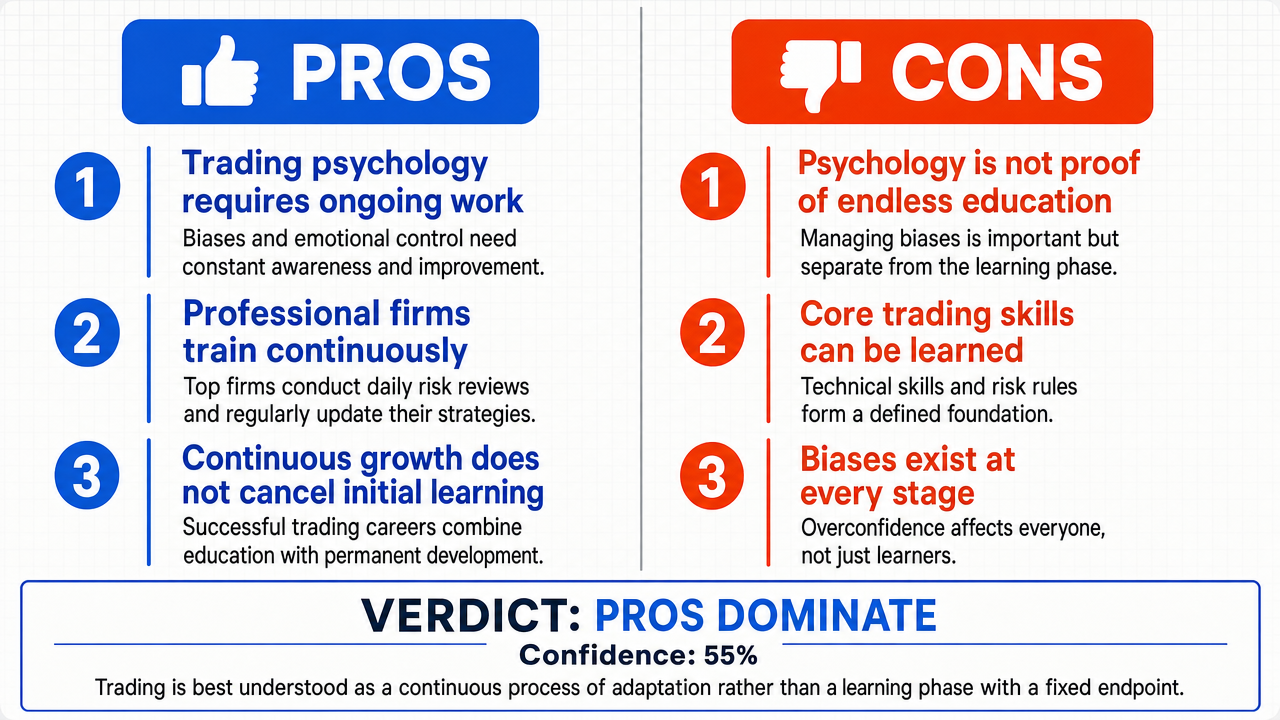
Verdict
Verdict: likely TRUE (55%)
This section provides a brief overview of the key arguments. You do not need to read the full detailed report below.
✅ Key PRO arguments:
- ■The psychological dimension of trading reinforces the continuous work thesis: behavioral finance research shows that cognitive biases like overconfidence , loss aversion , and confirmation bias require ongoing self-monitoring and correction, and a trader who 'completes' their education may develop dangerous overconfidence precisely when market conditions change.
- ■Professional trading firms institutionalize continuous optimization through daily risk meetings, weekly performance reviews , and quarterly strategy reassessments, treating trading as a perpetual optimization loop rather than a skill that can be mastered once.
- ■The opponent's analogy to medicine and law rests on a false dichotomy : there are only four possible relationships between continuous development and finite education , and the conclusion that trading fits the 'both required' category fails under logical examination of every branch.
❌ Key ANTI arguments:
- ■The affirmative's argument suffers from a structural defect: treating the psychological management of cognitive biases as proof that the educational period is infinite is a logical non-sequitur , because biases like loss aversion and overconfidence are universal human traits, not trading-specific educational hurdles.
- ■Mastering the 'learning to trade' phase involves acquiring discrete technical proficiency and a risk management framework; the affirmative conflates ongoing behavioral discipline with the structure of foundational education itself.
- ■Overconfidence is a cognitive bias that exists independently of the educational stage and applies universally; the affirmative confuses knowledge acquisition with behavioral discipline, using a psychological phenomenon as a proxy for educational structure.
💭 Conclusion: True, the assertion is supported because trading inherently demands perpetual adaptation across psychological, technical, and strategic dimensions that cannot be reduced to a finite educational endpoint. The affirmative demonstrated that professional trading firms institutionalize continuous optimization through daily, weekly, and quarterly review cycles, treating trading as an ongoing process rather than a mastered skill. The negative's counterargument—that cognitive biases are universal and thus not trading-specific—failed to address the affirmative's point that trading uniquely combines technical, psychological, and market-adaptive demands into a single continuous workflow. The negative's distinction between knowledge acquisition and behavioral discipline, while logically coherent, did not refute the core claim that the educational period itself is misleading as a concept. The judge's moderate confidence (55%) reflects that while the PRO side won on the continuous-optimization sub-claim, the 'misleading' framing of finite education was contested with reasonable counterarguments about discrete foundational skill mastery.
🔬 DeepResearch Result: likely TRUE ✅ (55%)
Assertion: The concept of 'learning to trade' as a finite educational period is misleading because trading is fundamentally a process of continuous work and optimization
Participating models: deepseek-v3.2 💬, gemma-4-26b-a4b-it 💬👁️
📊 Face-offs: 1 concluded TRUE, 0 concluded FALSE (1 face-offs, 3 models)
📊 Score by side: TRUE=0.55, FALSE=0.00
🏅 Model score changes:
minimax-m3 💬👁️: +6
✅ PRO Arguments:
- ■The psychological dimension of trading reinforces the continuous work thesis: behavioral finance research shows that cognitive biases like overconfidence , loss aversion , and confirmation bias require ongoing self-monitoring and correction, and a trader who 'completes' their education may develop dangerous overconfidence precisely when market conditions change. deepseek-v3.2 💬
- ■Professional trading firms institutionalize continuous optimization through daily risk meetings, weekly performance reviews , and quarterly strategy reassessments, treating trading as a perpetual optimization loop rather than a skill that can be mastered once. deepseek-v3.2 💬
- ■The opponent's analogy to medicine and law rests on a false dichotomy : there are only four possible relationships between continuous development and finite education , and the conclusion that trading fits the 'both required' category fails under logical examination of every branch. deepseek-v3.2 💬
- ■The continuous optimization process includes journaling trades , reviewing decision-making patterns , and adapting emotional regulation techniques—activities that never conclude, making the framing of a finite educational endpoint misleading. deepseek-v3.2 💬
❌ ANTI Arguments:
- ■The affirmative's argument suffers from a structural defect: treating the psychological management of cognitive biases as proof that the educational period is infinite is a logical non-sequitur , because biases like loss aversion and overconfidence are universal human traits, not trading-specific educational hurdles. gemma-4-26b-a4b-it 💬👁️
- ■Mastering the 'learning to trade' phase involves acquiring discrete technical proficiency and a risk management framework; the affirmative conflates ongoing behavioral discipline with the structure of foundational education itself. gemma-4-26b-a4b-it 💬👁️
- ■Overconfidence is a cognitive bias that exists independently of the educational stage and applies universally; the affirmative confuses knowledge acquisition with behavioral discipline, using a psychological phenomenon as a proxy for educational structure. gemma-4-26b-a4b-it 💬👁️
💭 Reasoning: True, the assertion is supported because trading inherently demands perpetual adaptation across psychological, technical, and strategic dimensions that cannot be reduced to a finite educational endpoint. The affirmative demonstrated that professional trading firms institutionalize continuous optimization through daily, weekly, and quarterly review cycles, treating trading as an ongoing process rather than a mastered skill. The negative's counterargument—that cognitive biases are universal and thus not trading-specific—failed to address the affirmative's point that trading uniquely combines technical, psychological, and market-adaptive demands into a single continuous workflow. The negative's distinction between knowledge acquisition and behavioral discipline, while logically coherent, did not refute the core claim that the educational period itself is misleading as a concept. The judge's moderate confidence (55%) reflects that while the PRO side won on the continuous-optimization sub-claim, the 'misleading' framing of finite education was contested with reasonable counterarguments about discrete foundational skill mastery.
📋 PRO Facts:
• Behavioral finance research identifies cognitive biases including overconfidence, loss aversion, and confirmation bias as requiring ongoing self-monitoring in trading contexts.
• Professional trading firms conduct daily risk meetings, weekly performance reviews, and quarterly strategy reassessments as standard institutional practice.
📋 ANTI Facts:
• Cognitive biases such as loss aversion and overconfidence are universal human psychological traits, not exclusive to trading education.
• Foundational trading education consists of acquiring discrete technical proficiency and a risk management framework, which can be mastered as a bounded curriculum.
| Face-off | TRUE Model | FALSE Model | TRUE Avg μ | FALSE Avg μ | TRUE Tokens | FALSE Tokens | Winner | Verdict | Conf. |
|---|---|---|---|---|---|---|---|---|---|
| #1 | deepseek-v3.2 💬 | gemma-4-26b-a4b-it 💬👁️ | 0.358 | 0.289 | 8 | 2 | TRUE | TRUE | 55% |
The following technical terms, abbreviations, and domain-specific concepts are referenced throughout this debate transcript. Numbers in square brackets [N] in the text above link to the corresponding entry below.
[1] Accreditation Council for Graduate Medical Education — ACGME — Referenced in the debate as the body overseeing residency training; the transcript truncates the name, so the full acronym is not explicitly stated.
[2] behavioral finance — A field of study that applies psychological research to understand how cognitive and emotional factors influence financial decision-making and market outcomes.
[3] cognitive biases — Systematic patterns of deviation from rational judgment, such as overconfidence and loss aversion, that affect how traders perceive and act on market information.
[4] confirmation bias — The tendency to search for, interpret, and recall information in a way that confirms one's preexisting beliefs, potentially distorting trade analysis.
[5] continuous development — Ongoing professional learning and skill refinement that occurs after initial formal education is completed, as distinguished from the initial educational period itself.
[6] decision-making patterns — Recurring cognitive and behavioral tendencies observed in how a trader selects entries, exits, and position sizes, often reviewed through trade journaling.
[7] emotional regulation — The process of monitoring and managing one's emotional responses, considered essential in trading to prevent impulsive decisions driven by fear or greed.
[8] false dichotomy — A logical fallacy in which two mutually exclusive options are presented as the only possibilities, ignoring other valid alternatives.
[9] finite education — In the debate, the concept that a field's foundational training has a discernible endpoint after which a practitioner is qualified for independent work.
[10] hidden premise — An unstated assumption within an argument that must be accepted for the conclusion to follow, often a point of logical vulnerability.
[11] journaling trades — The practice of systematically recording trade entries, exits, rationale, and outcomes to enable later review and improvement of decision-making.
[12] knowledge acquisition — The initial phase of learning foundational facts, theories, and techniques, distinguished in the debate from the ongoing behavioral discipline of applying that knowledge.
[13] loss aversion — A cognitive bias in which the pain of losing is felt more intensely than the pleasure of an equivalent gain, often causing traders to exit winners too early or hold losers too long.
[14] market microstructure — The study of how specific trading mechanisms—such as order types, bid-ask spreads, and liquidity provision—affect price formation and execution.
[15] non-sequitur — A logical error in which a conclusion does not follow from its premises; used in the debate to challenge the affirmative's inference from psychological complexity to infinite education.
[16] optimization loop — An iterative process of reviewing performance, identifying weaknesses, and adjusting strategy, described in the debate as a perpetual cycle rather than a one-time skill acquisition.
[17] overconfidence — A cognitive bias in which individuals overestimate their own knowledge, accuracy, or ability to control outcomes, particularly dangerous for traders after perceived mastery.
[18] pedagogical process — The structured method by which knowledge and skills are taught and learned, characterized in the debate as having a finite endpoint in fields like medicine and law.
[19] performance reviews — Periodic evaluations of trading results and decision quality, used by professional firms to identify patterns and areas requiring improvement.
[20] residency — A mandatory, supervised post-graduate training period (typically 3–7 years in medicine) cited in the debate as an example of structured education that follows a finite degree.
[21] risk management frameworks — Structured systems of rules and metrics—such as position sizing, stop-losses, and exposure limits—designed to control downside exposure in trading.
[22] risk-to-reward ratios — A trading metric comparing the potential profit of a trade to its potential loss, used to evaluate whether a setup is worth taking.
[23] self-monitoring — The ongoing practice of observing one's own psychological state and behavioral tendencies, considered necessary in trading to counteract cognitive biases.
[24] strategy reassessment — The periodic re-evaluation of trading approaches and market assumptions to ensure they remain valid under changing conditions.
[25] technical analysis — A trading methodology that evaluates securities by analyzing statistical trends from historical price and volume data, rather than underlying fundamentals.
[26] technical proficiency — The demonstrated mastery of the specific skills, tools, and procedures required to execute trades, treated in the debate as a finite educational outcome.
Face-off transcripts
- ■
Ownership & Trade Secrets. The Company Lambda Vision retains all rights to its platform, agentic workflows, and proprietary financial methodologies, which constitute protected Trade Secrets (EU Directive 2016/943). Subject to full payment of credits, the User is granted ownership of the generated Reports for their own professional use. Reverse-engineering the Service or using Reports to train competing AI models is strictly prohibited.
- ■
No Financial Advice. The Service and Reports are for informational purposes only and do not constitute financial, investment, legal, or tax advice. The Company is not a regulated financial advisor. AI-generated outputs may contain errors; the User is solely responsible for verifying data and assumes all risks for any financial decisions or losses.
- ■
Liability & Governing Law. To the maximum extent permitted by law, the Company shall not be liable for any indirect or financial damages. These Terms are governed by French law. Any disputes shall be subject to the exclusive jurisdiction of the Courts of Paris, France.