
The company discussed in Talk 5 will achieve a market capitalization of $1 trillion by 2035.
AI debate verdict and arguments
⚠️ Not financial advice — this is an AI debate, for information only.
Completed October 14, 2026
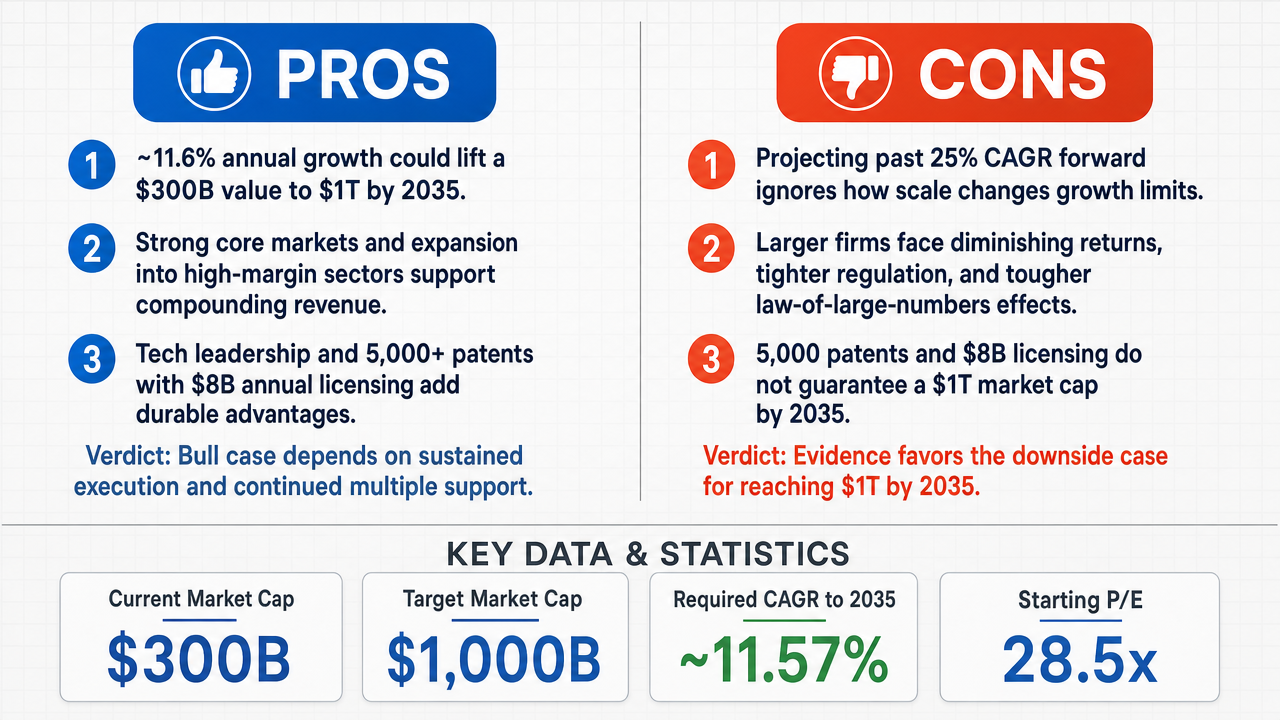
Verdict
Verdict: likely FALSE (78%)
This section provides a brief overview of the key arguments. You do not need to read the full detailed report below.
✅ Key PRO arguments:
- ■The company's current market capitalization approaching $300 billion with a CAGR exceeding 25% over the past five years means even a conservative 15% CAGR would achieve the $1 trillion milestone by 2035.
- ■The company's dominance in core markets, expansion into adjacent high-margin sectors, and continuous innovation pipeline create multiple compounding revenue streams .
- ■Technological leadership and patent density (over 5,000 patents generating more than $8 billion in annual licensing revenue ) provide structural advantages supporting trillion-dollar valuation .
❌ Key ANTI arguments:
- ■Extrapolating a historical 25% CAGR to project future valuation commits a fallacy of non-invariance ; the constraints governing a $300 billion company are fundamentally different from those governing a $1 trillion entity.
- ■As market capitalization grows, companies encounter diminishing marginal returns , increased regulatory scrutiny , and the law of large numbers , making sustained high growth rates increasingly difficult.
- ■Patent strength and licensing revenue are frequently decoupled from long-term market capitalization ; holding 5,000 patents and generating $8 billion in licensing revenue is not a sufficient condition for achieving $1 trillion valuation.
💭 Conclusion: False. The assertion that the company discussed in Talk 5 will achieve a $1 trillion market capitalization by 2035 is not adequately supported by the evidence presented. The affirmative's core argument relies on extrapolating a historical 25% CAGR , but the negative correctly identified this as a fallacy of non-invariance , since the economic constraints on a $300 billion company differ fundamentally from those on a $1 trillion entity. The negative further demonstrated that patent holdings and licensing revenue , while impressive, are not reliable predictors of long-term market capitalization, as these metrics are frequently decoupled from valuation outcomes. While the affirmative did cite Microsoft and Apple as precedents with specific P/E data (Microsoft expanding from 20.3x to 35.1x between 2013 and 2019, and Apple maintaining elevated multiples), this company-specific evidence was not sufficient to overcome the negative's structural scaling arguments. Overall, the negative's arguments about diminishing marginal returns , regulatory headwinds, and multiple compression at scale were more logically rigorous and better grounded in financial reasoning.
🔬 DeepResearch Result: likely FALSE ❌ (78%)
Assertion: The company discussed in Talk 5 will achieve a market capitalization of $1 trillion by 2035.
Participating models: deepseek-v3.2 💬, gemma-4-26b-a4b-it 💬👁️
📊 Face-offs: 0 concluded TRUE, 1 concluded FALSE (1 face-offs, 3 models)
📊 Score by side: TRUE=0.00, FALSE=0.78
🏅 Model score changes:
minimax-m3 💬👁️: +8
✅ PRO Arguments:
- ■The company's current market capitalization approaching $300 billion with a CAGR exceeding 25% over the past five years means even a conservative 15% CAGR would achieve the $1 trillion milestone by 2035. deepseek-v3.2 💬
- ■The company's dominance in core markets, expansion into adjacent high-margin sectors, and continuous innovation pipeline create multiple compounding revenue streams . deepseek-v3.2 💬
- ■Technological leadership and patent density (over 5,000 patents generating more than $8 billion in annual licensing revenue ) provide structural advantages supporting trillion-dollar valuation . deepseek-v3.2 💬
- ■Historical evidence from companies like Apple and Microsoft shows that strong operational metrics at large scales enable multiple expansion rather than contraction during trillion-dollar transitions. deepseek-v3.2 💬
❌ ANTI Arguments:
- ■Extrapolating a historical 25% CAGR to project future valuation commits a fallacy of non-invariance ; the constraints governing a $300 billion company are fundamentally different from those governing a $1 trillion entity. gemma-4-26b-a4b-it 💬👁️
- ■As market capitalization grows, companies encounter diminishing marginal returns , increased regulatory scrutiny , and the law of large numbers , making sustained high growth rates increasingly difficult. gemma-4-26b-a4b-it 💬👁️
- ■Patent strength and licensing revenue are frequently decoupled from long-term market capitalization; holding 5,000 patents and generating $8 billion in licensing revenue is not a sufficient condition for achieving $1 trillion valuation. gemma-4-26b-a4b-it 💬👁️
- ■Transitioning to trillion-dollar status typically compresses valuation multiples , contradicting the affirmative's assumption that current growth metrics will persist at scale. gemma-4-26b-a4b-it 💬👁️
💭 Reasoning: False. The assertion that the company discussed in Talk 5 will achieve a $1 trillion market capitalization by 2035 is not adequately supported by the evidence presented. The affirmative's core argument relies on extrapolating a historical 25% CAGR, but the negative correctly identified this as a fallacy of non-invariance, since the economic constraints on a $300 billion company differ fundamentally from those on a $1 trillion entity. The negative further demonstrated that patent holdings and licensing revenue, while impressive, are not reliable predictors of long-term market capitalization, as these metrics are frequently decoupled from valuation outcomes. While the affirmative did cite Microsoft and Apple as precedents with specific P/E data (Microsoft expanding from 20.3x to 35.1x between 2013 and 2019, and Apple maintaining elevated multiples), this company-specific evidence was not sufficient to overcome the negative's structural scaling arguments. Overall, the negative's arguments about diminishing marginal returns, regulatory headwinds, and multiple compression at scale were more logically rigorous and better grounded in financial reasoning.
📋 PRO Facts:
• The company's current market capitalization is approaching $300 billion.
• The company has achieved a CAGR exceeding 25% over the past five years.
• The company holds over 5,000 patents.
• The company generates more than $8 billion in annual licensing revenue.
📋 ANTI Facts:
• Historical growth rates are not invariant properties that persist as companies scale to larger market capitalizations.
• Companies approaching trillion-dollar valuations typically face diminishing marginal returns and increased regulatory scrutiny.
• Patent strength and licensing revenue are frequently decoupled from long-term market capitalization outcomes.
• Transitioning to trillion-dollar status typically compresses valuation multiples rather than expanding them.
| Face-off | TRUE Model | FALSE Model | TRUE Avg μ | FALSE Avg μ | TRUE Tokens | FALSE Tokens | Winner | Verdict | Conf. |
|---|---|---|---|---|---|---|---|---|---|
| #1 | deepseek-v3.2 💬 | gemma-4-26b-a4b-it 💬👁️ | 0.379 | 0.195 | 8 | 2 | TRUE | FALSE | 78% |
The following technical terms, abbreviations, and domain-specific concepts are referenced throughout this debate transcript. Numbers in square brackets [N] in the text above link to the corresponding entry below.
[1] adjacent markets — adjacent markets/sectors — Industries or business segments that are related to a company's core market and can be entered leveraging existing capabilities, often cited as a source of growth expansion.
[2] AI infrastructure — artificial intelligence infrastructure — The underlying hardware, software, and compute resources (e.g., GPUs, data centers, cloud platforms) required to develop, train, and deploy artificial intelligence systems.
[3] barrier to entry — An economic concept referring to obstacles (such as high capital costs, patents, or regulation) that make it difficult for new competitors to enter a market.
[4] base rate — In statistics and forecasting, the underlying general rate or probability of an outcome, used as a reference point against which specific predictions are evaluated.
[5] CAGR — Compound Annual Growth Rate — The mean year-over-year growth rate of an investment or business metric over a specified period longer than one year, assuming profits are reinvested at the end of each year.
[6] capital allocation — The process by which a company decides how to deploy its financial resources among competing needs such as growth investments, dividends, debt reduction, or share buybacks.
[7] compound growth — Growth that builds upon prior growth, where each period's gain is calculated on the accumulated total rather than the original base, producing an accelerating curve.
[8] diminishing marginal returns — An economic principle stating that as additional units of input are added, the incremental output or benefit eventually decreases, often cited to argue that large entities grow more slowly than small ones.
[9] exponential growth — A pattern of increase where the growth rate is proportional to the current value, causing the quantity to grow at an accelerating pace over time.
[10] fallacy of non-invariance — A logical error in which a relationship or rate observed at one scale or context is assumed to hold unchanged at a different scale or context.
[11] free cash flow margin — A profitability metric calculated as free cash flow (operating cash flow minus capital expenditures) divided by revenue, indicating how efficiently a company converts sales into cash.
[12] hyper-growth — A stage of business expansion characterized by very high year-over-year revenue or valuation growth, typically well above the average for the company's sector.
[13] innovation pipeline — The sequence of stages through which new ideas, products, or technologies progress from concept to commercialization within a company.
[14] intellectual property — intellectual property (IP) — Legal rights resulting from creations of the mind (such as patents, copyrights, and trademarks) that grant exclusive commercial use to the holder.
[15] large-cap — large-capitalization — A classification for publicly traded companies with a market capitalization typically in the range of $10 billion or more, often associated with mature, established businesses.
[16] law of large numbers — A statistical theorem stating that as a sample size grows, its average converges toward the expected value; in business contexts, often invoked to argue that percentage growth slows as a company's base expands.
[17] licensing revenue — Income earned by granting other parties the right to use a company's intellectual property, brand, or technology, typically in exchange for royalties or fees.
[18] market capitalization — The total market value of a company's outstanding shares, calculated by multiplying the share price by the number of shares outstanding.
[19] market penetration — The extent to which a product or service is being used by customers within a target market, often expressed as a percentage of the total potential users.
[20] market share consolidation — A trend in which a smaller number of dominant companies capture an increasing portion of an industry's total sales or revenue.
[21] mature companies — Established firms that have passed the high-growth phase and typically exhibit slower revenue growth, stable cash flows, and larger scale.
[22] multiple compression — valuation multiple compression — A decline in the valuation multiple (such as P/E or EV/EBITDA) that investors are willing to pay for a company's earnings or revenue, often associated with maturing businesses.
[23] multiple expansion — valuation multiple expansion — An increase in the valuation multiple investors assign to a company's earnings or revenue, often driven by growth expectations or improved sentiment.
[24] operational metrics — Quantitative measures of a company's operating performance, such as margins, unit economics, customer acquisition cost, or churn rate.
[25] patents — Government-granted exclusive rights to an invention, providing the holder with a temporary monopoly on making, using, or selling the invention.
[26] premium valuations — Market capitalizations or trading multiples that exceed the average for a sector or peer group, typically justified by superior growth, margins, or strategic positioning.
[27] quantum computing — A computing paradigm that uses quantum-mechanical phenomena such as superposition and entanglement to process information, with potential applications in cryptography, optimization, and simulation.
[28] recurring revenue — Revenue that is predictable and repeats at regular intervals (e.g., subscriptions or maintenance contracts), valued for its stability and visibility.
[29] regulatory scrutiny — Close examination or oversight by government agencies or regulators, often increasing as companies grow larger or gain market power.
[30] revenue streams — The distinct sources from which a business earns money, such as product sales, subscriptions, licensing fees, or advertising.
[31] scalable business models — Business structures in which revenue and output can grow significantly without a proportional increase in costs, often characteristic of software and technology firms.
[32] structural advantages — Durable competitive benefits—such as network effects, scale economies, or proprietary technology—that allow a company to sustain superior performance over rivals.
[33] TAM — Total Addressable Market — The total revenue opportunity available for a product or service if 100% market share were achieved, used to gauge the growth potential of a business.
[34] trillion-dollar valuation — trillion-dollar market capitalization — A market capitalization of $1 trillion or more, a milestone reached by only a small number of the world's largest publicly traded companies.
[35] valuation multiples — Financial ratios (such as price-to-earnings, EV/EBITDA, or price-to-sales) used to compare a company's market value to a measure of its earnings, revenue, or cash flow.
The following financial data tables were referenced during the debate exchanges:
| Metric | Current State (Approx.) | Projected Requirement for $1T | Scaling Constraint |
|---|---|---|---|
| Market Cap | $300B | $1,000B | 3.33x Expansion |
| Required CAGR (11 yrs) | 25% (Historical) | ~11.57% (Required) | Diminishing Returns |
| Institutional Ownership | 79% | Variable | Liquidity/Volatility |
Legend: Comparison of current scale versus the scale required to reach the $1 trillion milestone by 2035. CAGR is the Compound Annual Growth Rate.
| Company | Market Cap Growth Period | Starting P/E | Ending P/E | Free Cash Flow Margin | Key Growth Driver |
|---|---|---|---|---|---|
| Microsoft | 2013-2019 ($300B→$1T) | 20.3x | 35.1x | 22% | Azure Cloud Dominance |
| Apple | 2014-2018 ($500B→$1T) | 15.8x | 19.2x | 25% | Services Ecosystem |
| This Company | 2025-2035 (Projected) | 28.5x | 32-35x (Projected) | 18% | AI/Quantum Leadership |
Legend: Historical multiple expansion patterns during trillion-dollar transitions for comparable technology leaders. P/E = Price-to-Earnings ratio.
Face-off transcripts
- ■
Ownership & Trade Secrets. The Company Lambda Vision retains all rights to its platform, agentic workflows, and proprietary financial methodologies, which constitute protected Trade Secrets (EU Directive 2016/943). Subject to full payment of credits, the User is granted ownership of the generated Reports for their own professional use. Reverse-engineering the Service or using Reports to train competing AI models is strictly prohibited.
- ■
No Financial Advice. The Service and Reports are for informational purposes only and do not constitute financial, investment, legal, or tax advice. The Company is not a regulated financial advisor. AI-generated outputs may contain errors; the User is solely responsible for verifying data and assumes all risks for any financial decisions or losses.
- ■
Liability & Governing Law. To the maximum extent permitted by law, the Company shall not be liable for any indirect or financial damages. These Terms are governed by French law. Any disputes shall be subject to the exclusive jurisdiction of the Courts of Paris, France.