
The 10-year Treasury yield will decline after the 2026 midterm elections.
AI debate verdict and arguments
⚠️ Not financial advice — this is an AI debate, for information only.
Completed October 22, 2026
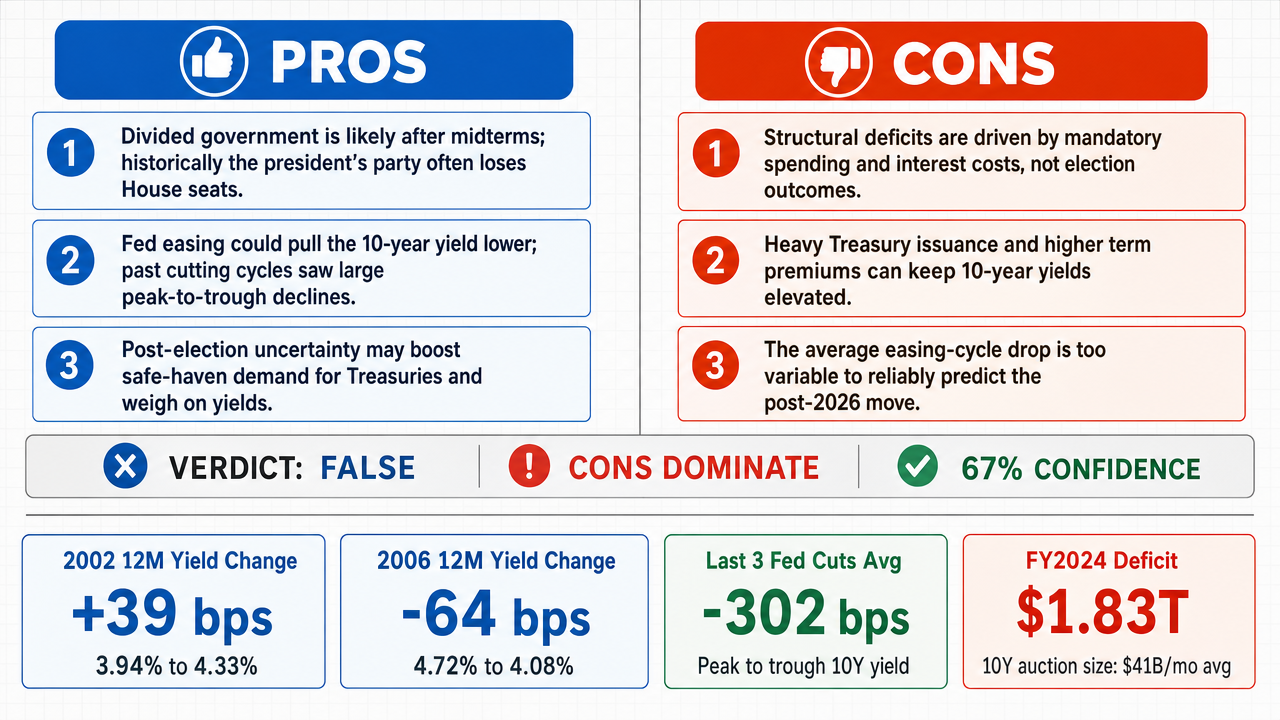
Verdict
Verdict: likely FALSE (67%)
This section provides a brief overview of the key arguments. You do not need to read the full detailed report below.
✅ Key PRO arguments:
- ■The 2026 midterms will almost certainly produce divided government , since the president's party has lost House seats in 19 of the last 21 midterms (1934–2022), averaging a 26-seat loss. Divided government produces legislative gridlock , which markets price as lower fiscal expansion risk, pushing yields down.
- ■A Federal Reserve easing cycle will anchor the 10-year Treasury yield lower, with historical easing cycles showing an average 302-basis-point decline in the 10-year yield.
- ■Safe-haven demand for Treasuries will increase amid post-election uncertainty, reinforcing downward pressure on yields.
❌ Key ANTI arguments:
- ■Structural U.S. fiscal deficits are now driven by mandatory spending and interest costs rather than discretionary legislative cycles, so divided government does not change the upward trajectory of the debt-to-GDP ratio . The CBO projects deficits are increasingly decoupled from any single midterm outcome.
- ■Rising term premiums, driven by heavy Treasury issuance and elevated supply, will push 10-year yields higher regardless of which party controls Congress.
- ■The historical easing-cycle average of a 302-basis-point decline in the 10-year yield is a meaningless predictive benchmark because variance across cycles is extreme; in several recent cycles the decline was substantially smaller than the stated average.
💭 Conclusion: False. The 10-year Treasury yield is more likely to rise than decline after the 2026 midterms because structural fiscal deficits , driven by mandatory spending and rising interest costs, are decoupled from the political composition of Congress. The CBO projects an upwardly biased debt-to-GDP trajectory that persists regardless of divided government , undermining the affirmative's gridlock-lowers-yields thesis. Rising term premiums and heavy Treasury issuance create supply pressure that can overwhelm any incremental safe-haven demand . The affirmative's reliance on a 302-basis-point average easing-cycle decline is statistically weak given the extreme variance across recent cycles. Finally, the affirmative's framework contains internal contradictions between demand-side and supply-side claims, weakening its directional conviction.
🔬 DeepResearch Result: likely FALSE ❌ (67%)
Assertion: The 10-year Treasury yield will decline after the 2026 midterm elections .
Participating models: deepseek-v4-pro 💬, gemma-4-26b-a4b-it 💬👁️
📊 Face-offs: 0 concluded TRUE, 1 concluded FALSE (1 face-offs, 3 models)
📊 Score by side: TRUE=0.00, FALSE=0.67
🏅 Model score changes:
minimax-m3 💬👁️: +7
✅ PRO Arguments:
- ■The 2026 midterms will almost certainly produce divided government , since the president's party has lost House seats in 19 of the last 21 midterms (1934–2022), averaging a 26-seat loss. Divided government produces legislative gridlock , which markets price as lower fiscal expansion risk, pushing yields down. deepseek-v4-pro 💬
- ■A Federal Reserve easing cycle will anchor the 10-year Treasury yield lower, with historical easing cycles showing an average 302-basis-point decline in the 10-year yield. deepseek-v4-pro 💬
- ■Safe-haven demand for Treasuries will increase amid post-election uncertainty, reinforcing downward pressure on yields. deepseek-v4-pro 💬
- ■When fiscal stimulus expectations recede under gridlock, growth forecasts are revised lower, which compresses term premiums and supports lower long-end yields. deepseek-v4-pro 💬
❌ ANTI Arguments:
- ■Structural U.S. fiscal deficits are now driven by mandatory spending and interest costs rather than discretionary legislative cycles, so divided government does not change the upward trajectory of the debt-to-GDP ratio . The CBO projects deficits are increasingly decoupled from any single midterm outcome. gemma-4-26b-a4b-it 💬👁️
- ■Rising term premiums, driven by heavy Treasury issuance and elevated supply, will push 10-year yields higher regardless of which party controls Congress. gemma-4-26b-a4b-it 💬👁️
- ■The historical easing-cycle average of a 302-basis-point decline in the 10-year yield is a meaningless predictive benchmark because variance across cycles is extreme; in several recent cycles the decline was substantially smaller than the stated average. gemma-4-26b-a4b-it 💬👁️
- ■A Treasury supply shock from continued large issuance can overwhelm flight-to-quality demand, preventing any safe-haven-driven yield decline and instead driving yields higher. gemma-4-26b-a4b-it 💬👁️
- ■The affirmative's safe-haven thesis is internally inconsistent: it claims demand-side factors will lower yields while simultaneously conceding that supply-side issuance pressure can overcome that demand, leaving no coherent directional prediction. gemma-4-26b-a4b-it 💬👁️
💭 Reasoning: False. The 10-year Treasury yield is more likely to rise than decline after the 2026 midterms because structural fiscal deficits , driven by mandatory spending and rising interest costs, are decoupled from the political composition of Congress. The CBO projects an upwardly biased debt-to-GDP trajectory that persists regardless of divided government, undermining the affirmative's gridlock-lowers-yields thesis. Rising term premiums and heavy Treasury issuance create supply pressure that can overwhelm any incremental safe-haven demand. The affirmative's reliance on a 302-basis-point average easing-cycle decline is statistically weak given the extreme variance across recent cycles. Finally, the affirmative's framework contains internal contradictions between demand-side and supply-side claims, weakening its directional conviction.
📋 PRO Facts:
• The president's party lost House seats in 19 of the last 21 midterm elections from 1934 to 2022, averaging a 26-seat loss.
• Historical Federal Reserve easing cycles show an average 302-basis-point decline in the 10-year Treasury yield.
📋 ANTI Facts:
• U.S. structural fiscal deficits are now driven primarily by mandatory spending and interest costs rather than discretionary legislative cycles.
• The Congressional Budget Office projects federal debt held by the public will exceed 106% of GDP by 2027, with annual deficits running above $1.8 trillion.
• Variance in 10-year yield moves across recent Fed easing cycles is extreme, with the projected 2024–2026 cycle showing a decline of roughly 120 bps—substantially smaller than the historical average.
| Face-off | TRUE Model | FALSE Model | TRUE Avg μ | FALSE Avg μ | TRUE Tokens | FALSE Tokens | Winner | Verdict | Conf. |
|---|---|---|---|---|---|---|---|---|---|
| #1 | deepseek-v4-pro 💬 | gemma-4-26b-a4b-it 💬👁️ | 0.543 | 0.349 | 6 | 2 | TRUE | FALSE | 67% |
The following technical terms, abbreviations, and domain-specific concepts are referenced throughout this debate transcript. Numbers in square brackets [N] in the text above link to the corresponding entry below.
[1] 10-year U.S. Treasury yield — The interest rate on U.S. government debt maturing in ten years, widely used as a benchmark for long-term borrowing costs and risk-free pricing.
[2] basis points — basis points (bps) — A unit equal to 1/100th of a percentage point (0.01%), commonly used to express changes in interest rates and bond yields.
[3] bond market — The market in which debt securities, particularly government and corporate bonds, are issued and traded.
[4] Congressional Budget Office (CBO) — Congressional Budget Office — A U.S. federal agency that provides nonpartisan budgetary and economic analysis to Congress, including projections of federal deficits and debt.
[5] debt-to-GDP ratio — A metric comparing a country's public debt to its gross domestic product, used to assess fiscal sustainability.
[6] divided government — A political situation in which different parties control different branches of government, typically associated with legislative gridlock.
[7] easing cycle — monetary easing cycle — A period during which a central bank lowers interest rates or loosens monetary policy to stimulate economic activity.
[8] Federal Reserve — Federal Reserve (the Fed) — The central bank of the United States, responsible for setting monetary policy, including the federal funds rate.
[9] fiscal dominance — A regime in which a government's fiscal needs constrain the central bank's ability to set monetary policy independently, often associated with rising debt issuance.
[10] fiscal expansion — An increase in government spending or reduction in taxes aimed at stimulating economic activity.
[11] fiscal stimulus — Government spending or tax policy actions intended to boost aggregate demand and economic growth.
[12] flight-to-quality — The movement of investor capital into safer assets, such as U.S. Treasuries, during periods of market stress or uncertainty.
[13] growth forecasts — Projections of future economic output, typically measured as changes in GDP, used to inform investment and policy decisions.
[14] House majority — The political party holding more than half of the seats in the U.S. House of Representatives, giving it control over that chamber.
[15] inflation expectations — Market- or survey-based estimates of future inflation, which influence nominal interest rates and monetary policy.
[16] interest expenses — The cost a government or entity incurs on its outstanding debt, measured as payments to bondholders.
[17] legislative gridlock — A situation in which divided government or partisan conflict prevents the passage of significant legislation.
[18] long-dated debt — Bonds or loans with maturities extending far into the future, typically ten years or longer, exposing holders to greater interest rate risk.
[19] mandatory spending — Government expenditures required by existing law, such as Social Security and Medicare, that do not require annual appropriations.
[20] Medicare — A U.S. federal health insurance program primarily serving people aged 65 and older, classified as mandatory spending.
[21] midterm elections — Elections held in the middle of a presidential term in which members of Congress and some state officials are elected.
[22] safe-haven demand — Investor preference for assets perceived as low-risk, such as U.S. Treasuries, during periods of economic or political uncertainty.
[23] Senate edge — A narrow partisan advantage in the U.S. Senate, typically referring to a small majority that could be reversed in an election.
[24] Social Security — A U.S. federal program providing retirement, disability, and survivor benefits, classified as mandatory spending.
[25] structural fiscal deficits — Budget deficits driven by long-term obligations and demographic trends rather than short-term economic cycles or discretionary policy.
[26] Summary of Economic Projections (SEP) — Summary of Economic Projections — A quarterly Federal Reserve publication containing individual FOMC members' economic forecasts, including projections for the federal funds rate.
[27] supply shock — A sudden change in the availability or cost of a good or asset, in this context referring to an unexpected increase in Treasury issuance.
[28] term premium — The additional yield investors require for holding longer-maturity bonds over shorter-maturity ones, compensating for greater interest rate and inflation risk.
[29] Treasury issuance — The sale of new U.S. government debt securities to investors, used to finance federal spending and refinance maturing debt.
[30] Treasury supply — The total quantity of U.S. government debt outstanding or being offered to the market at a given time.
The following financial data tables were referenced during the debate exchanges:
| Midterm Year | Pre-Election Yield | Post-12-Month Yield | Change (bps) |
|---|---|---|---|
| 2002 | 3.94% | 4.33% | +39 |
| 2006 | 4.72% | 4.08% | -64 |
| 2010 | 2.54% | 2.02% | -52 |
| 2014 | 2.35% | 2.16% | -19 |
| 2018 | 3.21% | 1.83% | -138 |
| 2022 | 4.15% | 4.44% | +29 |
Legend: 10-year U.S. Treasury yield before each midterm election (October) and 12 months after. Change in basis points. Source: Federal Reserve Economic Data (), series DGS10.
| Cutting Cycle | Peak 10Y Yield | Trough 10Y Yield | Decline (bps) |
|---|---|---|---|
| 2000–2003 | 6.44% | 3.11% | -333 |
| 2007–2008 | 5.15% | 2.06% | -309 |
| 2019–2020 | 3.15% | 0.52% | -263 |
| 2024–2026 (projected) | 4.70% | ~3.50% | ~-120 |
Legend: Peak-to-trough 10-year Treasury yield during the last three Fed cutting cycles, plus current-cycle projections. Source: DGS10 series; projections based on Fed SEP median 2026 dot plot implying continued easing.
| Period | Federal Deficit | 10Y Treasury Auction Size | 10Y Yield Change |
|---|---|---|---|
| FY2022 | $1.38T | $36B/mo (avg) | +236 bps |
| FY2023 | $1.70T | $39B/mo (avg) | -29 bps |
| FY2024 | $1.83T | $41B/mo (avg) | +5 bps |
Legend: Federal deficit (fiscal year), average monthly 10-year Treasury note auction size, and year-over-year change in the 10-year yield. Deficit data from U.S. Treasury Monthly Treasury Statement; auction data from TreasuryDirect auction announcements. FY2024 deficit is the CBO estimate published in the Monthly Budget Review, October 2024.
Face-off transcripts
- ■
Ownership & Trade Secrets. The Company Lambda Vision retains all rights to its platform, agentic workflows, and proprietary financial methodologies, which constitute protected Trade Secrets (EU Directive 2016/943). Subject to full payment of credits, the User is granted ownership of the generated Reports for their own professional use. Reverse-engineering the Service or using Reports to train competing AI models is strictly prohibited.
- ■
No Financial Advice. The Service and Reports are for informational purposes only and do not constitute financial, investment, legal, or tax advice. The Company is not a regulated financial advisor. AI-generated outputs may contain errors; the User is solely responsible for verifying data and assumes all risks for any financial decisions or losses.
- ■
Liability & Governing Law. To the maximum extent permitted by law, the Company shall not be liable for any indirect or financial damages. These Terms are governed by French law. Any disputes shall be subject to the exclusive jurisdiction of the Courts of Paris, France.