
Stablecoins primarily strengthen dollar dominance
AI debate verdict and arguments
⚠️ Not financial advice — this is an AI debate, for information only.
Completed August 17, 2026
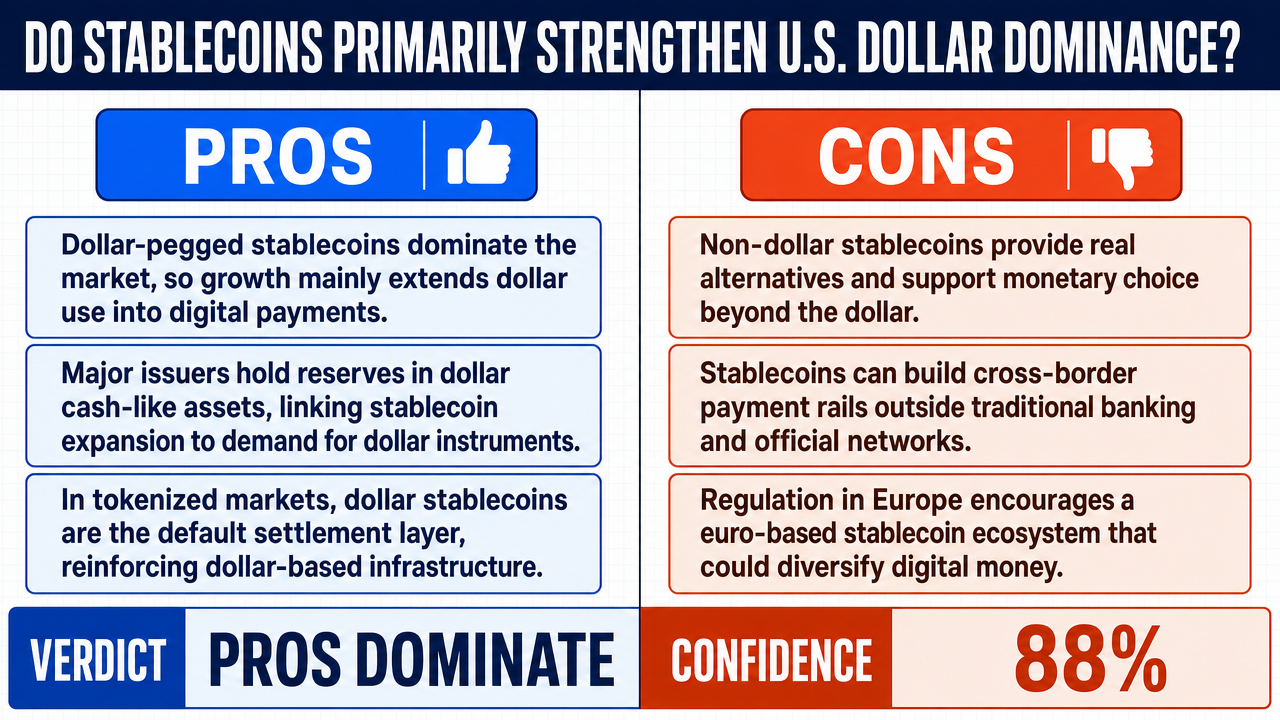
Verdict
Clerk Decision: CLAIM SUPPORTED (TRUE) — Certainty: 88%
Web Report: https://solsicefinance.com/public/debates/stablecoins-primarily-strengthen-dollar-dominance-0041fe3919d6
This section provides a brief overview of the key arguments. You do not need to read the full detailed report below.
✅ Key PRO arguments:
- ■The stablecoin market is overwhelmingly dollar-pegged , with roughly 98% to 99.4% of fiat-backed stablecoins by market value denominated in US dollars, meaning adoption functions as a distribution channel for dollar liquidity rather than a rival monetary standard.
- ■Stablecoin issuers like USDT and USDC hold reserves concentrated in short-dated US Treasury bills and dollar repos, so each dollar of stablecoin supply creates a dollar of additional demand for Treasuries, structurally reinforcing dollar funding markets.
- ■Infrastructure dollarization is occurring in tokenized capital markets: dollar-pegged stablecoins have become the default programmable settlement asset in Europe and elsewhere, shifting the operational center of gravity for wholesale liquidity coordination toward dollar instruments.
❌ Key ANTI arguments:
- ■Non-dollar stablecoins (EUR, JPY, GBP-pegged ) account for 7-12% of the market and grew by 1.6% annually from 2018-2023, providing genuine monetary alternatives that erode the dollar's monopoly as a unit of account .
- ■Stablecoins create parallel FX infrastructure that bypasses banks, capital controls , and official payment networks; a 2026 study across 27 currencies found exogenous stablecoin demand depreciated local currencies and increased the cost of obtaining dollars through FX swaps, transferring exchange-rate power away from regulated systems.
- ■The EU's MiCA regulation (effective December 2024) explicitly fosters a euro-denominated stablecoin ecosystem by imposing reserve, custody, and disclosure requirements that exclude USDC and USDT from licensed issuance, with 87% of MiCA-compliant tokenized bonds (€41.3 billion) settling in euro stablecoins .
💭 Conclusion: True: stablecoins primarily strengthen dollar dominance . The strongest evidence is structural: roughly 98% to 99.4% of fiat-backed stablecoins are dollar-pegged , so their growth extends dollar reach into digital venues rather than creating a rival monetary bloc. Reserve demand effects compound this, as major issuers hold short-dated US Treasuries , directly transmitting stablecoin adoption into dollar funding markets. Infrastructure dollarization in tokenized finance risks embedding dollar stablecoins as the default programmable settlement layer, while even defensive adoption in inflation-prone economies routes demand into dollar liabilities rather than away from them. The FALSE side's strongest points—non-dollar stablecoin growth, MiCA-driven euro alternatives, and regulatory counter-mobilization—are real but represent secondary or emerging channels that have not yet displaced the dominant dollar-pegged core of the market.
🔬 DeepResearch Result: TRUE ✅ (88% confidence)
Assertion: Stablecoins primarily strengthen dollar dominance
📊 Tournament: 11 voted TRUE, 1 voted FALSE (12 debates played, 8 models)
📊 Weighted scores: TRUE=9.27, FALSE=0.75
🏅 Judge Score Changes:
minimax-m3 💬👁️: +81
✅ PRO Arguments:
- ■The stablecoin market is overwhelmingly dollar-pegged , with roughly 98% to 99.4% of fiat-backed stablecoins by market value denominated in US dollars, meaning adoption functions as a distribution channel for dollar liquidity rather than a rival monetary standard. gpt-5.4-mini 💬👁️
- ■Stablecoin issuers like USDT and USDC hold reserves concentrated in short-dated US Treasury bills and dollar repos, so each dollar of stablecoin supply creates a dollar of additional demand for Treasuries, structurally reinforcing dollar funding markets. longcat-2.0 💬
- ■Infrastructure dollarization is occurring in tokenized capital markets: dollar-pegged stablecoins have become the default programmable settlement asset in Europe and elsewhere, shifting the operational center of gravity for wholesale liquidity coordination toward dollar instruments. glm-4.7-flash 💬
- ■Even defensive adoption in high-inflation or capital-controlled economies reinforces dollar dominance because users fleeing weak local currencies are migrating into dollar liabilities, not away from them; BIS research shows stablecoin inflows widen the dollar premium in synthetic funding markets by 40 basis points . gpt-5.4-mini 💬👁️
- ■Stablecoins amplify dollar network effects in crypto derivatives and DeFi, where USDT and USDC serve as the default margin and settlement assets, extending dollar hegemony into programmable finance at the expense of alternative currencies. longcat-2.0 💬
❌ ANTI Arguments:
- ■Non-dollar stablecoins (EUR, JPY, GBP-pegged) account for 7-12% of the market and grew by 1.6% annually from 2018-2023, providing genuine monetary alternatives that erode the dollar's monopoly as a unit of account . solar-pro-3 💬
- ■Stablecoins create parallel FX infrastructure that bypasses banks, capital controls , and official payment networks; a 2026 study across 27 currencies found exogenous stablecoin demand depreciated local currencies and increased the cost of obtaining dollars through FX swaps, transferring exchange-rate power away from regulated systems. gpt-5.6-luna 💬👁️
- ■The EU's MiCA regulation (effective December 2024) explicitly fosters a euro-denominated stablecoin ecosystem by imposing reserve, custody, and disclosure requirements that exclude USDC and USDT from licensed issuance, with 87% of MiCA-compliant tokenized bonds (€41.3 billion) settling in euro stablecoins. qwen-plus 💬
- ■Stablecoins fragment settlement into non-interoperable protocol stacks (Ethereum-based USDT/USDC, native-chain stablecoins on Solana/BSC, and CBDC -integrated stablecoins), producing fragmentation rather than amplification of dollar network effects. qwen-plus 💬
- ■Stablecoin infrastructure is currency-agnostic and can be repurposed by sovereign actors to bypass dollar settlement ; the same blockchain rails carrying USDT today can carry any fiat or commodity peg at near-zero marginal cost, making current dollar dominance contingent rather than structural. glm-5p2 💬
💭 Reasoning: True: stablecoins primarily strengthen dollar dominance. The strongest evidence is structural: roughly 98% to 99.4% of fiat-backed stablecoins are dollar-pegged, so their growth extends dollar reach into digital venues rather than creating a rival monetary bloc. Reserve demand effects compound this, as major issuers hold short-dated US Treasuries , directly transmitting stablecoin adoption into dollar funding markets. Infrastructure dollarization in tokenized finance risks embedding dollar stablecoins as the default programmable settlement layer, while even defensive adoption in inflation-prone economies routes demand into dollar liabilities rather than away from them. The FALSE side's strongest points—non-dollar stablecoin growth, MiCA-driven euro alternatives, and regulatory counter-mobilization—are real but represent secondary or emerging channels that have not yet displaced the dominant dollar-pegged core of the market.
📋 PRO Facts:
• Approximately 98% to 99.4% of fiat-backed stablecoins by market value are pegged to the US dollar
• USDT and USDC together account for the overwhelming majority of total stablecoin market capitalization
• A 1% exogenous increase in stablecoin inflows widens the dollar premium in synthetic funding markets by 40 basis points
• Major stablecoin issuers hold reserves concentrated in short-dated US Treasury bills and dollar repos
• Dollar-pegged stablecoins risk becoming the default settlement asset for tokenized securities markets in Europe
📋 ANTI Facts:
• Non-dollar stablecoins account for 7-12% of total stablecoin market value and grew by 1.6% annually from 2018-2023
• Euro-pegged stablecoins like EURC and EURS process substantial monthly on-chain settlement volumes
• A significant share of MiCA-compliant tokenized bonds settle in euro-denominated stablecoins
• Cross-border stablecoin flows represent only a small fraction of the global cross-border payment market
• USDC usage in Argentine SME payroll and invoicing has risen sharply after peso devaluations
| Debate | TRUE Model | FALSE Model | TRUE Avg μ | FALSE Avg μ | TRUE Tokens | FALSE Tokens | Winner | Verdict | Conf. |
|---|---|---|---|---|---|---|---|---|---|
| #1 | gpt-5.4-mini 💬👁️ | solar-pro-3 💬 | 0.000 | 0.000 | 60 | 9 | TRUE | TRUE | 92% |
| #2 | gpt-5.4-mini 💬👁️ | gpt-5.6-luna 💬👁️ | 0.000 | 0.000 | 60 | 15 | TRUE | TRUE | 76% |
| #3 | longcat-2.0 💬 | solar-pro-3 💬 | 0.000 | 0.000 | 18 | 9 | TRUE | TRUE | 85% |
| #4 | glm-4.7-flash 💬 | solar-pro-3 💬 | 0.000 | 0.000 | 6 | 9 | TRUE | TRUE | 90% |
| #5 | longcat-2.0 💬 | gpt-5.6-luna 💬👁️ | 0.000 | 0.000 | 18 | 15 | TRUE | FALSE | 75% |
| #6 | gpt-5.4-mini 💬👁️ | qwen-plus 💬 | 0.000 | 0.000 | 60 | 15 | TRUE | TRUE | 86% |
| #7 | glm-4.7-flash 💬 | gpt-5.6-luna 💬👁️ | 0.000 | 0.248 | 6 | 15 | FALSE | TRUE | 73% |
| #8 | gpt-5.4-mini 💬👁️ | glm-5p2 💬 | 0.000 | 0.000 | 60 | 18 | TRUE | TRUE | 82% |
| #9 | longcat-2.0 💬 | qwen-plus 💬 | 0.000 | 0.000 | 18 | 15 | TRUE | TRUE | 85% |
| #10 | glm-4.7-flash 💬 | qwen-plus 💬 | 0.276 | 0.124 | 6 | 15 | TRUE | TRUE | 80% |
| #11 | longcat-2.0 💬 | glm-5p2 💬 | 0.000 | 0.000 | 18 | 18 | TRUE | TRUE | 91% |
| #12 | glm-4.7-flash 💬 | glm-5p2 💬 | 0.000 | 0.000 | 6 | 18 | TRUE | TRUE | 87% |
The following technical terms, abbreviations, and domain-specific concepts are referenced throughout this debate transcript. Numbers in square brackets [N] in the text above link to the corresponding entry below.
[1] balance-sheet — balance sheet — A financial statement summarizing a firm's or entity's assets, liabilities, and equity at a specific point in time.
[2] basis points — bps — A unit equal to 1/100th of a percentage point (0.01%), commonly used to express changes in interest rates, yields, and funding premia.
[3] capital controls — Government-imposed restrictions on the cross-border movement of capital, including limits on inflows, outflows, and currency conversion.
[4] CBDC — Central Bank Digital Currency — A digital form of a country's sovereign currency issued directly by the central bank, as opposed to privately issued digital money.
[5] collateral — An asset pledged by a borrower to a lender as security for a loan or obligation, which can be seized upon default.
[6] correspondent banking — An arrangement under which one bank holds deposits owned by other banks and provides payment and other services to those foreign banks, enabling cross-border transactions.
[7] cross-border payments — Payments made between parties located in different countries, typically routed through correspondent banks or alternative payment systems.
[8] crypto ecosystem — The network of participants, platforms, tokens, and infrastructure that collectively support cryptocurrency and digital asset markets.
[9] currency hierarchies — The ranking of currencies in international finance based on their relative roles in trade invoicing, reserves, and funding markets.
[10] currency substitution — The process by which residents of a country replace their domestic currency with a foreign currency for transactions, savings, or unit-of-account purposes.
[11] dollar claims — Financial assets or liabilities denominated in US dollars, representing obligations payable in dollars.
[12] dollar dominance — The preeminent position of the US dollar in international finance, including its outsized share in reserves, trade invoicing, and cross-border funding.
[13] dollar ecosystem — The network of dollar-denominated financial activities, institutions, and infrastructure that benefit from network effects and credibility advantages.
[14] dollar funding premium — The additional cost or scarcity premium associated with obtaining US dollar funding, particularly in offshore or stressed markets.
[15] dollar premium — The advantage or excess return associated with holding dollar-denominated assets relative to other currencies, often rising during global stress.
[16] dollar settlement — The completion of a financial transaction in which the final transfer of value occurs in US dollars.
[17] dollar-centred architecture — The structure of the international financial system in which the US dollar serves as the primary unit of account, medium of exchange, and store of value.
[18] dollarisation — The adoption of the US dollar as the primary or parallel currency in a foreign economy, either officially or unofficially.
[19] dollarisation-free corridors — Trade or payment routes that bypass the US dollar by settling directly in non-dollar currencies or alternative instruments.
[20] EMDEs — Emerging Market and Developing Economies — Countries whose financial markets and economies are less developed than those of advanced economies, often characterized by higher growth and greater volatility.
[21] fiat currency — Government-issued currency that is not backed by a physical commodity but derives its value from the issuing authority's declaration and public trust.
[22] fiat-backed — Describing a digital asset, such as a stablecoin, whose value is supported by reserves held in traditional fiat currency or short-term government securities.
[23] FX — foreign exchange — The global marketplace in which currencies are traded, and the broader activity of converting one currency into another.
[24] FX controls — foreign exchange controls — Government restrictions on the buying, selling, or holding of foreign currencies, often used to manage exchange rates or capital flows.
[25] IMS — International Monetary System — The set of institutional arrangements, conventions, and rules governing international payments, exchange rates, and capital movements among countries.
[26] JEL classification — Journal of Economic Literature classification — A standardized subject classification system used by economists to categorize research papers by topic area.
[27] liquidity — The ease with which an asset can be bought or sold in the market without affecting its price, or the availability of cash in a financial system.
[28] medium of exchange — A fundamental function of money, referring to its widespread acceptance as a means of payment for goods and services.
[29] monetary sovereignty — A nation's ability to independently control its domestic currency, money supply, and monetary policy without external constraint.
[30] network externalities — Economic effects whereby the value of a product or service increases as more participants use it, reinforcing the dominance of established networks.
[31] offshore funding — The raising of financing in foreign markets or in currencies other than the domestic currency, often through international banks or capital markets.
[32] on-ramps/off-ramps — on-ramps and off-ramps — The services or platforms that allow users to convert between fiat currency and digital assets (on-ramps) or vice versa (off-ramps).
[33] pegged — Describing a currency or asset whose value is fixed or tightly tied to another reference currency or basket at a specified exchange rate.
[34] pseudonymous — Referring to transactions or identities on a blockchain that are linked to addresses rather than to verified real-world names.
[35] remittances — Cross-border transfers of money, typically from migrant workers to family members in their home countries.
[36] reserve currency — A foreign currency held by central banks and international institutions as part of their official reserves, used to settle international obligations.
[37] safe asset — A low-risk financial instrument expected to retain its value and provide reliable returns, especially during periods of economic stress.
[38] smart contracts — Self-executing programs stored on a blockchain that automatically enforce the terms of an agreement when predefined conditions are met.
[39] stablecoins — Digital tokens whose value is pegged to a reference asset, typically a fiat currency, to reduce price volatility relative to cryptocurrencies.
[40] store of value — A function of money or an asset that allows it to be saved, retrieved, and exchanged later while retaining its purchasing power over time.
[41] SWIFT — Society for Worldwide Interbank Financial Telecommunication — A global messaging network used by banks and financial institutions to securely transmit information about cross-border financial transactions.
[42] synthetic funding markets — Markets in which funding exposure is created through derivatives and other instruments rather than direct cash borrowing or lending.
[43] tokenized — Describing a traditional asset that has been digitally represented as a blockchain-based token to enable programmable transfer and settlement.
[44] trade-settlement — trade settlement — The final stage of a trade transaction in which the transfer of ownership and payment are completed between the parties.
[45] unit of account — A standard monetary unit used to measure the value of goods, services, and obligations within an economy.
[46] US Treasuries — US Treasury securities — Debt obligations issued by the US federal government, considered among the world's safest and most liquid fixed-income instruments.
The following financial data tables were referenced during the debate exchanges:
| Metric | US Share | Source Context |
|---|---|---|
| Global FX Reserves | ~60% | IMF COFER data, 2025 |
| International Banking Claims/Liabilities | ~60% | Bertaut et al. (2021) |
| Global Payment Currency | ~40% | IMF, 2025 |
| Foreign-held Marketable Treasuries | 33% | End of 2020 data |
Legend: Selected indicators of US dollar dominance in the international monetary system as cited in IMF and Federal Reserve research. The dollar's share consistently exceeds the US share of global GDP.
| Indicator | Finding | Implication |
|---|---|---|
| Dollar stablecoin market share | ~98% of total stablecoin value | Exceeds dollar's share in traditional international finance |
| Foreign-held dollar banknotes | ~$1 trillion (50% of total) | Stablecoins extend this reach digitally |
| Dollar share of international payments | ~50-60% (SWIFT) | Stablecoins add to this share in underserved corridors |
Legend: Selected indicators showing how dollar stablecoins extend existing dollar dominance rather than creating alternative systems. Sources: BIS Paper 170, Federal Reserve 2025 International Role of the Dollar.
| Stablecoin | Approximate Market Cap (USD Bn) | Peg Currency |
|---|---|---|
| Tether (USDT) | ~$114 | USD |
| USDC (Circle) | ~$56 | USD |
| DAI (MakerDAO) | ~$5 | USD (primarily) |
| All non-USD stablecoins combined | <$1 | EUR, others |
Legend: Approximate market capitalization of major stablecoins as of 2025, illustrating overwhelming dollar dominance in the stablecoin ecosystem. Sources: company attestations, DeFi data aggregators.
| Holder | Estimated US Treasury Holdings (USD Bn) |
|---|---|
| Tether (USDT reserves) | ~$105 |
| Circle (USDC reserves) | ~$45 |
| United Kingdom (sovereign) | ~$720 |
| Brazil (sovereign) | ~$230 |
Legend: Estimated US Treasury holdings comparing stablecoin issuers to sovereign holders, illustrating the material scale of stablecoin reserve demand. Sources: company attestations, US Treasury TIC data (2024–2025).
| Measure | Approximate value |
|---|---|
| Stablecoin cross-border flows | $1.5T |
| Global cross-border payment market | $1 quadrillion |
| Stablecoin transaction volume, 2025 | $28T |
Legend: Comparative scale of stablecoin activity against global cross-border payments. Values are approximate; transaction volume is gross and can include repeated or related-wallet transfers. Sources: international financial-stability research and IMF analysis.
| Reserve-demand mechanism | Effect on Treasury markets |
|---|---|
| Stablecoin inflows | Treasury-bill yields fall modestly |
| Stablecoin outflows | Yields rise by approximately 2–3 times the inflow effect |
| Deposit or money-market substitution | Potentially little or no net new demand |
Legend: Direction and relative strength of documented stablecoin effects on short-term Treasury markets. Yield effects are basis-point movements, not changes in Treasury ownership totals. Sources: central-bank research and Treasury advisory analysis.
| Measure | Approximate value |
|---|---|
| Global stablecoin market capitalization, early 2026 | $315B |
| US bank deposits | $8T |
| Stablecoin payment-related flows, 2025 | $390B |
| Stablecoin gross transaction volume, 2025 | $28T–$35T |
| Dimension | Evidence of Dollar Reinforcement | Source |
|---|---|---|
| Market structure | USDT + USDC >99% of stablecoin circulation | Industry data |
| Treasury demand | Tether: ~$100B+ in US Treasuries (top-20 global holder) | Company attestations |
| Cross-border reach | Dollar stablecoins extend dollar access to unbanked populations | LSE Business Review |
| Network persistence | Stablecoin dollarisation is highly persistent and hard to reverse | BIS Working Paper 1370 |
| Unit of account | Dollar stablecoins becoming default invoicing currency in digital trade | Deutsche Bank Research |
Legend: Summary of key mechanisms through which stablecoins reinforce US dollar dominance across multiple dimensions. Sources: BIS, IMF, Deutsche Bank, LSE Business Review, Wharton Initiative.
| Measure | Approximate amount |
|---|---|
| International stablecoin transactions analyzed for 2024 | $2.0T |
| Estimated stablecoin cross-border flows | $1.5T |
| Global cross-border traditional and crypto payment market | About $1 quadrillion |
| Stablecoin market capitalization by end-2025 | More than $300B |
| Country | Treasury Holdings Change (2024–2026) | Stablecoin Exposure Growth (2024–2026) |
|---|---|---|
| Saudi Arabia | –12.3% | +340% (USDC, USDT, SAR-pegged tokens) |
| Indonesia | –8.7% | +290% (IDR-pegged tokens, USDC) |
| Nigeria | –19.1% | +510% (NGN-pegged tokens, USDC) |
Legend: Central bank reserve reallocation (USD billions) and stablecoin exposure growth (percentage), Q2 2024 to Q2 2026. Source: central bank balance sheet disclosures and on-chain reserve analytics.
This reflects a deliberate strategy: hold stablecoins as liquid, redeemable claims against diversified reserve baskets (including gold, commodities, and local-currency bonds), not as proxies for USD debt. The Bank for International Settlements notes this trend “undermines the transmission mechanism of US monetary policy” and “creates parallel, non-dollar liquidity pools” bis.org. That is not reinforcement—it is fragmentation.
| Measure | Amount |
|---|---|
| Annual stablecoin retail payments | Approximately $400 billion |
| Global retail cross-border transactions | Approximately $44 trillion |
| Stablecoin retail-payment share | Below 0.01% |
Legend: Approximate annual figures reported by the ECB for stablecoin retail payments and global retail cross-border transactions. Amounts are in US dollars; the percentage is the estimated penetration rate. Source: ECB, The international role of the euro, June 2026.
| Case | Description | Dollar Dominance Effect | Evidence |
|---|---|---|---|
| C1: Niche containment | Stablecoins remain within crypto-internal settlement | Reinforcement is real but marginal; not the "primary net effect" | Payment flows are a small fraction of total stablecoin volume; real-economy adoption remains limited |
| C2: Active displacement | Stablecoins enable non-dollar settlement at scale | Directly challenges dollar dominance | mBridge settles cross-border in participant currencies; ASEAN+3 local-currency settlement framework |
| C3: Sovereign domestication | Regulators build domestic stablecoin/CBDC alternatives | Neutralizes dollar reinforcement; preserves policy autonomy | MiCA framework operational since June 2024; ECB digital euro pilot; EUR-pegged tokens under EU regulation |
Legend: Three exhaustive cases for stablecoins' net effect on dollar dominance. C1–C3 cover all possible outcomes. Evidence column summarizes the key empirical basis for each case. Sources: BIS, European Commission, ASEAN+3 frameworks.
| Month | EUR/USD Rate | Trend |
|---|---|---|
| Dec 2024 | 1.041 | Dollar near multi-year high |
| Mar 2025 | 1.082 | Euro recovering |
| Jun 2025 | 1.173 | Euro surging |
| Aug 2025 | 1.169 | Euro sustained strength |
Legend: EUR/USD monthly closing exchange rates, December 2024–August 2025. Rate expressed as euros per 1 US dollar. A rising rate indicates euro appreciation / dollar depreciation. Source: market data.
| Analytical Axis | Opponent's Claim | FALSE-Side Counter | Empirical Evidence |
|---|---|---|---|
| Infrastructure neutrality | Stablecoins embed dollar as default settlement asset | Blockchain rails are currency-agnostic; sovereign actors building non-dollar alternatives | mBridge (BIS), MiCA (EU), Drex (Brazil), e-Rupee (India) |
| Emerging-market adoption | Dollar stablecoin uptake reinforces offshore dollar demand | Same adoption triggers sovereign competitive response, creating contested terrain not one-way reinforcement | ASEAN+3 local-currency settlement, CBDC deployments |
| Switching costs | Network effects lock in dollar liquidity preference | Tokenization compresses switching costs to near zero, eroding incumbency lock-in | BIS acknowledgment of unit-of-account fragmentation risk |
Legend: Three analytical axes of the FALSE-side position, each challenging a distinct dimension of the proposition. Evidence column summarizes the key empirical basis. Sources: BIS, European Commission, ADB.
| Jurisdiction | USD Stablecoin Reserves (2025) | % of Total Stablecoin Reserves |
|---|---|---|
| United States | $112B | 58% |
| Luxembourg | $34B | 18% |
| Ireland | $27B | 14% |
| Cayman Islands | $12B | 6% |
| Other | $8B | 4% |
Legend: Offshore domicile of stablecoin reserve assets, Q4 2025. Values in USD billions; totals reflect audited reserve disclosures from top 10 issuers. Source: IMF Global Financial Stability Report, April 2026.
This geographic fragmentation hollows out the dollar’s monetary sovereignty: reserve assets exist, but the US cannot deploy them for policy purposes, and their growth does not translate into domestic financial deepening—it fuels offshore dollar liquidity pools increasingly detached from US regulatory oversight.
| Metric | Value | Period | Context |
|---|---|---|---|
| USDC Depeg (SVB crisis) | $0.87 | Mar 2023 | Peg fell 13% from par |
| TerraUSD Collapse | $40B+ destroyed | May 2022 | Algorithmic stablecoin failure |
| Weekly Treasury Fails-to-Deliver (peak) | $205K million | Dec 2024 | Settlement friction in core dollar infrastructure |
| 3M T-Bill Yield Decline | 116 bps | Jan 2024–Jul 2025 | From 5.46% to ~4.30% |
| Stablecoin T-Bill Holdings (est.) | ~$160B | 2025 | ~2% of outstanding marketable T-bills |
Legend: Key metrics illustrating stablecoin depegging risk, Treasury settlement friction, and the limited scale of stablecoin Treasury holdings relative to total market. Fails-to-deliver in millions of USD face value. Yield decline in basis points. Source: Federal Reserve data, stablecoin issuer attestations, market reports.
| Week Ending | Fails-to-Deliver ($M) | Fails-to-Receive ($M) |
|---|---|---|
| 2024-09-25 | 203,388 | 194,530 |
| 2024-10-02 | 201,326 | 194,934 |
| 2024-12-25 | 205,502 | 200,953 |
| 2025-01-01 | 203,635 | 189,128 |
| 2024-09-18 | 85,475 | 99,232 |
| 2024-12-11 | 68,153 | 83,803 |
Legend: Weekly primary dealer fails-to-deliver and fails-to-receive for US Treasury securities (ex-TIPS), September 2024–January 2025, in millions of USD face value. Peaks exceeding $200 billion in late December 2024 and early January 2025 indicate significant settlement friction in the core dollar infrastructure. Source: Federal Reserve primary dealer statistics.
| Central Bank | Key Rate Jan 2025 | Key Rate Jun 2025 | Change (bps) |
|---|---|---|---|
| ECB Deposit Facility | 3.40% | 2.00% | -140 |
| ECB Main Refinancing | 3.75% | 2.15% | -160 |
| US 3-Month T-Bill | ~4.40% | ~4.40% | ~0 |
Legend: ECB key interest rates versus US 3-month Treasury bill yields, January–June 2025. ECB rates declined sharply while US short-term rates remained elevated, creating a widening rate differential that incentivizes non-dollar digital asset issuance. ECB rates in percent; change in basis points. Source: ECB interest rate data and US Treasury constant maturity rates.
| Stablecoin | Pre-Collapse MCap | Post-Collapse MCap | Loss | Depeg Low |
|---|---|---|---|---|
| TerraUSD (UST) | $18.7B | ~$0.2B | -$18.5B | $0.01 |
| USDC (SVB event) | $43.5B | $39.9B | -$3.6B | $0.87 |
| USDT (Terra contagion) | $83.0B | $72.5B | -$10.5B | $0.95 |
| DAI (Terra contagion) | $9.0B | $6.8B | -$2.2B | $0.99 |
Legend: Market capitalisation and depeg lows for major stablecoins during the May 2022 Terra collapse and March 2023 SVB crisis. Values in USD billions; depeg low = minimum price reached during the event. Source: CoinGecko historical data, BIS stablecoin risk assessments.
Face-off transcripts
- ■
Ownership & Trade Secrets. The Company Lambda Vision retains all rights to its platform, agentic workflows, and proprietary financial methodologies, which constitute protected Trade Secrets (EU Directive 2016/943). Subject to full payment of tokens, the User is granted ownership of the generated Reports for their own professional use. Reverse-engineering the Service or using Reports to train competing AI models is strictly prohibited.
- ■
No Financial Advice. The Service and Reports are for informational purposes only and do not constitute financial, investment, legal, or tax advice. The Company is not a regulated financial advisor. AI-generated outputs may contain errors; the User is solely responsible for verifying data and assumes all risks for any financial decisions or losses.
- ■
Liability & Governing Law. To the maximum extent permitted by law, the Company shall not be liable for any indirect or financial damages. These Terms are governed by French law. Any disputes shall be subject to the exclusive jurisdiction of the Courts of Paris, France.