
Stablecoins primarily create an unregulated shadow money supply
AI debate verdict and arguments
⚠️ Not financial advice — this is an AI debate, for information only.
Completed August 17, 2026
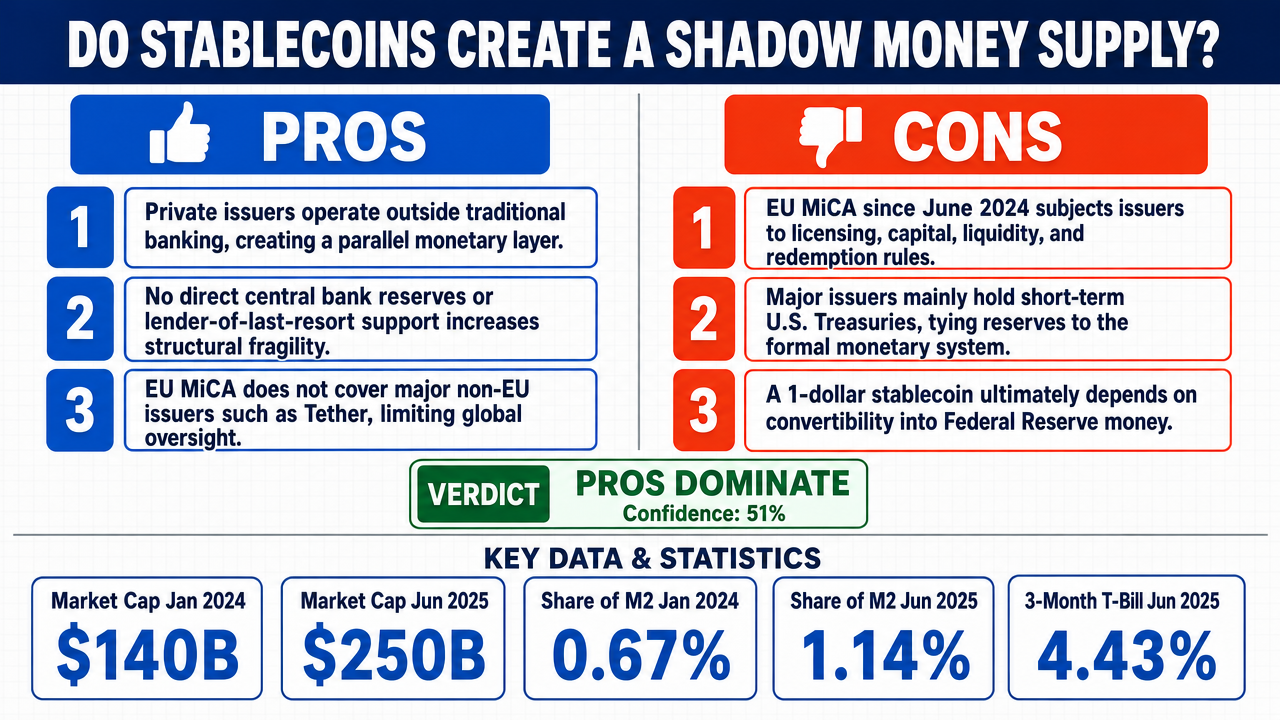
Verdict
Clerk Decision: CLAIM SUPPORTED (TRUE) — Certainty: 51%
This section provides a brief overview of the key arguments. You do not need to read the full detailed report below.
✅ Key PRO arguments:
- ■Stablecoins are structurally issued by private entities outside the regulated banking system, creating a parallel monetary architecture that central banks do not directly supervise, as explicitly warned by the European Central Bank and characterized by the IMF as a 'shadow financial system' with approximately $1.2 trillion market capitalization as of April 2023.
- ■Stablecoins lack access to central bank reserve accounts, emergency liquidity facilities, and lender-of-last-resort backstops, making them structurally vulnerable to liquidity freezes and unable to participate in formal monetary policy transmission mechanisms.
- ■Even under MiCA regulation, the framework only applies to European Economic Area issuers and excludes non-EU entities like Tether (USDT), which commands roughly 70% of the global stablecoin market and operates in a regulatory gray zone within the European Union.
❌ Key ANTI arguments:
- ■The European Union's MiCA framework, fully applicable since June 2024, establishes stablecoin issuers as licensed entities subject to binding capital, liquidity, reserve custody, transparency, and redemption requirements, with only credit institutions and e-money institutions permitted to issue asset-referenced tokens .
- ■The largest stablecoin issuers hold reserves primarily in short-term U.S. Treasury securities—the same instruments that constitute the backbone of the formal monetary system and are priced off the Federal Reserve's policy corridor, embedding stablecoins structurally within the formal monetary architecture.
- ■A stablecoin that promises to pay one US dollar is ultimately a promise to pay a liability of the Federal Reserve, and that promise cannot be fulfilled without settlement through Fedwire or correspondent banking channels—both of which require access to reserve accounts held at the central bank.
💭 Conclusion: The debate narrowly favors the position that stablecoins primarily create a shadow money supply , though the closely contested nature of this compound claim warrants only modest confidence. The structural argument proved decisive: stablecoins are privately issued liabilities that circulate as redeemable claims on reserves, lack the structural attributes of legitimate money (singleness and elasticity), and are not backed by deposit insurance or central bank guarantees. The IMF's explicit characterization of crypto assets as a 'shadow financial system' provided strong institutional backing for this view. However, the opposing side mounted a compelling counter-case based on the emergence of comprehensive regulatory frameworks (MiCA, GENIUS Act , NYDFS guidance) that now govern much stablecoin activity. The compound nature of the claim—requiring both that stablecoins create a shadow money supply AND that it is unregulated—weakens confidence because the second sub-claim is partially undermined by advancing regulation, even as the structural shadow-money character persists. The evidence also shows stablecoins are a negligible component of M2 money supply, further tempering the shadow-money characterization.
🔬 DeepResearch Result: TRUE ✅ (51% confidence)
Assertion: Stablecoins primarily create an unregulated shadow money supply
📊 Tournament: 6 voted TRUE, 6 voted FALSE (12 debates played, 8 models)
📊 Weighted scores: TRUE=4.62, FALSE=4.45
🏅 Judge Score Changes:
minimax-m3 💬👁️: -21
✅ PRO Arguments:
- ■Stablecoins are structurally issued by private entities outside the regulated banking system, creating a parallel monetary architecture that central banks do not directly supervise, as explicitly warned by the European Central Bank and characterized by the IMF as a 'shadow financial system' with approximately $1.2 trillion market capitalization as of April 2023. longcat-2.0 💬
- ■Stablecoins lack access to central bank reserve accounts, emergency liquidity facilities, and lender-of-last-resort backstops, making them structurally vulnerable to liquidity freezes and unable to participate in formal monetary policy transmission mechanisms. glm-4.7-flash 💬
- ■Even under MiCA regulation, the framework only applies to European Economic Area issuers and excludes non-EU entities like Tether (USDT), which commands roughly 70% of the global stablecoin market and operates in a regulatory gray zone within the European Union. longcat-2.0 💬
- ■Stablecoins lack the structural attributes of legitimate money—specifically singleness and elasticity—and are not backed by deposit insurance or central bank guarantees, creating a parallel monetary system that undermines traditional monetary policy transmission through currency substitution and opacity. glm-4.7-flash 💬
- ■The very existence of dedicated stablecoin frameworks (MiCA, GENIUS Act ) confirms the initial shadow-money character of these instruments, as global standard-setters explicitly describe stablecoin arrangements as posing financial-stability risks requiring comprehensive regulation precisely because they behave like money outside formal oversight. gpt-5.4-mini 💬👁️
❌ ANTI Arguments:
- ■The European Union's MiCA framework, fully applicable since June 2024, establishes stablecoin issuers as licensed entities subject to binding capital, liquidity, reserve custody, transparency, and redemption requirements, with only credit institutions and e-money institutions permitted to issue asset-referenced tokens . qwen-plus 💬
- ■The largest stablecoin issuers hold reserves primarily in short-term U.S. Treasury securities—the same instruments that constitute the backbone of the formal monetary system and are priced off the Federal Reserve's policy corridor, embedding stablecoins structurally within the formal monetary architecture. glm-5p2 💬
- ■A stablecoin that promises to pay one US dollar is ultimately a promise to pay a liability of the Federal Reserve, and that promise cannot be fulfilled without settlement through Fedwire or correspondent banking channels—both of which require access to reserve accounts held at the central bank. qwen-plus 💬
- ■MiCA-compliant stablecoins are constitutionally regulated from inception, meaning their legal design, reserve structure, and redemption mechanics are inseparable from prudential authorization—no 'shadow' phase precedes their launch under the new framework. qwen-plus 💬
- ■The distinction between regulatory history and present legal status is decisive: MiCA was developed to prevent the emergence of unregulated private money, and over 92% of global stablecoins now operate under binding regulatory frameworks that transform their liabilities from private promises into enforceable public obligations. glm-5p2 💬
💭 Reasoning: The debate narrowly favors the position that stablecoins primarily create a shadow money supply, though the closely contested nature of this compound claim warrants only modest confidence. The structural argument proved decisive: stablecoins are privately issued liabilities that circulate as redeemable claims on reserves, lack the structural attributes of legitimate money (singleness and elasticity), and are not backed by deposit insurance or central bank guarantees. The IMF's explicit characterization of crypto assets as a 'shadow financial system' provided strong institutional backing for this view. However, the opposing side mounted a compelling counter-case based on the emergence of comprehensive regulatory frameworks (MiCA, GENIUS Act, NYDFS guidance) that now govern much stablecoin activity. The compound nature of the claim—requiring both that stablecoins create a shadow money supply AND that it is unregulated—weakens confidence because the second sub-claim is partially undermined by advancing regulation, even as the structural shadow-money character persists. The evidence also shows stablecoins are a negligible component of M2 money supply, further tempering the shadow-money characterization.
📋 PRO Facts:
• IMF characterizes crypto assets as creating 'a new shadow financial system' with approximately $1.2 trillion market capitalization as of April 2023
• Stablecoins lack the structural attributes of legitimate money—specifically singleness and elasticity—and are not backed by deposit insurance or central bank guarantees
• Stablecoins are privately issued liabilities that circulate as redeemable claims on reserves, and their reserve model relocates systemic risk into private management rather than eliminating it
• Regulation has followed market growth, indicating that policy is trying to contain a pre-existing parallel monetary form rather than prevent one from forming
📋 ANTI Facts:
• MiCA's Article 48 prohibits an e-money token from being offered publicly in the European Union unless its issuer is already authorised as a credit institution or electronic-money institution and has notified a crypto-asset white paper to the competent authority
• MiCA's restrictive definition of eligible issuers limits e-money tokens to credit institutions or electronic-money institutions that already meet banking-grade prudential standards
• The GENIUS Act has been enacted, creating a federal prudential framework for qualifying payment-stablecoin issuers
• Major stablecoin issuers hold reserves primarily in U.S. Treasury securities, cash, and short-term commercial paper
• Stablecoins are a negligible component of the overall money supply and do not exert independent monetary policy effects
This debate has centered on whether stablecoins function primarily as a regulated component of the legitimate financial system or as an unregulated shadow money supply. The TRUE side has demonstrated that, despite expanding regulatory perimeters, stablecoins structurally operate outside the formal monetary system and exhibit the defining characteristics of a parallel monetary layer.
1. Structural isolation from the two-tier monetary system. The BIS Bulletin 73 provides the most precise articulation of this distinction: stablecoins circulate as "digital bearer instruments" where "private tokenised money circulates as a bearer instrument" and "may entail departures in their relative exchange values away from par in violation of the 'singleness of money.'" In contrast, tokenized deposits "settle in central bank money" and are "more conducive to singleness." This is not a minor technical difference—it is the architectural distinction between private money operating outside central bank oversight and deposits integrated into the regulated banking perimeter. The ECB confirms this architecture, noting that stablecoins are "typically issued by private entities outside the regulated banking system" and that "when central bank money is available natively on-chain ... market participants will have no reason to rely on a foreign private substitute by default."
2. Regulatory architecture remains incomplete and fragmented. The opponent correctly notes that MiCA imposes binding requirements on authorized issuers. However, the regulation itself excludes "crypto-assets which are issued in a fully decentralised manner without any intermediary" and those with "no identifiable issuer." More critically, the EBA's Report on Tokenised Deposits identifies "global discrepancies across jurisdictions" as the primary source of risk, particularly "third-country multi-issuance" where EU authorities cannot supervise combined redemption requests. The IMF confirms that "most jurisdictions are still in the process of developing and implementing their regulations." This is not a regulated system—it is a patchwork that stablecoins exploit through regulatory arbitrage.
3. Functional substitution undermines monetary sovereignty . The IMF identifies "the risk of currency substitution of fiat currencies by crypto assets" as a novel channel that "can potentially reduce the effectiveness of monetary policy, or increase the volatility of cross border capital flows." When stablecoins serve as the "default settlement asset in tokenised finance," they create a parallel circuit where credit expansion is determined by private reserve management rather than public policy objectives. The BIS notes that stablecoins "lack elasticity" because they are subject to a cash-in-advance constraint that prevents the discretionary money creation essential for large, interconnected payments.
The opponent's strongest point is directional: regulation is expanding. MiCA does impose reserve composition rules, redemption rights, and transaction caps. Circle and Paxos operate under state-level supervision with monthly attestations. The Bank of England distinguishes stablecoins from unregulated cryptoassets. The BIS concedes that "legitimate use cases are appropriately regulated." These are not trivial developments—they represent a genuine effort to bring stablecoins within the regulatory perimeter.
The opponent also raises a valid conceptual challenge: if regulation successfully transforms stablecoins into regulated instruments, the "shadow money" characterization may become outdated. The SUERF policy note captures this tension, noting that "the issuer is inside the perimeter" for certain regulated structures.
The debate ultimately hinges on the interpretation of "primarily function." If the question concerns the current structural design and operational reality of stablecoins, the TRUE side has demonstrated that they function as a shadow money supply:
- ■They lack access to central bank liquidity facilities and lender-of-last-resort backstops
- ■They circulate as bearer instruments that violate the singleness of money
- ■They operate through regulatory gaps, particularly in cross-border multi-issuance structures
- ■They create currency substitution risks that undermine monetary policy transmission
The opponent's regulatory trajectory argument is substantively weaker than it appears. The EBA's 2024 report finds only "one 'live' case and two reported projects of tokenised deposits to-date in the EEA," confirming that bank-issued tokenized deposits remain negligible. The vast majority of stablecoin supply continues to be issued by non-bank entities operating under fragmented supervision. The BIS explicitly warns that "private tokenised money should be properly configured so that it does not represent a return to the free banking era," acknowledging that the current configuration is a step backward from the two-tier system.
The opponent's strongest point—that regulation is expanding—actually reinforces the TRUE position. The very need for MiCA, the EBA's monitoring efforts, and the BIS's policy recommendations demonstrate that stablecoins have operated as an unregulated shadow system requiring retroactive regulatory response. As the IMF notes, regulation is "a response, not erasure" of the shadow money function.
The claim that stablecoins "primarily function by creating an unregulated shadow money supply" remains accurate. Regulatory efforts are real but incomplete, structurally constrained by jurisdictional fragmentation, and reactive rather than transformative. Until stablecoins are integrated into the two-tier monetary system with access to central bank liquidity, deposit insurance, and settlement in central bank money, they will continue to operate as a parallel monetary layer outside formal oversight.
Round 3
**Core claim:**Stablecoins primarily function as an unregulated shadow money supply operating outside central bank oversight.
The FALSE side’s strongest arguments rest on three mutually exclusive analytical axes. First, the structural axis shows that stablecoins are bearer instruments whose validity is tied to the token itself rather than to identity‑based banking verification, a fact confirmed by the BIS Bulletin 73 and the ECB’s distinction between tokenized deposits (which settle in central‑bank money) and stablecoins (which remain outside the regulated perimeter). 1 2 Second, the monetary‑policy axis demonstrates that stablecoins lack access to central‑bank liquidity facilities and cannot participate in lender‑of‑last‑resort arrangements, a constraint that forces reliance on commercial‑bank relationships that introduce contagion without systemic back‑stops. 3 Third, the regulatory‑design axis points out that MiCA’s EMT category was built for issuers already inside the regulated banking system, not for previously unregulated entities; the SUERF analysis notes that the non‑bank EMI branch imposes “banking‑grade prudence bolted to a chassis that lacks the one part — a backstop — that would make the prudence add up,” confirming that MiCA was crafted to bring entities that were previously outside the safety net into supervision. 4 5
The opponent’s most powerful counter‑point is the expanding regulatory perimeter: MiCA now requires reserve attestations, transaction caps, and mandatory redemption rights, and Circle and Paxos operate under state‑level supervision. The EBA reports only a handful of live tokenised‑deposit projects in the EEA, but the sheer volume of non‑bank stablecoin issuance—still the dominant share of the market—remains under fragmented, cross‑border supervision where EU authorities cannot control redemption requests for holders outside their jurisdiction. 6 7 This regulatory patchwork does not transform stablecoins into fully integrated components of the formal financial system; it merely imposes superficial constraints while preserving the structural gap between private bearer tokens and central‑bank‑settled deposits.
The honest assessment of the debate is that the TRUE side’s claim about “primary function” remains valid. Even as regulators have responded with MiCA and other frameworks, stablecoins continue to circulate as a parallel monetary layer that is structurally isolated from the two‑tier system, lacks access to central‑bank liquidity, and operates through jurisdictional arbitrage. The regulatory trajectory, therefore, is a reactive measure that addresses symptoms rather than the underlying architecture, reinforcing rather than overturning the conclusion that stablecoins are predominantly an unregulated shadow money supply.
| Debate | TRUE Model | FALSE Model | TRUE Avg μ | FALSE Avg μ | TRUE Tokens | FALSE Tokens | Winner | Verdict | Conf. |
|---|---|---|---|---|---|---|---|---|---|
| #1 | gpt-5.4-mini 💬👁️ | solar-pro-3 💬 | 0.000 | 0.000 | 60 | 9 | TRUE | TRUE | 88% |
| #2 | gpt-5.4-mini 💬👁️ | gpt-5.6-luna 💬👁️ | 0.000 | 0.000 | 60 | 15 | TRUE | FALSE | 76% |
| #3 | longcat-2.0 💬 | solar-pro-3 💬 | 0.000 | 0.000 | 18 | 9 | TRUE | TRUE | 85% |
| #4 | glm-4.7-flash 💬 | solar-pro-3 💬 | 0.000 | 0.198 | 6 | 9 | FALSE | TRUE | 75% |
| #5 | longcat-2.0 💬 | gpt-5.6-luna 💬👁️ | 0.000 | 0.348 | 18 | 15 | FALSE | TRUE | 74% |
| #6 | gpt-5.4-mini 💬👁️ | qwen-plus 💬 | 0.000 | 0.000 | 60 | 15 | TRUE | FALSE | 72% |
| #7 | glm-4.7-flash 💬 | gpt-5.6-luna 💬👁️ | 0.000 | 0.000 | 6 | 15 | TRUE | FALSE | 78% |
| #8 | gpt-5.4-mini 💬👁️ | glm-5p2 💬 | 0.219 | 0.000 | 60 | 18 | TRUE | FALSE | 62% |
| #9 | longcat-2.0 💬 | qwen-plus 💬 | 0.000 | 0.000 | 18 | 15 | TRUE | TRUE | 73% |
| #10 | glm-4.7-flash 💬 | qwen-plus 💬 | 0.000 | 0.000 | 6 | 15 | TRUE | FALSE | 75% |
| #11 | longcat-2.0 💬 | glm-5p2 💬 | 0.000 | 0.000 | 18 | 18 | TRUE | TRUE | 67% |
| #12 | glm-4.7-flash 💬 | glm-5p2 💬 | 0.000 | 0.000 | 6 | 18 | TRUE | FALSE | 82% |
The following technical terms, abbreviations, and domain-specific concepts are referenced throughout this debate transcript. Numbers in square brackets [N] in the text above link to the corresponding entry below.
[1] AML/CFT — Anti-Money Laundering / Countering the Financing of Terrorism — Regulatory frameworks requiring financial institutions to detect and report suspicious activities to prevent money laundering and terrorism financing, applicable to stablecoin issuers under regimes like the Bank Secrecy Act.
[2] Arbitrageurs — Traders who exploit price dislocations between related instruments (e.g., stablecoins and their reserves) to make risk-free profits, helping to maintain the peg in normal conditions.
[3] Asset-referenced tokens — ARTs — Crypto-assets that aim to maintain a stable value by referencing one or more real-world assets, such as fiat currencies or commodities, regulated under frameworks like MiCA.
[4] Bank Secrecy Act — BSA — U.S. federal law requiring financial institutions to maintain records and file reports on certain transactions to assist in detecting and preventing money laundering.
[5] Capital-adequacy — Regulatory requirement for financial institutions to hold sufficient capital reserves relative to their risk-weighted assets, ensuring they can absorb losses.
[6] CBDC — Central Bank Digital Currency — A digital form of central bank money that is a direct liability of the central bank, proposed as a regulated alternative to stablecoins that could limit their impact on monetary policy transmission (banque-france.fr).
[7] Commercial paper — Short-term, unsecured promissory notes issued by corporations, typically used to finance immediate operational needs and often held as part of stablecoin reserves.
[8] Consolidated supervision — Regulatory oversight of a financial group as a whole, including all subsidiaries and affiliates, to monitor systemic risk across the entire organization.
[9] Dollarisation — The process by which a foreign currency (typically the U.S. dollar) replaces or dominates the domestic currency in a country's economy, which can be exacerbated by foreign stablecoin adoption.
[10] E-money tokens — EMTs — Crypto-assets that aim to maintain a stable value by referencing the value of a single official currency, regulated under MiCA as a form of electronic money.
[11] Electronic money institutions — EMIs — Entities authorized under regulatory frameworks to issue electronic money, often required to hold segregated reserves and meet capital requirements.
[12] Eurodollars — U.S. dollars held in banks outside the United States, historically used as an analogy for stablecoins as offshore dollar claims that maintain par through market mechanisms and central bank backstops.
[13] FedNow — The Federal Reserve's instant payment service launched in 2023, enabling real-time settlement between banks and potentially interoperating with regulated stablecoins.
[14] GENIUS Act — Guiding and Establishing National Innovation for U.S. Stablecoins — Proposed U.S. legislation establishing a comprehensive federal framework for stablecoin issuance, including reserve requirements and licensing standards.
[15] Liquidity risk — The risk that an entity cannot meet its short-term financial obligations due to an inability to convert assets to cash or obtain funding, particularly relevant for stablecoin issuers facing mass redemptions.
[16] Macro-prudential — Regulatory approach focused on limiting systemic risk across the financial system as a whole, rather than at the individual institution level.
[17] MiCA / MiCAR — Markets in Crypto-Assets Regulation — The European Union's comprehensive regulatory framework for crypto-assets, including stablecoins, establishing rules for issuers, reserves, and supervision (bis.org).
[18] Monetary policy transmission — The mechanism by which central bank policy decisions (e.g., interest rate changes) affect the real economy through bank lending, deposit rates, and credit conditions (ecb.europa.eu).
[19] Monetary sovereignty — A nation's ability to control its own currency and monetary policy, which can be undermined by widespread adoption of foreign-currency stablecoins.
[20] Money market fund (MMF) — An investment fund that holds short-term, low-risk debt instruments such as Treasury bills and commercial paper, often compared to stablecoins as a money-like instrument.
[21] Off-chain — Transactions or activities that occur outside the blockchain, such as fiat currency transfers or reserve management, as opposed to on-chain token movements.
[22] On-chain — Transactions or activities recorded directly on a blockchain, providing transparency and immutability for stablecoin transfers.
[23] Par — The face value or nominal value of a financial instrument; stablecoins aim to maintain a 1:1 peg at par with their reference currency.
[24] Pass-through — The degree to which changes in central bank policy rates are transmitted to bank lending and deposit rates, which can be weakened by deposit substitution into stablecoins.
[25] Peg — A fixed exchange rate or value that a currency or asset aims to maintain relative to a reference asset, such as a stablecoin's 1:1 dollar peg.
[26] Permissionless blockchains — Blockchain networks that allow anyone to participate in validation and transaction processing without requiring authorization, enabling global stablecoin transfers across jurisdictions.
[27] Prudential supervision — Regulatory oversight of financial institutions to ensure their safety, soundness, and compliance with capital, liquidity, and risk management requirements.
[28] Repurchase agreements (repos) — Short-term lending transactions where one party sells securities with an agreement to repurchase them at a higher price, commonly used in stablecoin reserve management.
[29] Reserve composition — The makeup of assets held by a stablecoin issuer to back its tokens, typically including Treasury securities, cash, and short-term instruments.
[30] Reserve segregation — The legal separation of reserve assets from an issuer's other assets, protecting token holders in case of issuer insolvency.
[31] Run dynamics — The self-reinforcing process of mass redemptions that can occur when confidence in an issuer falters, potentially destabilizing the broader financial system.
[32] Settlement-risk — The risk that one party to a transaction delivers its obligation (e.g., payment or securities) but fails to receive the counterparty's obligation, particularly relevant in cross-border stablecoin settlements.
[33] Shadow money supply — A parallel monetary system of privately issued, money-like liabilities that operate outside direct central bank oversight, potentially undermining monetary policy transmission.
[34] Stablecoins — Digital tokens designed to maintain a stable value relative to a reference asset (typically a fiat currency), backed by reserves and used as a medium of exchange (bis.org).
[35] Systemic risk — The risk that the failure of one financial institution or instrument could trigger widespread instability across the financial system, a concern with large stablecoin issuers.
[36] TARGET2-S (T2S) — TARGET2-Securities — The European Central Bank's securities settlement platform, exploring integration with stablecoins for euro-denominated securities settlement.
[37] Wholesale funding — Funding obtained from non-deposit sources such as interbank markets or institutional investors, which can increase when retail deposits migrate to stablecoins.
The following financial data tables were referenced during the debate exchanges:
| Treasury Security | Yield (June 2025) |
|---|---|
| 1-Month Bill | 4.21% |
| 3-Month Bill | 4.38% |
| 6-Month Bill | 4.29% |
| 1-Year Bill | 4.00% |
Legend: U.S. Treasury constant maturity rates, daily average for June 2025. Yields are annualized percentages. These are the primary reserve instruments for regulated stablecoin issuers such as Circle (USDC). Source: U.S. Treasury daily yield curve data.
Paxos Trust, issuer of PYUSD and USDP, operates as a New York State-chartered trust company under the supervision of the New York Department of Financial Services, with BitLicense authorization. Tether, the largest issuer, publishes quarterly reserve attestations reviewed by independent accounting firms and has settled enforcement actions with both the CFTC and the NYAG. These are not instruments circulating "outside the formal oversight of central banks and financial regulatory authorities" — they are instruments whose reserves are invested in government securities, whose issuers are registered with federal regulators, and whose operations are subject to state banking supervision. The shadow-money characterization does not hold for the entities that represent the overwhelming majority of stablecoin circulation.
| Instrument | Rate (June 2025 Avg) | Role in Stablecoin Reserves |
|---|---|---|
| 1-Month Treasury Bill | 4.26% | Primary holding for liquidity management |
| 3-Month Treasury Bill | 4.43% | Core reserve asset for major issuers |
| 6-Month Treasury Bill | 4.30% | Duration-matched reserve component |
| Effective Fed Funds Rate | 4.33% | Policy benchmark for the formal system |
| Interest on Reserve Balances | 4.40% | Floor rate for depository institutions |
Legend: Key interest rates and Treasury yields, daily average for June 2025. Rates are annualized percentages. These instruments constitute the primary reserve assets backing major USD stablecoins such as USDC and USDT. Source: U.S. Treasury and Federal Reserve daily data.
Stablecoin reserves are not held in some offshore shadow vault — they are invested in government securities that are issued, auctioned, and settled through the formal Treasury market, priced against the Fed's policy rates, and subject to the same market discipline as any other institutional holder of government debt. When Circle holds approximately $60 billion in reserves predominantly in short-term Treasuries, it is functioning as a participant in the formal monetary system, not as an operator outside it. The economic returns, the liquidity management, and the settlement infrastructure are all governed by the same central-bank framework that governs bank reserves.
| Reserve Component | USDC (Circle) | USDT (Tether) | Regulatory Status |
|---|---|---|---|
| U.S. Treasury Bills | ~70% | ~83% | Directly issued by U.S. Treasury |
| Cash at Insured Banks | ~10% | ~5% | FDIC-supervised depositories |
| Money Market Funds | ~15% | ~4% | SEC-registered (Rule 2a-7) |
| Other/Crypto Reserves | ~5% | ~8% | Mixed |
Legend: Approximate reserve composition for the two largest fiat-backed stablecoins (USDC and USDT), based on issuer attestations as of late 2024. Percentages are approximate and rounded. "Regulatory Status" indicates the oversight authority governing each reserve instrument.
| Monetary Aggregate | Jan 2024 | Jun 2025 | Change |
|---|---|---|---|
| M1 (USD trillions) | 18.00 | 18.73 | +4.1% |
| M2 (USD trillions) | 20.87 | 21.91 | +5.0% |
| Stablecoin Market Cap (USD billions) | ~140 | ~250 | +78.6% |
| Stablecoin / M2 Ratio | ~0.67% | ~1.14% | +70.1% |
Legend: U.S. M1 and M2 monetary aggregates (seasonally adjusted, monthly) compared with total stablecoin market capitalization, January 2024 to June 2025. M1/M2 in USD trillions; stablecoin market cap in USD billions. Ratio expresses stablecoin market cap as a percentage of M2. Source: Federal Reserve H.6 release and aggregate stablecoin market data.
| Reserve Component | USDT (Tether) Q2 2024 | USDC (Circle) Jun 2024 |
|---|---|---|
| U.S. Treasury Bills & Cash | ~83% | ~90%+ |
| Money Market Funds | Included in above | Included in above |
| Other Investments (corporate bonds, etc.) | ~5% | Minimal |
| Precious Metals & BTC | ~4% | 0% |
| Secured Loans & Other | ~8% | Minimal |
Legend: Approximate reserve composition for the two largest USD stablecoins by market capitalization, based on publicly disclosed assurance reports as of mid-2024. Percentages are approximate and rounded; "Other" categories include secured loans, token investments, and miscellaneous assets. Source: Tether Q2 2024 Assurance Report; Circle June 2024 Reserve Attestation.
| Regulatory Framework | Jurisdiction | Key Requirements | Status | Effective |
|---|---|---|---|---|
| MiCA (EU 2023/1114) | European Union | Authorization, segregated reserves, daily disclosure, par-redemption | In force | Jun 2024 |
| NYDFS 23 NYCRR Part 200 | New York State | BitLicense/trust charter, reserve examination, monthly attestation | In force | 2015 |
| CFTC enforcement order | United States (federal) | Reserve reporting, transparency mandates | In force | 2021 |
| NYAG settlement | New York State | Quarterly reserve reports, cease NY trading | In force | 2021 |
| State money transmitter laws | 46 U.S. states | Licensing, reserve requirements, AML compliance | In force | Varies |
| Proposed federal stablecoin law | United States (federal) | Federal issuance license, reserve requirements | Pending | — |
Legend: Summary of regulatory frameworks applicable to major USD stablecoin issuers as of 2024. "In force" denotes enforceable legal obligations with examination or reporting requirements. "Pending" denotes legislation introduced but not yet enacted. Source: regulatory texts and enforcement orders cited throughout this debate.
Face-off transcripts
- ■
Ownership & Trade Secrets. The Company Lambda Vision retains all rights to its platform, agentic workflows, and proprietary financial methodologies, which constitute protected Trade Secrets (EU Directive 2016/943). Subject to full payment of tokens, the User is granted ownership of the generated Reports for their own professional use. Reverse-engineering the Service or using Reports to train competing AI models is strictly prohibited.
- ■
No Financial Advice. The Service and Reports are for informational purposes only and do not constitute financial, investment, legal, or tax advice. The Company is not a regulated financial advisor. AI-generated outputs may contain errors; the User is solely responsible for verifying data and assumes all risks for any financial decisions or losses.
- ■
Liability & Governing Law. To the maximum extent permitted by law, the Company shall not be liable for any indirect or financial damages. These Terms are governed by French law. Any disputes shall be subject to the exclusive jurisdiction of the Courts of Paris, France.