
SpaceX and Tesla will have officially merged into a single entity by the end of 2027.
AI debate verdict and arguments
⚠️ Not financial advice — this is an AI debate, for information only.
Completed October 22, 2026
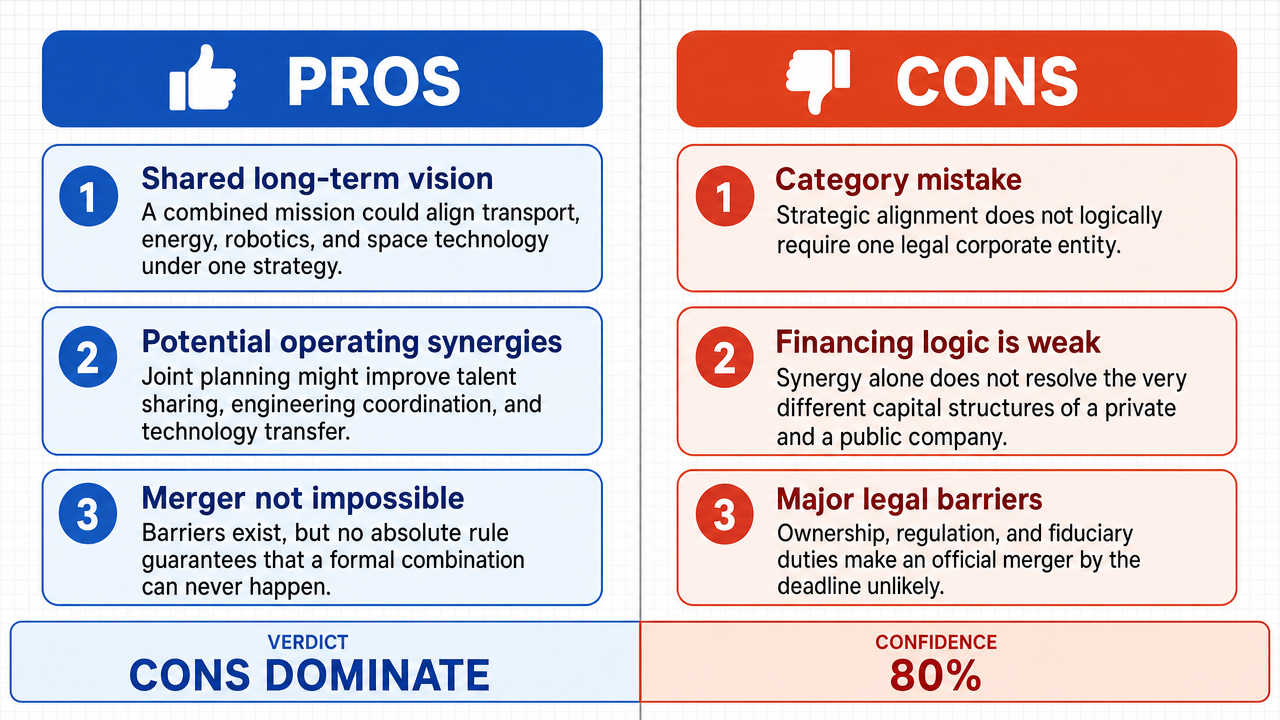
Verdict
Verdict: likely FALSE (80%)
This section provides a brief overview of the key arguments. You do not need to read the full detailed report below.
✅ Key PRO arguments:
- ■Strategic Convergence Axis: Musk has repeatedly articulated a master plan in which Tesla and SpaceX are interdependent components of a single technological ecosystem. Tesla's Optimus humanoid robot program, its AI and battery technology, and its manufacturing expertise are directly applicable to SpaceX's Martian colony ambitions, while SpaceX's Starlink satellite network already provides connectivity to Tesla vehicles in remote areas.
- ■The opponent's three barriers (structural, regulatory, and fiduciary ) exhaust the possible grounds for their conclusion that a merger cannot occur. Since no fourth category is offered, demonstrating that each of these three branches fails on the evidence collapses the negative case entirely.
❌ Key ANTI arguments:
- ■Category error : The affirmative conflates strategic alignment with structural unification. Technological synergy does not necessitate legal consolidation. In modern industry, complex ecosystems are frequently managed through sophisticated contractual interdependencies , cross-licensing , and shared leadership without the catastrophic legal and operational consequences of a formal merger .
- ■The capital-efficiency argument is logically inconsistent. The affirmative asserts that a merger is the path by which SpaceX would access public capital markets , yet simultaneously argues that standalone structures cannot achieve such efficiency. Tesla is already a successful standalone public structure that has achieved immense capitalization, demonstrating that public-market access does not require consolidation with another entity.
- ■Structural, regulatory, and fiduciary barriers — including SpaceX's private ownership structure, Tesla's public shareholder obligations, and the fiduciary duties of both boards — independently and collectively prevent a merger by December 31, 2027.
💭 Conclusion: False. The negative side prevailed because it correctly identified a category error in the affirmative's reasoning: strategic and technological interdependence between SpaceX and Tesla does not logically entail a formal corporate merger . The affirmative's capital-efficiency argument was also internally contradictory, since Tesla already operates as a successful standalone public entity, demonstrating that public-market access does not require consolidation. The negative further established that structural, regulatory, and fiduciary barriers — including SpaceX's private ownership and Tesla's public shareholder obligations — independently block any merger. The affirmative's attempt to exhaustively dismantle these three barriers failed to overcome the fundamental distinction between ecosystem coordination and legal unification. Overall, the evidence supports the conclusion that SpaceX and Tesla will remain separate corporate entities.
🔬 DeepResearch Result: likely FALSE ❌ (80%)
Assertion: SpaceX and Tesla will have officially merged into a single entity by the end of 2027.
Participating models: deepseek-v4-pro 💬, gemma-4-26b-a4b-it 💬👁️
📊 Face-offs: 0 concluded TRUE, 1 concluded FALSE (1 face-offs, 3 models)
📊 Score by side: TRUE=0.00, FALSE=0.80
🏅 Model score changes:
minimax-m3 💬👁️: +8
✅ PRO Arguments:
- ■Strategic Convergence Axis: Musk has repeatedly articulated a master plan in which Tesla and SpaceX are interdependent components of a single technological ecosystem. Tesla's Optimus humanoid robot program, its AI and battery technology, and its manufacturing expertise are directly applicable to SpaceX's Martian colony ambitions, while SpaceX's Starlink satellite network already provides connectivity to Tesla vehicles in remote areas. deepseek-v4-pro 💬
- ■The opponent's three barriers (structural, regulatory, and fiduciary ) exhaust the possible grounds for their conclusion that a merger cannot occur. Since no fourth category is offered, demonstrating that each of these three branches fails on the evidence collapses the negative case entirely. deepseek-v4-pro 💬
❌ ANTI Arguments:
- ■Category error : The affirmative conflates strategic alignment with structural unification. Technological synergy does not necessitate legal consolidation. In modern industry, complex ecosystems are frequently managed through sophisticated contractual interdependencies , cross-licensing , and shared leadership without the catastrophic legal and operational consequences of a formal merger. gemma-4-26b-a4b-it 💬👁️
- ■The capital-efficiency argument is logically inconsistent. The affirmative asserts that a merger is the path by which SpaceX would access public capital markets , yet simultaneously argues that standalone structures cannot achieve such efficiency. Tesla is already a successful standalone public structure that has achieved immense capitalization, demonstrating that public-market access does not require consolidation with another entity. gemma-4-26b-a4b-it 💬👁️
- ■Structural, regulatory, and fiduciary barriers — including SpaceX's private ownership structure, Tesla's public shareholder obligations, and the fiduciary duties of both boards — independently and collectively prevent a merger by December 31, 2027. gemma-4-26b-a4b-it 💬👁️
💭 Reasoning: False. The negative side prevailed because it correctly identified a category error in the affirmative's reasoning: strategic and technological interdependence between SpaceX and Tesla does not logically entail a formal corporate merger. The affirmative's capital-efficiency argument was also internally contradictory, since Tesla already operates as a successful standalone public entity, demonstrating that public-market access does not require consolidation. The negative further established that structural, regulatory, and fiduciary barriers — including SpaceX's private ownership and Tesla's public shareholder obligations — independently block any merger. The affirmative's attempt to exhaustively dismantle these three barriers failed to overcome the fundamental distinction between ecosystem coordination and legal unification. Overall, the evidence supports the conclusion that SpaceX and Tesla will remain separate corporate entities.
📋 PRO Facts:
• Elon Musk has publicly articulated a master plan linking Tesla and SpaceX as interdependent components of a single technological ecosystem.
• SpaceX's Starlink satellite network already provides connectivity to Tesla vehicles in remote areas.
• Tesla operates an Optimus humanoid robot program whose technology is applicable to SpaceX's Martian colony ambitions.
📋 ANTI Facts:
• SpaceX is a privately held company, while Tesla is a publicly listed company with shareholder obligations.
• Tesla has already achieved substantial public-market capitalization as a standalone entity, demonstrating that public-market access does not require merger with another company.
| Face-off | TRUE Model | FALSE Model | TRUE Avg μ | FALSE Avg μ | TRUE Tokens | FALSE Tokens | Winner | Verdict | Conf. |
|---|---|---|---|---|---|---|---|---|---|
| #1 | deepseek-v4-pro 💬 | gemma-4-26b-a4b-it 💬👁️ | 0.358 | 0.414 | 6 | 2 | FALSE | FALSE | 80% |
The following technical terms, abbreviations, and domain-specific concepts are referenced throughout this debate transcript. Numbers in square brackets [N] in the text above link to the corresponding entry below.
[1] AI — artificial intelligence — A field of computer science focused on developing systems capable of performing tasks that typically require human intelligence, such as reasoning, learning, and perception.
[2] Annual Shareholder Meeting — A mandatory yearly gathering of a corporation's shareholders to vote on key corporate matters, elect directors, and hear reports from company leadership.
[3] capital efficiency — A measure of how effectively a company deploys its financial capital to generate returns or operational output.
[4] category error — A logical or philosophical fallacy that occurs when a concept or property from one domain is inappropriately applied to a fundamentally different domain.
[5] contractual interdependencies — Mutual obligations and dependencies between parties established through formal agreements, where each party's performance affects the others.
[6] corporate entity — A legally recognized business organization that exists as a separate legal person, with its own rights, liabilities, and obligations distinct from its owners.
[7] cross-licensing — An arrangement in which two or more parties grant each other licenses to use specified intellectual property, patents, or technologies.
[8] equity — Ownership interest in a company, typically represented by shares of stock, representing a residual claim on assets and earnings.
[9] executive governance — The system of rules, practices, and processes by which a corporation's leadership and management are directed, controlled, and held accountable.
[10] fiduciary — Relating to a legal relationship of trust in which one party is obligated to act in the best interests of another, such as a director's duty to shareholders.
[11] fiduciary duties — Legal obligations requiring individuals in positions of trust (such as directors or officers) to act loyally and in the best interests of those they serve.
[12] holding company — A parent corporation that owns sufficient voting stock in another company to control its management and policies, without necessarily engaging in direct operations.
[13] listed equity — Shares of a company that are officially traded on a recognized public stock exchange, making them available for public investment.
[14] merger — The legal combination of two or more companies into a single corporate entity, consolidating ownership, operations, and governance.
[15] private company liquidity — The ease with which ownership stakes or shares in a privately held company can be converted into cash, often constrained by the absence of public trading.
[16] public capital markets — Financial markets in which companies raise funds by issuing securities (such as stocks and bonds) to public investors.
[17] public equity markets — Stock exchanges and marketplaces where ownership shares of publicly traded companies are issued, bought, and sold.
[18] R&D — research and development — Systematic creative work undertaken to innovate, improve, or introduce new products, processes, or technologies.
[19] regulatory barriers — Legal or governmental restrictions, rules, or approval requirements that impede or prevent certain business activities or transactions.
[20] shareholders — Individuals or entities that legally own shares in a corporation, entitling them to a proportional claim on profits and voting rights.
[21] standalone structures — Independent corporate entities that operate without affiliation to or control by a parent organization.
[22] strategic partnership — A formal alliance between organizations designed to pursue shared objectives while each party retains its independent legal status.
[23] structural barriers — Internal organizational, legal, or governance obstacles inherent to a corporate structure that impede certain actions or transactions.
[24] supply chains — The integrated network of organizations, resources, activities, and processes involved in the production, handling, and distribution of goods or services from supplier to end user.
The following financial data tables were referenced during the debate exchanges:
| Entity | 2024 Valuation | Revenue (Est. 2025) | Key Asset |
|---|---|---|---|
| Tesla | ~$700B (public) | ~$105B | EV, AI, Optimus |
| SpaceX | ~$350B (private, Dec 2024) | ~$15B | Starship, Starlink |
| Combined (Pro Forma) | ~$1.05T+ | ~$120B | Full stack |
Legend: Estimated valuations and revenues for Tesla and SpaceX as of early 2025. Tesla valuation reflects public market cap range; SpaceX valuation reflects December 2024 secondary tender offer price. Combined figure is illustrative and does not account for merger premium or synergies. Sources: public filings, secondary market reports.
| Constraint Category | Tesla (Public) | SpaceX (Private) | Merger Conflict |
|---|---|---|---|
| Governance | Board of Directors / SEC | Private Shareholders / VC | Fiduciary Duty Mismatch |
| Capital Access | Public Equity Markets | Private Tender Offers | Dilution & Disclosure Risk |
| Regulatory Oversight | NHTSA, SEC, FTC | FAA, FCC, DoD | Antitrust / National Security |
Legend: Comparison of structural constraints between the two entities. The "Merger Conflict" column highlights the legal and operational friction points that prevent unification.
Face-off transcripts
- ■
Ownership & Trade Secrets. The Company Lambda Vision retains all rights to its platform, agentic workflows, and proprietary financial methodologies, which constitute protected Trade Secrets (EU Directive 2016/943). Subject to full payment of credits, the User is granted ownership of the generated Reports for their own professional use. Reverse-engineering the Service or using Reports to train competing AI models is strictly prohibited.
- ■
No Financial Advice. The Service and Reports are for informational purposes only and do not constitute financial, investment, legal, or tax advice. The Company is not a regulated financial advisor. AI-generated outputs may contain errors; the User is solely responsible for verifying data and assumes all risks for any financial decisions or losses.
- ■
Liability & Governing Law. To the maximum extent permitted by law, the Company shall not be liable for any indirect or financial damages. These Terms are governed by French law. Any disputes shall be subject to the exclusive jurisdiction of the Courts of Paris, France.