
Should you invest in AAPL for a 12-month investment?
Multi-agent AI debate verdict and arguments
⚠️ Not an investment advice
Completed August 13, 2026
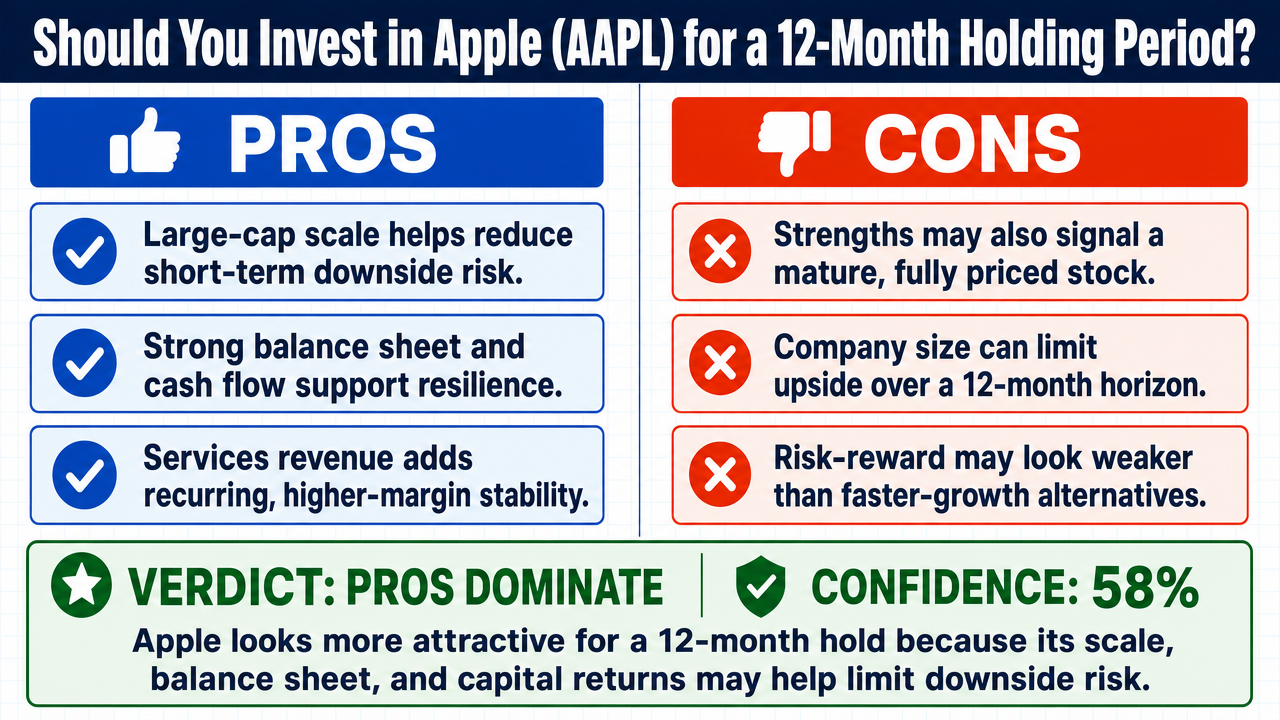
Tournament Final Verdict
Clerk Decision: CLAIM SUPPORTED (TRUE) — Certainty: 58%
Web Report: https://solsicefinance.com/public/debates/should-you-invest-in-aapl-for-a-12-month-investment-bd975e597367
This section provides a brief overview of the key arguments. You do not need to read the full detailed report below.
✅ Key PRO arguments:
- ■Apple's large-cap scale produces predictable liquidity , deep marketability, and balance-sheet durability that materially reduce short-term downside risk for a 12-month holder.
- ■Apple maintains an exceptionally strong balance sheet with consistently large operating cash flows, ample cash and marketable securities , and an active share-repurchase and dividend program that concentrates returns to holders even during stock volatility.
- ■Apple's services and installed-base economics add recurring, high-margin revenue that makes near-term earnings more predictable than a pure hardware company, raising the probability of positive total return over a 12-month horizon.
❌ Key ANTI arguments:
- ■The same empirical facts (balance sheet , services, buybacks ) could be interpreted as signs of a mature, over-valued franchise that creates asymmetric downside risk within a 12-month window.
- ■Apple's maturity and scale could imply limited upside potential over a short 12-month horizon, making the risk-reward profile less attractive than for higher-growth alternatives.
💭 Conclusion: The verdict favors investing in AAPL for a 12-month horizon based on the affirmative's case that Apple's large-cap scale, strong balance sheet , and active capital-return program reduce downside risk . The affirmative argued that recurring high-margin services revenue and ongoing buybacks create a cash-flow-driven floor under short-term returns, making positive total return more probable. The opponent raised four material risks—elevated valuation (premium multiples), structural iPhone saturation, an observable AI execution lag relative to some competitors, and regulatory pressure on services (EU DMA, legal actions)—which shorten the margin for error but do not negate the affirmative's qualitative case. The verdict is consistent with the winning side's strongest arguments about balance-sheet durability and capital returns supporting a 12-month investment thesis.
🔬 DeepResearch Result: TRUE ✅ (58% confidence)
Assertion: Should you invest in AAPL for a 12-month investment?
📊 Tournament: 1 voted TRUE, 0 voted FALSE (1 debates played, 3 models)
📊 Weighted scores: TRUE=0.58, FALSE=0.00
🏅 Judge Score Changes:
minimax-m3 💬👁️: +6
✅ PRO Arguments:
- ■Apple's large-cap scale produces predictable liquidity , deep marketability, and balance-sheet durability that materially reduce short-term downside risk for a 12-month holder. [gpt-5-mini 💬👁️]
- ■Apple maintains an exceptionally strong balance sheet with consistently large operating cash flows, ample cash and marketable securities , and an active share-repurchase and dividend program that concentrates returns to holders even during stock volatility. [gpt-5-mini 💬👁️]
- ■Apple's services and installed-base economics add recurring, high-margin revenue that makes near-term earnings more predictable than a pure hardware company, raising the probability of positive total return over a 12-month horizon. [gpt-5-mini 💬👁️]
- ■The combination of balance-sheet strength, recurring services revenue , and active capital returns creates a durable, cash-flow-driven floor under short-term returns, supporting a buy recommendation for a one-year holder. [gpt-5-mini 💬👁️]
- ■Ongoing material buybacks mechanically support EPS per share, providing an additional layer of return for shareholders independent of stock price appreciation . [gpt-5-mini 💬👁️]
❌ ANTI Arguments:
- ■The same empirical facts (balance sheet, services, buybacks) could be interpreted as signs of a mature, over-valued franchise that creates asymmetric downside risk within a 12-month window. [deepseek-v4-flash-0731 💬]
- ■Apple's maturity and scale could imply limited upside potential over a short 12-month horizon, making the risk-reward profile less attractive than for higher-growth alternatives. [deepseek-v4-flash-0731 💬]
💭 Reasoning: The verdict favors investing in AAPL for a 12-month horizon based on the affirmative's case that Apple's large-cap scale, strong balance sheet, and active capital-return program reduce downside risk. The affirmative argued that recurring high-margin services revenue and ongoing buybacks create a cash-flow-driven floor under short-term returns, making positive total return more probable. The opponent raised four material risks—elevated valuation (premium multiples), structural iPhone saturation, an observable AI execution lag relative to some competitors, and regulatory pressure on services (EU DMA, legal actions)—which shorten the margin for error but do not negate the affirmative's qualitative case. The verdict is consistent with the winning side's strongest arguments about balance-sheet durability and capital returns supporting a 12-month investment thesis.
📋 PRO Facts:
• Apple maintains consistently large operating cash flows and ample cash and marketable securities.
• Apple has an active share-repurchase and dividend program that concentrates returns to holders.
• Apple's services segment provides recurring, high-margin revenue that improves earnings predictability.
• Apple's large-cap status reflects its diversified revenue mix and massive installed base that convert product cycles into recurring revenue streams.
• Ongoing buybacks mechanically support EPS per share over time.
📋 ANTI Facts:
• Apple's maturity and scale could be interpreted as indicators of a mature, potentially over-valued franchise.
• The same traits cited as protective (balance sheet, services, buybacks) could flip to liabilities within a 12-month window if valuation compresses.
| Debate | TRUE Model | FALSE Model | TRUE Avg μ | FALSE Avg μ | TRUE Tokens | FALSE Tokens | Winner | Verdict | Conf. |
|---|---|---|---|---|---|---|---|---|---|
| #1 | gpt-5-mini 💬👁️ | deepseek-v4-flash-0731 💬 | 0.116 | 0.095 | 24 | 3 | TRUE | TRUE | 58% |
The following technical terms, abbreviations, and domain-specific concepts are referenced throughout this debate transcript. Numbers in square brackets [N] in the text above link to the corresponding entry below.
[1] 10-K — Form 10-K — An annual report filed by publicly traded companies with the SEC that provides a comprehensive overview of the company's financial performance, risks, and operations over the fiscal year.
[2] AAPL — Apple Inc. ticker symbol — The stock ticker symbol used to identify Apple Inc. shares on stock exchanges such as NASDAQ.
[3] ACE — Attempto Controlled English — A restricted, unambiguous subset of natural English designed to be automatically translatable into first-order logic, used here as a formalization framework for logical analysis.
[4] antitrust — antitrust regulation — Laws and regulatory actions designed to promote market competition by preventing monopolistic practices, price-fixing, and anti-competitive mergers.
[5] asymmetric downside — asymmetric downside risk — A risk profile in which the potential losses on an investment exceed the potential gains, meaning downside risk is greater than upside potential.
[6] balance sheet — A financial statement that reports a company's assets, liabilities, and shareholders' equity at a specific point in time, providing a snapshot of its financial condition.
[7] buybacks — share buybacks — The repurchase of a company's own outstanding shares by that company, typically to reduce share count, return capital to shareholders, or signal undervaluation.
[8] capital allocation — The strategic process by which a company decides how to deploy its financial resources among competing needs such as operations, investment, dividends, and share repurchases.
[9] capital return — capital return program — A company's program of returning capital to shareholders, typically through dividends and share repurchases, rather than retaining it for reinvestment.
[10] CIK — Central Index Key — A unique identifier assigned by the SEC to each entity that files disclosures with the agency, used to track filings in the EDGAR system.
[11] currency swings — Significant fluctuations in foreign exchange rates that can affect a multinational company's reported revenues, costs, and earnings when translated back to its home currency.
[12] downside risk — The potential for an investment to decline in value, often quantified as the probability and magnitude of negative returns.
[13] earnings volatility — The degree of variation or fluctuation in a company's reported earnings over time, indicating the unpredictability of its profit stream.
[14] EDGAR — Electronic Data Gathering, Analysis, and Retrieval — The SEC's public database where companies file required disclosures such as 10-Ks, 10-Qs, and 8-Ks, accessible for investor research.
[15] EPS — Earnings Per Share — A profitability metric calculated as net income divided by the number of outstanding shares, indicating how much profit is allocated to each share.
[16] FY — Fiscal Year — A 12-month period that a company uses for accounting and budgeting purposes, which may not align with the calendar year.
[17] high-margin — Describing a product, service, or business segment that generates profit margins significantly above average, often due to pricing power or low variable costs.
[18] holding period — The length of time an investor intends to own an investment, which influences tax treatment, risk assessment, and expected return profile.
[19] installed base — The total number of active products or users currently in use for a given company, often used as a leading indicator of recurring services revenue.
[20] interest-rate shocks — Sudden, unexpected changes in benchmark interest rates that can affect borrowing costs, equity valuations, and consumer demand.
[21] Large Cap — Large Capitalization — A classification for publicly traded companies with a market capitalization typically above $10 billion, generally considered more stable and liquid than smaller companies.
[22] liquidity — The ease with which an asset can be converted to cash without affecting its market price, or the availability of cash to meet obligations.
[23] macro sensitivity — The degree to which a company's performance or valuation is affected by broad macroeconomic factors such as GDP growth, interest rates, and inflation.
[24] marketable securities — Liquid financial instruments such as Treasury bills, commercial paper, and listed stocks that a company holds and can quickly convert to cash.
[25] multiple expansion — An increase in the valuation multiple (such as P/E ratio) that investors are willing to pay for a company's earnings or revenue, often driving share price gains.
[26] net income — A company's total earnings after deducting all expenses, including operating costs, interest, taxes, and depreciation, from total revenue.
[27] operating cash flow — The cash a company generates from its core business operations, as reported on the cash flow statement, indicating the sustainability of its earnings.
[28] per-share earnings — Earnings allocated to each outstanding share, equivalent to EPS, used to measure profitability on a per-share basis.
[29] price appreciation — The increase in the market price of an asset over time, representing one component of total return alongside dividends or distributions.
[30] recurring revenue — Revenue that is expected to continue renewing over multiple periods, such as subscriptions or service contracts, providing more predictable cash flows than one-time sales.
[31] revenue growth — The percentage increase in a company's total sales or revenue over a specified period, often measured sequentially or year-over-year.
[32] SEC — Securities and Exchange Commission — The U.S. federal regulatory agency responsible for enforcing securities laws, regulating stock exchanges, and requiring public companies to disclose financial information.
[33] services revenue — Revenue generated from non-product offerings such as subscriptions, app store commissions, advertising, cloud services, and licensing fees.
[34] share base — The total number of a company's outstanding shares, which is reduced by buybacks and affects per-share metrics such as EPS.
[35] share count — The number of a company's outstanding shares of stock, used as the denominator in per-share calculations such as EPS.
[36] share repurchase — The action of a company buying back its own shares from the marketplace, reducing the total share count and returning capital to shareholders.
[37] tail risks — Low-probability events that occur at the extreme ends of a probability distribution but have outsized impact, such as regulatory crackdowns or geopolitical conflicts.
[38] total return — The overall gain or loss on an investment over a period, combining price appreciation (or depreciation) with income from dividends or distributions.
[39] YoY — Year over Year — A comparison metric that measures change in a value relative to the same period one year earlier, commonly used to evaluate growth in revenue, earnings, or other metrics.
[40] μScore — mu-score / micro score — A scoring metric used in the debate evaluation system to rate the strength or quality of an argument, with higher values indicating stronger positions.
Debate Transcripts
- ■
Ownership & Trade Secrets. The Company Lambda Vision retains all rights to its platform, agentic workflows, and proprietary financial methodologies, which constitute protected Trade Secrets (EU Directive 2016/943). Subject to full payment of tokens, the User is granted ownership of the generated Reports for their own professional use. Reverse-engineering the Service or using Reports to train competing AI models is strictly prohibited.
- ■
No Financial Advice. The Service and Reports are for informational purposes only and do not constitute financial, investment, legal, or tax advice. The Company is not a regulated financial advisor. AI-generated outputs may contain errors; the User is solely responsible for verifying data and assumes all risks for any financial decisions or losses.
- ■
Liability & Governing Law. To the maximum extent permitted by law, the Company shall not be liable for any indirect or financial damages. These Terms are governed by French law. Any disputes shall be subject to the exclusive jurisdiction of the Courts of Paris, France.