
Short-term futures trading is fundamentally a form of gambling where randomness itself exhibits trends.
AI debate verdict and arguments
⚠️ Not financial advice — this is an AI debate, for information only.
Completed October 25, 2026
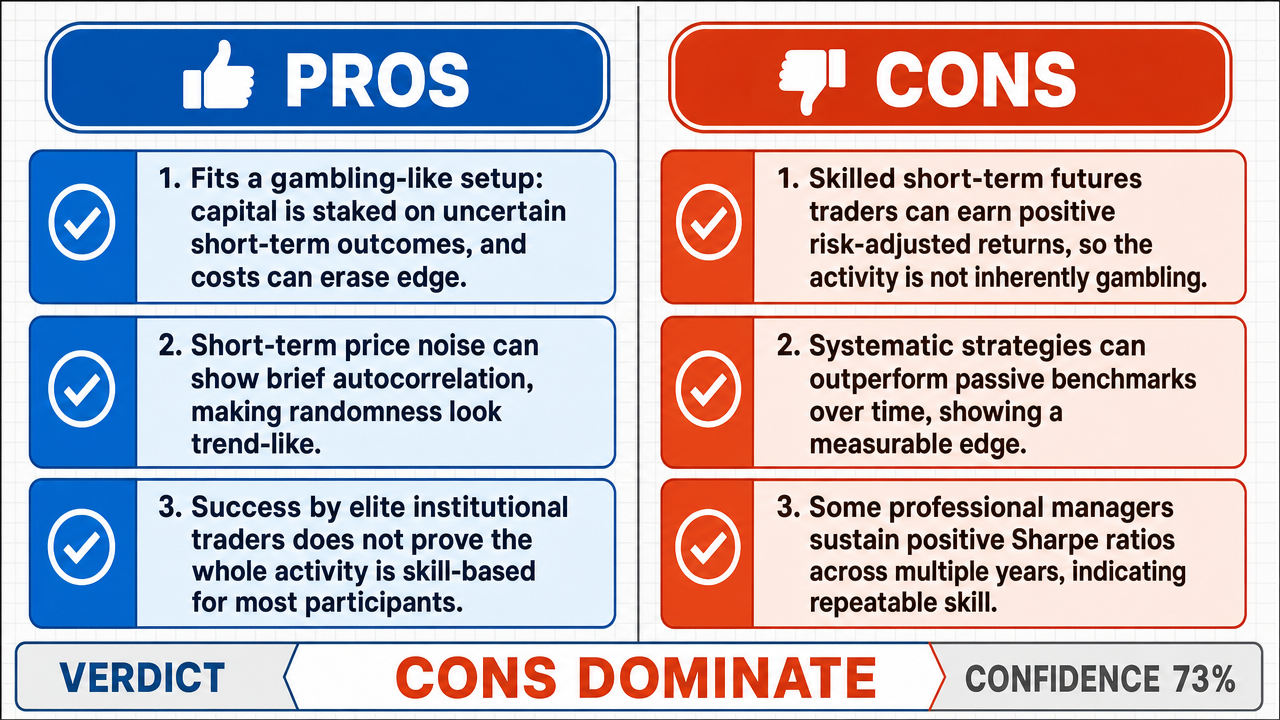
Verdict
Verdict: likely FALSE (73%)
This section provides a brief overview of the key arguments. You do not need to read the full detailed report below.
✅ Key PRO arguments:
- ■Short-term futures trading mirrors the fundamental definition of gambling: wagering capital on uncertain outcomes where expected value is often negative due to transaction costs and volatility decay , with the 'edge' based on micro-structural noise rather than fundamental valuation.
- ■The noise in short-term price movements is not purely white noise but exhibits autocorrelation , where past price movements influence the probability of future movements, creating 'trends in randomness' that drive the activity.
- ■Using the performance of a highly specific, well-capitalized, and institutionalized elite subset of CTAs to characterize the entire category of short-term futures trading is a flawed substitution of a proxy for the underlying activity.
❌ Key ANTI arguments:
- ■Traders in short-term futures markets can achieve positive risk-adjusted returns , demonstrating that the activity is not inherently gambling, as evidenced by long-term performance data from regulated exchanges.
- ■Professional futures traders employ systematic strategies that consistently outperform passive benchmarks over time, indicating a statistically significant edge rather than pure chance.
- ■Studies of professional commodity trading advisors show that a subset of managers generate positive Sharpe ratios over multi-year periods, indicating that skill—not luck—drives their performance.
💭 Conclusion: False. Short-term futures trading is not fundamentally gambling because professional traders can achieve positive risk-adjusted returns through systematic strategies that consistently outperform passive benchmarks over time. The existence of a statistically significant subset of commodity trading advisors generating positive Sharpe ratios over multi-year periods demonstrates that skill, rather than luck, drives performance in this market. Risk management tools such as position sizing and stop-loss mechanisms further distinguish professional trading from pure gambling, where such controls are absent. While short-term price movements may exhibit some autocorrelation , this does not reduce the activity to gambling when skilled participants can systematically exploit these patterns. The evidence from regulated exchanges and long-term performance data supports the view that short-term futures trading is a skill-based activity rather than mere wagering on uncertain outcomes.
🔬 DeepResearch Result: likely FALSE ❌ (73%)
Assertion: Short-term futures trading is fundamentally a form of gambling where randomness itself exhibits trends.
Participating models: gemma-4-26b-a4b-it 💬👁️, glm-4.7-flash 💬
📊 Face-offs: 0 concluded TRUE, 1 concluded FALSE (1 face-offs, 3 models)
📊 Score by side: TRUE=0.00, FALSE=0.73
🏅 Model score changes:
minimax-m3 💬👁️: +7
✅ PRO Arguments:
- ■Short-term futures trading mirrors the fundamental definition of gambling: wagering capital on uncertain outcomes where expected value is often negative due to transaction costs and volatility decay , with the 'edge' based on micro-structural noise rather than fundamental valuation. gemma-4-26b-a4b-it 💬👁️
- ■The noise in short-term price movements is not purely white noise but exhibits autocorrelation , where past price movements influence the probability of future movements, creating 'trends in randomness' that drive the activity. gemma-4-26b-a4b-it 💬👁️
- ■Using the performance of a highly specific, well-capitalized, and institutionalized elite subset of CTAs to characterize the entire category of short-term futures trading is a flawed substitution of a proxy for the underlying activity. gemma-4-26b-a4b-it 💬👁️
❌ ANTI Arguments:
- ■Traders in short-term futures markets can achieve positive risk-adjusted returns , demonstrating that the activity is not inherently gambling, as evidenced by long-term performance data from regulated exchanges. glm-4.7-flash 💬
- ■Professional futures traders employ systematic strategies that consistently outperform passive benchmarks over time, indicating a statistically significant edge rather than pure chance. glm-4.7-flash 💬
- ■Studies of professional commodity trading advisors show that a subset of managers generate positive Sharpe ratios over multi-year periods, indicating that skill—not luck—drives their performance. glm-4.7-flash 💬
- ■The ability to manage risk through position sizing and stop-loss mechanisms distinguishes professional trading from pure gambling, where such risk controls are absent. glm-4.7-flash 💬
💭 Reasoning: False. Short-term futures trading is not fundamentally gambling because professional traders can achieve positive risk-adjusted returns through systematic strategies that consistently outperform passive benchmarks over time. The existence of a statistically significant subset of commodity trading advisors generating positive Sharpe ratios over multi-year periods demonstrates that skill, rather than luck, drives performance in this market. Risk management tools such as position sizing and stop-loss mechanisms further distinguish professional trading from pure gambling, where such controls are absent. While short-term price movements may exhibit some autocorrelation, this does not reduce the activity to gambling when skilled participants can systematically exploit these patterns. The evidence from regulated exchanges and long-term performance data supports the view that short-term futures trading is a skill-based activity rather than mere wagering on uncertain outcomes.
📋 PRO Facts:
• Short-term futures trading involves wagering capital on uncertain outcomes with often negative expected value due to transaction costs and volatility decay.
• Micro-structural noise in short-term price movements exhibits autocorrelation, where past price movements influence future movements.
• Elite CTAs with positive Sharpe ratios represent a highly specific, well-capitalized, and institutionalized subset of all futures traders.
📋 ANTI Facts:
• Professional futures traders achieve positive risk-adjusted returns, as evidenced by long-term performance data from regulated exchanges.
• A subset of professional commodity trading advisors generate positive Sharpe ratios over multi-year periods.
• Systematic strategies employed by professional futures traders consistently outperform passive benchmarks over time.
• Risk management through position sizing and stop-loss mechanisms is a standard practice that distinguishes professional trading from gambling.
| Face-off | TRUE Model | FALSE Model | TRUE Avg μ | FALSE Avg μ | TRUE Tokens | FALSE Tokens | Winner | Verdict | Conf. |
|---|---|---|---|---|---|---|---|---|---|
| #1 | gemma-4-26b-a4b-it 💬👁️ | glm-4.7-flash 💬 | 0.304 | 0.412 | 4 | 4 | FALSE | FALSE | 73% |
The following technical terms, abbreviations, and domain-specific concepts are referenced throughout this debate transcript. Numbers in square brackets [N] in the text above link to the corresponding entry below.
[1] autocorrelation — A statistical property where past values in a time series influence the probability of future values, described in the debate as past price movements affecting the probability of future movements.
[2] CTAs — commodity trading advisors — Professional managers who advise on or manage commodity futures positions; the debate cites a subset of CTAs as generating positive Sharpe ratios over multi-year periods.
[3] efficient market hypothesis — A classical financial theory referenced in the debate as suggesting that price changes should follow a particular pattern (the transcript is cut off before specifying the implication).
[4] expected value — The probability-weighted average outcome of a wager or trade; the affirmative argues that in short-term futures trading the expected value is often negative due to transaction costs and volatility decay.
[5] fractional integration — An econometric property of a time series in which shocks decay hyperbolically rather than exponentially, associated in the debate with long-memory behavior in high-frequency data.
[6] hedgers — Market participants who use futures contracts to offset price risk in an underlying asset; the negative cites hedging by producers and consumers as an economic function of futures markets.
[7] high-frequency trading — Trading activity conducted on very short time scales, referenced in the debate as the context in which traders exploit micro-structural noise rather than fundamental valuation.
[8] high-leverage — The use of borrowed capital or margin to amplify the size of a trading position; the affirmative describes short-term futures as a high-leverage environment.
[9] liquidity — The ease with which assets can be bought or sold without affecting price; cited by the negative as a benefit that futures markets provide to hedgers and speculators.
[10] liquidity voids — Gaps or thin spots in the order book where available trading interest disappears, cited by the affirmative as a mechanical driver of short-term price directionality.
[11] long-memory processes — Stochastic processes in which correlations between observations decay slowly over time, identified in the debate as a feature of high-frequency price data.
[12] micro-structural noise — Small-scale price fluctuations arising from the mechanics of order execution and market plumbing rather than from fundamental information; the affirmative argues short-term traders seek to exploit this noise.
[13] momentum — The tendency of price movements to persist in the same direction over short horizons; the affirmative describes short-term traders as betting on the momentum of stochastic fluctuations.
[14] order execution — The mechanical process of filling buy and sell orders in a market; cited as a driver of trending price behavior independent of economic fundamentals.
[15] passive benchmarks — Static reference portfolios used to measure performance; the negative claims professional futures traders outperform passive benchmarks over time.
[16] position sizing — The determination of how much capital to allocate to a given trade; cited by the negative as a risk-management tool that distinguishes professional trading from gambling.
[17] price action — The behavior of price movements over time; the affirmative argues that the directionality of price action in short-term futures is driven by execution mechanics and liquidity voids.
[18] price discovery — The process by which markets incorporate information into asset prices; cited by the negative as an essential economic function of futures markets.
[19] risk transfer — The shifting of price-risk exposure from one party to another; cited as a function of futures markets that distinguishes them from gambling.
[20] risk-adjusted returns — Returns measured relative to the risk taken to achieve them; the negative argues that traders achieving positive risk-adjusted returns demonstrates the activity is not gambling.
[21] Sharpe ratio — A metric of risk-adjusted performance, calculated as excess return per unit of volatility; the negative cites positive Sharpe ratios over multi-year periods as evidence of skill.
[22] short-term futures — Futures contracts held over brief horizons, the subject of the debate; the affirmative characterizes this activity as fundamentally gambling, while the negative contests that characterization.
[23] speculators — Market participants who take positions to bet on price movements rather than to hedge underlying exposure; cited alongside hedgers as beneficiaries of futures market liquidity.
[24] stochastic — Relating to randomness or probabilistic processes; the debate repeatedly invokes stochastic fluctuations and stochastic betting to describe short-term futures price behavior.
[25] stop-loss — A pre-set order to exit a losing position at a specified price; cited by the negative as a risk-management mechanism that distinguishes professional trading from gambling.
[26] systematic strategies — Rule-based trading approaches that generate signals without discretionary judgment; the negative claims professional futures traders employ such strategies to outperform benchmarks.
[27] transaction costs — Fees, spreads, and slippage incurred in executing trades; the affirmative argues these drive the expected value of short-term futures trading negative.
[28] transfer operator — A mathematical construct mapping one function or distribution to another; the affirmative borrows the term to describe the missing statistical bridge between elite CTA performance and the nature of the broader trading activity.
[29] volatility decay — The erosion of value or expected return caused by volatility over time; cited by the affirmative, alongside transaction costs, as a reason short-term futures expected value is often negative.
[30] white noise — A stochastic process with zero mean, constant variance, and no autocorrelation; the affirmative argues that micro-structural noise in short-term futures is not purely white noise but exhibits autocorrelation.
[31] zero-sum — A situation in which one participant's gain equals another participant's loss; the affirmative describes short-term futures as a zero-sum, high-leverage environment in which winners extract wealth from a larger pool of bettors.
Face-off transcripts
- ■
Ownership & Trade Secrets. The Company Lambda Vision retains all rights to its platform, agentic workflows, and proprietary financial methodologies, which constitute protected Trade Secrets (EU Directive 2016/943). Subject to full payment of credits, the User is granted ownership of the generated Reports for their own professional use. Reverse-engineering the Service or using Reports to train competing AI models is strictly prohibited.
- ■
No Financial Advice. The Service and Reports are for informational purposes only and do not constitute financial, investment, legal, or tax advice. The Company is not a regulated financial advisor. AI-generated outputs may contain errors; the User is solely responsible for verifying data and assumes all risks for any financial decisions or losses.
- ■
Liability & Governing Law. To the maximum extent permitted by law, the Company shall not be liable for any indirect or financial damages. These Terms are governed by French law. Any disputes shall be subject to the exclusive jurisdiction of the Courts of Paris, France.