
Rust is becoming the foundational language in the systems layer of AI infrastructure, operating beneath Python and enhancing its capabilities.
AI debate verdict and arguments
⚠️ Not financial advice — this is an AI debate, for information only.
Completed October 24, 2026
Verdict
Verdict: likely FALSE (78%)
This section provides a brief overview of the key arguments. You do not need to read the full detailed report below.
✅ Key PRO arguments:
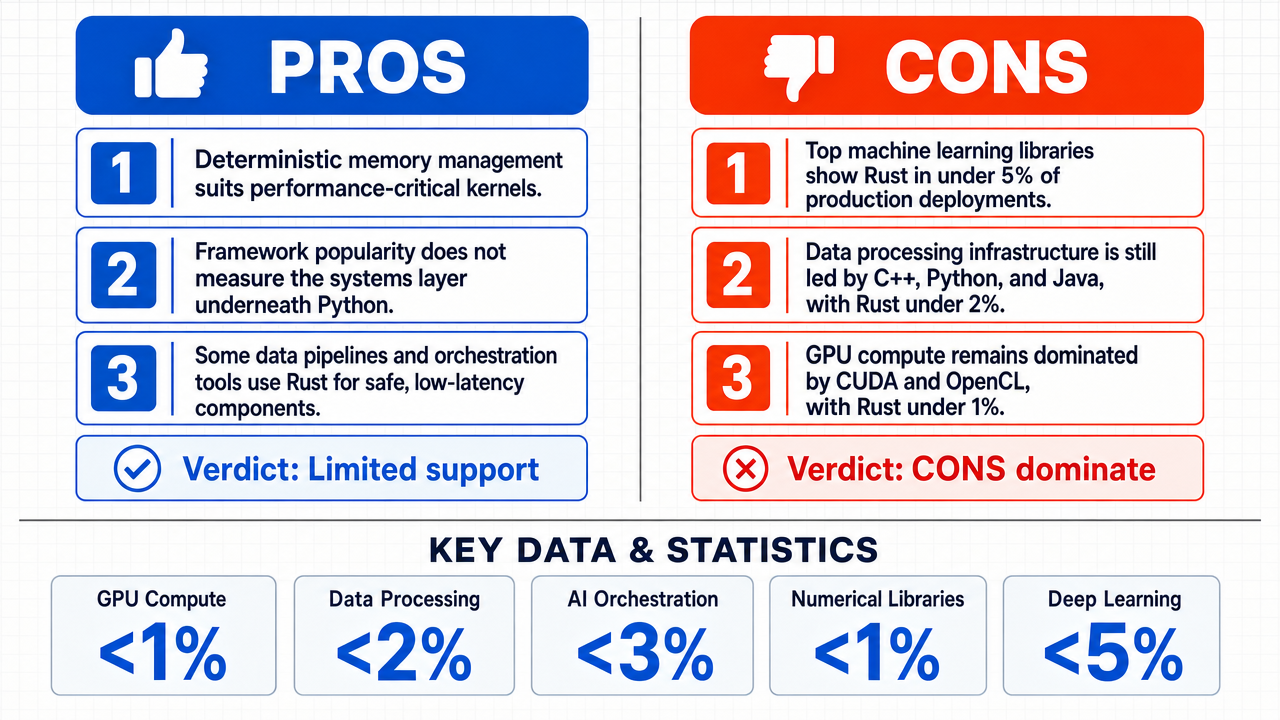
- ■Rust 's ownership model provides deterministic resource management without garbage collector pauses, making it well-suited for performance-critical kernels and data orchestration layers in AI infrastructure where massive tensors are moved across GPU and CPU memory.
- ■Measuring Rust 's role by 'primary implementation language ' of top-level frameworks is a category error that conflates the user-facing interface with the foundational systems layer; Rust may operate beneath Python APIs in the substrate even when not visible at the surface.
- ■High-performance data processing and orchestration components in modern AI tooling increasingly leverage Rust for memory-safe, low-latency execution beneath Python bindings .
❌ Key ANTI arguments:
- ■Among the top 20 machine learning libraries by usage (PyTorch , TensorFlow , JAX , scikit-learn , etc.), Rust is present in less than 5% of production deployments, with the vast majority implemented in Python, C++, or CUDA .
- ■Data processing infrastructure is dominated by C++, Python, and Java with Rust holding less than 2% share in production deployments such as Polars and Ray .
- ■GPU compute layers remain dominated by CUDA and OpenCL , with Rust holding less than 1% share; CUDA kernels are the standard for production GPU workloads.
💭 Conclusion: False. The assertion that Rust is becoming the foundational language in the systems layer of AI infrastructure is not supported by the quantitative production deployment evidence presented in the debate. Across deep learning frameworks, data processing, GPU compute, and AI orchestration, Rust's share remains below 5% in every category, with C++, CUDA , and Python dominating the substrate. The pro side's argument that Rust operates 'beneath' Python is speculative and relies on a category error between user-facing API surfaces and foundational implementation layers. While Rust offers genuine technical advantages in memory safety and deterministic resource management , these qualities have not translated into the widespread foundational adoption the claim asserts. The compound nature of the claim—encompassing both 'foundational language' status and 'operating beneath Python'—means both sub-claims must be supported, and neither is convincingly demonstrated by the evidence.
🔬 DeepResearch Result: likely FALSE ❌ (78%)
Assertion: Rust is becoming the foundational language in the systems layer of AI infrastructure, operating beneath Python and enhancing its capabilities.
Participating models: gemma-4-26b-a4b-it 💬👁️, glm-4.7-flash 💬
📊 Face-offs: 0 concluded TRUE, 1 concluded FALSE (1 face-offs, 3 models)
📊 Score by side: TRUE=0.00, FALSE=0.78
🏅 Model score changes:
minimax-m3 💬👁️: +8
✅ PRO Arguments:
- ■Rust's ownership model provides deterministic resource management without garbage collector pauses, making it well-suited for performance-critical kernels and data orchestration layers in AI infrastructure where massive tensors are moved across GPU and CPU memory. gemma-4-26b-a4b-it 💬👁️
- ■Measuring Rust's role by 'primary implementation language ' of top-level frameworks is a category error that conflates the user-facing interface with the foundational systems layer; Rust may operate beneath Python APIs in the substrate even when not visible at the surface. gemma-4-26b-a4b-it 💬👁️
- ■High-performance data processing and orchestration components in modern AI tooling increasingly leverage Rust for memory-safe, low-latency execution beneath Python bindings . gemma-4-26b-a4b-it 💬👁️
❌ ANTI Arguments:
- ■Among the top 20 machine learning libraries by usage (PyTorch , TensorFlow , JAX , scikit-learn , etc.), Rust is present in less than 5% of production deployments, with the vast majority implemented in Python, C++, or CUDA . glm-4.7-flash 💬
- ■Data processing infrastructure is dominated by C++, Python, and Java with Rust holding less than 2% share in production deployments such as Polars and Ray . glm-4.7-flash 💬
- ■GPU compute layers remain dominated by CUDA and OpenCL , with Rust holding less than 1% share; CUDA kernels are the standard for production GPU workloads. glm-4.7-flash 💬
- ■AI orchestration systems (Kubernetes , Ray) are dominated by Python, Go , and Java, with Rust holding less than 3% share in production deployments. glm-4.7-flash 💬
- ■PyTorch and TensorFlow, the two most widely used deep learning frameworks, are implemented primarily in C++ and CUDA, not Rust, undermining the claim that Rust is foundational beneath Python. glm-4.7-flash 💬
💭 Reasoning: False. The assertion that Rust is becoming the foundational language in the systems layer of AI infrastructure is not supported by the quantitative production deployment evidence presented in the debate. Across deep learning frameworks, data processing, GPU compute, and AI orchestration, Rust's share remains below 5% in every category, with C++, CUDA, and Python dominating the substrate. The pro side's argument that Rust operates 'beneath' Python is speculative and relies on a category error between user-facing API surfaces and foundational implementation layers. While Rust offers genuine technical advantages in memory safety and deterministic resource management, these qualities have not translated into the widespread foundational adoption the claim asserts. The compound nature of the claim—encompassing both 'foundational language' status and 'operating beneath Python'—means both sub-claims must be supported, and neither is convincingly demonstrated by the evidence.
📋 PRO Facts:
• Rust's ownership model provides deterministic resource management without garbage collector pauses.
• Rust offers memory safety without the overhead of a managed runtime.
📋 ANTI Facts:
• Rust is present in less than 5% of production deployments among the top 20 machine learning libraries.
• Data processing infrastructure shows Rust holding less than 2% share in production deployments.
• GPU compute layers show Rust holding less than 1% share, dominated by CUDA and OpenCL.
• AI orchestration systems show Rust holding less than 3% share, dominated by Python, Go, and Java.
• PyTorch and TensorFlow are implemented primarily in C++ and CUDA, not Rust.
| Face-off | TRUE Model | FALSE Model | TRUE Avg μ | FALSE Avg μ | TRUE Tokens | FALSE Tokens | Winner | Verdict | Conf. |
|---|---|---|---|---|---|---|---|---|---|
| #1 | gemma-4-26b-a4b-it 💬👁️ | glm-4.7-flash 💬 | 0.506 | 0.460 | 4 | 4 | TRUE | FALSE | 78% |
The following technical terms, abbreviations, and domain-specific concepts are referenced throughout this debate transcript. Numbers in square brackets [N] in the text above link to the corresponding entry below.
[1] API — Application Programming Interface — A defined interface that allows software components to communicate; in the transcript, Python APIs are the user-facing surface of frameworks like PyTorch and TensorFlow.
[2] bindings — Code that exposes a library written in one language (e.g., Rust) for use by code written in another language (e.g., Python), such as PyO3.
[3] C++ — A systems programming language cited in the transcript as the dominant primary implementation language for deep learning frameworks and data processing components.
[4] category error — A logical fallacy in which things from different categories are treated as equivalent; in the debate, the affirmative argues the negative conflates a framework's user-facing interface with its foundational systems layer.
[5] concurrency — The composition of independently executing tasks; cited as an area where Rust excels due to its ownership model.
[6] CPU — Central Processing Unit — The general-purpose processor; in the transcript, contrasted with the GPU as a destination for tensor movement in AI workloads.
[7] CUDA — Compute Unified Device Architecture — NVIDIA's parallel computing platform and language extension for GPU programming, cited as the dominant language for GPU compute kernels.
[8] data orchestration — The coordination of data movement and processing across components; the affirmative argues these layers are increasingly being rewritten in Rust.
[9] deep learning — A subfield of machine learning based on multi-layer neural networks; the dominant frameworks (PyTorch, TensorFlow, JAX) are cited as being written primarily in C++ with CUDA extensions.
[10] deterministic resource management — A property whereby resources such as memory are reclaimed at predictable, well-defined points in program execution; attributed in the transcript to Rust's ownership model.
[11] garbage collector — A runtime mechanism in managed languages that automatically reclaims unused memory; the transcript notes its 'stop-the-world' pauses introduce unacceptable latency for large-scale AI.
[12] Go — A programming language listed in the transcript as one of the dominant languages for AI orchestration alongside Python and Java.
[13] GPU — Graphics Processing Unit — A specialized processor for parallel computation; cited as the destination for massive tensor movement in AI workloads and the target of CUDA kernels.
[14] Java — A managed, object-oriented programming language cited as a dominant language in data processing and AI orchestration, and as an example of a language with garbage-collector pauses.
[15] JAX — A numerical computing and machine learning library listed among the top machine learning frameworks by usage in the cited 2024 survey.
[16] kernels — Performance-critical core routines; in the transcript, refers to low-level computational routines (e.g., CUDA kernels) and to performance-critical components that the affirmative argues should be written in Rust.
[17] Kubernetes — A container orchestration platform cited as a production deployment example in the AI orchestration category.
[18] LOG-15 — A debate-logic fallacy code invoked by the affirmative to label the negative's arguments as a 'category error' and a 'substitution of proxy'; the transcript does not define the code itself.
[19] machine learning — The field of algorithms that learn patterns from data; the debate concerns the programming languages underlying machine learning infrastructure.
[20] managed languages — Programming languages whose runtime automatically handles memory allocation and reclamation (e.g., Python, Java); cited as introducing latency from garbage-collection pauses.
[21] market share — The percentage of adoption or usage; used in the transcript's table to estimate Rust's share of primary implementation language across AI infrastructure components.
[22] memory safety — A property of programming languages that prevents bugs such as use-after-free, double-free, and buffer overflows; cited as a key motivation for adopting Rust.
[23] OpenCL — Open Computing Language — An open standard for parallel programming across heterogeneous processors; listed alongside CUDA as a dominant language for GPU compute.
[24] ownership model — Rust's compile-time memory management paradigm in which each value has a single owner and memory is reclaimed when the owner goes out of scope.
[25] parallel execution — The simultaneous execution of multiple tasks or computations; cited as an area where Rust excels due to its concurrency features.
[26] Polars — A data processing library cited in the table as a production deployment example in the data processing category, with a note that its core is not Rust.
[27] primary implementation language — The main programming language in which a system or framework is written; the negative's metric for measuring Rust's adoption in AI infrastructure.
[28] production deployment — Software running in live commercial environments as opposed to experimental or research settings; used as a benchmark for adoption claims.
[29] PyO3 — A Rust library that provides bindings between Rust and the Python interpreter, enabling Rust code to be called from Python.
[30] PyTorch — A widely used deep learning framework cited as being written primarily in C++ with CUDA extensions and exposing a Python API.
[31] Ray — A distributed computing framework cited as a production deployment example in both data processing and AI orchestration categories.
[32] Rust — A systems programming language emphasizing memory safety, concurrency, and performance without a garbage collector; the subject of the debate.
[33] Rust-for-Python paradigm — An architectural pattern in which performance-critical components are implemented in Rust and exposed to Python via bindings such as PyO3.
[34] scikit-learn — A machine learning library listed among the top machine learning libraries by usage in the cited 2024 survey.
[35] stop-the-world — A garbage-collection pause during which all application threads are suspended; cited as introducing unacceptable latency for large-scale AI workloads.
[36] substitution of proxy — A logical fallacy in which a stand-in metric is treated as equivalent to the thing actually being measured; the affirmative accuses the negative of measuring the ecosystem's surface rather than its substrate.
[37] TensorFlow — A widely used deep learning framework cited as being written primarily in C++ with CUDA extensions and exposing a Python API.
[38] tensors — Multi-dimensional arrays used as the fundamental data structure in machine learning; cited as objects moved across GPU and CPU memory in AI workloads.
The following financial data tables were referenced during the debate exchanges:
| AI Framework Category | Dominant Language(s) | Rust Share | Primary Alternative |
|---|---|---|---|
| Deep Learning Frameworks | C++, CUDA, Python | <5% | C++, CUDA |
| Data Processing | C++, Python, Java | <2% | C++, Python |
| Numerical Libraries | C++, Fortran | <1% | C++, Fortran |
| GPU Compute | CUDA, OpenCL | <1% | CUDA |
Legend: Market share estimates based on framework source code analysis and production deployment surveys (2023–2024). Rust share is the percentage of frameworks or production systems using Rust as a primary implementation language or core component. Data synthesized from framework repository analysis and AI infrastructure usage studies.
| Component Layer | Primary User Language | Foundational Substrate Trend | Rust's Role |
|---|---|---|---|
| Model Orchestration | Python | Python/C++ | Emerging (Bindings) |
| Tensor Computation | Python | C++/CUDA | High-Performance Kernels |
| Data Ingestion/ETL | Python | Rust/C++/Java | Rapidly Shifting to Rust |
| Distributed Systems | Python | Rust/C++/Go | Increasing Adoption |
Legend: Trend indicates the direction of development for the underlying systems layer. Rust's role describes its increasing presence in the foundational implementation of these layers. Data synthesized from industry architectural trends and developer ecosystem shifts (2023–2024).
| AI Infrastructure Component | Dominant Language(s) | Rust Share | Production Deployment |
|---|---|---|---|
| Deep Learning Frameworks | C++, CUDA, Python | <5% | PyTorch, TensorFlow, JAX |
| Data Processing | C++, Python, Java | <2% | Polars, Ray (not Rust core) |
| GPU Compute | CUDA, OpenCL | <1% | CUDA kernels only |
| AI Orchestration | Python, Go, Java | <3% | Kubernetes, Ray |
Legend: Market share estimates for primary implementation language in production AI infrastructure (2023-2024). Rust share is the percentage of frameworks or systems where Rust is the primary implementation language. Production deployment indicates actual use in commercial AI systems.
Face-off transcripts
- ■
Ownership & Trade Secrets. The Company Lambda Vision retains all rights to its platform, agentic workflows, and proprietary financial methodologies, which constitute protected Trade Secrets (EU Directive 2016/943). Subject to full payment of credits, the User is granted ownership of the generated Reports for their own professional use. Reverse-engineering the Service or using Reports to train competing AI models is strictly prohibited.
- ■
No Financial Advice. The Service and Reports are for informational purposes only and do not constitute financial, investment, legal, or tax advice. The Company is not a regulated financial advisor. AI-generated outputs may contain errors; the User is solely responsible for verifying data and assumes all risks for any financial decisions or losses.
- ■
Liability & Governing Law. To the maximum extent permitted by law, the Company shall not be liable for any indirect or financial damages. These Terms are governed by French law. Any disputes shall be subject to the exclusive jurisdiction of the Courts of Paris, France.