
Rocket Lab will achieve $5 to $10 billion in annual revenue within the years 2031 to 2036.
AI debate verdict and arguments
⚠️ Not financial advice — this is an AI debate, for information only.
Completed October 18, 2026
Verdict
Verdict: likely FALSE (72%)
This section provides a brief overview of the key arguments. You do not need to read the full detailed report below.
✅ Key PRO arguments:
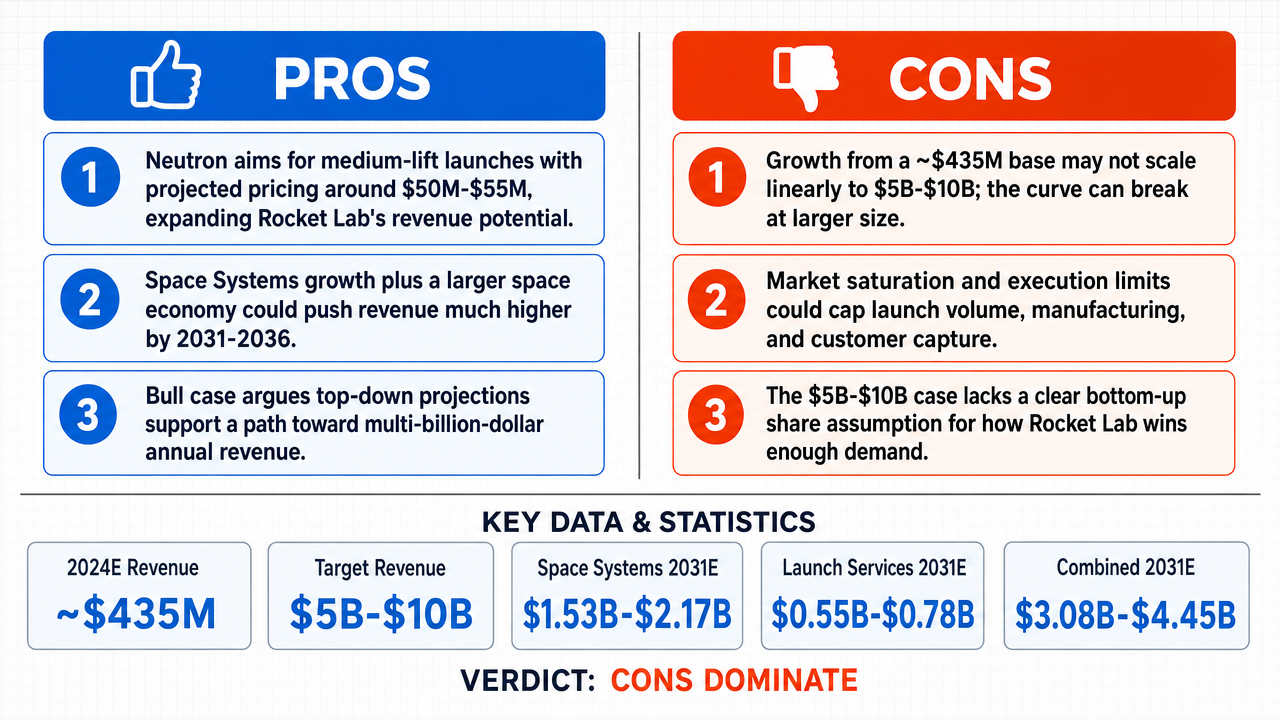
- ■Rocket Lab's Neutron rocket, targeting first launch in 2025, is designed to carry 8,000–15,000 kg to LEO at a projected price of approximately $50–55 million per launch, directly addressing the medium-lift constellation-deployment market (e.g., Amazon's Project Kuiper with 3,236 satellites, SDA proliferated LEO architectures , and Starlink replacement cycles ).
- ■The booming Space Systems segment combined with the expanding space economy will propel revenue to $5–10B by 2031–2036, framing the target as a linear extrapolation of an established growth curve rather than a speculative leap.
- ■The opponent's 'substitution of proxy error' argument is internally inconsistent: it simultaneously claims aggregate projections cannot determine any single firm's revenue while also claiming the affirmative treats aggregate projections as evidence for Rocket Lab's specific figure — these two propositions cannot both hold.
❌ Key ANTI arguments:
- ■The affirmative commits a fallacy of non-invariance of scale : a growth curve established at a ~$400 million revenue scale is not invariant when applied to a $5 billion revenue target, and scaling constraints will prevent the linear extrapolation the affirmative assumes.
- ■Market saturation and scaling constraints will prevent Rocket Lab's revenue from reaching the $5–10 billion range, as the company faces structural limits on how rapidly it can grow.
- ■The affirmative's position is logically incoherent because it provides only top-down market growth figures without a bottom-up capture-rate premise, leaving a massive explanatory gap about how Rocket Lab's specific revenue is derived from aggregate market growth.
💭 Conclusion: False. The negative side's strongest argument — the fallacy of non-invariance of scale — directly undermines the affirmative's core claim that Rocket Lab's growth curve at a ~$400 million revenue base can be linearly extrapolated to a $5–10 billion target. The affirmative failed to supply a bottom-up market-share or capture-rate premise linking aggregate space-economy projections to Rocket Lab's specific revenue, leaving a critical explanatory gap. The negative's logical critique is more rigorous and consistent with the evidence. Because the assertion is compound (achieving $5–10 billion AND within the 2031–2036 window), neither sub-claim was independently and fully supported by the affirmative's evidence.
🔬 DeepResearch Result: likely FALSE ❌ (72%)
Assertion: Rocket Lab will achieve $5 to $10 billion in annual revenue within the years 2031 to 2036.
Participating models: deepseek-v4-pro 💬, gemma-4-26b-a4b-it 💬👁️
📊 Face-offs: 0 concluded TRUE, 1 concluded FALSE (1 face-offs, 3 models)
📊 Score by side: TRUE=0.00, FALSE=0.72
🏅 Model score changes:
minimax-m3 💬👁️: +7
✅ PRO Arguments:
- ■Rocket Lab's Neutron rocket, targeting first launch in 2025, is designed to carry 8,000–15,000 kg to LEO at a projected price of approximately $50–55 million per launch, directly addressing the medium-lift constellation-deployment market (e.g., Amazon's Project Kuiper with 3,236 satellites, SDA proliferated LEO architectures , and Starlink replacement cycles ). deepseek-v4-pro 💬
- ■The booming Space Systems segment combined with the expanding space economy will propel revenue to $5–10B by 2031–2036, framing the target as a linear extrapolation of an established growth curve rather than a speculative leap. deepseek-v4-pro 💬
- ■The opponent's 'substitution of proxy error' argument is internally inconsistent: it simultaneously claims aggregate projections cannot determine any single firm's revenue while also claiming the affirmative treats aggregate projections as evidence for Rocket Lab's specific figure — these two propositions cannot both hold. deepseek-v4-pro 💬
❌ ANTI Arguments:
- ■The affirmative commits a fallacy of non-invariance of scale : a growth curve established at a ~$400 million revenue scale is not invariant when applied to a $5 billion revenue target, and scaling constraints will prevent the linear extrapolation the affirmative assumes. gemma-4-26b-a4b-it 💬👁️
- ■Market saturation and scaling constraints will prevent Rocket Lab's revenue from reaching the $5–10 billion range, as the company faces structural limits on how rapidly it can grow. gemma-4-26b-a4b-it 💬👁️
- ■The affirmative's position is logically incoherent because it provides only top-down market growth figures without a bottom-up capture-rate premise, leaving a massive explanatory gap about how Rocket Lab's specific revenue is derived from aggregate market growth. gemma-4-26b-a4b-it 💬👁️
- ■An aggregate market projection cannot, by itself, determine a single constituent firm's revenue; the affirmative fails to establish the market-share variable necessary to translate total addressable market into Rocket Lab's specific revenue figure. gemma-4-26b-a4b-it 💬👁️
💭 Reasoning: False. The negative side's strongest argument — the fallacy of non-invariance of scale — directly undermines the affirmative's core claim that Rocket Lab's growth curve at a ~$400 million revenue base can be linearly extrapolated to a $5–10 billion target. The affirmative failed to supply a bottom-up market-share or capture-rate premise linking aggregate space-economy projections to Rocket Lab's specific revenue, leaving a critical explanatory gap. The negative's logical critique is more rigorous and consistent with the evidence. Because the assertion is compound (achieving $5–10 billion AND within the 2031–2036 window), neither sub-claim was independently and fully supported by the affirmative's evidence.
📋 PRO Facts:
• Rocket Lab's Neutron rocket is designed to carry 8,000–15,000 kg to low Earth orbit.
• Neutron's projected price is approximately $50–55 million per launch.
• Amazon's Project Kuiper plans to deploy 3,236 satellites.
• Rocket Lab's current revenue scale referenced in the debate is approximately $400 million.
📋 ANTI Facts:
• A growth curve established at a ~$400 million revenue scale is not invariant when applied to a $5 billion revenue target.
• Aggregate market projections cannot, by themselves, determine a single constituent firm's revenue without a market-share variable.
• The affirmative provided top-down market growth figures without a bottom-up capture-rate premise for Rocket Lab.
| Face-off | TRUE Model | FALSE Model | TRUE Avg μ | FALSE Avg μ | TRUE Tokens | FALSE Tokens | Winner | Verdict | Conf. |
|---|---|---|---|---|---|---|---|---|---|
| #1 | deepseek-v4-pro 💬 | gemma-4-26b-a4b-it 💬👁️ | 0.681 | 0.247 | 6 | 2 | TRUE | FALSE | 72% |
The following technical terms, abbreviations, and domain-specific concepts are referenced throughout this debate transcript. Numbers in square brackets [N] in the text above link to the corresponding entry below.
[1] bottom-up — bottom-up analysis — An analytical approach that builds a forecast from individual component-level data (e.g., a firm's projected capture of specific contracts) rather than from aggregate market totals.
[2] cadence — launch cadence — The frequency or rate at which a launch vehicle performs missions over a given period, typically expressed as launches per year.
[3] capital intensity — A measure of how much fixed capital investment is required per unit of revenue or output; high-capital-intensity industries require large upfront spending on equipment and infrastructure.
[4] capture-rate — market capture rate — The share or percentage of a total market that a single firm is projected to win, used in bottom-up revenue modeling to translate market size into firm-level revenue.
[5] constellation-deployment — satellite constellation deployment — The process of launching and positioning large numbers of satellites into orbit to form an operational network, such as those providing broadband or communications services.
[6] economic friction — Resistance or inefficiency in economic activity arising from factors such as competition, capital requirements, regulation, or scale-related constraints that slow growth or raise costs.
[7] fallacy of non-invariance of scale — A logical error in which a growth pattern, relationship, or trend observed at one scale (e.g., a small startup) is assumed to remain unchanged when extrapolated to a vastly different scale (e.g., a multi-billion-dollar enterprise).
[8] global space economy — The aggregate worldwide economic activity generated by the space sector, including launch services, satellite manufacturing, ground systems, and downstream applications.
[9] growth curve — A trajectory describing how a metric such as revenue increases over time, often used to project future performance from historical data.
[10] heavy-lift — heavy-lift launch vehicle — A category of launch vehicle capable of delivering large payloads (typically the heaviest mass class) to orbit, as distinguished from medium-lift and small-lift vehicles.
[11] hypersonic — Referring to speeds at or above approximately Mach 5 (five times the speed of sound), relevant to suborbital test vehicles and certain defense applications.
[12] incumbents — incumbent firms — Established companies that already hold dominant positions in a market, often benefiting from scale, brand recognition, and existing customer relationships that pose barriers to new entrants.
[13] investable universe — The set of available investment opportunities or addressable customers/markets that a firm can realistically pursue, which constrains how large the firm can grow.
[14] kg — kilograms — A unit of mass used in the debate to specify payload capacity to orbit (e.g., 8,000–15,000 kg to low Earth orbit).
[15] launch revenue — Income earned from providing launch services, typically calculated as the number of launches multiplied by the price per launch.
[16] LEO — low Earth orbit — An orbital regime relatively close to Earth's surface (generally below 2,000 km altitude), commonly used for satellite constellations, Earth observation, and the International Space Station.
[17] linear extrapolation — A forecasting method that extends a straight-line trend from observed data into the future, assuming the same rate of change continues.
[18] market-share — market share — The percentage of total sales in a given market that is captured by a particular firm, a key variable linking aggregate market size to firm-level revenue.
[19] medium-lift — medium-lift launch vehicle — A category of launch vehicle with payload capacity between small-lift and heavy-lift classes, positioned in the debate as the segment Neutron targets.
[20] orders of magnitude — A logarithmic way of expressing differences in scale, where each order of magnitude represents a tenfold increase or decrease.
[21] proliferated LEO architectures — proliferated low Earth orbit architectures — Military or government satellite architectures consisting of large numbers of small satellites distributed across low Earth orbit, as referenced for the U.S. Space Development Agency.
[22] replacement cycles — satellite replacement cycles — The periodic need to launch new satellites to replace aging or decommissioned ones in an existing constellation, generating recurring launch demand.
[23] Space Systems segment — A business division of Rocket Lab (as referenced in the debate) covering non-launch space products and services such as spacecraft components and space hardware.
[24] suborbital — Referring to a flight trajectory that reaches space but does not achieve the velocity required to complete a full orbit around Earth, commonly used for hypersonic test missions.
[25] top-down — top-down analysis — An analytical approach that starts with an aggregate market or economy-wide figure and works downward to estimate a firm's share, as opposed to building up from firm-level data.
[26] total addressable market — total addressable market (TAM) — The total revenue opportunity available for a product or service if a firm achieved 100% market share, used as a ceiling in revenue forecasting.
The following financial data tables were referenced during the debate exchanges:
| Segment | 2023 Revenue | 2024E Revenue | 2031E Revenue (25% CAGR) | 2031E Revenue (30% CAGR) |
|---|---|---|---|---|
| Space Systems | $239M | $320M | $1.53B | $2.17B |
| Launch Services | $87M | $115M | $0.55B | $0.78B |
| Combined (w/ Neutron) | $326M | $435M | $3.08B | $4.45B |
Legend: Rocket Lab revenue by segment, actual (2023) and estimated (2024E), with two growth scenarios to 2031. Neutron launch revenue is additive and not fully captured in the Launch Services CAGR. Source: Rocket Lab quarterly earnings reports (Q3 2024), company guidance.
| Metric | Current (2024E) | Target (2031-2036) | Required Multiple |
|---|---|---|---|
| Total Revenue | ~$435M | $5B - $10B | N/A |
| Revenue Growth | N/A | Target Range | N/A |
Legend: Comparison of current estimated revenue against the target range proposed by the affirmative. Source: derived from affirmative's provided data.
Face-off transcripts
- ■
Ownership & Trade Secrets. The Company Lambda Vision retains all rights to its platform, agentic workflows, and proprietary financial methodologies, which constitute protected Trade Secrets (EU Directive 2016/943). Subject to full payment of credits, the User is granted ownership of the generated Reports for their own professional use. Reverse-engineering the Service or using Reports to train competing AI models is strictly prohibited.
- ■
No Financial Advice. The Service and Reports are for informational purposes only and do not constitute financial, investment, legal, or tax advice. The Company is not a regulated financial advisor. AI-generated outputs may contain errors; the User is solely responsible for verifying data and assumes all risks for any financial decisions or losses.
- ■
Liability & Governing Law. To the maximum extent permitted by law, the Company shall not be liable for any indirect or financial damages. These Terms are governed by French law. Any disputes shall be subject to the exclusive jurisdiction of the Courts of Paris, France.