
PayPal's stock price will reach $150 per share within the next four years.
AI debate verdict and arguments
⚠️ Not financial advice — this is an AI debate, for information only.
Completed October 20, 2026
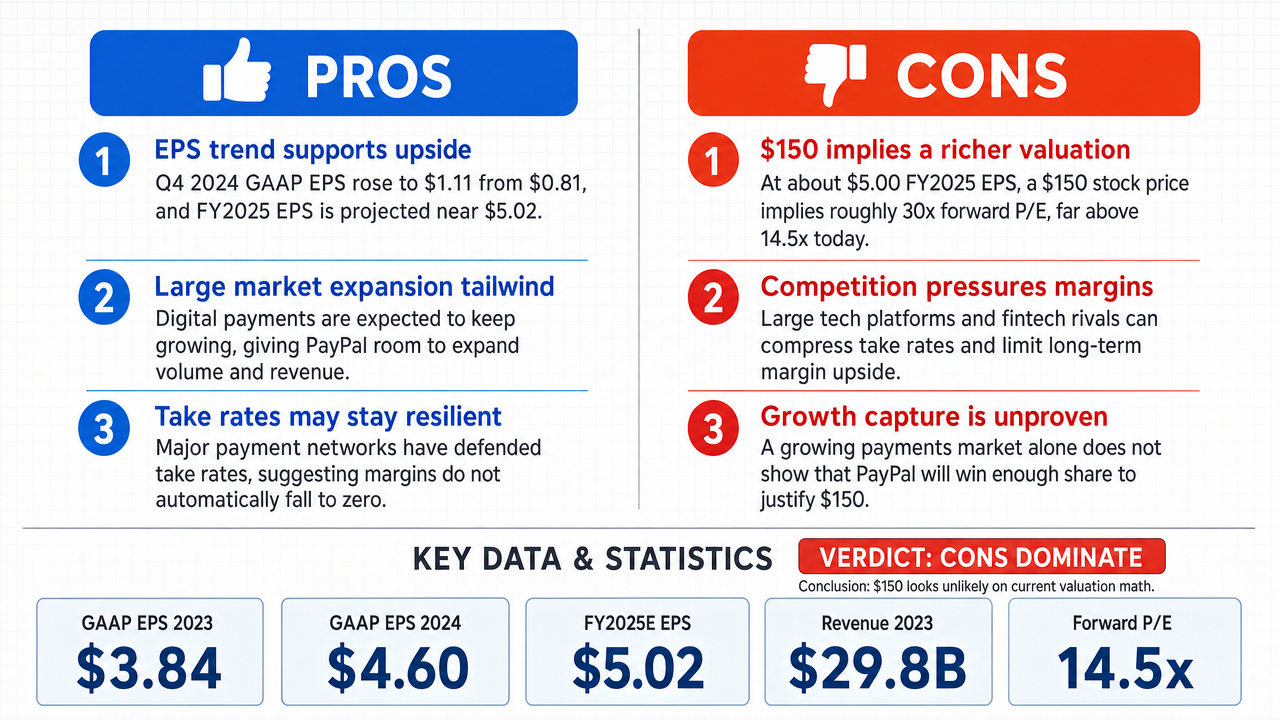
Verdict
Verdict: likely FALSE (58%)
This section provides a brief overview of the key arguments. You do not need to read the full detailed report below.
✅ Key PRO arguments:
- ■PayPal's earnings trajectory supports a $150 price: Q4 2024 GAAP EPS reached $1.11, up 37% from $0.81 in the prior-year quarter, and FY2025 consensus projects revenue of ~$34.0 billion with EPS expanding toward $5.00, which the PRO claimed would put a $150 stock at 15–16x forward earnings .
- ■The global digital payments market is expanding at a 15% CAGR toward $15 trillion by 2028, providing a large addressable market that PayPal can capture to fuel growth.
- ■The claim that scale and competition inevitably drive take rates to zero is empirically false, since Visa and Mastercard maintained their take rates over the past decade despite competition from Square, Stripe, Apple Pay, and Google Pay.
❌ Key ANTI arguments:
- ■The PRO's valuation framework contains a fatal internal contradiction: if FY2025 EPS is ~$5.00 and the stock price is $150, the implied forward P/E is 30x, not the 15–16x the PRO claimed. A 30x multiple is double the 'mature fintech ' range and is not justified by the evidence presented.
- ■Structural margin compression from hyper-scale tech giants and specialized fintech competitors drives take rates toward zero as the digital payments market expands, meaning PayPal cannot capture market growth without significant margin erosion that would prevent a $150 share price.
- ■The 15% CAGR to a $15 trillion digital payments market by 2028 is conjecture presented as fact, and the PRO provides no credible mechanism for how PayPal captures this growth at sustainable margins.
💭 Conclusion: False. The verdict is FALSE because the affirmative's own valuation math undermines the $150 thesis: with FY2025 EPS projected at ~$5.00, a $150 share price implies a 30x forward P/E , which exceeds both the PRO's proposed 18x normalization multiple and the current 14.5x forward P/E, exposing a fatal internal contradiction in the central argument. The PRO's secondary claims about a 15% CAGR digital payments market reaching $15 trillion by 2028 are speculative projections rather than established facts, and the PRO offered no credible mechanism for PayPal to capture this growth without margin erosion . The NEGATIVE correctly noted that structural competition from hyper-scale tech giants and fintechs pressures take rates , making sustained margin expansion unlikely. While PayPal's Q4 2024 EPS did grow 37% year-over-year to $1.11, this single data point does not bridge the gap to the multiples required for a $150 price. The combination of the mathematical contradiction and unproven market-share assumptions makes the FALSE verdict the stronger conclusion.
🔬 DeepResearch Result: likely FALSE ❌ (58%)
Assertion: PayPal's stock price will reach $150 per share within the next four years.
Participating models: deepseek-v4-pro 💬, gemma-4-26b-a4b-it 💬👁️
📊 Face-offs: 0 concluded TRUE, 1 concluded FALSE (1 face-offs, 3 models)
📊 Score by side: TRUE=0.00, FALSE=0.58
🏅 Model score changes:
minimax-m3 💬👁️: +6
✅ PRO Arguments:
- ■PayPal's earnings trajectory supports a $150 price: Q4 2024 GAAP EPS reached $1.11, up 37% from $0.81 in the prior-year quarter, and FY2025 consensus projects revenue of ~$34.0 billion with EPS expanding toward $5.00, which the PRO claimed would put a $150 stock at 15–16x forward earnings . deepseek-v4-pro 💬
- ■The global digital payments market is expanding at a 15% CAGR toward $15 trillion by 2028, providing a large addressable market that PayPal can capture to fuel growth. deepseek-v4-pro 💬
- ■The claim that scale and competition inevitably drive take rates to zero is empirically false, since Visa and Mastercard maintained their take rates over the past decade despite competition from Square, Stripe, Apple Pay, and Google Pay. deepseek-v4-pro 💬
❌ ANTI Arguments:
- ■The PRO's valuation framework contains a fatal internal contradiction: if FY2025 EPS is ~$5.00 and the stock price is $150, the implied forward P/E is 30x, not the 15–16x the PRO claimed. A 30x multiple is double the 'mature fintech ' range and is not justified by the evidence presented. gemma-4-26b-a4b-it 💬👁️
- ■Structural margin compression from hyper-scale tech giants and specialized fintech competitors drives take rates toward zero as the digital payments market expands, meaning PayPal cannot capture market growth without significant margin erosion that would prevent a $150 share price. gemma-4-26b-a4b-it 💬👁️
- ■The 15% CAGR to a $15 trillion digital payments market by 2028 is conjecture presented as fact, and the PRO provides no credible mechanism for how PayPal captures this growth at sustainable margins. gemma-4-26b-a4b-it 💬👁️
💭 Reasoning: False. The verdict is FALSE because the affirmative's own valuation math undermines the $150 thesis: with FY2025 EPS projected at ~$5.00, a $150 share price implies a 30x forward P/E, which exceeds both the PRO's proposed 18x normalization multiple and the current 14.5x forward P/E, exposing a fatal internal contradiction in the central argument. The PRO's secondary claims about a 15% CAGR digital payments market reaching $15 trillion by 2028 are speculative projections rather than established facts, and the PRO offered no credible mechanism for PayPal to capture this growth without margin erosion. The NEGATIVE correctly noted that structural competition from hyper-scale tech giants and fintechs pressures take rates, making sustained margin expansion unlikely. While PayPal's Q4 2024 EPS did grow 37% year-over-year to $1.11, this single data point does not bridge the gap to the multiples required for a $150 price. The combination of the mathematical contradiction and unproven market-share assumptions makes the FALSE verdict the stronger conclusion.
📋 PRO Facts:
• Q4 2024 GAAP EPS was $1.11, up 37% from $0.81 in the prior-year quarter.
• FY2025 consensus revenue is projected at approximately $34.0 billion, implying 7–8% growth.
• FY2025 consensus EPS is projected toward $5.00.
📋 ANTI Facts:
• At a $150 share price and FY2025 EPS of ~$5.00, the implied forward P/E is 30x, well above the PRO's proposed 18x normalization multiple and the current 14.5x forward P/E.
• A 30x forward P/E far exceeds the fintech peers median of 19.8x shown in the evidence.
• The 15% CAGR projection for the global digital payments market reaching $15 trillion by 2028 is conjecture, not an established fact.
| Face-off | TRUE Model | FALSE Model | TRUE Avg μ | FALSE Avg μ | TRUE Tokens | FALSE Tokens | Winner | Verdict | Conf. |
|---|---|---|---|---|---|---|---|---|---|
| #1 | deepseek-v4-pro 💬 | gemma-4-26b-a4b-it 💬👁️ | 0.682 | 0.258 | 6 | 2 | TRUE | FALSE | 58% |
The following technical terms, abbreviations, and domain-specific concepts are referenced throughout this debate transcript. Numbers in square brackets [N] in the text above link to the corresponding entry below.
[1] active accounts — A user-engagement metric used by PayPal referring to the number of customer accounts that have conducted at least one transaction within a defined period (typically the trailing 12 months).
[2] CAGR — Compound Annual Growth Rate — The mean annual growth rate of an investment or business metric over a specified period longer than one year, assuming profits are reinvested at the end of each year.
[3] commoditized market — A market in which products or services from competing providers have become largely undifferentiated, leading buyers to base purchasing decisions primarily on price.
[4] consensus analyst estimates — The average or median of financial forecasts (e.g., for revenue or EPS) produced by a group of sell-side equity analysts covering a company, used as a benchmark for expected performance.
[5] cost discipline — A management approach focused on controlling or reducing operating expenses to improve margins and free cash flow.
[6] EPS — Earnings Per Share — A company's net profit divided by the number of outstanding shares, used as a standard measure of corporate profitability on a per-share basis.
[7] fintech — financial technology — The sector of companies that use software and digital platforms to deliver financial services such as payments, lending, and money management, often competing with or displacing traditional banks.
[8] forward earnings — A projection of a company's earnings over a future period (commonly the next fiscal year), as opposed to trailing earnings based on historical results.
[9] forward P/E — forward Price-to-Earnings ratio — A valuation multiple calculated by dividing a company's current share price by its projected (forward) earnings per share, used to gauge how much investors are paying for expected future profits.
[10] FY2025 — Fiscal Year 2025 — The 12-month accounting period designated as '2025' by a company for financial reporting purposes, which may or may not align with the calendar year.
[11] GAAP — Generally Accepted Accounting Principles — A standardized set of accounting rules and reporting conventions used in the United States to prepare and present financial statements.
[12] hyper-scale — A descriptor for technology companies operating at very large scale, typically with global infrastructure, massive user bases, and significant pricing leverage over suppliers and partners.
[13] margin compression — A sustained decline in a company's profit margin (gross, operating, or net), often caused by rising costs, competitive pricing pressure, or unfavorable mix shifts.
[14] margin erosion — The gradual reduction of profitability per unit or transaction, typically resulting from competitive pressure, discounting, or rising input costs.
[15] operating leverage — The degree to which a company's operating income changes in response to changes in revenue, arising from a cost structure containing a high proportion of fixed costs.
[16] P/E multiple — Price-to-Earnings multiple — A valuation ratio calculated by dividing a company's share price by its earnings per share, indicating how many dollars investors pay for each dollar of profit.
[17] payment transactions per active account — An engagement metric used by PayPal measuring the average number of payment transactions conducted annually by each active account, used as a proxy for user activity and monetization depth.
[18] pricing power — A company's ability to raise the prices of its products or services without losing customers or market share, typically arising from brand strength, switching costs, or differentiated offerings.
[19] Q4 2024 — Fourth Quarter of 2024 — The three-month period from October through December 2024, used as a quarterly reporting period in corporate financial statements.
[20] share buybacks — share buybacks (share repurchases) — Transactions in which a company uses its cash to repurchase its own outstanding shares from the market, reducing share count and typically supporting earnings per share.
[21] take rates — In the payments industry, the percentage fee that a payment processor or platform retains from each transaction it processes, serving as a primary revenue metric for payment companies.
[22] total addressable market — Total Addressable Market (TAM) — The total revenue opportunity available to a product or service if it achieved 100% market share, used to size the upper bound of growth potential.
[23] transaction margins — The profit earned on each individual transaction after deducting processing costs, interchange fees, and other variable expenses, commonly used as a profitability metric in payments businesses.
[24] valuation multiples — Ratios (such as P/E, EV/EBITDA, or P/S) used to compare a company's market value to a financial metric, enabling relative valuation across companies or over time.
[25] valuation normalisation — The process or expectation that a company's valuation multiples will revert toward historical averages or peer-group averages, often used as a basis for price-target arguments.
The following financial data tables were referenced during the debate exchanges:
| Metric | FY2023 | FY2024 | FY2025E | 2-Yr Growth |
|---|---|---|---|---|
| Revenue | $29.8B | $31.8B | $34.0B | +14.1% |
| GAAP EPS | $3.84 | $4.60 | $5.02 | +30.7% |
| Active Accounts | 426M | 434M | 438M | +2.8% |
Legend: PayPal key financial metrics (FY2023 actual, FY2024 actual, FY2025 consensus estimates). Revenue in USD billions; EPS in USD; accounts in millions. Growth = total change FY2023–FY2025E. Source: PayPal annual and quarterly earnings reports, analyst consensus via Visible Alpha.
| Valuation Metric | PayPal (PYPL) | S&P 500 IT Sector | Fintech Peers Median |
|---|---|---|---|
| Forward P/E | 14.5x | 25.2x | 19.8x |
| EV/EBITDA | 10.3x | 18.7x | 14.5x |
| FCF Yield | 7.8% | 3.1% | 4.5% |
Legend: Valuation comparison — PayPal vs. S&P 500 Information Technology sector and median of select fintech peers (Block, Adyen, Fiserv, FIS, Global Payments). Forward P/E based on consensus FY2025 estimates. FCF Yield = free cash flow / market capitalisation. Source: company filings, S&P Capital IQ, and consensus analyst estimates as of early 2025.
| Metric | 2021 Peak (Approx) | Current (2024/25E) | Trend Direction |
|---|---|---|---|
| Forward P/E Multiple | ~80x | ~14.5x | Declining |
| Revenue Growth Rate | High Double-Digit | ~7-8% | Decelerating |
| Competitive Intensity | Moderate | Extreme | Increasing |
Legend: Comparison of PayPal's peak valuation era versus current market reality. P/E reflects historical highs during the pandemic vs. current consensus. Trend direction indicates the structural shift in the company's market position.
| Payment Platform | 2019 Take Rate | 2024 Take Rate | Volume Growth | Take Rate Change |
|---|---|---|---|---|
| PayPal (Total) | 2.62% | 2.10% | +197% | -52 bps |
| Adyen | 0.76% | 0.85% | +185% | +9 bps |
| Stripe (Standard) | 2.90% | 2.90% | +300%+ | 0 bps |
Legend: Take rate trends for major payment platforms (2019–2024). PayPal total take rate = total revenue / total payment volume. Adyen take rate per company filings. Stripe standard pricing per published rate card. Volume growth = estimated TPV growth over period. Source: company annual reports (PayPal 10-K, Adyen annual report FY2024), Stripe published pricing page.
| Variable | Asserted Value | Required for 15x Multiple | Discrepancy |
|---|---|---|---|
| Target Price | $150.00 | $150.00 | $0.00 |
| Forward EPS | $5.00 | $10.00 | -$5.00 |
| Implied P/E | 30x | 15x | +15x |
Legend: Comparison of the argument's stated EPS against the EPS required to achieve the stated $150 price at a 15x multiple. Discrepancy shows the gap between the two conflicting assertions.
Face-off transcripts
- ■
Ownership & Trade Secrets. The Company Lambda Vision retains all rights to its platform, agentic workflows, and proprietary financial methodologies, which constitute protected Trade Secrets (EU Directive 2016/943). Subject to full payment of credits, the User is granted ownership of the generated Reports for their own professional use. Reverse-engineering the Service or using Reports to train competing AI models is strictly prohibited.
- ■
No Financial Advice. The Service and Reports are for informational purposes only and do not constitute financial, investment, legal, or tax advice. The Company is not a regulated financial advisor. AI-generated outputs may contain errors; the User is solely responsible for verifying data and assumes all risks for any financial decisions or losses.
- ■
Liability & Governing Law. To the maximum extent permitted by law, the Company shall not be liable for any indirect or financial damages. These Terms are governed by French law. Any disputes shall be subject to the exclusive jurisdiction of the Courts of Paris, France.