
Oil prices will remain elevated above $90 per barrel until the US mid-term elections in November 2026.
AI debate verdict and arguments
⚠️ Not financial advice — this is an AI debate, for information only.
Completed October 17, 2026
Verdict
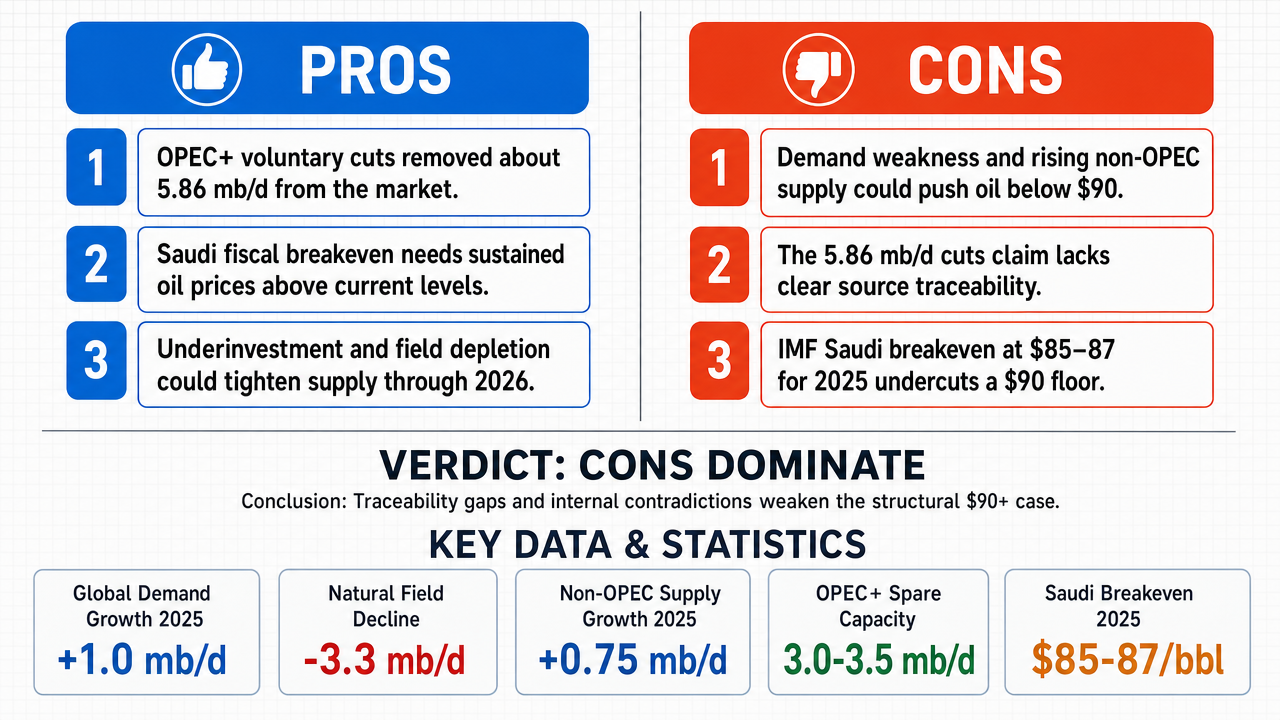
Verdict: likely FALSE (66%)
This section provides a brief overview of the key arguments. You do not need to read the full detailed report below.
✅ Key PRO arguments:
- ■OPEC+ has functioned as a proactive supply manager, with collective voluntary cuts layered atop mandatory quotas removing approximately 5.86 mb/d from the market since 2023, most recently extended in December 2024 through at least Q1 2026, establishing a structural price floor .
- ■Saudi Arabia's fiscal breakeven oil price , documented in the IMF 's October 2024 Regional Economic Outlook, requires sustained prices well above current levels, incentivizing OPEC+ to defend a floor near or above $90/barrel through coordinated supply restraint.
- ■Chronic underinvestment in upstream development and natural field depletion will create a structural supply deficit that supports prices above $90 through 2026 regardless of short-term demand fluctuations.
❌ Key ANTI arguments:
- ■Global oil demand destruction and surging non-OPEC supply growth will combine to depress prices below $90, undercutting the affirmative's structural-deficit thesis over a multi-quarter horizon through November 2026.
- ■The affirmative's case suffers from a lack of traceability: it cites 5.86 mb/d in cumulative voluntary cuts without referencing specific ministerial communiqués or data sets, and it commits a fallacy of hindsight by extrapolating past OPEC+ cohesion to a future period covering ~15 months.
- ■The affirmative's supply-side argument contains internal contradictions: it simultaneously cites an IMF Saudi fiscal breakeven of $85–87 per barrel for 2025 (a figure already below $90) while invoking historical price-war stress events as evidence of cartel unity, undermining the claim that $90 is a defended floor.
💭 Conclusion: The negative side exposed traceability gaps and internal contradictions in the affirmative's structural-floor thesis, most notably the IMF Saudi breakeven of $85–87 per barrel for 2025, which is itself below the $90 threshold the assertion claims will be sustained. The affirmative provided plausible mechanisms (OPEC+ voluntary cuts , underinvestment, geopolitics) but failed to anchor them to verifiable data and could not coherently reconcile its breakeven evidence with a $90 floor. The negative's case depends in part on the contestable premise that non-OPEC supply growth and demand response will overwhelm OPEC+ discipline, limiting confidence in the verdict.
🔬 DeepResearch Result: likely FALSE ❌ (66%)
Assertion: Oil prices will remain elevated above $90 per barrel until the US mid-term elections in November 2026.
Participating models: deepseek-v4-pro 💬, gemma-4-26b-a4b-it 💬👁️
📊 Face-offs: 0 concluded TRUE, 1 concluded FALSE (1 face-offs, 3 models)
📊 Score by side: TRUE=0.00, FALSE=0.66
🏅 Model score changes:
minimax-m3 💬👁️: +7
✅ PRO Arguments:
- ■OPEC+ has functioned as a proactive supply manager, with collective voluntary cuts layered atop mandatory quotas removing approximately 5.86 mb/d from the market since 2023, most recently extended in December 2024 through at least Q1 2026, establishing a structural price floor . deepseek-v4-pro 💬
- ■Saudi Arabia's fiscal breakeven oil price , documented in the IMF 's October 2024 Regional Economic Outlook, requires sustained prices well above current levels, incentivizing OPEC+ to defend a floor near or above $90/barrel through coordinated supply restraint. deepseek-v4-pro 💬
- ■Chronic underinvestment in upstream development and natural field depletion will create a structural supply deficit that supports prices above $90 through 2026 regardless of short-term demand fluctuations. deepseek-v4-pro 💬
❌ ANTI Arguments:
- ■Global oil demand destruction and surging non-OPEC supply growth will combine to depress prices below $90, undercutting the affirmative's structural-deficit thesis over a multi-quarter horizon through November 2026. gemma-4-26b-a4b-it 💬👁️
- ■The affirmative's case suffers from a lack of traceability: it cites 5.86 mb/d in cumulative voluntary cuts without referencing specific ministerial communiqués or data sets, and it commits a fallacy of hindsight by extrapolating past OPEC+ cohesion to a future period covering ~15 months. gemma-4-26b-a4b-it 💬👁️
- ■The affirmative's supply-side argument contains internal contradictions: it simultaneously cites an IMF Saudi fiscal breakeven of $85–87 per barrel for 2025 (a figure already below $90) while invoking historical price-war stress events as evidence of cartel unity, undermining the claim that $90 is a defended floor. gemma-4-26b-a4b-it 💬👁️
💭 Reasoning: The negative side exposed traceability gaps and internal contradictions in the affirmative's structural-floor thesis, most notably the IMF Saudi breakeven of $85–87 per barrel for 2025, which is itself below the $90 threshold the assertion claims will be sustained. The affirmative provided plausible mechanisms (OPEC+ voluntary cuts, underinvestment, geopolitics) but failed to anchor them to verifiable data and could not coherently reconcile its breakeven evidence with a $90 floor. The negative's case depends in part on the contestable premise that non-OPEC supply growth and demand response will overwhelm OPEC+ discipline, limiting confidence in the verdict.
📋 PRO Facts:
• OPEC+ voluntary cuts removed approximately 5.86 mb/d from the market cumulatively since 2023.
• The most recent OPEC+ cut extension was announced in December 2024.
• Saudi Arabia's fiscal breakeven oil price was cited from the IMF at $85–87 per barrel for 2025.
📋 ANTI Facts:
• The IMF cited a Saudi fiscal breakeven of $85–87 per barrel for 2025, which is below the $90 threshold in the assertion.
• The affirmative cited 5.86 mb/d in cumulative voluntary cuts without referencing specific ministerial communiqués or data sources to verify that exact figure.
• Historical OPEC+ price-war stress events cited as evidence of cartel cohesion actually demonstrated episodes of price collapse below $90.
| Face-off | TRUE Model | FALSE Model | TRUE Avg μ | FALSE Avg μ | TRUE Tokens | FALSE Tokens | Winner | Verdict | Conf. |
|---|---|---|---|---|---|---|---|---|---|
| #1 | deepseek-v4-pro 💬 | gemma-4-26b-a4b-it 💬👁️ | 0.563 | 0.267 | 6 | 2 | TRUE | FALSE | 66% |
The following technical terms, abbreviations, and domain-specific concepts are referenced throughout this debate transcript. Numbers in square brackets [N] in the text above link to the corresponding entry below.
[1] binding constraint — A limiting factor whose threshold cannot be exceeded without forcing a decisive response. In the debate, the affirmative argues Saudi Arabia's fiscal breakeven acts as a binding constraint on its production-cutting behavior.
[2] cartel cohesion — The degree of unity, discipline, and coordinated action among members of a producer cartel such as OPEC+.
[3] chronic underinvestment — A persistent, long-term shortfall in capital spending relative to the level needed to maintain or expand productive capacity. The affirmative cites this as a driver of structural supply deficits.
[4] cumulative volume — The total aggregated quantity accumulated over a defined period, here used in reference to the running total of OPEC+ production cuts since 2023.
[5] demand destruction — A sustained reduction in oil consumption triggered by sustained high prices, in which buyers permanently alter behavior, switch fuels, or curtail activity. The negative argues this will depress prices; the affirmative disputes whether it has occurred at the $90 threshold.
[6] fiscal breakeven oil price — The oil price a country needs, on average, for its projected government revenues to equal its projected government spending. The IMF figure cited in the debate for Saudi Arabia is approximately $85–87/barrel for 2025.
[7] forward-looking — Based on expectations about future conditions rather than on currently observed data. In the debate, both sides accuse each other of relying on forward-looking claims that cannot yet be verified.
[8] geopolitical risk premium — The component of the oil price attributed to uncertainty over political events (sanctions, conflict, supply disruption) rather than to physical supply–demand fundamentals. The affirmative treats it as a structural floor; the negative argues it is by definition transient — a point disputed in the debate.
[9] IMF — International Monetary Fund — An international financial institution that publishes economic outlooks and country-level data. The debate cites the IMF's October 2024 Regional Economic Outlook for the Middle East and Central Asia for Saudi Arabia's fiscal breakeven figure.
[10] lollipop cut — Informal industry term for a unilateral, extra production cut announced by Saudi Arabia outside the OPEC+ quota framework. The transcript references the July 2023 extra 1 mb/d Saudi cut under this label.
[11] mandatory quotas — Required production ceilings that OPEC+ member states are formally assigned and obligated to observe, as distinct from voluntary cuts layered on top.
[12] mb/d — million barrels per day — Unit of measurement for oil production or consumption rates, equal to one million 42-gallon barrels per day.
[13] ministerial communiqués — Official public statements issued at the conclusion of OPEC+ ministerial meetings, typically formalizing production-cut decisions and quota allocations.
[14] natural field depletion — The inherent, physics-driven decline in output from a producing oil well or field over time, which requires ongoing investment to offset.
[15] non-OPEC supply — Crude oil production from countries outside the OPEC+ framework (e.g., the United States, Brazil, Guyana, Canada). The negative argues surging non-OPEC supply will depress prices.
[16] OPEC+ — Organization of the Petroleum Exporting Countries and allies — A group comprising OPEC members plus additional cooperating oil-producing countries (notably Russia), which coordinates production levels to influence global oil prices.
[17] price floor — A level below which prices are argued not to fall, typically because producer behavior (cuts, fiscal needs) provides structural support. The affirmative treats the fiscal breakeven as establishing a price floor; the negative disputes the floor's stability.
[18] price wars — Periods of aggressive price competition between producers, often used as leverage or punishment within a cartel. The debate references the 2020 and 2022 episodes.
[19] production cuts — Coordinated reductions in oil output by producing countries, used by OPEC+ to support prices by tightening physical supply.
[20] Q1 — first quarter — The three-month period from January through March. The debate states OPEC+ cuts were extended at least through Q1 2026.
[21] realized record — Data on outcomes that have actually occurred, as opposed to forecasts or projections. The affirmative notes that none of the negative's central claims (demand destruction at $90, surging non-OPEC supply) appear in the realized record.
[22] risk premium — The portion of an asset's price that compensates holders for bearing identified risks above and beyond baseline expectations. In oil markets this is often associated with geopolitical risk (see also: geopolitical risk premium).
[23] stress tests — Analyses that examine how a system, entity, or price level would perform under severely adverse scenarios. The debate references historical stress tests and price-war episodes as evidence about cartel behavior.
[24] structural floor — A price-support level argued to be embedded in long-term supply–demand mechanics (e.g., fiscal needs, depletion costs) rather than in short-term events.
[25] structural supply deficits — Persistent shortfalls between oil supply and demand arising from long-term factors such as underinvestment and field depletion, as opposed to cyclical or weather-driven imbalances.
[26] supply-management — The deliberate coordination of production levels to influence market prices. The affirmative argues OPEC+ has evolved from a reactive cartel into a proactive supply manager.
[27] Vision 2030 — Saudi Vision 2030 — Saudi Arabia's national economic diversification and development program, with associated multi-year public-spending commitments cited in the debate as a driver of the Kingdom's fiscal breakeven oil price.
[28] voluntary cuts — Production reductions that OPEC+ members agree to implement on top of their mandatory quotas, characterized in the debate as the layer that has removed approximately 5.86 mb/d from the market since 2023.
The following financial data tables were referenced during the debate exchanges:
| Region | Estimated 2025 Production Growth (mb/d) | Primary Driver |
|---|---|---|
| United States | 0.4 | Permian Consolidation |
| Guyana | 0.15 | ExxonMobil/TotalEnergies |
| Brazil | 0.12 | Pre-salt Expansion |
| Canada | 0.08 | Oil Sands Efficiency |
| Non-OPEC Total | 0.75 | Diversified Growth |
Legend: Projected annual production increases for 2025. Values in millions of barrels per day (mb/d).
| Component | Volume (mb/d) | Source |
|---|---|---|
| Global Demand Growth (2025) | +1.0 | IEA Oil Market Report, January 2025 |
| Natural Field Decline | −3.3 | IEA World Energy Outlook 2024, October 2024 |
| Non-OPEC Supply Growth (2025) | +0.75 | Opponent's own estimate |
| Net Supply Gap Before OPEC+ | −3.55 | Calculated |
| OPEC+ Effective Spare Capacity (ex-Iran/Russia) | 3.0–3.5 | IEA Oil Market Report, January 2025 |
Legend: Supply-demand balance components for 2025. Positive values indicate additions to supply; negative values indicate withdrawals or gaps. The net gap of 3.55 mb/d nearly exhausts all available OPEC+ spare capacity, leaving the market structurally tight. Sources: IEA publications as cited.
| Investment Metric | Affirmative Claim (USD) | Market Reality/Trend | Delta |
|---|---|---|---|
| Required Annual Capex | $625B (Avg) | $530B (2024 Actual) | -$95B |
| Natural Decline Rate | 4.5% | 3.8% (Optimized) | -0.7% |
| US Shale Growth Rate | 0.4 mb/d | 0.3 mb/d (Projected) | -0.1 mb/d |
Legend: Comparison of the affirmative's "structural deficit" assumptions against observed and projected market data. Values represent annual averages or rates.
Face-off transcripts
- ■
Ownership & Trade Secrets. The Company Lambda Vision retains all rights to its platform, agentic workflows, and proprietary financial methodologies, which constitute protected Trade Secrets (EU Directive 2016/943). Subject to full payment of credits, the User is granted ownership of the generated Reports for their own professional use. Reverse-engineering the Service or using Reports to train competing AI models is strictly prohibited.
- ■
No Financial Advice. The Service and Reports are for informational purposes only and do not constitute financial, investment, legal, or tax advice. The Company is not a regulated financial advisor. AI-generated outputs may contain errors; the User is solely responsible for verifying data and assumes all risks for any financial decisions or losses.
- ■
Liability & Governing Law. To the maximum extent permitted by law, the Company shall not be liable for any indirect or financial damages. These Terms are governed by French law. Any disputes shall be subject to the exclusive jurisdiction of the Courts of Paris, France.