
Nvidia, not AMD, offers a better investment opportunity for the decade of 2026 to 2036 based on its current valuation and growth prospects.
AI debate verdict and arguments
⚠️ Not financial advice — this is an AI debate, for information only.
Completed October 14, 2026
Verdict
Verdict: likely FALSE (76%)
This section provides a brief overview of the key arguments. You do not need to read the full detailed report below.
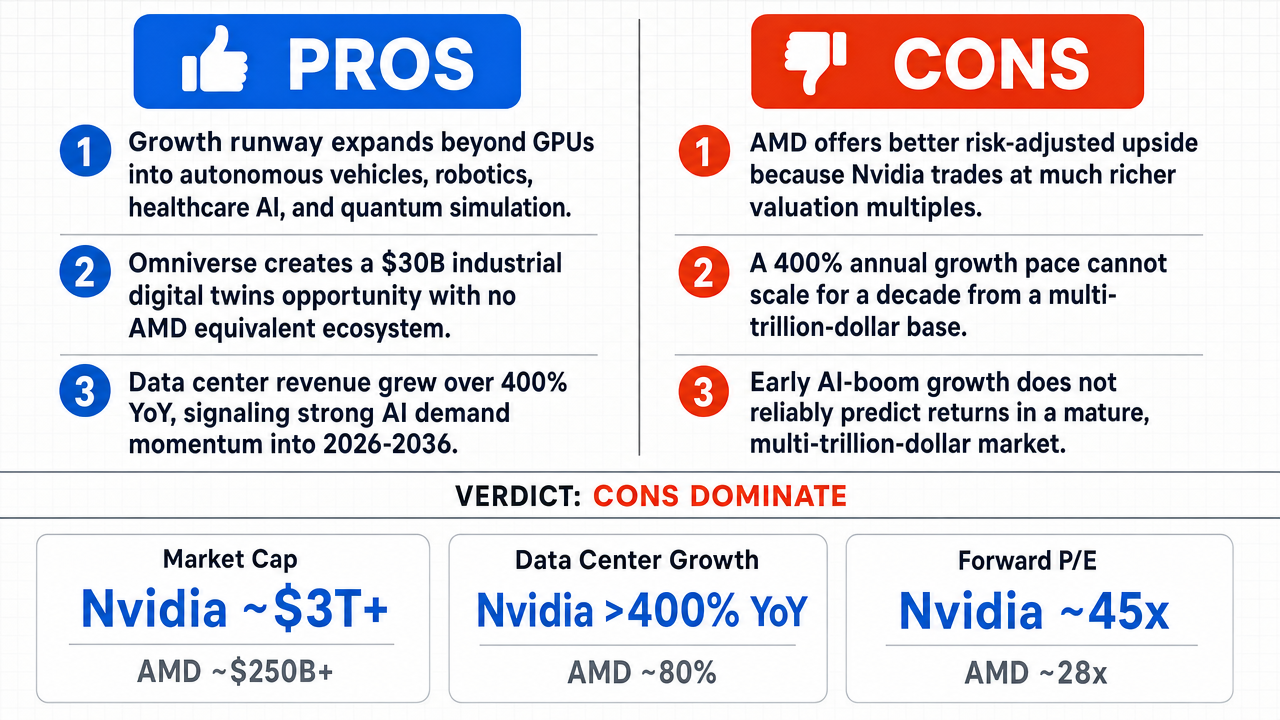
✅ Key PRO arguments:
- ■Nvidia's growth runway extends beyond traditional GPU markets into autonomous vehicles , robotics , healthcare AI , and quantum computing simulation , areas where AMD lacks comparable strategic positioning .
- ■Nvidia's Omniverse platform represents a $30 billion market opportunity in industrial digital twins , while AMD has no equivalent ecosystem play .
- ■Nvidia's data center business grew over 400% year-over-year in recent quarters, demonstrating accelerating adoption that will sustain through the 2026-2036 period as AI becomes ubiquitous.
❌ Key ANTI arguments:
- ■AMD's valuation and market positioning offer superior risk-adjusted upside compared to Nvidia's overextended multiples , as projecting 400% growth rates linearly into the next decade is a failure of scale invariance .
- ■Maintaining a 400% annual growth rate for ten years at a multi-trillion-dollar market capitalization is arithmetically impossible, as the resulting valuation would exceed total global wealth many times over.
- ■A growth rate recorded when Nvidia was a specialized player in a nascent AI boom cannot predict the constraints of a mature, multi-trillion-dollar market cap entity in 2030, especially as the investable universe for AI hardware reaches saturation.
💭 Conclusion: False. The assertion that Nvidia offers a superior investment opportunity to AMD for 2026-2036 is not supported by the evidence presented, as the anti side successfully demonstrated that Nvidia's recent 400% year-over-year data center growth rate is arithmetically unsustainable over a decade at its current multi-trillion-dollar market capitalization. The pro side's argument that this growth rate would persist through 2026-2036 was shown to be internally contradictory, since maintaining such a trajectory would produce a valuation exceeding total global wealth. The anti side's emphasis on scale invariance and the impossibility of linear projection from a nascent-boom growth rate to a mature-market scenario provided the strongest evidentiary basis for rejecting the claim. While Nvidia does possess genuine ecosystem advantages in areas like Omniverse and adjacent AI markets, the valuation sub-claim of the compound assertion was not independently substantiated, lowering overall confidence in the pro position.
🔬 DeepResearch Result: likely FALSE ❌ (76%)
Assertion: Nvidia, not AMD, offers a better investment opportunity for the decade of 2026 to 2036 based on its current valuation and growth prospects.
Participating models: deepseek-v3.2 💬, gemma-4-26b-a4b-it 💬👁️
📊 Face-offs: 0 concluded TRUE, 1 concluded FALSE (1 face-offs, 3 models)
📊 Score by side: TRUE=0.00, FALSE=0.76
🏅 Model score changes:
minimax-m3 💬👁️: +8
✅ PRO Arguments:
- ■Nvidia's growth runway extends beyond traditional GPU markets into autonomous vehicles , robotics , healthcare AI , and quantum computing simulation , areas where AMD lacks comparable strategic positioning . deepseek-v3.2 💬
- ■Nvidia's Omniverse platform represents a $30 billion market opportunity in industrial digital twins , while AMD has no equivalent ecosystem play . deepseek-v3.2 💬
- ■Nvidia's data center business grew over 400% year-over-year in recent quarters, demonstrating accelerating adoption that will sustain through the 2026-2036 period as AI becomes ubiquitous. deepseek-v3.2 💬
- ■Nvidia's comprehensive AI ecosystem captures value more effectively than AMD's hardware-centric approach, either through proportional capture of AI-generated surplus or through ecosystem lock-in that exceeds proportional translation. deepseek-v3.2 💬
❌ ANTI Arguments:
- ■AMD's valuation and market positioning offer superior risk-adjusted upside compared to Nvidia's overextended multiples , as projecting 400% growth rates linearly into the next decade is a failure of scale invariance . gemma-4-26b-a4b-it 💬👁️
- ■Maintaining a 400% annual growth rate for ten years at a multi-trillion-dollar market capitalization is arithmetically impossible, as the resulting valuation would exceed total global wealth many times over. gemma-4-26b-a4b-it 💬👁️
- ■A growth rate recorded when Nvidia was a specialized player in a nascent AI boom cannot predict the constraints of a mature, multi-trillion-dollar market cap entity in 2030, especially as the investable universe for AI hardware reaches saturation. gemma-4-26b-a4b-it 💬👁️
- ■The affirmative's two propositions—that Nvidia's data center grew 400% YoY and that this will sustain through 2026-2036—are mutually exclusive within any realistic economic framework. gemma-4-26b-a4b-it 💬👁️
💭 Reasoning: False. The assertion that Nvidia offers a superior investment opportunity to AMD for 2026-2036 is not supported by the evidence presented, as the anti side successfully demonstrated that Nvidia's recent 400% year-over-year data center growth rate is arithmetically unsustainable over a decade at its current multi-trillion-dollar market capitalization. The pro side's argument that this growth rate would persist through 2026-2036 was shown to be internally contradictory, since maintaining such a trajectory would produce a valuation exceeding total global wealth. The anti side's emphasis on scale invariance and the impossibility of linear projection from a nascent-boom growth rate to a mature-market scenario provided the strongest evidentiary basis for rejecting the claim. While Nvidia does possess genuine ecosystem advantages in areas like Omniverse and adjacent AI markets, the valuation sub-claim of the compound assertion was not independently substantiated, lowering overall confidence in the pro position.
📋 PRO Facts:
• Nvidia's data center business grew over 400% year-over-year in recent quarters
• Nvidia's Omniverse platform represents a $30 billion market opportunity in industrial digital twins
• Nvidia has strategic positioning in autonomous vehicles, robotics, healthcare AI, and quantum computing simulation
📋 ANTI Facts:
• Nvidia operates at a multi-trillion-dollar market capitalization, making sustained 400% annual growth arithmetically impossible over a decade
• Maintaining 400% annual growth for ten years would produce a valuation exceeding total global wealth many times over
• Growth rates observed during a nascent AI boom period cannot be linearly projected to a mature, saturated market environment
| Face-off | TRUE Model | FALSE Model | TRUE Avg μ | FALSE Avg μ | TRUE Tokens | FALSE Tokens | Winner | Verdict | Conf. |
|---|---|---|---|---|---|---|---|---|---|
| #1 | deepseek-v3.2 💬 | gemma-4-26b-a4b-it 💬👁️ | 0.250 | 0.227 | 8 | 2 | TRUE | FALSE | 76% |
The following technical terms, abbreviations, and domain-specific concepts are referenced throughout this debate transcript. Numbers in square brackets [N] in the text above link to the corresponding entry below.
[1] AI — Artificial Intelligence — Computer systems capable of performing tasks that typically require human intelligence, such as visual perception, speech recognition, and decision-making.
[2] AI ecosystem — An interconnected suite of products, platforms, and services centered on artificial intelligence technologies.
[3] AI hardware — Physical computing components designed to support artificial intelligence workloads.
[4] AI infrastructure — The computing foundation, including hardware and systems, used to deploy and run artificial intelligence applications.
[5] AI optimization — The use of artificial intelligence to improve efficiency or performance in business operations.
[6] autonomous vehicles — Self-driving vehicles that can operate without human intervention using AI and sensor technologies.
[7] capital inflow — The movement of investment money into a particular market, sector, or asset class.
[8] data center — A facility used to house computer systems and associated components for data processing and storage.
[9] data center segment — The business division of a company focused on data center products and services.
[10] digital twins — Virtual replicas of physical objects, processes, or systems used for simulation and analysis.
[11] economic surplus — The excess value generated by economic activity beyond the costs of production.
[12] ecosystem lock-in — A situation where customers become dependent on a vendor's integrated product ecosystem, making switching difficult.
[13] ecosystem play — A business strategy centered on building an interconnected suite of products and services.
[14] GPU — Graphics Processing Unit — A specialized electronic circuit designed to rapidly process memory and manipulate images, widely used in AI computing.
[15] gross margins — A profitability metric calculated as revenue minus the cost of goods sold, expressed as a percentage of revenue.
[16] growth rate — The percentage change in a metric, such as revenue or earnings, over a specified period.
[17] growth runway — The potential for future growth in a company's business over an extended period.
[18] healthcare AI — The application of artificial intelligence technologies to medical and healthcare contexts.
[19] institutional positions — Large investment holdings held by organizations such as pension funds, mutual funds, and hedge funds.
[20] investable universe — The total set of securities or assets available for investment consideration.
[21] investment thesis — A reasoned argument or rationale for making a particular investment.
[22] market cap — market capitalization — The total market value of a company's outstanding shares, calculated as share price multiplied by shares outstanding.
[23] market maturity — The stage of development in which a market has reached a stable, established state with widespread adoption.
[24] market opportunity — The potential revenue or size available in a particular market segment.
[25] market saturation — A state in which a market has reached maximum penetration and further growth is limited.
[26] mean reversion — A financial theory suggesting that asset prices and returns tend to move toward their long-term average over time.
[27] multiples — Valuation ratios used to compare a company's market value to a financial metric such as earnings or revenue.
[28] Omniverse — Nvidia's platform described in the debate as representing a market opportunity in industrial digital twins.
[29] overextended multiples — Valuation ratios considered excessively high relative to fundamentals or historical norms.
[30] proportional capture — The acquisition of value in direct proportion to the value created.
[31] quantum computing simulation — The use of classical computers to simulate quantum computing systems and algorithms.
[32] revenue capture — The portion of total available revenue that a company successfully obtains.
[33] risk-adjusted upside — Potential investment gains measured relative to the risk taken to achieve them.
[34] robotics — The design, manufacture, and use of automated machines capable of performing complex tasks.
[35] scale invariance — A property where relationships or patterns remain consistent regardless of the scale at which they are measured.
[36] strategic positioning — The way a company differentiates itself and arranges its offerings to compete effectively in the market.
[37] take-rate — The percentage of transaction value or economic surplus that a company captures as revenue.
[38] valuation — The process of determining the current worth of an asset or company.
[39] YoY — Year-over-Year — A comparison of a metric between the same period in different years, used to measure growth or change.
The following financial data tables were referenced during the debate exchanges:
| Metric | Nvidia (Estimated) | AMD (Estimated) | Comparison |
|---|---|---|---|
| Forward P/E Ratio | ~45x | ~28x | Nvidia Premium |
| Data Center Revenue Growth (YoY) | >400% | ~80% | Divergent Velocity |
| Market Cap Scale | ~$3T+ | ~$250B+ | Scale Disparity |
| Relative Valuation Gap | High | Moderate | Risk/Reward |
Legend: Comparative valuation and growth metrics based on recent fiscal year performance and consensus estimates. Nvidia shows significantly higher growth velocity but carries a much higher valuation premium.
| Metric | Nvidia Value Capture | Economic Implication |
|---|---|---|
| Data Center Gross Margin | 78% | Demonstrates substantial pricing power |
| Software Revenue Growth | >100% YoY | Ecosystem lock-in creating recurring revenue |
| Estimated Customer ROI | 3-5x annual savings | Justifies premium pricing |
| Platform Switching Costs | High | Creates disproportionate value capture |
Legend: Nvidia's financial metrics demonstrate effective capture of AI-generated economic value through pricing power and ecosystem advantages.
Face-off transcripts
- ■
Ownership & Trade Secrets. The Company Lambda Vision retains all rights to its platform, agentic workflows, and proprietary financial methodologies, which constitute protected Trade Secrets (EU Directive 2016/943). Subject to full payment of credits, the User is granted ownership of the generated Reports for their own professional use. Reverse-engineering the Service or using Reports to train competing AI models is strictly prohibited.
- ■
No Financial Advice. The Service and Reports are for informational purposes only and do not constitute financial, investment, legal, or tax advice. The Company is not a regulated financial advisor. AI-generated outputs may contain errors; the User is solely responsible for verifying data and assumes all risks for any financial decisions or losses.
- ■
Liability & Governing Law. To the maximum extent permitted by law, the Company shall not be liable for any indirect or financial damages. These Terms are governed by French law. Any disputes shall be subject to the exclusive jurisdiction of the Courts of Paris, France.