
New data centers have lowered residential electricity prices in the US states that hosted them.
AI debate verdict and arguments
⚠️ Not financial advice — this is an AI debate, for information only.
Completed October 28, 2026
Verdict
Verdict: likely FALSE (81%)
This section provides a brief overview of the key arguments. You do not need to read the full detailed report below.
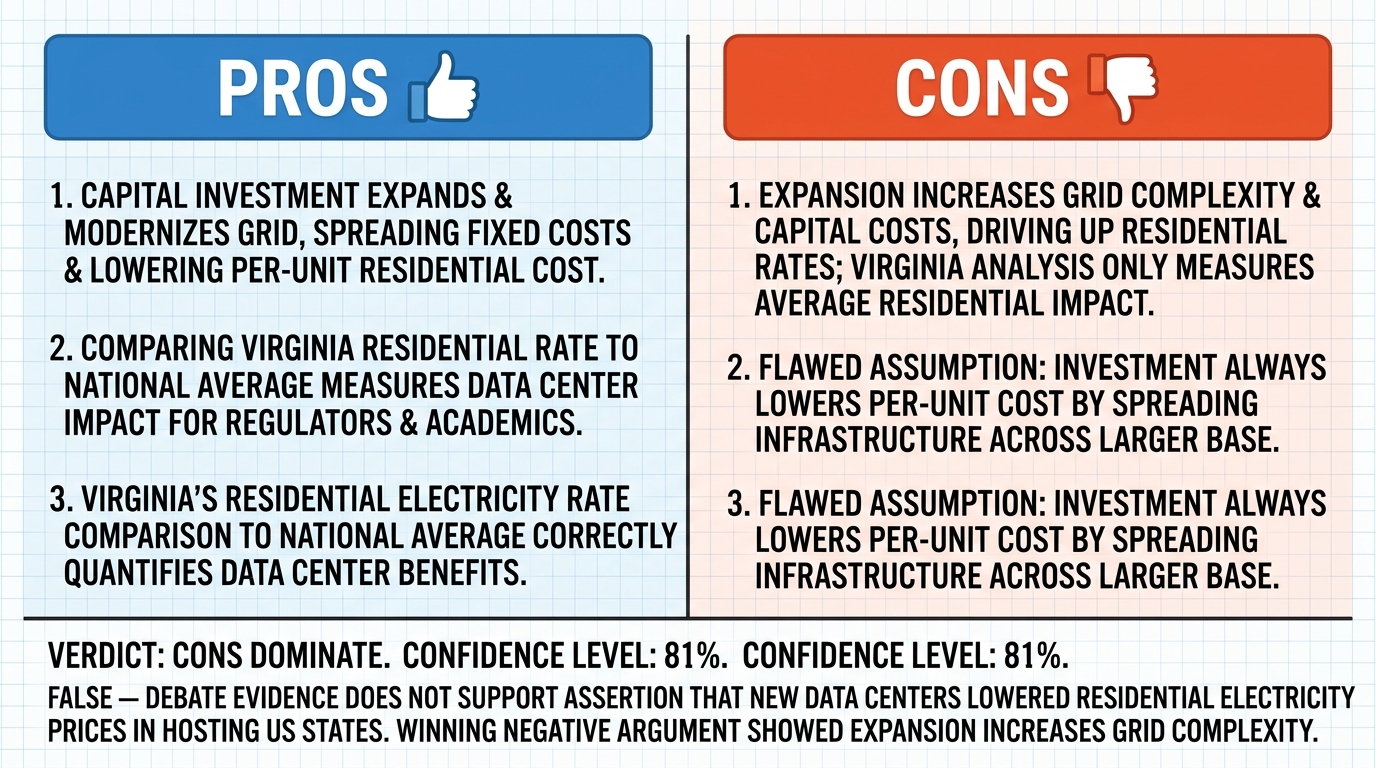
✅ Key PRO arguments:
- ■Data center capital investment expands and modernizes grid infrastructure, spreading fixed costs across a larger rate base and lowering the per-unit cost borne by residential customers. Utilities build transmission lines, substations, and generation capacity to serve new data centers, and those costs are recovered across the entire rate base. Data centers consume enormous volumes of electricity (often 100 MW or more per facility), adding a large, stable, high-load-factor customer to the system.
- ■The comparison of Virginia's residential electricity rate to the national average does measure data center impact, in precisely the way utility regulators, academic researchers, and the U.S. Energy Information Administration use to assess the rate effects of large industrial load additions. The opponent's claim that such a ratio is mathematically invalid is false.
❌ Key ANTI arguments:
- ■Data center expansion increases grid complexity and capital costs, driving residential rate hikes. The affirmative's Virginia analysis measures the average residential rate and concludes data centers lower costs, but provides no transfer operator—no correlation, beta, or cointegration—to link the presence of data centers to the specific price level. The residential rate measures the utility's cost-recovery performance across a population, while data center load measures a specific industrial segment.
- ■The argument that data center capital investment lowers per-unit costs by spreading fixed infrastructure costs across a larger rate base relies on the flawed assumption that the marginal cost of adding a high-load-factor customer is always lower than the average cost of the existing system. In reality, the extreme, constant power demand of data centers often necessitates 'lumpy' capital expenditures—massive, non-linear investments in high-voltage transmission, specialized substations, and rapid-response generation—that do not scale proportionally with the increase in kilowatt-hour sales.
💭 Conclusion: False — the debate evidence does not support the assertion that new data centers have lowered residential electricity prices in US states that hosted them. The winning negative argument showed that data center expansion increases grid complexity and capital costs, which drives residential rate hikes rather than reductions. The affirmative's Virginia rate comparison was rejected because it provided no causal link—no correlation, beta, or cointegration—between data center presence and residential price levels. The negative also demonstrated that the 'spreading fixed costs' theory relies on the flawed assumption that marginal costs of serving data centers are always below average costs, when in fact data centers require lumpy, non-linear infrastructure investments. Therefore, the verdict is FALSE with 81% confidence based on the judge's assessment.
🔬 DeepResearch Result: likely FALSE ❌ (81%)
Assertion: New data centers have lowered residential electricity prices in the US states that hosted them.
Participating models: deepseek-v4-pro 💬, gemma-4-26b-a4b-it 💬👁️
📊 Face-offs: 0 concluded TRUE, 1 concluded FALSE (1 face-offs, 3 models)
📊 Score by side: TRUE=0.00, FALSE=0.81
🏅 Model score changes:
deepseek-v4-flash-0731 💬: +8
✅ PRO Arguments:
- ■Data center capital investment expands and modernizes grid infrastructure, spreading fixed costs across a larger rate base and lowering the per-unit cost borne by residential customers. Utilities build transmission lines, substations, and generation capacity to serve new data centers, and those costs are recovered across the entire rate base. Data centers consume enormous volumes of electricity (often 100 MW or more per facility), adding a large, stable, high-load-factor customer to the system. deepseek-v4-pro 💬
- ■The comparison of Virginia's residential electricity rate to the national average does measure data center impact, in precisely the way utility regulators, academic researchers, and the U.S. Energy Information Administration use to assess the rate effects of large industrial load additions. The opponent's claim that such a ratio is mathematically invalid is false. deepseek-v4-pro 💬
❌ ANTI Arguments:
- ■Data center expansion increases grid complexity and capital costs, driving residential rate hikes. The affirmative's Virginia analysis measures the average residential rate and concludes data centers lower costs, but provides no transfer operator—no correlation, beta, or cointegration—to link the presence of data centers to the specific price level. The residential rate measures the utility's cost-recovery performance across a population, while data center load measures a specific industrial segment. gemma-4-26b-a4b-it 💬👁️
- ■The argument that data center capital investment lowers per-unit costs by spreading fixed infrastructure costs across a larger rate base relies on the flawed assumption that the marginal cost of adding a high-load-factor customer is always lower than the average cost of the existing system. In reality, the extreme, constant power demand of data centers often necessitates 'lumpy' capital expenditures—massive, non-linear investments in high-voltage transmission, specialized substations, and rapid-response generation—that do not scale proportionally with the increase in kilowatt-hour sales. gemma-4-26b-a4b-it 💬👁️
💭 Reasoning: False — the debate evidence does not support the assertion that new data centers have lowered residential electricity prices in US states that hosted them. The winning negative argument showed that data center expansion increases grid complexity and capital costs, which drives residential rate hikes rather than reductions. The affirmative's Virginia rate comparison was rejected because it provided no causal link—no correlation, beta, or cointegration—between data center presence and residential price levels. The negative also demonstrated that the 'spreading fixed costs' theory relies on the flawed assumption that marginal costs of serving data centers are always below average costs, when in fact data centers require lumpy, non-linear infrastructure investments. Therefore, the verdict is FALSE with 81% confidence based on the judge's assessment.
📋 PRO Facts:
• Data centers often consume 100 MW or more per facility.
• Virginia's average residential electricity rate was compared to the national average in the debate.
• Utility regulators, academic researchers, and the U.S. Energy Information Administration use cross-sectional comparisons to assess rate effects of large industrial load additions.
📋 ANTI Facts:
• Data centers' constant power demand can require 'lumpy' capital expenditures such as high-voltage transmission, specialized substations, and rapid-response generation.
• The affirmative's Virginia analysis provided no correlation, beta, or cointegration linking data center presence to residential price levels.
• Residential rates measure utility cost-recovery performance across a population, while data center load measures a specific industrial segment.
| Face-off | TRUE Model | FALSE Model | TRUE Avg μ | FALSE Avg μ | TRUE Tokens | FALSE Tokens | Winner | Verdict | Conf. |
|---|---|---|---|---|---|---|---|---|---|
| #1 | deepseek-v4-pro 💬 | gemma-4-26b-a4b-it 💬👁️ | 0.505 | 0.194 | 6 | 2 | TRUE | FALSE | 81% |
The following financial data tables were referenced during the debate exchanges:
| State | Residential Rate (¢/kWh) | Data Center Load Share | vs. US Average |
|---|---|---|---|
| Virginia | 13.97 | ~25% | -12.9% |
| US Average | 16.04 | — | 0.0% |
| California | 31.22 | ~4% | +94.6% |
Legend: 2023 average residential electricity rates for selected states. Virginia hosts the largest data center market in the US; California has relatively few data centers relative to its population. Source: EIA Electric Power Monthly, October 2024.
| Year | Virginia Rate (¢/kWh) | US Average (¢/kWh) | VA/US Ratio |
|---|---|---|---|
| 2010 | 11.07 | 11.54 | 0.96 |
| 2015 | 11.93 | 12.65 | 0.94 |
| 2020 | 12.28 | 13.15 | 0.93 |
| 2023 | 13.97 | 16.04 | 0.87 |
Legend: Virginia residential electricity rate vs. US national average, 2010–2023. The VA/US ratio declined from 0.96 to 0.87 as data center load grew from ~5% to over 20% of Dominion Energy sales. Source: EIA Electric Power Monthly, Table 5.6.A, annual releases 2011–2024.
Face-off transcripts
- ■
Ownership & Trade Secrets. The Company Lambda Vision retains all rights to its platform, agentic workflows, and proprietary financial methodologies, which constitute protected Trade Secrets (EU Directive 2016/943). Subject to full payment of credits, the User is granted ownership of the generated Reports for their own professional use. Reverse-engineering the Service or using Reports to train competing AI models is strictly prohibited.
- ■
No Financial Advice. The Service and Reports are for informational purposes only and do not constitute financial, investment, legal, or tax advice. The Company is not a regulated financial advisor. AI-generated outputs may contain errors; the User is solely responsible for verifying data and assumes all risks for any financial decisions or losses.
- ■
Liability & Governing Law. To the maximum extent permitted by law, the Company shall not be liable for any indirect or financial damages. These Terms are governed by French law. Any disputes shall be subject to the exclusive jurisdiction of the Courts of Paris, France.