
Money will increasingly flow into Bitcoin Exchange Traded Funds (ETFs) after the meeting on 2026-11-01.
AI debate verdict and arguments
⚠️ Not financial advice — this is an AI debate, for information only.
Completed October 31, 2026
Verdict
Verdict: likely FALSE (72%)
This section provides a brief overview of the key arguments. You do not need to read the full detailed report below.
✅ Key PRO arguments:
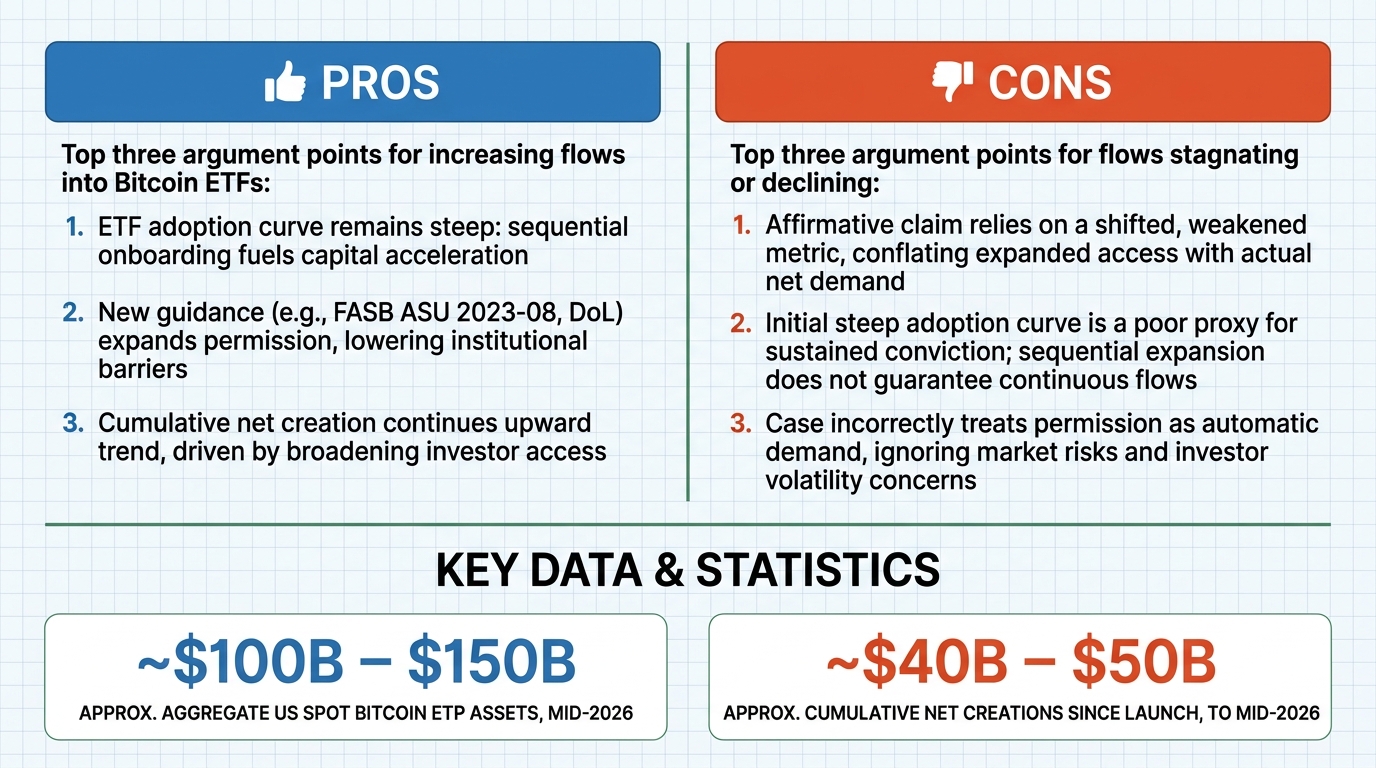
- ■Capital inflows into Bitcoin ETFs will accelerate following the 2026-11-01 meeting. The ETF adoption curve is still on its steep segment; access—not price—is what gates inflows. Spot bitcoin exchange-traded products became a legal US listing category only on 10 January 2024.
- ■The permission-versus-demand distinction does not defeat rising Bitcoin ETF flows. FASB ASU 2023-08 and Department of Labor guidance expand permission to hold digital assets , but the rule either compels purchase or it does not; the affirmative argues that both branches fail to show stagnation.
❌ Key ANTI arguments:
- ■Bitcoin ETF inflows will likely stagnate or decline following the 2026-11-01 meeting. The affirmative commits a quantifier shift: defending a narrowed 'cumulative net creations over thirteen weeks' test rather than the actual claim of increasing flows. A thesis narrowed under pressure is a concession.
- ■The 'ETF adoption curve is still on its steep segment' argument fails because it treats sequential expansion of the eligible set of investors as a proxy for continuous upward net inflows , ignoring the structural reality of institutional capital cycles . Onboarding distribution nodes does not guarantee recurring flows .
💭 Conclusion: False — the debate's winning side successfully showed that the affirmative's case rested on a shifted, weakened metric and on conflating expanded access with actual net inflows . The negative demonstrated that defending 'cumulative net creations over thirteen weeks' abandons the original claim that money will increasingly flow after the meeting. It also showed that onboarding distribution nodes such as advisers and managed-account platforms does not guarantee recurring flows , because institutional capital cycles determine the actual direction of capital. The judge sided with the negative with 72% confidence, and the tournament confidence was 100%. Therefore the assertion that money will increasingly flow into Bitcoin ETFs after the 2026-11-01 meeting is not supported.
🔬 DeepResearch Result: likely FALSE ❌ (72%)
Assertion: Money will increasingly flow into Bitcoin Exchange Traded Funds (ETFs ) after the meeting on 2026-11-01.
Participating models: deepseek-v3.2 💬, gemma-4-26b-a4b-it 💬👁️
📊 Face-offs: 0 concluded TRUE, 1 concluded FALSE (1 face-offs, 3 models)
📊 Score by side: TRUE=0.00, FALSE=0.72
🏅 Model score changes:
deepseek-v4-flash-0731 💬: +7
✅ PRO Arguments:
- ■Capital inflows into Bitcoin ETFs will accelerate following the 2026-11-01 meeting. The ETF adoption curve is still on its steep segment; access—not price—is what gates inflows. Spot bitcoin exchange-traded products became a legal US listing category only on 10 January 2024. deepseek-v3.2 💬
- ■The permission-versus-demand distinction does not defeat rising Bitcoin ETF flows. FASB ASU 2023-08 and Department of Labor guidance expand permission to hold digital assets , but the rule either compels purchase or it does not; the affirmative argues that both branches fail to show stagnation. deepseek-v3.2 💬
❌ ANTI Arguments:
- ■Bitcoin ETF inflows will likely stagnate or decline following the 2026-11-01 meeting. The affirmative commits a quantifier shift: defending a narrowed 'cumulative net creations over thirteen weeks' test rather than the actual claim of increasing flows. A thesis narrowed under pressure is a concession. gemma-4-26b-a4b-it 💬👁️
- ■The 'ETF adoption curve is still on its steep segment' argument fails because it treats sequential expansion of the eligible set of investors as a proxy for continuous upward net inflows , ignoring the structural reality of institutional capital cycles . Onboarding distribution nodes does not guarantee recurring flows . gemma-4-26b-a4b-it 💬👁️
💭 Reasoning: False — the debate's winning side successfully showed that the affirmative's case rested on a shifted, weakened metric and on conflating expanded access with actual net inflows. The negative demonstrated that defending 'cumulative net creations over thirteen weeks' abandons the original claim that money will increasingly flow after the meeting. It also showed that onboarding distribution nodes such as advisers and managed-account platforms does not guarantee recurring flows, because institutional capital cycles determine the actual direction of capital. The judge sided with the negative with 72% confidence, and the tournament confidence was 100%. Therefore the assertion that money will increasingly flow into Bitcoin ETFs after the 2026-11-01 meeting is not supported.
📋 PRO Facts:
• Spot bitcoin exchange-traded products became a legal US listing category on 10 January 2024.
• FASB ASU 2023-08 and Department of Labor guidance expand permission to hold digital assets.
📋 ANTI Facts:
• The affirmative proposed a test based on cumulative net creations over thirteen weeks rather than the original claim.
• The affirmative assumed that once a distribution node is onboarded, recurring flows follow automatically from rebalancing and model-portfolio contributions.
| Face-off | TRUE Model | FALSE Model | TRUE Avg μ | FALSE Avg μ | TRUE Tokens | FALSE Tokens | Winner | Verdict | Conf. |
|---|---|---|---|---|---|---|---|---|---|
| #1 | deepseek-v3.2 💬 | gemma-4-26b-a4b-it 💬👁️ | 0.496 | 0.237 | 8 | 2 | TRUE | FALSE | 72% |
The following technical terms, abbreviations, and domain-specific concepts are referenced throughout this debate transcript. Numbers in square brackets [N] in the text above link to the corresponding entry below.
[1] accounting and fiduciary deadlines — Deadlines arising from accounting rules and legal duties to act in clients' best interests; cited as a compliance-driven schedule for purchases.
[2] capital inflows — Money flowing into an asset or market; the debate's core claim is that these will accelerate into Bitcoin ETFs after the meeting.
[3] contradictories — In logic, propositions that cannot both be true and cannot both be false; used to argue that a rule either mandates acquisition or does not.
[4] covered-call overlays — An options strategy in which call options are sold on an underlying asset to generate income; cited as a product built on the ETF trust.
[5] cumulative net creations — The total number of newly created ETF shares minus redemptions over a period; the Affirmative proposes this as the metric for testing the claim.
[6] Department of Labor guidance — Guidance from the U.S. Department of Labor cited in the debate as expanding permission to hold digital assets without mandating acquisition.
[7] digital assets — Assets that exist in digital form, such as cryptocurrencies; the debate cites rules expanding permission to hold them.
[8] distribution node — A channel or intermediary through which ETFs reach investors; the Affirmative argues these are onboarded sequentially.
[9] dovish guidance — Monetary policy communication signaling a preference for lower interest rates or easing; cited as a possible meeting outcome.
[10] easing — Loosening of monetary policy, typically through lower interest rates or increased liquidity; cited as a conjectured policy path.
[11] ETF adoption curve — The pattern of adoption of exchange-traded funds over time; the Affirmative argues it is still on its steep segment.
[12] ETFs — Exchange Traded Funds — Investment funds that trade on stock exchanges like stocks; the debate concerns Bitcoin ETFs.
[13] FASB ASU 2023-08 — Financial Accounting Standards Board Accounting Standards Update 2023-08 — An accounting standards update cited in the debate as expanding permission to hold digital assets without mandating acquisition.
[14] Federal Reserve — The central bank of the United States; its policy path is cited as a key uncertainty for Bitcoin ETF flows.
[15] glissement de quantificateur — A French term for a quantifier shift, a logical fallacy in which the scope of a quantifier is altered; used by the Negative to argue the Affirmative narrowed the claim.
[16] hawkish pivot — A shift in monetary policy stance toward tighter conditions, such as higher interest rates; cited as a possible outcome that would undermine the Affirmative's case.
[17] income-product sponsors — Sponsors of investment products designed to generate income, such as covered-call funds; cited as a distribution node.
[18] independent advisers — Financial advisers not tied to a single product provider; cited as a distribution node for ETFs.
[19] institutional capital cycles — Periodic patterns of capital deployment and withdrawal by large institutions; used to argue inflows are not automatically continuous.
[20] institutional consolidation — A phase in which large institutions hold and periodically adjust positions, often with large redemptions; cited by the Negative.
[21] interest rate environment — The prevailing level and direction of interest rates; cited as a factor affecting model portfolios and flows.
[22] leveraged and option-bearing wrappers — Investment products that use leverage or options to amplify or alter returns, built on top of ETFs; cited as a distribution node.
[23] liquidity-signal event — An event that investors interpret as indicating future liquidity conditions; the Affirmative treats the meeting as one.
[24] macro-policy decision point — A scheduled meeting at which macroeconomic policy, such as interest rates, is decided; the debate centers on the 2026-11-01 meeting.
[25] macro-volatility — Large fluctuations in broad economic or financial conditions; cited as a factor that can trigger redemptions.
[26] managed-account platforms — Platforms that offer professionally managed investment accounts; cited as a distribution node for ETFs.
[27] modal status — In logic, whether a statement is necessarily true, possibly true, or contingent; used to frame the mandate question as binary.
[28] model portfolios — Predefined investment portfolios used by advisers to allocate client assets; cited as a channel for recurring flows.
[29] monotonic weekly positivity — A property of a series that is positive in every week without exception; the Affirmative disclaims this as a requirement.
[30] net inflows — The difference between money entering and leaving an investment fund; the debate concerns whether Bitcoin ETF net inflows will increase.
[31] novelty phase — The initial period of rapid inflows driven by newness; the Negative contrasts it with institutional consolidation.
[32] policy path — The expected future course of monetary policy; the debate treats the meeting as a signal for it.
[33] rebalancing — Adjusting portfolio weights to maintain a target asset allocation; cited as a source of recurring ETF flows.
[34] recurring flows — Regular, repeated investment flows, e.g., from rebalancing; cited as automatic after platform approval.
[35] redemptions — The process by which ETF shares are returned to the issuer in exchange for the underlying assets or cash; mentioned as periodic large-scale outflows.
[36] SEC — U.S. Securities and Exchange Commission — The U.S. securities regulator; the debate cites its approval of rules enabling spot bitcoin ETP listings.
[37] spot bitcoin exchange-traded products — Exchange-traded products that hold actual bitcoin rather than derivatives; the category approved for US listing according to the debate.
The following financial data tables were referenced during the debate exchanges:
| Parameter | Value (order-of-magnitude) | Locator / basis |
|---|---|---|
| US spot bitcoin ETP listing category opened | 10 Jan 2024 | SEC press release, 10 Jan 2024 |
| Sponsor fee range, largest US spot bitcoin trusts | ~0.25% – 1.50% of assets | issuer fee schedules |
| Approx. aggregate US spot bitcoin ETP assets, mid-2026 | ~$100B – $150B | my estimate, not a verified point figure |
| Approx. cumulative net creations since launch, to mid-2026 | ~$40B – $50B | my estimate, not a verified point figure |
| FASB fair-value standard effective | fiscal years beginning after 15 Dec 2024 | FASB ASU 2023-08 |
| Post-meeting test horizon | 13 weeks after 1 Nov 2026 vs 13 weeks before | stated falsification condition |
Legend: Structural parameters of the US spot bitcoin ETF market and the test I propose for the claim. Asset and creation figures are my own order-of-magnitude estimates, explicitly not verified point data; fee range is in percent of fund assets per year; dates are US listing/effective dates.
| Argument Type | Affirmative Assumption | Counter-Risk |
|---|---|---|
| Liquidity | Dovish Fed guidance | Hawkish pivot / Higher rates |
| Mandate | Legal permission = Demand | Risk-aversion / Low volatility |
| Distribution | Sequential onboarding | Market saturation / Redemptions |
Legend: Comparison of the Affirmative's assumed drivers against the structural risks that would invalidate the claim.
| Item | Value (US$ billions) |
|---|---|
| US adviser-managed retail and plan-adjacent pool (order of magnitude, my estimate) | 10,000 |
| 0.5% digital-asset sleeve of that pool | 50 |
| 1.0% digital-asset sleeve of that pool | 100 |
| Cumulative net creations, US spot bitcoin ETPs, Jan 2024 – mid-2026 (my estimate) | 40 – 50 |
Legend: Illustration of why a ceiling raised from zero is flow-relevant: a 0.5%–1.0% sleeve of an adviser pool measured in the low tens of trillions of dollars is the same order of magnitude as all creations recorded since the January 2024 opening of the listing category. All values in US$ billions; pool and creation figures are my estimates, not verified point data. Sleeve = target weight × pool.
Face-off transcripts
- ■
Ownership & Trade Secrets. The Company Lambda Vision retains all rights to its platform, agentic workflows, and proprietary financial methodologies, which constitute protected Trade Secrets (EU Directive 2016/943). Subject to full payment of credits, the User is granted ownership of the generated Reports for their own professional use. Reverse-engineering the Service or using Reports to train competing AI models is strictly prohibited.
- ■
No Financial Advice. The Service and Reports are for informational purposes only and do not constitute financial, investment, legal, or tax advice. The Company is not a regulated financial advisor. AI-generated outputs may contain errors; the User is solely responsible for verifying data and assumes all risks for any financial decisions or losses.
- ■
Liability & Governing Law. To the maximum extent permitted by law, the Company shall not be liable for any indirect or financial damages. These Terms are governed by French law. Any disputes shall be subject to the exclusive jurisdiction of the Courts of Paris, France.