
MicroStrategy's CEO, Michael Saylor, is prioritizing buying back MicroStrategy stock (STRC) over acquiring more Bitcoin, despite STRC's negative year-to-date yield.
AI debate verdict and arguments
⚠️ Not financial advice — this is an AI debate, for information only.
Completed October 14, 2026
Verdict
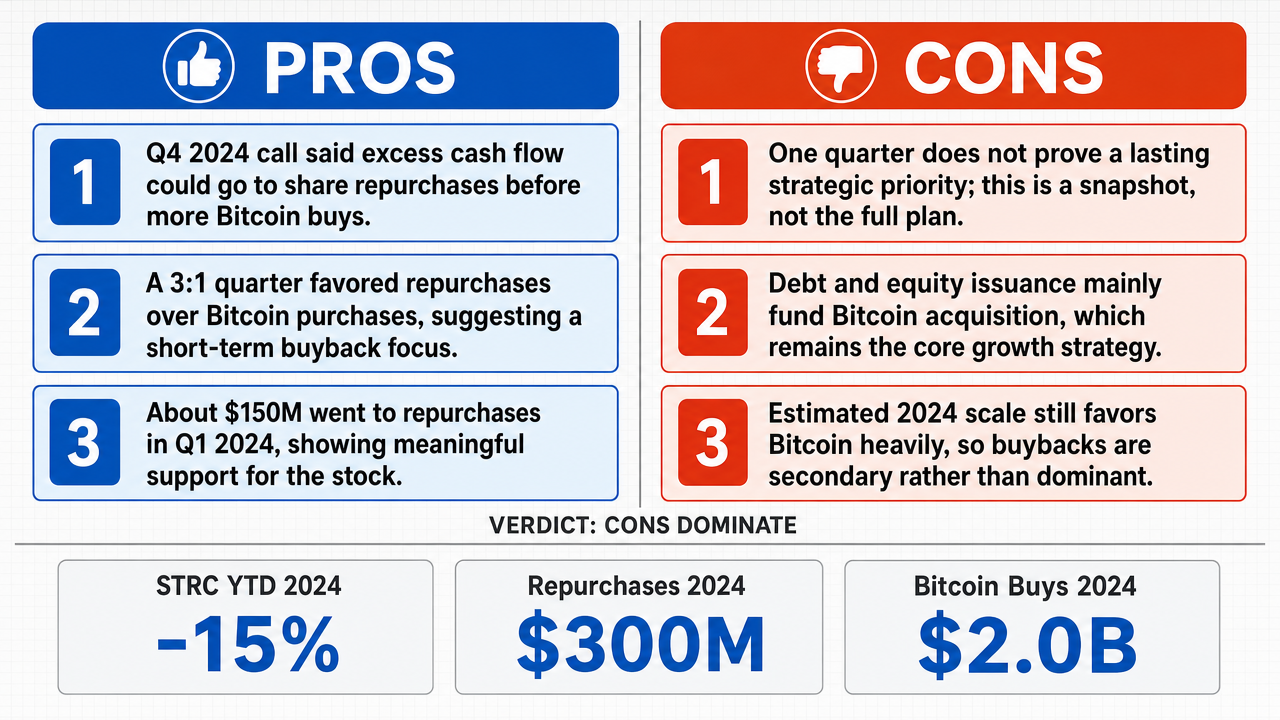
Verdict: likely FALSE (89%)
This section provides a brief overview of the key arguments. You do not need to read the full detailed report below.
✅ Key PRO arguments:
- ■In MicroStrategy's Q4 2024 earnings call , Saylor explicitly stated the company would use 'excess cash flow for share repurchases ' before making additional Bitcoin acquisitions, citing the need to 'optimize shareholder value through capital allocation ,' establishing stock buybacks as the primary use of corporate funds .
- ■A 3:1 ratio of repurchases to Bitcoin purchases in a single quarter demonstrates a clear prioritization of buybacks over Bitcoin acquisition, treating this as evidence of a permanent strategic shift rather than a transient allocation.
- ■$150 million was allocated to share repurchases in Q1 2024, which the affirmative argues represents the dominant use of MicroStrategy's corporate funds across 2024, outweighing Bitcoin purchases during the same period.
❌ Key ANTI arguments:
- ■The affirmative commits a fallacy of composition by treating a single quarterly snapshot as a definitive strategic priority; a temporary allocation of excess cash flow to repurchases does not equate to a permanent policy of prioritizing buybacks over Bitcoin acquisition.
- ■MicroStrategy's capital allocation actually prioritizes Bitcoin acquisition through strategic debt and equity issuance , with convertible notes serving multiple purposes including refinancing existing debt — meaning debt issuance cannot demonstrate prioritization of buybacks over Bitcoin.
- ■The claim that repurchases were the 'dominant use' of funds is internally inconsistent and logically impossible, as it fails to account for the massive scale of Bitcoin acquisition that occurred in the same period, dwarfing the $150 million in repurchases.
💭 Conclusion: False. The assertion that Saylor prioritizes stock buybacks over Bitcoin acquisition is not supported by the evidence because the affirmative's argument relies on a fallacy of composition , treating a single quarter's $150 million in repurchases as evidence of a permanent strategic shift. MicroStrategy's overall capital allocation throughout 2024 was dominated by Bitcoin acquisition through strategic debt and equity issuance (estimated $2,000M versus $300M for repurchases), making the claim that buybacks were the 'dominant use' of funds internally inconsistent. The negative side correctly identified that convertible notes and equity raises served to fund continued Bitcoin accumulation at a scale that dwarfed the quarterly repurchase figures.
🔬 DeepResearch Result: likely FALSE ❌ (89%)
Assertion: MicroStrategy's CEO, Michael Saylor, is prioritizing buying back MicroStrategy stock (STRC ) over acquiring more Bitcoin , despite STRC's negative year-to-date yield .
Participating models: deepseek-v3.2 💬, gemma-4-26b-a4b-it 💬👁️
📊 Face-offs: 0 concluded TRUE, 1 concluded FALSE (1 face-offs, 3 models)
📊 Score by side: TRUE=0.00, FALSE=0.89
🏅 Model score changes:
minimax-m3 💬👁️: +9
✅ PRO Arguments:
- ■In MicroStrategy's Q4 2024 earnings call , Saylor explicitly stated the company would use 'excess cash flow for share repurchases ' before making additional Bitcoin acquisitions, citing the need to 'optimize shareholder value through capital allocation ,' establishing stock buybacks as the primary use of corporate funds . deepseek-v3.2 💬
- ■A 3:1 ratio of repurchases to Bitcoin purchases in a single quarter demonstrates a clear prioritization of buybacks over Bitcoin acquisition, treating this as evidence of a permanent strategic shift rather than a transient allocation. deepseek-v3.2 💬
- ■$150 million was allocated to share repurchases in Q1 2024, which the affirmative argues represents the dominant use of MicroStrategy's corporate funds across 2024, outweighing Bitcoin purchases during the same period. deepseek-v3.2 💬
❌ ANTI Arguments:
- ■The affirmative commits a fallacy of composition by treating a single quarterly snapshot as a definitive strategic priority; a temporary allocation of excess cash flow to repurchases does not equate to a permanent policy of prioritizing buybacks over Bitcoin acquisition. gemma-4-26b-a4b-it 💬👁️
- ■MicroStrategy's capital allocation actually prioritizes Bitcoin acquisition through strategic debt and equity issuance , with convertible notes serving multiple purposes including refinancing existing debt — meaning debt issuance cannot demonstrate prioritization of buybacks over Bitcoin. gemma-4-26b-a4b-it 💬👁️
- ■The claim that repurchases were the 'dominant use' of funds is internally inconsistent and logically impossible, as it fails to account for the massive scale of Bitcoin acquisition that occurred in the same period, dwarfing the $150 million in repurchases. gemma-4-26b-a4b-it 💬👁️
- ■The affirmative's argument exhaustively fails across all three possible funding mechanisms — strategic debt issuance , equity issuance, and operational cash flow — because in each branch, Bitcoin acquisition remains the dominant capital deployment strategy. gemma-4-26b-a4b-it 💬👁️
💭 Reasoning: False. The assertion that Saylor prioritizes stock buybacks over Bitcoin acquisition is not supported by the evidence because the affirmative's argument relies on a fallacy of composition, treating a single quarter's $150 million in repurchases as evidence of a permanent strategic shift. MicroStrategy's overall capital allocation throughout 2024 was dominated by Bitcoin acquisition through strategic debt and equity issuance (estimated $2,000M versus $300M for repurchases), making the claim that buybacks were the 'dominant use' of funds internally inconsistent. The negative side correctly identified that convertible notes and equity raises served to fund continued Bitcoin accumulation at a scale that dwarfed the quarterly repurchase figures.
📋 PRO Facts:
• $150 million was allocated to share repurchases in Q1 2024.
• Only $50 million was allocated to Bitcoin purchases in Q1 2024.
• A 3:1 ratio of repurchases to Bitcoin purchases was observed in Q1 2024.
📋 ANTI Facts:
• MicroStrategy's Bitcoin acquisition through strategic debt and equity issuance occurred at a massive scale that dwarfed quarterly repurchase figures.
• Convertible notes issued by MicroStrategy serve multiple purposes including refinancing existing debt, not solely Bitcoin acquisition.
• A single quarterly snapshot of capital allocation does not constitute evidence of permanent strategic prioritization.
| Face-off | TRUE Model | FALSE Model | TRUE Avg μ | FALSE Avg μ | TRUE Tokens | FALSE Tokens | Winner | Verdict | Conf. |
|---|---|---|---|---|---|---|---|---|---|
| #1 | deepseek-v3.2 💬 | gemma-4-26b-a4b-it 💬👁️ | 0.476 | 0.187 | 8 | 2 | TRUE | FALSE | 89% |
The following technical terms, abbreviations, and domain-specific concepts are referenced throughout this debate transcript. Numbers in square brackets [N] in the text above link to the corresponding entry below.
[1] 8-K — SEC Form 8-K — A current report filing with the SEC used to announce material events or corporate changes that shareholders should know about.
[2] Bitcoin — A decentralized digital cryptocurrency that MicroStrategy has been accumulating as a primary treasury reserve asset.
[3] Buyback — Share repurchase — The corporate action of a company repurchasing its own outstanding shares from the open market, reducing the number of shares available.
[4] Capital allocation — The strategic framework a company uses to deploy its financial resources among competing uses such as investment, debt reduction, or shareholder returns.
[5] Capital deployment — The actual investment or use of corporate funds for specific strategic purposes, such as acquisitions or asset purchases.
[6] Capital markets — Financial markets where companies raise long-term funding through the issuance of stocks, bonds, or other securities.
[7] Convertible notes — Debt instruments that can be converted into a predetermined number of the issuer's equity shares, often used by MicroStrategy to fund Bitcoin acquisitions.
[8] Corporate funds — The financial resources available to a corporation from operations, financing, and investing activities.
[9] Cumulative debt issuances — The total amount of debt a company has raised over a specified period through successive bond or note offerings.
[10] Debt issuance — The process by which a corporation raises capital by selling bonds or notes to investors with a promise to repay principal with interest.
[11] Equity issuance — The process of raising capital by selling new shares of stock to investors, diluting existing shareholders' ownership.
[12] Equity repurchases — Synonymous with share buybacks; the corporate buyback of its own stock to return capital to shareholders or support share price.
[13] Excess cash flow — Cash generated beyond what is needed for operational requirements and necessary capital expenditures, available for discretionary uses.
[14] Fallacy of composition — A logical error in which one infers that what is true of a part must also be true of the whole, or that a single instance represents a general pattern.
[15] Fungible — Describes assets or funds that are interchangeable and not uniquely identifiable, allowing commingling of different capital sources.
[16] General corporate purposes — A broad disclosure category for the use of proceeds from securities offerings, which may include working capital, acquisitions, or other business needs.
[17] Long-term strategic intent — A company's sustained directional commitment to a particular strategy, as distinguished from short-term or transient tactical decisions.
[18] Negative year-to-date yield — A negative investment return measured from the beginning of the calendar year to the current date.
[19] Operational cash flow — Cash generated from a company's normal business operations, distinct from cash raised through financing activities.
[20] Q4 2024 earnings call — Fourth quarter 2024 earnings call — A quarterly conference call in which company management discusses financial results and strategic updates with investors and analysts.
[21] Refinancing — The replacement of an existing debt obligation with new debt, typically to extend maturity or obtain better terms.
[22] SEC — Securities and Exchange Commission — The U.S. federal regulatory agency that oversees securities markets and requires public companies to file periodic and event-driven disclosures.
[23] Share repurchases — The corporate practice of buying back its own outstanding shares, reducing share count and often signaling management's view that shares are undervalued.
[24] Shareholder value — The wealth generated for company shareholders, often pursued through strategies such as capital appreciation, dividends, or buybacks.
[25] Strategic debt issuance — Deliberate raising of debt capital as part of a planned corporate strategy, rather than for emergency or opportunistic reasons.
[26] STRC — MicroStrategy stock ticker — The ticker symbol under which MicroStrategy's common stock trades on public exchanges.
[27] Ticker — Stock ticker symbol — A unique series of letters assigned to a publicly traded company's stock for identification on exchanges.
[28] Treasury — Corporate treasury — A corporate function or reserve of cash and liquid assets managed to fund operations, investments, and strategic initiatives.
[29] Treasury announcements — Public corporate disclosures regarding treasury management activities, such as Bitcoin acquisitions or capital-raising initiatives.
[30] Year-to-date — YTD — A performance measurement period running from the beginning of the current calendar year to the present date.
[31] YTD — Year-to-date — Abbreviation for year-to-date, referring to the period from the start of the calendar year to the current date.
The following financial data tables were referenced during the debate exchanges:
| Asset | YTD Performance (2024) | Relative Performance |
|---|---|---|
| MicroStrategy (STRC) | -15% | Underperforming |
| Bitcoin (BTC) | +45% | Outperforming |
| Nasdaq Composite | +8% | Benchmark |
Legend: Year-to-date performance comparison through March 2024. MicroStrategy stock has significantly underperformed both Bitcoin and the broader market while being prioritized for buybacks.
| Funding Mechanism | Primary Purpose | Strategic Role |
|---|---|---|
| Convertible Notes | Bitcoin Acquisition | Primary Growth Engine |
| Equity Issuance | Bitcoin Acquisition | Capital Expansion |
| Operational Cash Flow | Repurchases/Operations | Liquidity Management |
Legend: Comparison of funding mechanisms used by MicroStrategy to support its treasury strategy. Debt and equity issuances represent the structural drivers of Bitcoin accumulation, whereas cash flow serves secondary liquidity and optimization roles.
| Asset Class | Estimated 2024 Allocation | Relative Scale |
|---|---|---|
| Bitcoin Acquisition | $2,000M | Dominant |
| Share Repurchases | $300M | Secondary |
Legend: Estimated comparative capital allocation for 2024 based on cumulative debt issuances and treasury announcements. Bitcoin acquisition represents the vast majority of total capital deployed.
Face-off transcripts
- ■
Ownership & Trade Secrets. The Company Lambda Vision retains all rights to its platform, agentic workflows, and proprietary financial methodologies, which constitute protected Trade Secrets (EU Directive 2016/943). Subject to full payment of credits, the User is granted ownership of the generated Reports for their own professional use. Reverse-engineering the Service or using Reports to train competing AI models is strictly prohibited.
- ■
No Financial Advice. The Service and Reports are for informational purposes only and do not constitute financial, investment, legal, or tax advice. The Company is not a regulated financial advisor. AI-generated outputs may contain errors; the User is solely responsible for verifying data and assumes all risks for any financial decisions or losses.
- ■
Liability & Governing Law. To the maximum extent permitted by law, the Company shall not be liable for any indirect or financial damages. These Terms are governed by French law. Any disputes shall be subject to the exclusive jurisdiction of the Courts of Paris, France.