
Meta Platforms, Inc. will need to raise at least $100 billion in new capital (debt or equity) by the end of 2027 to fund its AI initiatives and existing commitments.
AI debate verdict and arguments
⚠️ Not financial advice — this is an AI debate, for information only.
Completed October 24, 2026
Verdict
Verdict: likely FALSE (78%)
This section provides a brief overview of the key arguments. You do not need to read the full detailed report below.
✅ Key PRO arguments:
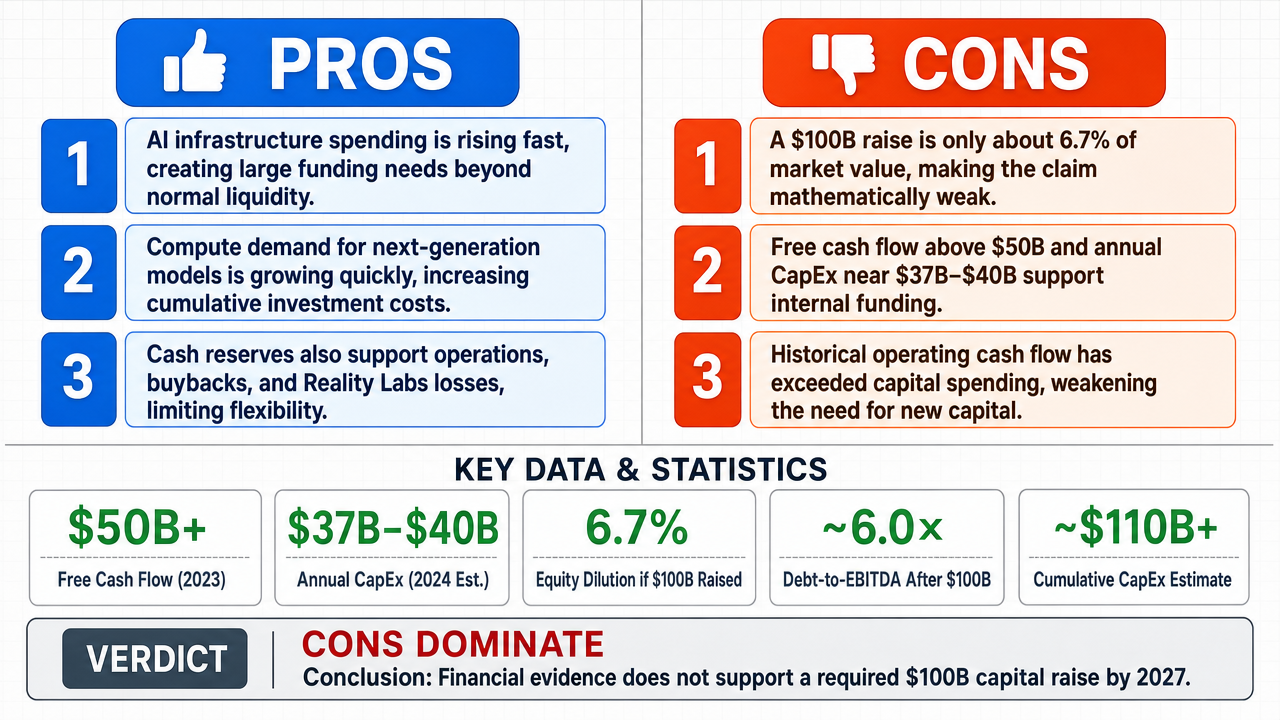
- ■Escalating capital expenditure for AI infrastructure (GPUs , data centers) creates a massive liquidity requirement that exceeds Meta's current free cash flow projections, necessitating external financing by 2027.
- ■AI hardware cycles are accelerating and the scale of compute required for next-generation models is growing exponentially, pushing cumulative investment costs through 2027 to levels that cannot be covered by internal cash generation alone.
- ■Even with robust operational cash flows, existing reserves are already committed to maintaining operations, shareholder returns , and covering the Reality Labs deficit, leaving a funding gap that requires raising at least $100 billion externally.
❌ Key ANTI arguments:
- ■The $100 billion figure is mathematically implausible: Meta's market cap is approximately $1.5 trillion, and raising $100 billion (roughly 6.7% of market value) through debt or equity is an extraordinary and unnecessary measure given Meta's internal cash generation capacity.
- ■Meta's annual free cash flow exceeds $50 billion while projected annual CapEx is approximately $40 billion, generating sufficient internal liquidity to fund most capital needs without external financing .
- ■The claim's own premises undercut it: if Meta's operating cash flow has historically exceeded capital expenditures, then its current cash generation capacity provides the very internal funding mechanism the conclusion denies, making the leap to a $100 billion external raise a logical contradiction.
💭 Conclusion: False. The assertion that Meta must raise at least $100 billion in new capital by end of 2027 is not supported by the financial evidence presented in this debate. Meta's annual free cash flow exceeding $50 billion against projected annual CapEx of approximately $40 billion demonstrates that internal cash generation is sufficient to cover capital needs without external financing . The claim's own premise that operating cash flow historically exceeds capital expenditures directly contradicts the conclusion that a massive external funding gap exists. Raising $100 billion would represent roughly 6.7% of Meta's approximately $1.5 trillion market capitalization, an extraordinary measure not warranted by the company's demonstrated self-funding capacity.
🔬 DeepResearch Result: likely FALSE ❌ (78%)
Assertion: Meta Platforms, Inc. will need to raise at least $100 billion in new capital (debt or equity) by the end of 2027 to fund its AI initiatives and existing commitments.
Participating models: gemma-4-26b-a4b-it 💬👁️, glm-4.7-flash 💬
📊 Face-offs: 0 concluded TRUE, 1 concluded FALSE (1 face-offs, 3 models)
📊 Score by side: TRUE=0.00, FALSE=0.78
🏅 Model score changes:
minimax-m3 💬👁️: +8
✅ PRO Arguments:
- ■Escalating capital expenditure for AI infrastructure (GPUs , data centers) creates a massive liquidity requirement that exceeds Meta's current free cash flow projections, necessitating external financing by 2027. gemma-4-26b-a4b-it 💬👁️
- ■AI hardware cycles are accelerating and the scale of compute required for next-generation models is growing exponentially, pushing cumulative investment costs through 2027 to levels that cannot be covered by internal cash generation alone. gemma-4-26b-a4b-it 💬👁️
- ■Even with robust operational cash flows, existing reserves are already committed to maintaining operations, shareholder returns , and covering the Reality Labs deficit, leaving a funding gap that requires raising at least $100 billion externally. gemma-4-26b-a4b-it 💬👁️
- ■Meta has explicitly signaled a significant ramp-up in CapEx to support its AI roadmap , and the cumulative cost of these investments through 2027 is projected to reach levels that necessitate external financing. gemma-4-26b-a4b-it 💬👁️
❌ ANTI Arguments:
- ■The $100 billion figure is mathematically implausible: Meta's market cap is approximately $1.5 trillion, and raising $100 billion (roughly 6.7% of market value) through debt or equity is an extraordinary and unnecessary measure given Meta's internal cash generation capacity. glm-4.7-flash 💬
- ■Meta's annual free cash flow exceeds $50 billion while projected annual CapEx is approximately $40 billion, generating sufficient internal liquidity to fund most capital needs without external financing. glm-4.7-flash 💬
- ■The claim's own premises undercut it: if Meta's operating cash flow has historically exceeded capital expenditures, then its current cash generation capacity provides the very internal funding mechanism the conclusion denies, making the leap to a $100 billion external raise a logical contradiction. glm-4.7-flash 💬
- ■Meta has demonstrated a consistent ability to self-fund operations and growth through internally generated cash flow, and cumulative CapEx of $115–$130 billion through 2027 is manageable within that self-funding framework without requiring a massive external capital raise. glm-4.7-flash 💬
💭 Reasoning: False. The assertion that Meta must raise at least $100 billion in new capital by end of 2027 is not supported by the financial evidence presented in this debate. Meta's annual free cash flow exceeding $50 billion against projected annual CapEx of approximately $40 billion demonstrates that internal cash generation is sufficient to cover capital needs without external financing. The claim's own premise that operating cash flow historically exceeds capital expenditures directly contradicts the conclusion that a massive external funding gap exists. Raising $100 billion would represent roughly 6.7% of Meta's approximately $1.5 trillion market capitalization, an extraordinary measure not warranted by the company's demonstrated self-funding capacity.
📋 PRO Facts:
• Meta has explicitly signaled a significant ramp-up in CapEx to support its AI roadmap, including procurement of high-end GPUs and construction of massive data centers.
• AI hardware cycles are accelerating and the scale of compute required for next-generation models is growing exponentially.
• Cumulative CapEx through 2027 is projected to reach $115–$130 billion according to the affirmative's own figures.
• Meta's existing cash flow and reserves are already committed to maintaining operations, shareholder returns, and the Reality Labs deficit.
📋 ANTI Facts:
• Meta's market capitalization is approximately $1.5 trillion.
• Meta's annual free cash flow exceeds $50 billion.
• Meta's projected annual CapEx is approximately $40 billion.
• Meta has demonstrated a consistent ability to self-fund operations and growth through internally generated cash flow.
| Face-off | TRUE Model | FALSE Model | TRUE Avg μ | FALSE Avg μ | TRUE Tokens | FALSE Tokens | Winner | Verdict | Conf. |
|---|---|---|---|---|---|---|---|---|---|
| #1 | gemma-4-26b-a4b-it 💬👁️ | glm-4.7-flash 💬 | 0.256 | 0.426 | 4 | 4 | FALSE | FALSE | 78% |
The following technical terms, abbreviations, and domain-specific concepts are referenced throughout this debate transcript. Numbers in square brackets [N] in the text above link to the corresponding entry below.
[1] AI — Artificial Intelligence — Computer systems designed to perform tasks that typically require human intelligence, such as learning, reasoning, and pattern recognition. In the debate, it refers to the technology driving Meta's infrastructure investments.
[2] AI arms race — Industry jargon referring to the intense competitive pressure among major technology companies to develop and deploy AI capabilities ahead of rivals, often framed as a strategic contest requiring massive capital commitment.
[3] AI hardware cycles — The recurring patterns of procurement and deployment of specialized computing hardware (such as GPUs) used to train and run AI models, which the affirmative argues are accelerating.
[4] AI infrastructure — The underlying physical and computational resources—data centers, GPUs, networking, and storage—required to develop and operate AI systems at scale.
[5] AI roadmap — A company's strategic plan outlining the development, deployment, and scaling of AI technologies over a defined time horizon.
[6] CapEx — Capital Expenditure — Funds used by a company to acquire, upgrade, or maintain physical assets such as data centers and GPUs. In the debate, Meta's annual CapEx is cited as $28.1B (2023) and projected at $37B–$40B (2024).
[7] capital buffer — A reserve of capital held to absorb financial shocks or fund large expenditures without disrupting ongoing operations or shareholder returns.
[8] cash flow — The net movement of money into and out of a company over a period, used to assess liquidity and the ability to fund investments and obligations.
[9] cash reserves — Liquid assets held by a company to meet obligations and fund operations; in the debate, cited as already committed to operations, shareholder returns, and the Reality Labs deficit.
[10] compute — Computing power and processing resources, particularly the scale of computational capacity required for training and running next-generation AI models.
[11] cumulative CapEx — The total capital expenditure aggregated over a multi-year period; in the debate, projected to reach $115–$130 billion through 2027.
[12] debt issuance — The process by which a company raises capital by selling bonds or other debt instruments to investors, obligating repayment with interest.
[13] debt-to-EBITDA ratio — A leverage metric comparing a company's total debt to its EBITDA, used to assess financial risk. In the debate, Meta's ratio is cited as below 3×, with a $100B issuance projected to raise it to approximately 6×.
[14] dividend — A distribution of a portion of a company's earnings to shareholders, typically paid in cash; cited in the debate as part of Meta's $10 billion annual shareholder return program.
[15] EBITDA — Earnings Before Interest, Taxes, Depreciation, and Amortization — A financial metric measuring a company's operating profitability by excluding interest, taxes, and non-cash charges; used as the denominator in the debt-to-EBITDA ratio.
[16] equity issuance — The process by which a company raises capital by selling new shares of stock to investors, diluting existing ownership.
[17] external financing — Capital raised from sources outside the company—such as debt or equity markets—as opposed to internally generated cash flow.
[18] free cash flow — The cash a company generates after accounting for capital expenditures, representing the funds available for distribution, debt reduction, or reinvestment. Cited in the debate as exceeding $50 billion annually for Meta.
[19] GPUs — Graphics Processing Units — Specialized processors originally designed for graphics rendering but now widely used to accelerate AI model training and inference due to their parallel processing capabilities.
[20] liquidity — The availability of cash or easily convertible assets to meet short-term obligations and fund expenditures; in the debate, refers to the cash needed for AI infrastructure investment.
[21] market cap — market capitalization — The total dollar value of a company's outstanding shares, calculated as share price multiplied by shares outstanding. Cited in the debate as approximately $1.5 trillion for Meta.
[22] next-generation models — Advanced AI models that require substantially greater computational resources than predecessors, driving the exponential growth in compute demand referenced in the debate.
[23] operating cash flow — Cash generated by a company's core business operations, before financing and investing activities; cited in the debate as historically exceeding capital expenditures.
[24] Reality Labs — Meta's division focused on virtual reality, augmented reality, and metaverse technologies, referenced in the debate as a source of ongoing cash demands (deficit).
[25] share buybacks — share repurchases — Transactions in which a company buys back its own outstanding shares from the market, reducing share count and returning capital to shareholders; cited as part of Meta's $10 billion annual program.
[26] shareholder returns — Value delivered to shareholders through dividends and share buybacks; in the debate, cited as a competing use of cash alongside AI investment.
The following financial data tables were referenced during the debate exchanges:
| Metric | 2023 Actual | 2024 Guidance/Est | 2025-2027 Projected Trend |
|---|---|---|---|
| Annual CapEx | $28.1B | $37B - $40B | Increasing |
| AI Infrastructure Spend | Significant | Accelerating | Exponential |
| Cumulative CapEx (Est) | $28.1B | ~$110B+ | >$150B |
Legend: Estimated capital expenditure trends for Meta Platforms, Inc. based on recent earnings guidance and industry scaling models. Values in USD billions.
| Metric | Current Value | Post-$100B Issuance | Peer Norm | Feasibility |
|---|---|---|---|---|
| Debt-to-EBITDA | ~2.5× | ~6.0× | 4–5× | Viable |
| Equity Dilution | 0% | 6.7% | Normal for large raises | Viable |
| Free Cash Flow (2023) | $50B+ | Sufficient for CapEx | Sustainable | Internal funding possible |
Legend: Meta's current leverage and valuation metrics, projected outcomes of a $100B issuance, and comparison to peer norms. Debt-to-EBITDA = Net Debt / EBITDA; dilution % = Issuance / Market Cap. Source: company filings and market data.
Face-off transcripts
- ■
Ownership & Trade Secrets. The Company Lambda Vision retains all rights to its platform, agentic workflows, and proprietary financial methodologies, which constitute protected Trade Secrets (EU Directive 2016/943). Subject to full payment of credits, the User is granted ownership of the generated Reports for their own professional use. Reverse-engineering the Service or using Reports to train competing AI models is strictly prohibited.
- ■
No Financial Advice. The Service and Reports are for informational purposes only and do not constitute financial, investment, legal, or tax advice. The Company is not a regulated financial advisor. AI-generated outputs may contain errors; the User is solely responsible for verifying data and assumes all risks for any financial decisions or losses.
- ■
Liability & Governing Law. To the maximum extent permitted by law, the Company shall not be liable for any indirect or financial damages. These Terms are governed by French law. Any disputes shall be subject to the exclusive jurisdiction of the Courts of Paris, France.