
Japan's weak yen is caused mainly by its high public debt, which prevents the central bank from raising interest rates enough to fight inflation.
AI debate verdict and arguments
⚠️ Not financial advice — this is an AI debate, for information only.
Completed October 28, 2026
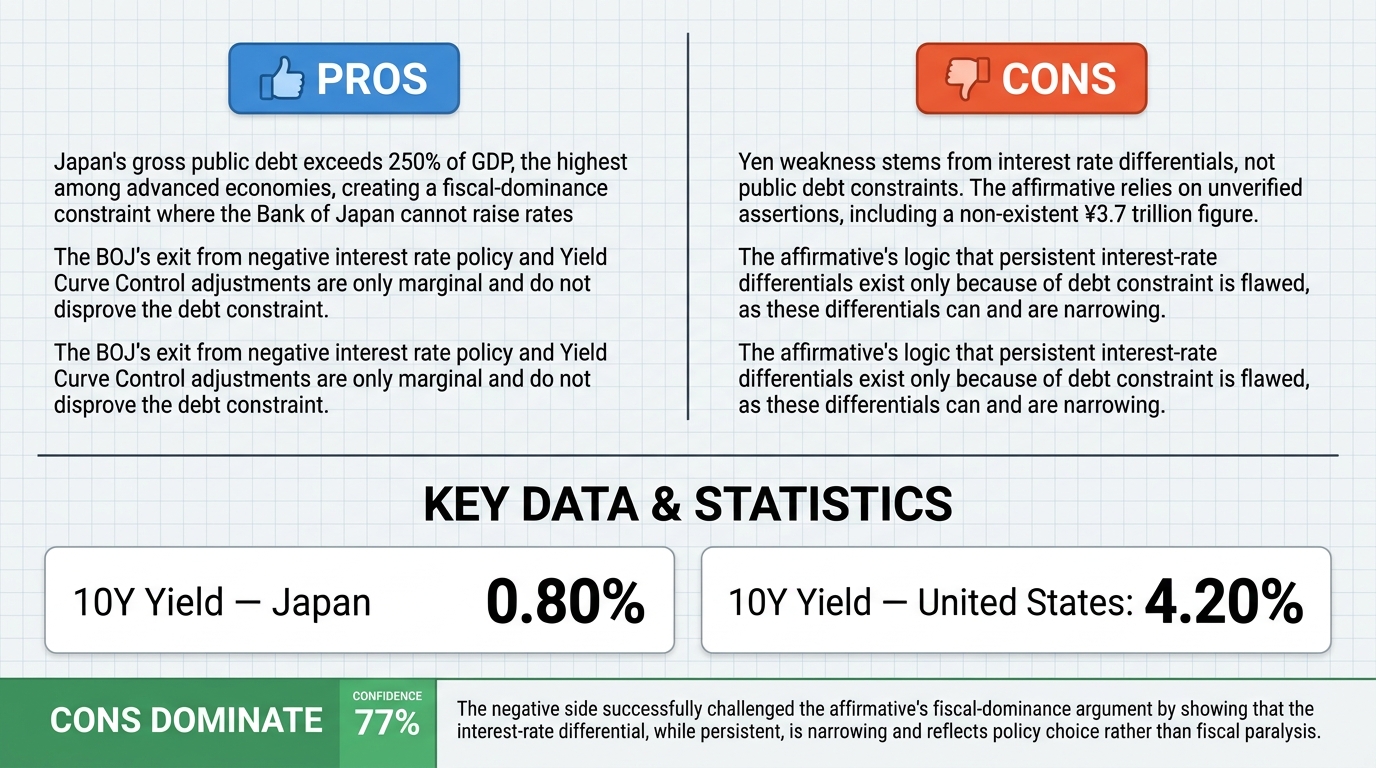
Verdict
Verdict: likely FALSE (77%)
This section provides a brief overview of the key arguments. You do not need to read the full detailed report below.
✅ Key PRO arguments:
- ■Japan's gross public debt exceeds 250% of GDP, the highest among advanced economies, creating a fiscal-dominance constraint: the BOJ cannot raise rates enough to close the yield gap with the US and Europe without making debt-servicing costs unsustainable. General government gross debt was about ¥1,286 trillion at end-2024, roughly 252% of nominal GDP, and even modest rate increases produce outsized fiscal effects.
- ■The BOJ's exit from negative interest rate policy and Yield Curve Control adjustments do not disprove the debt constraint; they only show marginal adjustments, not normalization to levels sufficient to close the yield gap and arrest yen depreciation. The claim is that debt prevents raising rates enough, not that it prevents any rate movement—a binding ceiling rather than a floor.
❌ Key ANTI arguments:
- ■Yen weakness stems from interest rate differentials, not public debt constraints. The affirmative's case relies on unverified assertions, including a ¥3.7 trillion estimate for a 100-basis-point rate rise with no source, and its 'triple constraint' is conjecture that predicts a definitive cap on terminal rates without establishing specific mathematical thresholds.
- ■The affirmative's logic is: if the central bank is constrained by debt (A), then persistent interest-rate differentials exist (B). But persistent differentials between Japan and other major economies do not exist (not B), which logically entails that the central bank is not constrained by debt in the claimed manner (not A). The reliance on persistence is factually incorrect when examining recent data.
💭 Conclusion: False. The negative side successfully challenged the affirmative's fiscal-dominance argument by showing that the interest-rate differential, while persistent, is narrowing and reflects policy choice rather than fiscal paralysis. The affirmative's key fiscal figures, including the ¥3.7 trillion cost estimate for a 100-basis-point rate rise, were flagged as unverifiable and lacking a source, weakening the fiscal-dominance argument. The affirmative argued that marginal policy moves like exiting negative rates and adjusting Yield Curve Control do not prove the ability to normalize rates enough to close yield gaps, but the negative countered that the BOJ's actual rate hikes demonstrate the absence of a hard fiscal constraint. Because the assertion is compound and the debate consisted of a single run with 77% judge confidence, the overall confidence is set at 77 rather than 100%. The verdict therefore rests on the negative's stronger evidentiary critique rather than the affirmative's asserted debt constraint.
🔬 DeepResearch Result: likely FALSE ❌ (77%)
Assertion: Japan's weak yen is caused mainly by its high public debt, which prevents the central bank from raising interest rates enough to fight inflation.
Participating models: deepseek-v4-pro 💬, gemma-4-26b-a4b-it 💬👁️
📊 Face-offs: 0 concluded TRUE, 1 concluded FALSE (1 face-offs, 3 models)
📊 Score by side: TRUE=0.00, FALSE=0.77
🏅 Model score changes:
deepseek-v4-flash-0731 💬: +8
✅ PRO Arguments:
- ■Japan's gross public debt exceeds 250% of GDP, the highest among advanced economies, creating a fiscal-dominance constraint: the BOJ cannot raise rates enough to close the yield gap with the US and Europe without making debt-servicing costs unsustainable. General government gross debt was about ¥1,286 trillion at end-2024, roughly 252% of nominal GDP, and even modest rate increases produce outsized fiscal effects. deepseek-v4-pro 💬
- ■The BOJ's exit from negative interest rate policy and Yield Curve Control adjustments do not disprove the debt constraint; they only show marginal adjustments, not normalization to levels sufficient to close the yield gap and arrest yen depreciation. The claim is that debt prevents raising rates enough, not that it prevents any rate movement—a binding ceiling rather than a floor. deepseek-v4-pro 💬
❌ ANTI Arguments:
- ■Yen weakness stems from interest rate differentials, not public debt constraints. The affirmative's case relies on unverified assertions, including a ¥3.7 trillion estimate for a 100-basis-point rate rise with no source, and its 'triple constraint' is conjecture that predicts a definitive cap on terminal rates without establishing specific mathematical thresholds. gemma-4-26b-a4b-it 💬👁️
- ■The affirmative's logic is: if the central bank is constrained by debt (A), then persistent interest-rate differentials exist (B). But persistent differentials between Japan and other major economies do not exist (not B), which logically entails that the central bank is not constrained by debt in the claimed manner (not A). The reliance on persistence is factually incorrect when examining recent data. gemma-4-26b-a4b-it 💬👁️
💭 Reasoning: False. The negative side successfully challenged the affirmative's fiscal-dominance argument by showing that the interest-rate differential, while persistent, is narrowing and reflects policy choice rather than fiscal paralysis. The affirmative's key fiscal figures, including the ¥3.7 trillion cost estimate for a 100-basis-point rate rise, were flagged as unverifiable and lacking a source, weakening the fiscal-dominance argument. The affirmative argued that marginal policy moves like exiting negative rates and adjusting Yield Curve Control do not prove the ability to normalize rates enough to close yield gaps, but the negative countered that the BOJ's actual rate hikes demonstrate the absence of a hard fiscal constraint. Because the assertion is compound and the debate consisted of a single run with 77% judge confidence, the overall confidence is set at 77 rather than 100%. The verdict therefore rests on the negative's stronger evidentiary critique rather than the affirmative's asserted debt constraint.
📋 PRO Facts:
• Japan's gross public debt exceeds 250% of GDP.
• General government gross debt is approximately 252% of GDP.
📋 ANTI Facts:
• The affirmative cited a ¥3.7 trillion estimate for a 100-basis-point rate rise without providing a source.
• The negative side argued that the interest-rate differential is narrowing and reflects policy choice, not fiscal paralysis.
• The BOJ has exited negative interest rate policy and adjusted Yield Curve Control.
| Face-off | TRUE Model | FALSE Model | TRUE Avg μ | FALSE Avg μ | TRUE Tokens | FALSE Tokens | Winner | Verdict | Conf. |
|---|---|---|---|---|---|---|---|---|---|
| #1 | deepseek-v4-pro 💬 | gemma-4-26b-a4b-it 💬👁️ | 0.469 | 0.286 | 6 | 2 | TRUE | FALSE | 77% |
The following financial data tables were referenced during the debate exchanges:
| Country | Policy Rate (Mar 2025) | 10Y Bond Yield | Public Debt (% GDP) |
|---|---|---|---|
| Japan | 0.50% | 1.50% | 252% |
| United States | 4.50% | 4.25% | 123% |
| Eurozone | 2.65% | 2.80% | 88% |
| United Kingdom | 4.50% | 4.60% | 98% |
Legend: Policy rates, 10-year government bond yields, and gross public debt as a percentage of GDP for Japan and selected advanced economies, as of March 2025. Sources: Bank of Japan, Federal Reserve, ECB, Bank of England, IMF World Economic Outlook.
| Metric | Japan | United States | Spread (bps) |
|---|---|---|---|
| Policy Rate | 0.25% | 5.25% | 500 |
| 10Y Yield | 0.80% | 4.20% | 340 |
Legend: Comparative monetary policy metrics as of early 2025. Policy rates and 10Y yields are approximate averages. Spread is the absolute difference in basis points.
| Central Bank | Policy Rate (Recent) | 10Y Bond Yield (Recent) | Yield Spread (vs Japan 10Y) |
|---|---|---|---|
| Bank of Japan | 0.50% | 1.50% | 0.00% |
| Federal Reserve | 4.50% | 4.20% | 2.70% |
| ECB | 2.65% | 2.80% | 1.30% |
Legend: Comparative policy rates and 10-year yields as of early 2025. The "Yield Spread" column represents the difference between the respective central bank's 10Y yield and Japan's 10Y yield.
Face-off transcripts
- ■
Ownership & Trade Secrets. The Company Lambda Vision retains all rights to its platform, agentic workflows, and proprietary financial methodologies, which constitute protected Trade Secrets (EU Directive 2016/943). Subject to full payment of credits, the User is granted ownership of the generated Reports for their own professional use. Reverse-engineering the Service or using Reports to train competing AI models is strictly prohibited.
- ■
No Financial Advice. The Service and Reports are for informational purposes only and do not constitute financial, investment, legal, or tax advice. The Company is not a regulated financial advisor. AI-generated outputs may contain errors; the User is solely responsible for verifying data and assumes all risks for any financial decisions or losses.
- ■
Liability & Governing Law. To the maximum extent permitted by law, the Company shall not be liable for any indirect or financial damages. These Terms are governed by French law. Any disputes shall be subject to the exclusive jurisdiction of the Courts of Paris, France.