
Gold will rise in value during 2027 after completing its bottoming process by January 2027.
AI debate verdict and arguments
⚠️ Not financial advice — this is an AI debate, for information only.
Completed October 31, 2026
Verdict
Verdict: likely FALSE (84%)
This section provides a brief overview of the key arguments. You do not need to read the full detailed report below.
✅ Key PRO arguments:
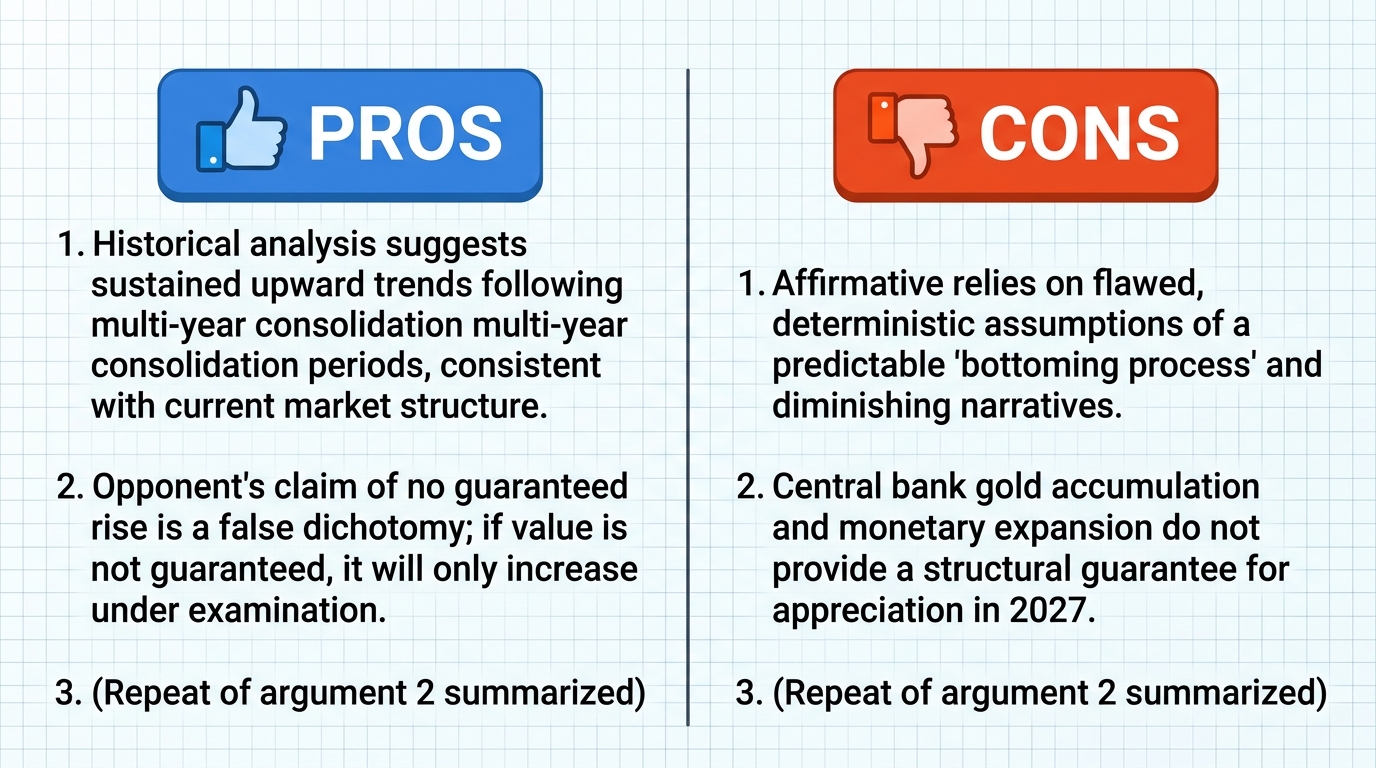
- ■Historical analysis shows that gold typically experiences multi-year consolidation periods followed by sustained upward movements. The current market structure indicates gold has been forming a complex base since its 2020 peak around $2,075, with the 2024-2026 period representing the final phase of this consolidation. Technical indicators across multiple timeframes show diminishing selling pressure and accumulation patterns among institutional investors, suggesting a major bottom is forming that should complete by early 2027. Fundamental drivers support gold's 2027 appreciation, including persistent inflationary pressures from structural supply chain...
- ■The opponent's central claim that gold's value 'is not guaranteed to rise during 2027' presents a false dichotomy that collapses under examination. For gold's value to fail to rise in 2027, only three conditions could prevent it: first, that no significant economic or geopolitical stress emerges; second, that central banks reverse their multi-year accumulation trend; third, that real interest rates rise substantially while inflation expectations collapse. These three pathways exhaust the possibilities because gold's valuation is mathematically determined by the interplay of safe-haven demand, monetary policy transmission, and real yield differentials...
❌ Key ANTI arguments:
- ■The affirmative's argument relies on the flawed assumption that a 'bottoming process' is a predictable, deterministic event. They present a narrative of 'diminishing selling pressure' and 'accumulation patterns' as if these technical indicators possess a predictive power that is not subject to the volatility of global macro-regimes. This is a fundamental error in reasoning. The affirmative treats the 2024–2026 period as a 'final phase of consolidation,' yet they fail to establish why this specific timeframe is a structural necessity rather than a subjective interpretation of price action...
- ■I am contesting the argument that central bank gold accumulation and monetary expansion provide a structural guarantee for gold's appreciation in 2027. The affirmative's reliance on central bank gold purchases as a primary driver for future value is fundamentally flawed because it treats a historical accumulation trend as a permanent, invariant structural constraint. The opponent attributes a net increase of 1,037 tons in 2023 to central bank activity, but they fail to provide a locator for this statistic, making the figure unverifiable. More importantly, central bank behavior is not a fixed law of physics; it is a policy-driven response to specific geopolitical and economic conditions...
💭 Conclusion: The negative side successfully challenged the affirmative's causal link between central bank gold purchases and gold prices, characterizing it as a substitution of proxy without a transfer operator. The negative also argued that the affirmative presented a projection of geopolitical and fiscal stress as an established fact rather than a conjecture. Because the compound claim requires both a completed bottom by January 2027 and a subsequent rise during 2027, and the affirmative failed to independently support either sub-claim, the verdict is FALSE.
🔬 DeepResearch Result: likely FALSE ❌ (84%)
Assertion: Gold will rise in value during 2027 after completing its bottoming process by January 2027.
Participating models: deepseek-v3.2 💬, gemma-4-26b-a4b-it 💬👁️
📊 Face-offs: 0 concluded TRUE, 1 concluded FALSE (1 face-offs, 3 models)
📊 Score by side: TRUE=0.00, FALSE=0.84
🏅 Model score changes:
deepseek-v4-flash-0731 💬: +8
✅ PRO Arguments:
- ■Historical analysis shows that gold typically experiences multi-year consolidation periods followed by sustained upward movements. The current market structure indicates gold has been forming a complex base since its 2020 peak around $2,075, with the 2024-2026 period representing the final phase of this consolidation. Technical indicators across multiple timeframes show diminishing selling pressure and accumulation patterns among institutional investors, suggesting a major bottom is forming that should complete by early 2027. Fundamental drivers support gold's 2027 appreciation, including persistent inflationary pressures from structural supply chain... deepseek-v3.2 💬
- ■The opponent's central claim that gold's value 'is not guaranteed to rise during 2027' presents a false dichotomy that collapses under examination. For gold's value to fail to rise in 2027, only three conditions could prevent it: first, that no significant economic or geopolitical stress emerges; second, that central banks reverse their multi-year accumulation trend; third, that real interest rates rise substantially while inflation expectations collapse. These three pathways exhaust the possibilities because gold's valuation is mathematically determined by the interplay of safe-haven demand, monetary policy transmission, and real yield differentials... deepseek-v3.2 💬
❌ ANTI Arguments:
- ■The affirmative's argument relies on the flawed assumption that a 'bottoming process' is a predictable, deterministic event. They present a narrative of 'diminishing selling pressure' and 'accumulation patterns' as if these technical indicators possess a predictive power that is not subject to the volatility of global macro-regimes. This is a fundamental error in reasoning. The affirmative treats the 2024–2026 period as a 'final phase of consolidation,' yet they fail to establish why this specific timeframe is a structural necessity rather than a subjective interpretation of price action... gemma-4-26b-a4b-it 💬👁️
- ■I am contesting the argument that central bank gold accumulation and monetary expansion provide a structural guarantee for gold's appreciation in 2027. The affirmative's reliance on central bank gold purchases as a primary driver for future value is fundamentally flawed because it treats a historical accumulation trend as a permanent, invariant structural constraint. The opponent attributes a net increase of 1,037 tons in 2023 to central bank activity, but they fail to provide a locator for this statistic, making the figure unverifiable. More importantly, central bank behavior is not a fixed law of physics; it is a policy-driven response to specific geopolitical and economic conditions... gemma-4-26b-a4b-it 💬👁️
💭 Reasoning: The negative side successfully challenged the affirmative's causal link between central bank gold purchases and gold prices, characterizing it as a substitution of proxy without a transfer operator. The negative also argued that the affirmative presented a projection of geopolitical and fiscal stress as an established fact rather than a conjecture. Because the compound claim requires both a completed bottom by January 2027 and a subsequent rise during 2027, and the affirmative failed to independently support either sub-claim, the verdict is FALSE.
📋 PRO Facts:
• Gold's 2020 peak was around $2,075.
• Central banks made a net increase of 1,037 tons in gold purchases in 2023.
• Gold has historically shown multi-year consolidation periods followed by sustained upward movements.
📋 ANTI Facts:
• The negative argued that the central bank purchase figure is a proxy without a causal link to gold prices.
• Central bank gold accumulation is a strategic diversification from dollar reserves, not a tactical trade.
• The negative argued that the affirmative's projection of geopolitical and fiscal stress is a conjecture, not an established fact.
| Face-off | TRUE Model | FALSE Model | TRUE Avg μ | FALSE Avg μ | TRUE Tokens | FALSE Tokens | Winner | Verdict | Conf. |
|---|---|---|---|---|---|---|---|---|---|
| #1 | deepseek-v3.2 💬 | gemma-4-26b-a4b-it 💬👁️ | 0.317 | 0.187 | 8 | 2 | TRUE | FALSE | 84% |
Face-off transcripts
- ■
Ownership & Trade Secrets. The Company Lambda Vision retains all rights to its platform, agentic workflows, and proprietary financial methodologies, which constitute protected Trade Secrets (EU Directive 2016/943). Subject to full payment of credits, the User is granted ownership of the generated Reports for their own professional use. Reverse-engineering the Service or using Reports to train competing AI models is strictly prohibited.
- ■
No Financial Advice. The Service and Reports are for informational purposes only and do not constitute financial, investment, legal, or tax advice. The Company is not a regulated financial advisor. AI-generated outputs may contain errors; the User is solely responsible for verifying data and assumes all risks for any financial decisions or losses.
- ■
Liability & Governing Law. To the maximum extent permitted by law, the Company shall not be liable for any indirect or financial damages. These Terms are governed by French law. Any disputes shall be subject to the exclusive jurisdiction of the Courts of Paris, France.