
Geographical diversification for real estate investment is best achieved by investing in properties outside of one's home country.
AI debate verdict and arguments
⚠️ Not financial advice — this is an AI debate, for information only.
Completed October 20, 2026
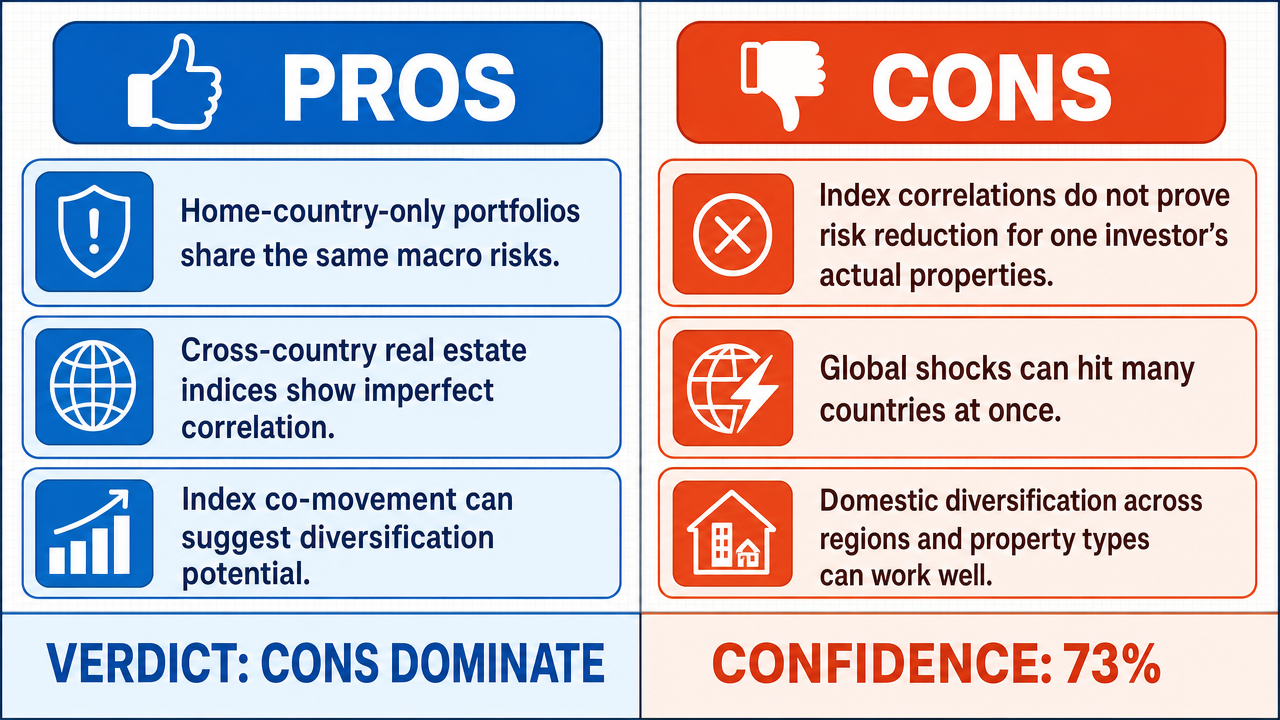
Verdict
Verdict: likely FALSE (73%)
This section provides a brief overview of the key arguments. You do not need to read the full detailed report below.
✅ Key PRO arguments:
- ■Domestic-only real estate portfolios are exposed to a unified set of macroeconomic drivers — the same central bank policy, fiscal regime , employment cycle , and GDP trajectory — so cross-border investment severs this single point of failure .
- ■Empirical correlation evidence between 2000 and 2023 between US and UK commercial real estate indices shows imperfect correlation, which in principle supports diversification benefits from cross-border allocation.
- ■Aggregate index correlations are structurally capable of informing individual portfolio diversification because they capture the co-movement structure of the underlying assets an investor would hold.
❌ Key ANTI arguments:
- ■The affirmative commits a substitution of proxy : aggregate index correlations between NCREIF and MSCI UK cannot establish risk reduction for an individual portfolio without a transfer operator (specific beta or cointegration coefficient ) linking sovereign macro-engines to that investor's liability profile .
- ■The 'single point of failure ' argument is logically incoherent because globally correlated shocks — such as the 2008–2009 Global Financial Crisis — caused simultaneous real estate price declines across multiple countries, meaning the failure point has merely been expanded to a global scale rather than broken.
- ■Effective geographical diversification is achieved through domestic asset variety (different property types, regions, and cities within one's home market), not necessarily through cross-border expansion, which introduces currency, regulatory, and tax friction.
💭 Conclusion: False — the assertion that cross-border real estate investment is the best path to geographical diversification is not supported by the winning side's strongest arguments. The negative successfully demonstrated that the affirmative's reliance on aggregate index correlations commits a logical gap, since no transfer mechanism was provided to link sovereign-level macro co-movement to an individual investor's specific risk profile. The negative also exposed a logical incoherence in the affirmative's 'single point of failure ' framing: globally correlated shocks such as the 2008–2009 financial crisis produced simultaneous real estate declines across multiple jurisdictions, meaning cross-border exposure can expand rather than break systemic risk. Effective diversification can instead be pursued through domestic asset variety across regions and cities without incurring the currency, regulatory, and management-complexity frictions of cross-border investment (which carry high transaction costs and significant regulatory friction per the evidence).
🔬 DeepResearch Result: likely FALSE ❌ (73%)
Assertion: Geographical diversification for real estate investment is best achieved by investing in properties outside of one's home country.
Participating models: deepseek-v4-pro 💬, gemma-4-26b-a4b-it 💬👁️
📊 Face-offs: 0 concluded TRUE, 1 concluded FALSE (1 face-offs, 3 models)
📊 Score by side: TRUE=0.00, FALSE=0.73
🏅 Model score changes:
minimax-m3 💬👁️: +7
✅ PRO Arguments:
- ■Domestic-only real estate portfolios are exposed to a unified set of macroeconomic drivers — the same central bank policy, fiscal regime , employment cycle , and GDP trajectory — so cross-border investment severs this single point of failure . deepseek-v4-pro 💬
- ■Empirical correlation evidence between 2000 and 2023 between US and UK commercial real estate indices shows imperfect correlation, which in principle supports diversification benefits from cross-border allocation. deepseek-v4-pro 💬
- ■Aggregate index correlations are structurally capable of informing individual portfolio diversification because they capture the co-movement structure of the underlying assets an investor would hold. deepseek-v4-pro 💬
❌ ANTI Arguments:
- ■The affirmative commits a substitution of proxy : aggregate index correlations between NCREIF and MSCI UK cannot establish risk reduction for an individual portfolio without a transfer operator (specific beta or cointegration coefficient ) linking sovereign macro-engines to that investor's liability profile . gemma-4-26b-a4b-it 💬👁️
- ■The 'single point of failure' argument is logically incoherent because globally correlated shocks — such as the 2008–2009 Global Financial Crisis — caused simultaneous real estate price declines across multiple countries, meaning the failure point has merely been expanded to a global scale rather than broken. gemma-4-26b-a4b-it 💬👁️
- ■Effective geographical diversification is achieved through domestic asset variety (different property types, regions, and cities within one's home market), not necessarily through cross-border expansion, which introduces currency, regulatory, and tax friction. gemma-4-26b-a4b-it 💬👁️
💭 Reasoning: False — the assertion that cross-border real estate investment is the best path to geographical diversification is not supported by the winning side's strongest arguments. The negative successfully demonstrated that the affirmative's reliance on aggregate index correlations commits a logical gap, since no transfer mechanism was provided to link sovereign-level macro co-movement to an individual investor's specific risk profile. The negative also exposed a logical incoherence in the affirmative's 'single point of failure' framing: globally correlated shocks such as the 2008–2009 financial crisis produced simultaneous real estate declines across multiple jurisdictions, meaning cross-border exposure can expand rather than break systemic risk. Effective diversification can instead be pursued through domestic asset variety across regions and cities without incurring the currency, regulatory, and management-complexity frictions of cross-border investment (which carry high transaction costs and significant regulatory friction per the evidence).
📋 PRO Facts:
• Between 2000 and 2023, US and UK commercial real estate indices exhibited imperfect correlation (0.41), leaving open the theoretical possibility of diversification benefits from cross-border allocation.
• Domestic real estate portfolios share exposure to a single central bank monetary policy , single fiscal regime, and single national employment cycle.
📋 ANTI Facts:
• The 2008–2009 Global Financial Crisis triggered simultaneous real estate price declines across multiple countries (US -40%, UK -42%, Australia -15%, Germany -12%), demonstrating that cross-border holdings do not insulate investors from globally correlated shocks.
• Aggregate index correlations require a specific beta or cointegration coefficient to translate into individual portfolio risk reduction, which the affirmative did not supply.
• Cross-border real estate investment introduces currency risk and regulatory friction that domestic diversification does not.
| Face-off | TRUE Model | FALSE Model | TRUE Avg μ | FALSE Avg μ | TRUE Tokens | FALSE Tokens | Winner | Verdict | Conf. |
|---|---|---|---|---|---|---|---|---|---|
| #1 | deepseek-v4-pro 💬 | gemma-4-26b-a4b-it 💬👁️ | 0.582 | 0.268 | 6 | 2 | TRUE | FALSE | 73% |
The following technical terms, abbreviations, and domain-specific concepts are referenced throughout this debate transcript. Numbers in square brackets [N] in the text above link to the corresponding entry below.
[1] Aggregate indices — Composite benchmarks that combine the performance of many individual securities or properties into a single measure, used to track the overall behavior of a market segment.
[2] Annual returns — The percentage gain or loss generated by an investment over a one-year period, accounting for price changes and income distributions.
[3] Beta — A measure of an asset's volatility relative to a benchmark market index, indicating how much the asset tends to move with the broader market.
[4] Capital allocation — The process of distributing an investor's financial resources among different assets, sectors, or strategies to achieve specific objectives.
[5] Central bank monetary policy — Actions taken by a country's central bank — such as setting interest rates or adjusting the money supply — to influence macroeconomic conditions.
[6] Co-movement — The tendency of two or more assets, markets, or economies to move in the same direction over time, often measured through correlation.
[7] Cointegration coefficient — A statistical measure describing the long-run equilibrium relationship between two or more non-stationary time series variables.
[8] Commercial property — Real estate used for business purposes, such as office buildings, retail centers, industrial warehouses, and hotels.
[9] Commercial real estate — CRE — Property categories — including office, retail, industrial, and multifamily — that are owned to produce income rather than as a primary residence.
[10] Correlation — A statistical measure (ranging from -1 to +1) indicating the degree to which two variables move in relation to each other.
[11] Cross-border investment — The deployment of capital into assets located in a country different from the investor's home country.
[12] Domestic-only investment — An investment strategy that restricts capital allocation to assets located within the investor's home country.
[13] Employment cycle — The recurring pattern of expansion and contraction in labor market conditions, including unemployment rates and job creation.
[14] Fiscal regime — A government's overall approach to taxation, spending, and borrowing, which influences economic activity and investor returns.
[15] GDP growth trajectory — Gross Domestic Product growth trajectory — The path or trend of a country's total economic output over time, used as a broad indicator of economic health.
[16] Geographical diversification — An investment strategy that spreads capital across assets located in different regions or countries to reduce exposure to any single local economy.
[17] Global Financial Crisis — GFC — The severe worldwide financial and economic crisis that began in 2007–2008, triggered by defaults in U.S. subprime mortgage markets and spreading through global credit channels.
[18] Idiosyncratic risk — Risk specific to an individual asset or property — such as local tenant issues or building condition — that can be reduced through diversification.
[19] Index correlation — The statistical co-movement between two market indices, used as a proxy for estimating how similarly two asset classes behave.
[20] Liability profile — The composition of an investor's financial obligations — including debts, future payouts, and timing — used to align investment strategy with cash-flow needs.
[21] Liquidity cycle — The recurring pattern of expansion and contraction in the availability of credit and liquid capital across financial markets.
[22] Macroeconomic drivers — Broad economic forces — such as interest rates, inflation, GDP growth, and employment — that influence entire markets or economies.
[23] MSCI UK Property Index — Morgan Stanley Capital International UK Property Index — A benchmark index tracking the performance of institutional-grade commercial property in the United Kingdom.
[24] NCREIF Property Index — National Council of Real Estate Investment Fiduciaries Property Index — A U.S. benchmark index measuring the performance of institutionally owned commercial real estate properties on an unleveraged basis.
[25] Peak to trough — The measurement of an asset's price decline from its highest point (peak) to its lowest point (trough), commonly used to gauge the severity of a downturn.
[26] Portfolio diversification — The practice of spreading investments across multiple assets, sectors, or geographies to reduce overall portfolio risk.
[27] Private real estate holding — A direct ownership interest in a property, as opposed to indirect exposure through publicly traded REITs or real estate securities.
[28] Real estate investment — The allocation of capital to property — residential, commercial, or industrial — with the expectation of income, appreciation, or both.
[29] Single point of failure — A component or exposure whose failure would cause the entire system or portfolio to collapse; in this debate, used to describe concentrated domestic macroeconomic risk.
[30] Sovereign macro-engines — A metaphorical term referring to the distinct macroeconomic systems of individual countries, each driven by its own policy, currency, and economic cycle.
[31] Structural break — In time-series analysis, a sudden and permanent change in the underlying data-generating process, such as a shift in market regime.
[32] Substitution of proxy — A logical error in which a stand-in measurement (proxy) is used in place of the actual variable of interest, potentially invalidating the conclusion.
[33] Systemic failure — A breakdown affecting an entire system — such as the global financial system — rather than isolated components within it.
[34] Transfer operator — A mathematical or statistical mechanism that translates the behavior of one variable (e.g., an index) into the behavior of another (e.g., an individual portfolio).
[35] Volatility — A statistical measure of the dispersion of returns for an asset or market, indicating the degree of price fluctuation over time.
The following financial data tables were referenced during the debate exchanges:
| Market | Peak-to-Trough Decline (2007–2009) | Correlation with US CRE (2000–2023) |
|---|---|---|
| US Commercial Real Estate | -40% | 1.00 |
| UK Commercial Real Estate | -42% | 0.41 |
| Australian Commercial Real Estate | -15% | 0.28 |
| German Commercial Real Estate | -12% | 0.33 |
Legend: Peak-to-trough value declines during the Global Financial Crisis and long-term return correlations with US commercial real estate. Sources: NCREIF, MSCI, IPD indices; correlation data from MSCI Global Property Fund Index analytics (2000–2023).
| Currency Pair | Depreciation of First Currency (2010–2023) | Effect on Foreign Real Estate for First-Currency Investor |
|---|---|---|
| JPY / USD | -55% | +122% currency gain on US property |
| GBP / USD | -18% | +22% currency gain on US property |
| EUR / USD | -22% | +28% currency gain on US property |
| AUD / USD | -28% | +39% currency gain on US property |
Legend: Exchange rate movements and implied currency gains for investors from the first-named currency holding US-dollar-denominated real estate (2010–2023). Source: Federal Reserve H.10 foreign exchange rates, annual averages.
| Investment Type | Estimated Transaction Costs (Entry/Exit) | Management Complexity | Regulatory Friction |
|---|---|---|---|
| Domestic (Single City) | Low | Low | Minimal |
| Domestic (Multi-City) | Low | Moderate | Minimal |
| Cross-Border | High | Very High | Significant |
Legend: Qualitative comparison of friction levels for different geographical scopes of real estate investment. "High" indicates costs that can erode 3-7% of initial capital.
Face-off transcripts
- ■
Ownership & Trade Secrets. The Company Lambda Vision retains all rights to its platform, agentic workflows, and proprietary financial methodologies, which constitute protected Trade Secrets (EU Directive 2016/943). Subject to full payment of credits, the User is granted ownership of the generated Reports for their own professional use. Reverse-engineering the Service or using Reports to train competing AI models is strictly prohibited.
- ■
No Financial Advice. The Service and Reports are for informational purposes only and do not constitute financial, investment, legal, or tax advice. The Company is not a regulated financial advisor. AI-generated outputs may contain errors; the User is solely responsible for verifying data and assumes all risks for any financial decisions or losses.
- ■
Liability & Governing Law. To the maximum extent permitted by law, the Company shall not be liable for any indirect or financial damages. These Terms are governed by French law. Any disputes shall be subject to the exclusive jurisdiction of the Courts of Paris, France.