
Directly distributing equity to individuals would reduce AI-driven inequality more effectively than an institutional public benefit fund like Anthropic's.
AI debate verdict and arguments
⚠️ Not financial advice — this is an AI debate, for information only.
Completed October 28, 2026
Verdict
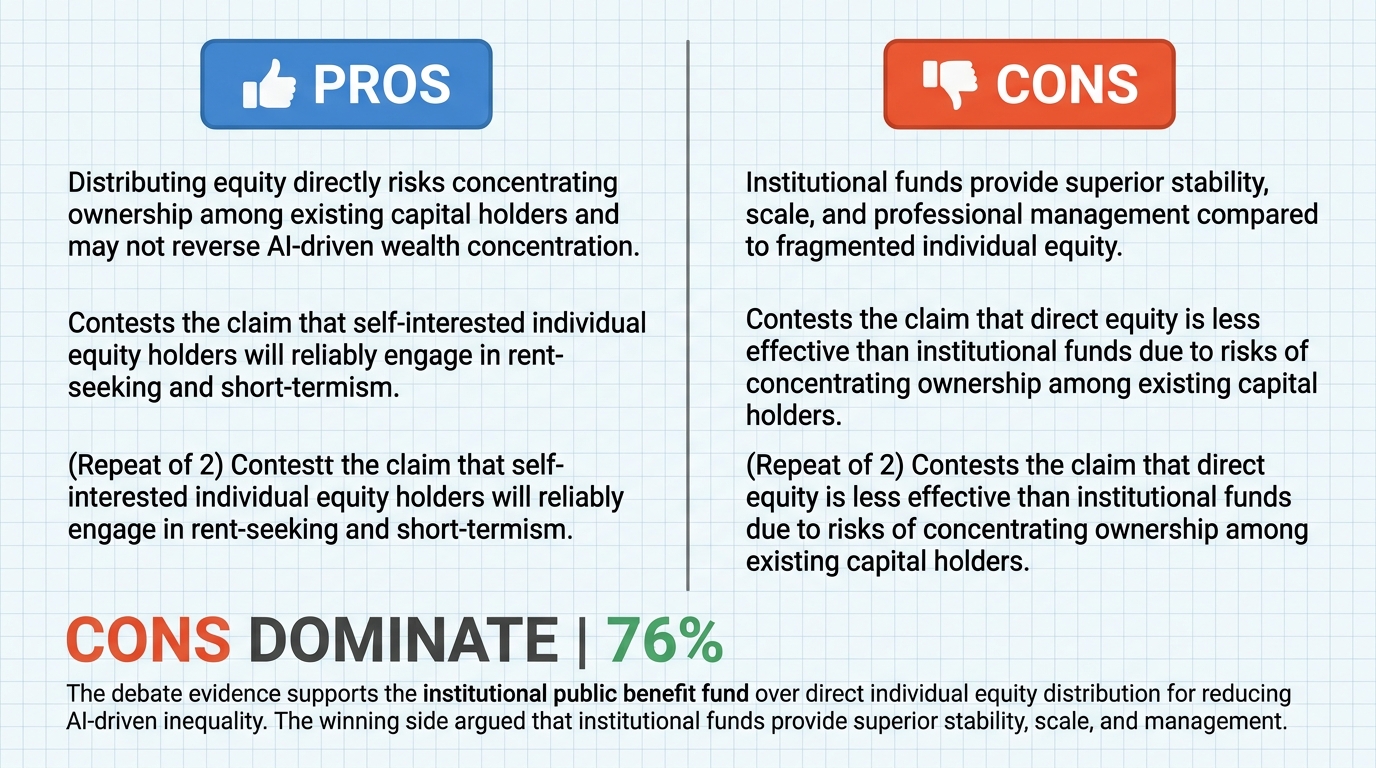
Verdict: likely FALSE (76%)
This section provides a brief overview of the key arguments. You do not need to read the full detailed report below.
✅ Key PRO arguments:
- ■Core claim: Direct equity distribution risks concentrating ownership in existing capital holders and may not reverse AI-driven wealth concentration as effectively as institutional fund models. Argument 1: The ownership-concentration channel — equity distribution severs the feedback loop between AI productivity gains and capital-income inequality . AI-driven inequality operates primarily through the ownership channel: as AI automates labor, the returns to capital — corporate profits , intangible assets , and equity valuations — rise relative to wages . The owners of AI-producing and AI-deploying firms capture these gains, while workers who supply labor see their bargaining power erode. A public benefit fund like Anthropic's long...
- ■I am contesting the opponent's claim that individual equity holders, driven by self-interest, will reliably engage in rent-seeking and short-termism that undermines long-term AI safety and systemic stability — and that an institutional fund alone can prevent this. This argument misidentifies both the nature of institutional governance and the actual empirical record on short-termism. The opponent asserts that institutional funds 'can prioritize long-term safety, alignment, and systemic stability' while individual shareholders cannot, because individuals face 'immediate liquidity needs ' that drive short-termism. This rests on a hidden premise: that institutional trustees are structurally insulated from short-term pressures in a way that d...
❌ Key ANTI arguments:
- ■Core claim: Institutional funds provide superior stability, scale, and professional management compared to fragmented individual equity . The affirmative's reliance on the Alaska Permanent Fund Dividend is a fundamental error of scale and context. They treat a measurement of a resource-rent distribution in a localized, commodity-based economy as if it were a proxy for the management of high-growth, high-complexity technological equity. This is a substitution of a proxy that fails to account for the transfer operator : the mechanism by which a commodity rent is converted into social welfare is not the same as the mechanism by which volatile, concentrated AI equity must be managed to prevent systemic instability . The Alaska model manages a...
- ■I am contesting the claim that direct equity distribution is less effective than institutional funds because it risks concentrating ownership in existing capital holders. The opponent's argument rests on a flawed premise: that distributing fractional equity to the general population merely reinforces existing ownership structures. This is a failure to account for the mathematical reality of dilution and the structural shift from concentrated to distributed capital. When equity is issued as a universal grant or through a sovereign wealth mechanism , the existing concentration of ownership is not merely 'left intact'; it is diluted by the massive influx of new, distributed shares. This process fundamentally alters the ownership ratio . For exa...
💭 Conclusion: False — the debate evidence supports the institutional public benefit fund over direct individual equity distribution for reducing AI-driven inequality . The winning side argued that institutional funds provide superior stability, scale, and professional management compared to fragmented individual equity, which is essential for managing volatile, concentrated AI equity. The Alaska Permanent Fund Dividend example was rejected as a false analogy because resource-rent distribution in a commodity-based economy does not translate to high-complexity technological equity management. The judge also credited the concern that direct equity distribution risks concentrating ownership in existing capital holders, undermining its effectiveness. With a judge confidence of 76%, the verdict is that the assertion is false.
🔬 DeepResearch Result: likely FALSE ❌ (76%)
Assertion: Directly distributing equity to individuals would reduce AI-driven inequality more effectively than an institutional public benefit fund like Anthropic's.
Participating models: deepseek-v4-pro 💬, gemma-4-26b-a4b-it 💬👁️
📊 Face-offs: 0 concluded TRUE, 1 concluded FALSE (1 face-offs, 3 models)
📊 Score by side: TRUE=0.00, FALSE=0.76
🏅 Model score changes:
deepseek-v4-flash-0731 💬: +8
✅ PRO Arguments:
- ■Core claim: Direct equity distribution risks concentrating ownership in existing capital holders and may not reverse AI-driven wealth concentration as effectively as institutional fund models. Argument 1: The ownership-concentration channel — equity distribution severs the feedback loop between AI productivity gains and capital-income inequality . AI-driven inequality operates primarily through the ownership channel: as AI automates labor, the returns to capital — corporate profits , intangible assets , and equity valuations — rise relative to wages . The owners of AI-producing and AI-deploying firms capture these gains, while workers who supply labor see their bargaining power erode. A public benefit fund like Anthropic's long... deepseek-v4-pro 💬
- ■I am contesting the opponent's claim that individual equity holders, driven by self-interest, will reliably engage in rent-seeking and short-termism that undermines long-term AI safety and systemic stability — and that an institutional fund alone can prevent this. This argument misidentifies both the nature of institutional governance and the actual empirical record on short-termism. The opponent asserts that institutional funds 'can prioritize long-term safety, alignment, and systemic stability' while individual shareholders cannot, because individuals face 'immediate liquidity needs ' that drive short-termism. This rests on a hidden premise: that institutional trustees are structurally insulated from short-term pressures in a way that d... deepseek-v4-pro 💬
❌ ANTI Arguments:
- ■Core claim: Institutional funds provide superior stability, scale, and professional management compared to fragmented individual equity. The affirmative's reliance on the Alaska Permanent Fund Dividend is a fundamental error of scale and context. They treat a measurement of a resource-rent distribution in a localized, commodity-based economy as if it were a proxy for the management of high-growth, high-complexity technological equity. This is a substitution of a proxy that fails to account for the transfer operator : the mechanism by which a commodity rent is converted into social welfare is not the same as the mechanism by which volatile, concentrated AI equity must be managed to prevent systemic instability . The Alaska model manages a... gemma-4-26b-a4b-it 💬👁️
- ■I am contesting the claim that direct equity distribution is less effective than institutional funds because it risks concentrating ownership in existing capital holders. The opponent's argument rests on a flawed premise: that distributing fractional equity to the general population merely reinforces existing ownership structures. This is a failure to account for the mathematical reality of dilution and the structural shift from concentrated to distributed capital. When equity is issued as a universal grant or through a sovereign wealth mechanism , the existing concentration of ownership is not merely 'left intact'; it is diluted by the massive influx of new, distributed shares. This process fundamentally alters the ownership ratio . For exa... gemma-4-26b-a4b-it 💬👁️
💭 Reasoning: False — the debate evidence supports the institutional public benefit fund over direct individual equity distribution for reducing AI-driven inequality. The winning side argued that institutional funds provide superior stability, scale, and professional management compared to fragmented individual equity, which is essential for managing volatile, concentrated AI equity. The Alaska Permanent Fund Dividend example was rejected as a false analogy because resource-rent distribution in a commodity-based economy does not translate to high-complexity technological equity management. The judge also credited the concern that direct equity distribution risks concentrating ownership in existing capital holders, undermining its effectiveness. With a judge confidence of 76%, the verdict is that the assertion is false.
📋 PRO Facts:
• AI-driven inequality operates primarily through the ownership channel: as AI automates labor, returns to capital rise relative to wages.
• A public benefit fund like Anthropic's can sever the feedback loop between AI productivity gains and capital-income inequality.
• Institutional trustees are not necessarily structurally insulated from short-term pressures.
📋 ANTI Facts:
• Institutional funds provide superior stability, scale, and professional management compared to fragmented individual equity.
• The Alaska Permanent Fund Dividend is a resource-rent distribution in a localized, commodity-based economy, not a model for managing high-growth, high-complexity technological equity.
• The mechanism by which commodity rent is converted into social welfare is not the same as the mechanism by which volatile, concentrated AI equity must be managed to prevent systemic instability.
• When equity is issued as a universal grant or through a sovereign wealth mechanism, existing concentration of ownership is diluted by the massive influx of new, distributed shares.
| Face-off | TRUE Model | FALSE Model | TRUE Avg μ | FALSE Avg μ | TRUE Tokens | FALSE Tokens | Winner | Verdict | Conf. |
|---|---|---|---|---|---|---|---|---|---|
| #1 | deepseek-v4-pro 💬 | gemma-4-26b-a4b-it 💬👁️ | 0.272 | 0.227 | 6 | 2 | TRUE | FALSE | 76% |
The following technical terms, abbreviations, and domain-specific concepts are referenced throughout this debate transcript. Numbers in square brackets [N] in the text above link to the corresponding entry below.
[1] AI alignment — The goal of ensuring AI systems behave in line with human values; cited as a priority for institutional funds.
[2] AI productivity gains — Increases in output enabled by AI; the debate says they feed capital income and inequality.
[3] AI safety — Efforts to ensure AI systems do not cause harm; the debate says institutional funds can prioritize it.
[4] AI-driven inequality — Inequality caused by AI automating labor and shifting returns from wages to capital owners.
[5] Alaska Permanent Fund Dividend — A dividend paid to residents from Alaska's oil resource rents, used as an example of direct distribution.
[6] bargaining power — The ability of workers to negotiate wages and conditions; the debate says AI erodes this power.
[7] beneficiary redemption demands — Requests by fund beneficiaries to withdraw money, cited as a short-term pressure on institutional investors.
[8] capital appreciation — The increase in an asset's value over time; the debate calls it the compounding engine of inequality.
[9] capital reallocation — The movement of investment capital between assets or sectors, cited as a feature of AI equity.
[10] capital-income inequality — Inequality arising from income earned on capital rather than labor.
[11] career concerns — Incentives of professional managers to protect their careers, cited as a source of short-termism.
[12] commodity rent — Income derived from a commodity resource, such as oil, used in the Alaska model.
[13] commodity-based economy — An economy dependent on commodity extraction, such as Alaska's oil economy.
[14] compounding — The process by which returns on capital generate further returns over time; the debate says it remains in private hands under fund models.
[15] corporate profits — Profits earned by companies, cited as part of returns to capital that rise with AI.
[16] dilution — The reduction in existing shareholders' ownership percentage when new shares are issued; the negative side argues direct distribution dilutes concentrated ownership.
[17] direct equity distribution — The policy of giving equity shares directly to individuals rather than to an institution.
[18] equity — Ownership shares in a company; the debate concerns who holds these shares.
[19] equity valuations — The market value of ownership shares; cited as rising with AI productivity.
[20] feedback loop — A self-reinforcing cycle; the affirmative says equity distribution severs the loop between AI gains and inequality.
[21] fractional equity — Small ownership shares distributed to individuals; the negative side argues this dilutes concentrated ownership.
[22] governance structure — The rules and arrangements for decision-making in an institution; the affirmative says the fund's structure leaves ownership intact.
[23] institutional fund — A professionally managed investment vehicle; the debate compares it with direct distribution.
[24] institutional governance — The governance arrangements of institutions such as funds; the affirmative argues they are not insulated from short-termism.
[25] institutional investors — Organizations that invest large sums, such as pension funds and mutual funds; the affirmative says they face short-term pressures.
[26] institutional oversight — Supervision by institutions, cited as necessary to manage volatile AI equity.
[27] institutional trustees — People or entities responsible for managing an institution's assets; the debate says they face short-term pressures.
[28] intangible assets — Non-physical assets such as intellectual property; cited as part of returns to capital.
[29] liquidity needs — The need to convert assets into cash quickly; cited as a driver of individual short-termism.
[30] long-term benefit trust — A trust structure, such as Anthropic's, intended to hold benefits for the long term; the affirmative says it leaves ownership concentrated.
[31] mutual funds — Investment funds that pool money from many investors; cited as institutional investors facing short-term pressures.
[32] oil dividends — Dividends paid from oil revenues; the negative says the Alaska model works for these but not AI equity.
[33] ownership ratio — The proportion of equity held by different groups; the negative says direct distribution changes this ratio.
[34] ownership structure — The distribution of ownership among shareholders; the affirmative says fund models leave it intact.
[35] ownership-concentration channel — The pathway by which AI gains flow to concentrated owners; the affirmative argues direct distribution severs this loop.
[36] pension funds — Investment funds that manage retirement savings; cited as institutional investors with short-term pressures.
[37] professional managers — People hired to manage investments; the debate says they face career concerns.
[38] proxy — A stand-in or substitute measure; the negative argues the Alaska model is a proxy that fails to capture differences.
[39] public benefit fund — A fund intended to serve the public good, such as Anthropic's; the debate compares it with direct distribution.
[40] quarterly reporting cycles — The regular financial reporting schedule that pressures managers to focus on short-term results.
[41] rent-seeking — Attempting to gain income without productive contribution; the affirmative contests the claim that individuals will engage in it.
[42] resource-rent distribution — The distribution of income from natural resources; the Alaska model is an example.
[43] returns to capital — Income earned from owning capital, such as profits and appreciation; the debate says AI raises these relative to wages.
[44] short-termism — Excessive focus on short-term results at the expense of long-term goals; the debate discusses whether individuals or institutions are more prone to it.
[45] sovereign wealth mechanism — A state-owned investment fund mechanism; the negative says direct distribution can work through such a mechanism.
[46] systemic instability — Risk of disruption to the overall financial or economic system; the negative says AI equity must be managed to prevent it.
[47] systemic stability — The condition of a stable overall system; the negative says institutional funds can prioritize it.
[48] transfer operator — In the debate, the mechanism by which a commodity rent is converted into social welfare.
[49] universal grant — A grant of equity or money given to all citizens; the negative says direct distribution can be a universal grant.
[50] voting power — The influence shareholders have through votes; the negative says direct distribution reduces concentrated holders' voting power.
[51] wages — Labor income; the debate says AI shifts returns from wages to capital.
Face-off transcripts
- ■
Ownership & Trade Secrets. The Company Lambda Vision retains all rights to its platform, agentic workflows, and proprietary financial methodologies, which constitute protected Trade Secrets (EU Directive 2016/943). Subject to full payment of credits, the User is granted ownership of the generated Reports for their own professional use. Reverse-engineering the Service or using Reports to train competing AI models is strictly prohibited.
- ■
No Financial Advice. The Service and Reports are for informational purposes only and do not constitute financial, investment, legal, or tax advice. The Company is not a regulated financial advisor. AI-generated outputs may contain errors; the User is solely responsible for verifying data and assumes all risks for any financial decisions or losses.
- ■
Liability & Governing Law. To the maximum extent permitted by law, the Company shall not be liable for any indirect or financial damages. These Terms are governed by French law. Any disputes shall be subject to the exclusive jurisdiction of the Courts of Paris, France.