
Direct physical possession of gold is a preferred method of ownership over gold ETFs.
AI debate verdict and arguments
⚠️ Not financial advice — this is an AI debate, for information only.
Completed October 20, 2026
Verdict
Verdict: likely FALSE (62%)
This section provides a brief overview of the key arguments. You do not need to read the full detailed report below.
✅ Key PRO arguments:
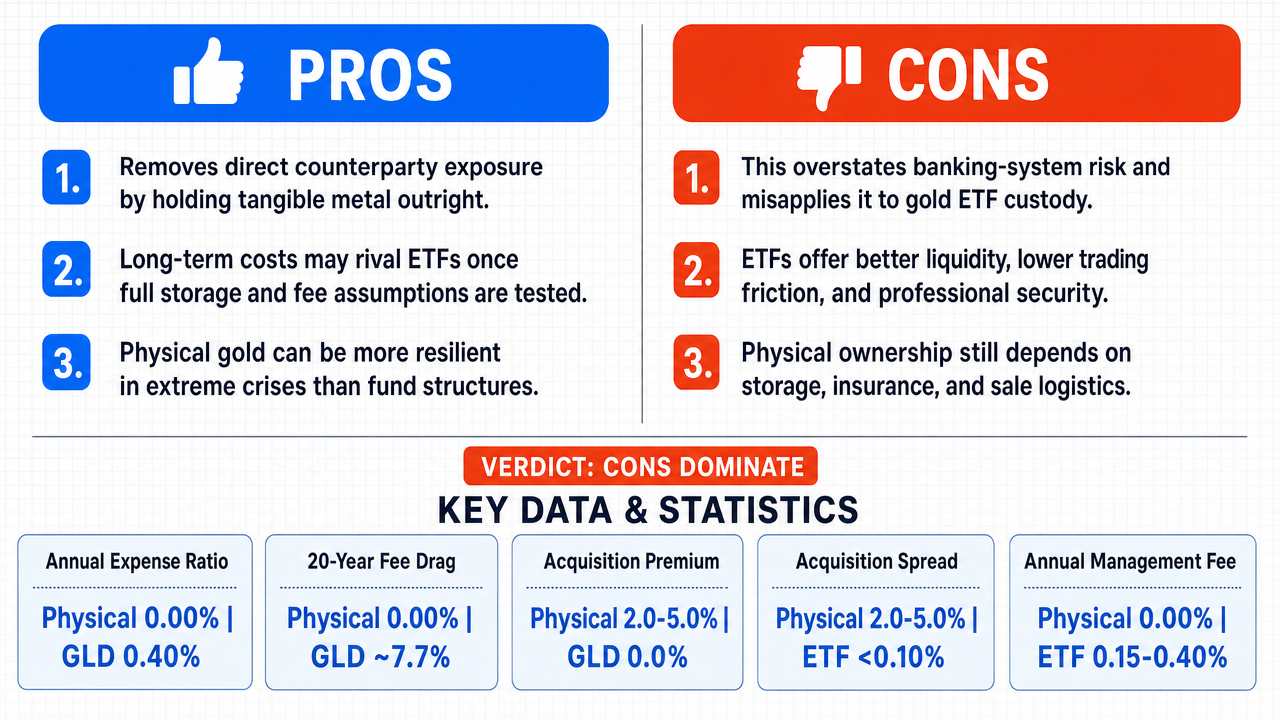
- ■Direct physical possession of gold extinguishes counterparty risk entirely because the owner holds a tangible, unencumbered asset that no intermediary can dilute, freeze, or default upon, whereas gold ETFs layer multiple counterparties (trust, custodian bank , authorized participants , fund sponsor ) each introducing a point of failure.
- ■A full-lifecycle cost analysis incorporating insurance, secure storage, and exit friction does not necessarily favor ETFs over physical gold, challenging the claim that ETFs are more cost-efficient on a total-cost-of-ownership basis.
- ■Physical gold provides crisis resilience that gold ETFs structurally cannot match, since in extreme financial stress ETF redemption mechanisms and custodial chains may be impaired while personally held bullion remains directly accessible.
❌ Key ANTI arguments:
- ■The affirmative's counterparty risk argument commits a fallacy of substitution: it cites the risks of the broader banking system and the specific custodial limitations of a single trust, then illegitimately generalizes these to all indirect ownership without establishing the logical link between the cited failures and the broader ETF structure.
- ■Gold ETFs are superior due to liquidity , lower transaction friction, and institutional-grade security arrangements that individual physical owners cannot replicate at scale.
- ■The affirmative's claim that physical gold is an 'unencumbered asset' free from counterparty risk is internally contradictory, because maintaining direct possession of any meaningful volume necessarily requires third-party infrastructure (vaulting, insurance, transport) that reintroduces the exact counterparty dependencies the argument claims to eliminate.
💭 Conclusion: False. The debate concluded that gold ETFs are the preferred method of ownership over direct physical possession of gold. The negative side successfully demonstrated that the affirmative's central counterparty-risk argument commits a fallacy of substitution by extrapolating from specific institutional failures to all indirect ownership structures without establishing the logical bridge. The negative further exposed an internal contradiction in the affirmative's position: maintaining direct physical possession of any meaningful volume necessarily relies on third-party infrastructure such as vaulting, insurance, and secure transport, which reintroduces the very counterparty dependencies the argument claimed to eliminate. The affirmative's challenge to ETF cost-efficiency was undermined by the negative's emphasis on ETFs' superior liquidity and lower transactional friction. The affirmative's safety-based framing retained some intuitive appeal but was outweighed by the structural and operational advantages of the ETF wrapper.
🔬 DeepResearch Result: likely FALSE ❌ (62%)
Assertion: Direct physical possession of gold is a preferred method of ownership over gold ETFs.
Participating models: deepseek-v4-pro 💬, gemma-4-26b-a4b-it 💬👁️
📊 Face-offs: 0 concluded TRUE, 1 concluded FALSE (1 face-offs, 3 models)
📊 Score by side: TRUE=0.00, FALSE=0.62
🏅 Model score changes:
minimax-m3 💬👁️: +6
✅ PRO Arguments:
- ■Direct physical possession of gold extinguishes counterparty risk entirely because the owner holds a tangible, unencumbered asset that no intermediary can dilute, freeze, or default upon, whereas gold ETFs layer multiple counterparties (trust, custodian bank , authorized participants , fund sponsor ) each introducing a point of failure. deepseek-v4-pro 💬
- ■A full-lifecycle cost analysis incorporating insurance, secure storage, and exit friction does not necessarily favor ETFs over physical gold, challenging the claim that ETFs are more cost-efficient on a total-cost-of-ownership basis. deepseek-v4-pro 💬
- ■Physical gold provides crisis resilience that gold ETFs structurally cannot match, since in extreme financial stress ETF redemption mechanisms and custodial chains may be impaired while personally held bullion remains directly accessible. deepseek-v4-pro 💬
❌ ANTI Arguments:
- ■The affirmative's counterparty risk argument commits a fallacy of substitution: it cites the risks of the broader banking system and the specific custodial limitations of a single trust, then illegitimately generalizes these to all indirect ownership without establishing the logical link between the cited failures and the broader ETF structure. gemma-4-26b-a4b-it 💬👁️
- ■Gold ETFs are superior due to liquidity , lower transaction friction, and institutional-grade security arrangements that individual physical owners cannot replicate at scale. gemma-4-26b-a4b-it 💬👁️
- ■The affirmative's claim that physical gold is an 'unencumbered asset' free from counterparty risk is internally contradictory, because maintaining direct possession of any meaningful volume necessarily requires third-party infrastructure (vaulting, insurance, transport) that reintroduces the exact counterparty dependencies the argument claims to eliminate. gemma-4-26b-a4b-it 💬👁️
💭 Reasoning: False. The debate concluded that gold ETFs are the preferred method of ownership over direct physical possession of gold. The negative side successfully demonstrated that the affirmative's central counterparty-risk argument commits a fallacy of substitution by extrapolating from specific institutional failures to all indirect ownership structures without establishing the logical bridge. The negative further exposed an internal contradiction in the affirmative's position: maintaining direct physical possession of any meaningful volume necessarily relies on third-party infrastructure such as vaulting, insurance, and secure transport, which reintroduces the very counterparty dependencies the argument claimed to eliminate. The affirmative's challenge to ETF cost-efficiency was undermined by the negative's emphasis on ETFs' superior liquidity and lower transactional friction. The affirmative's safety-based framing retained some intuitive appeal but was outweighed by the structural and operational advantages of the ETF wrapper.
📋 PRO Facts:
• Gold ETF structures involve intermediary layers including a trust structure and a custodian bank holding bullion.
• Physical gold ownership carries ongoing costs including insurance, secure storage, and exit friction that must be weighed against ETF expense ratios.
📋 ANTI Facts:
• Citing the custodial limitations or default risk of a single trust does not logically establish that all indirect gold ownership structures carry equivalent counterparty risk.
• Direct physical possession of meaningful gold volumes requires reliance on third-party vaulting, insurance, and security infrastructure, which itself constitutes a counterparty relationship.
| Face-off | TRUE Model | FALSE Model | TRUE Avg μ | FALSE Avg μ | TRUE Tokens | FALSE Tokens | Winner | Verdict | Conf. |
|---|---|---|---|---|---|---|---|---|---|
| #1 | deepseek-v4-pro 💬 | gemma-4-26b-a4b-it 💬👁️ | 0.546 | 0.283 | 6 | 2 | TRUE | FALSE | 62% |
The following technical terms, abbreviations, and domain-specific concepts are referenced throughout this debate transcript. Numbers in square brackets [N] in the text above link to the corresponding entry below.
[1] Acquisition premium — The markup over the spot price paid when initially purchasing physical gold, described in the affirmative's argument as the only material cost asymmetry at entry compared to ETF ownership.
[2] Allocated gold — A form of bullion custody in which specific gold bars are assigned to a particular owner, contrasted in the transcript with unallocated gold held in a pooled account.
[3] Armored transport services — Specialized logistics providers used to move physical gold, cited by the negative as a third-party intermediary that introduces counterparty risk into physical possession.
[4] Authorized participants — Large institutional entities in an ETF structure that create and redeem shares, identified in the affirmative's argument as a layer that may suspend redemptions during market stress.
[5] Bullion — Gold (or other precious metals) in bulk, bar, or coin form, held by a custodian bank on behalf of an ETF.
[6] Carrying costs — The recurring costs of holding an asset over time, used in the affirmative's narrow-scope cost comparison against ETF expense ratios.
[7] Counterparty risk — The risk that another party in a financial arrangement will default, become insolvent, or otherwise fail to meet its obligations. The affirmative claims physical possession eliminates it entirely; the negative disputes this, arguing physical possession also relies on intermediaries such as vaulting providers and insurers.
[8] Crisis resilience — The ability of an asset or ownership structure to withstand financial or systemic crises, cited by the affirmative as a structural advantage of physical gold over ETFs.
[9] Custodian bank — A bank that holds bullion on behalf of an ETF trust, identified in the affirmative's argument as a layer that may face insolvency and a point of counterparty failure.
[10] Disclosure risk — Risk arising from a custodian's lack of transparency obligations, distinguished by the negative from 'ownership risk' in its critique of the affirmative's argument.
[11] ETF (exchange-traded fund) — Exchange-traded fund — An investment fund whose shares are traded on a stock exchange, structured in the transcript as involving a trust, custodian bank, authorized participants, and a fund sponsor.
[12] Exit friction — Costs and difficulties incurred when selling or otherwise disposing of an asset, included by the affirmative in its full-lifecycle cost analysis of physical gold versus ETFs.
[13] Expense ratio — The annual fee charged by a fund (such as an ETF), expressed as a percentage of assets, characterized by the affirmative as a perpetual drag on returns.
[14] Full-lifecycle cost analysis — A cost comparison incorporating all acquisition, holding, and exit costs over the entire ownership period, contrasted in the affirmative's argument with a narrow recurring-costs-only scope.
[15] Fund sponsor — The entity that creates and manages an ETF, listed by the affirmative as one of the intermediary layers introducing potential points of failure.
[16] GLD — SPDR Gold Shares (largest gold ETF) — The ticker symbol for the largest gold-backed ETF, cited by the affirmative via World Gold Council prospectus language regarding the trust's inability to compel custodian disclosure of allocated gold.
[17] Insurance underwriters — Entities that issue insurance policies, cited by the negative as third-party intermediaries in a physical possession model that, by the affirmative's own logic, would constitute counterparty risk.
[18] Liquidity — The ease with which an asset can be converted to cash without affecting its market price, cited by the negative as a structural advantage of gold ETFs.
[19] Ownership risk — The risk of losing legal claim to an underlying asset, distinguished by the negative from 'disclosure risk' in arguing that the affirmative conflates the two.
[20] Perpetual drag — The ongoing reduction in investor returns caused by recurring ETF fees, used by the affirmative to argue that physical gold's one-time acquisition premium is recovered over time.
[21] Prospectus — A legal disclosure document for an investment offering, cited by the affirmative from the World Gold Council's GLD prospectus regarding custodian disclosure obligations.
[22] Redemption mechanism — The process by which ETF shares are exchanged for the underlying asset (or cash), whose legal validity the negative argues the affirmative fails to establish.
[23] Redemptions — The act of selling ETF shares back to the fund, identified by the affirmative as a process that authorized participants may suspend during market stress.
[24] Total Cost of Ownership — A comprehensive cost assessment incorporating insurance, secure storage, and exit friction, used by the negative to argue ETFs are more cost-efficient; the affirmative disputes this conclusion under both narrow and full-lifecycle scopes.
[25] Transfer operator — The entity responsible for maintaining records of ETF share ownership, cited by the negative as a missing link in the affirmative's argument connecting custodian disclosure obligations to investor ownership rights.
[26] Trustee — The entity holding legal title to the assets of an ETF trust, identified by the affirmative as a layer that may fail in its oversight duties.
[27] Unallocated gold — A form of bullion custody in which the investor has a general claim on a pool of gold rather than title to specific bars, referenced in the affirmative's discussion of GLD's prospectus language.
[28] Underlying asset rights — The legal claims an investor holds to the actual asset backing a financial instrument, whose preservation the negative argues the affirmative fails to demonstrate is threatened by custodian disclosure limitations.
[29] Vaulting providers — Specialized secure-storage operators used to hold physical gold, cited by the negative as third-party intermediaries that introduce counterparty risk into physical possession.
[30] World Gold Council — An industry association for the gold sector, cited by the affirmative as the source of GLD prospectus language regarding the trust's inability to compel custodian disclosure of allocated gold.
The following financial data tables were referenced during the debate exchanges:
| Cost Factor | Physical Gold (Coins/Bars) | Gold ETF (GLD) | Gold ETF (IAU) |
|---|---|---|---|
| One-Time Acquisition Premium | 2.0–5.0% | 0.0% (broker spread only) | 0.0% (broker spread only) |
| Annual Expense Ratio | 0.00% | 0.40% | 0.25% |
| 20-Year Cumulative Fee Drag | 0.00% | ~7.7% | ~4.9% |
| Storage Cost (Annual) | ~0.10–0.50% (safe box) | Included in ER | Included in ER |
Legend: Cost comparison between physical gold and major gold ETFs over a 20-year holding horizon. Expense ratio drag calculated as (1 - (1 - ER)^20). Physical storage assumes bank safe deposit box. Source: fund prospectuses and World Gold Council data.
| Cost Component | Physical Gold (Small Scale) | Gold ETF (Institutional) |
|---|---|---|
| Acquisition Spread | 2.0% - 5.0% | <0.10% |
| Annual Storage/Insurance | 0.50% - 1.50% | Included in ER |
| Annual Management Fee | 0.00% | 0.15% - 0.40% |
| Liquidity/Exit Friction | High (Days/Weeks) | Negligible (Seconds) |
| Total Annual Drag (Est.) | ~1.00% - 2.00% | ~0.15% - 0.50% |
Legend: Estimated annual cost of ownership comparing private physical holdings against major ETFs. Physical costs include estimated insurance and secure storage. ETF costs include management fees.
Face-off transcripts
- ■
Ownership & Trade Secrets. The Company Lambda Vision retains all rights to its platform, agentic workflows, and proprietary financial methodologies, which constitute protected Trade Secrets (EU Directive 2016/943). Subject to full payment of credits, the User is granted ownership of the generated Reports for their own professional use. Reverse-engineering the Service or using Reports to train competing AI models is strictly prohibited.
- ■
No Financial Advice. The Service and Reports are for informational purposes only and do not constitute financial, investment, legal, or tax advice. The Company is not a regulated financial advisor. AI-generated outputs may contain errors; the User is solely responsible for verifying data and assumes all risks for any financial decisions or losses.
- ■
Liability & Governing Law. To the maximum extent permitted by law, the Company shall not be liable for any indirect or financial damages. These Terms are governed by French law. Any disputes shall be subject to the exclusive jurisdiction of the Courts of Paris, France.