
Commercial real estate is facing challenges.
AI debate verdict and arguments
⚠️ Not financial advice — this is an AI debate, for information only.
Completed October 20, 2026
Verdict
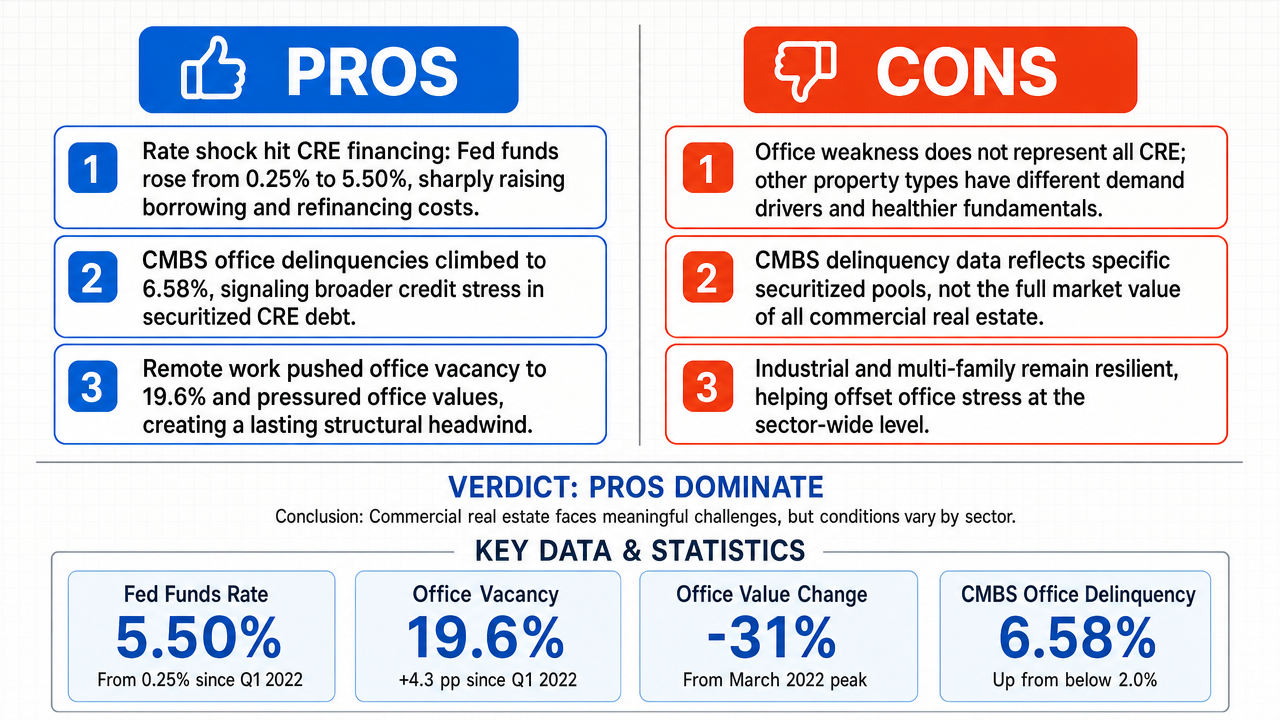
Verdict: likely TRUE (80%)
Web Report: https://solsicefinance.com/public/debates/commercial-real-estate-is-facing-challenges-ca2e444e6994
This section provides a brief overview of the key arguments. You do not need to read the full detailed report below.
✅ Key PRO arguments:
- ■The most aggressive Federal Reserve tightening cycle in four decades has fundamentally disrupted CRE financing: the federal funds rate rose from near zero to 5.25–5.50% (March 2022 to July 2023), and the 10-year Treasury yield climbed from approximately 1.5% to above 4%, where it has remained through 2024. Because CRE is overwhelmingly debt-financed with typical LTV ratios of 60–75%, this rate surge has created a refinancing wall that pressures property valuations and borrower solvency.
- ■Rising CMBS delinquency rates signal systemic credit deterioration across securitized CRE debt pools, indicating that distress extends beyond isolated assets into the broader financing infrastructure of the sector.
- ■Structural shifts including remote work adoption have driven sustained office vacancies and declining property valuations , creating a secular headwind independent of interest rate cycles.
❌ Key ANTI arguments:
- ■The opposition commits a fallacy of composition by treating office-sector distress as a proxy for the entire CRE industry, ignoring the structural strength and rapid expansion of industrial and multi-family sectors driven by last-mile logistics and e-commerce integration.
- ■CMBS delinquency rates measure credit performance within specific securitized pools and are not a direct measurement of the market value of all commercial property; using the volatility of a specific debt instrument to define the state of a massive, multi-asset class is a category error.
- ■Diversified asset classes within CRE ensure sector-wide resilience; even if office faces a localized structural transition, industrial and multi-family segments maintain high occupancy and demand, preventing a sector-wide collapse.
💭 Conclusion: True, the evidence supports that commercial real estate is facing meaningful challenges, though the picture is nuanced across sub-sectors. The PRO side demonstrated a concrete refinancing wall driven by the federal funds rate rising from near zero to 5.25–5.50% and the 10-year Treasury yield climbing from approximately 1.5% to above 4%, which directly pressures typical CRE financing structures. The ANTI side correctly identified that industrial and multi-family segments remain resilient and that CMBS delinquency is a credit metric rather than a direct valuation measure, but this diversification argument does not negate the existence of significant sector-wide headwinds. The judge weighted the structural refinancing pressure and office-sector secular decline more heavily than the diversification counter-argument, finding that conceded distress in major segments undermines claims of sector-wide resilience. Overall, the verdict reflects that CRE is genuinely facing challenges even if certain sub-sectors continue to perform.
🔬 DeepResearch Result: likely TRUE ✅ (80%)
Assertion: Commercial real estate is facing challenges.
Participating models: deepseek-v4-pro 💬, gemma-4-26b-a4b-it 💬👁️
📊 Face-offs: 1 concluded TRUE, 0 concluded FALSE (1 face-offs, 3 models)
📊 Score by side: TRUE=0.80, FALSE=0.00
🏅 Model score changes:
minimax-m3 💬👁️: +8
✅ PRO Arguments:
- ■The most aggressive Federal Reserve tightening cycle in four decades has fundamentally disrupted CRE financing: the federal funds rate rose from near zero to 5.25–5.50% (March 2022 to July 2023), and the 10-year Treasury yield climbed from approximately 1.5% to above 4%, where it has remained through 2024. Because CRE is overwhelmingly debt-financed with typical LTV ratios of 60–75%, this rate surge has created a refinancing wall that pressures property valuations and borrower solvency. deepseek-v4-pro 💬
- ■Rising CMBS delinquency rates signal systemic credit deterioration across securitized CRE debt pools, indicating that distress extends beyond isolated assets into the broader financing infrastructure of the sector. deepseek-v4-pro 💬
- ■Structural shifts including remote work adoption have driven sustained office vacancies and declining property valuations, creating a secular headwind independent of interest rate cycles. deepseek-v4-pro 💬
❌ ANTI Arguments:
- ■The opposition commits a fallacy of composition by treating office-sector distress as a proxy for the entire CRE industry, ignoring the structural strength and rapid expansion of industrial and multi-family sectors driven by last-mile logistics and e-commerce integration. gemma-4-26b-a4b-it 💬👁️
- ■CMBS delinquency rates measure credit performance within specific securitized pools and are not a direct measurement of the market value of all commercial property; using the volatility of a specific debt instrument to define the state of a massive, multi-asset class is a category error. gemma-4-26b-a4b-it 💬👁️
- ■Diversified asset classes within CRE ensure sector-wide resilience; even if office faces a localized structural transition, industrial and multi-family segments maintain high occupancy and demand, preventing a sector-wide collapse. gemma-4-26b-a4b-it 💬👁️
💭 Reasoning: True, the evidence supports that commercial real estate is facing meaningful challenges, though the picture is nuanced across sub-sectors. The PRO side demonstrated a concrete refinancing wall driven by the federal funds rate rising from near zero to 5.25–5.50% and the 10-year Treasury yield climbing from approximately 1.5% to above 4%, which directly pressures typical CRE financing structures. The ANTI side correctly identified that industrial and multi-family segments remain resilient and that CMBS delinquency is a credit metric rather than a direct valuation measure, but this diversification argument does not negate the existence of significant sector-wide headwinds. The judge weighted the structural refinancing pressure and office-sector secular decline more heavily than the diversification counter-argument, finding that conceded distress in major segments undermines claims of sector-wide resilience. Overall, the verdict reflects that CRE is genuinely facing challenges even if certain sub-sectors continue to perform.
📋 PRO Facts:
• The federal funds rate rose from near zero to a target range of 5.25–5.50% between March 2022 and July 2023.
• The 10-year Treasury yield climbed from approximately 1.5% to above 4% and remained there through 2024.
• CMBS delinquency rates have been rising, signaling credit deterioration in securitized CRE debt.
📋 ANTI Facts:
• Industrial real estate demand has been supported by structural shifts in consumer behavior toward online retail and last-mile logistics.
• CMBS delinquency rates measure credit performance within specific securitized pools, not aggregate market value of all commercial property.
• Multi-family and industrial segments have maintained high occupancy rates despite office-sector weakness.
| Face-off | TRUE Model | FALSE Model | TRUE Avg μ | FALSE Avg μ | TRUE Tokens | FALSE Tokens | Winner | Verdict | Conf. |
|---|---|---|---|---|---|---|---|---|---|
| #1 | deepseek-v4-pro 💬 | gemma-4-26b-a4b-it 💬👁️ | 0.718 | 0.396 | 6 | 2 | TRUE | TRUE | 80% |
The following technical terms, abbreviations, and domain-specific concepts are referenced throughout this debate transcript. Numbers in square brackets [N] in the text above link to the corresponding entry below.
[1] 10-year Treasury yield — 10-year U.S. Treasury bond yield — The interest rate on U.S. government bonds maturing in 10 years, used as a benchmark for pricing long-term debt including commercial real estate loans.
[2] Asset class — A category of investments with similar characteristics and behavior in the market, such as office, industrial, or multi-family real estate.
[3] Benchmark — A standard reference rate or index against which financial instruments are priced or measured.
[4] Capital — Financial resources available for investment or lending, referenced in the debate in the context of total capital available to the commercial real estate sector.
[5] Cash-flow strain — Pressure on a borrower's liquidity caused by elevated or unexpected debt-service obligations relative to income.
[6] Class B/C assets — Class B/C commercial real estate assets — A classification of buildings by quality and location, with Class A being the highest tier and Class B/C denoting older or less-prime properties that the debate describes as 'challenged.'
[7] CMBS — Commercial Mortgage-Backed Securities — Securities backed by pools of commercial real estate loans; delinquency rates on CMBS are cited in the debate as a measure of credit performance in a specific segment of the debt market.
[8] Commercial real estate (CRE) — commercial real estate — Property used for business purposes, including office, industrial, multi-family, and retail sectors; the debate disputes whether the sector as a whole is in distress.
[9] Credit instrument — A financial document or contract representing a loan or debt obligation, such as a commercial mortgage or CMBS tranche.
[10] Credit performance — A measure of how well borrowers are meeting their debt obligations, often tracked through delinquency and default rates.
[11] Debt-financed — Funded primarily through borrowing rather than equity; the debate notes that commercial real estate is 'overwhelmingly debt-financed' with typical loan-to-value ratios of 60–75%.
[12] Debt-service obligations — The required periodic payments of principal and interest on borrowed funds.
[13] Delinquency rates — The percentage of loans within a pool that are past due on payments; cited in the debate as a measure of distress in CMBS.
[14] E-commerce — electronic commerce — Online retail activity, cited in the debate as a structural driver of demand for warehouse and distribution space.
[15] Fallacy of composition — A logical error in which what is true of individual parts is incorrectly assumed to be true of the whole; cited by the negative side as the flaw in treating office-sector distress as a proxy for the entire CRE industry.
[16] Federal funds rate — The target interest rate set by the Federal Reserve at which banks lend reserve balances to each other overnight; the debate notes it rose from near zero to 5.25–5.50% between March 2022 and July 2023.
[17] Fixed-rate — fixed-rate debt — Debt carrying a constant interest rate over its life; the debate notes fixed-rate CRE borrowers face a 'punishing refinancing environment' when rates rise.
[18] Floating-rate — floating-rate debt — Debt whose interest rate adjusts periodically based on a reference rate; the debate notes floating-rate CRE borrowers face 'immediate cash-flow strain' when rates rise.
[19] Industrial real estate — Property used for manufacturing, warehousing, and distribution; cited in the debate as a 'high-performance pillar' driven by e-commerce and last-mile logistics.
[20] Last-mile logistics — The final stage of delivery from a distribution hub to the end customer; cited in the debate as a structural driver of demand for industrial warehouse space.
[21] Loan-to-value ratio (LTV) — loan-to-value ratio — The ratio of a loan amount to the appraised value of the collateral property; the debate states typical CRE loans have LTVs of 60–75%.
[22] Logistics hubs — Central nodes in distribution networks where goods are stored and dispatched; cited in the debate as maintaining high occupancy and rental growth.
[23] Maturity wall — A large concentration of debt coming due within a specific time period; the debate cites an estimate that approximately $1.5 trillion in US CRE debt will mature between 2024 and 2026.
[24] Multi-family — multi-family real estate — Residential properties containing multiple separate housing units; cited in the debate as a sector experiencing structural strength.
[25] Occupancy rates — The percentage of available space that is currently leased or in use; cited in the debate as remaining high in key logistics hubs.
[26] Office vacancies — The portion of office space that is unoccupied; cited in the debate as evidence of distress in the office sector.
[27] Property valuations — The assessed market worth of real estate assets; the debate disputes whether declining valuations represent a systemic collapse or a localized transition.
[28] Refinancing — The process of replacing an existing loan with a new loan, typically at more favorable terms; the debate describes a 'punishing refinancing environment' caused by higher rates.
[29] Rental growth — The rate of increase in rental income over time; cited in the debate as a sign of strength in industrial and logistics properties.
[30] Securitized pool — A bundle of loans packaged together and sold as securities to investors; the debate notes that CMBS delinquency rates measure credit performance within such pools, not overall market value.
[31] Structural headwinds — Long-term, fundamental negative factors affecting a sector; the affirmative side cites rising rates, remote work, and declining valuations as structural headwinds for CRE.
[32] Systemic collapse — A failure affecting an entire system or market rather than isolated segments; the debate disputes whether CRE is experiencing systemic collapse or localized distress.
[33] Tightening cycle — monetary tightening cycle — A period during which a central bank raises interest rates to restrain inflation; the debate describes the 2022–2023 Fed tightening cycle as 'the most aggressive in four decades.'
[34] Valuation declines — Decreases in the assessed market value of assets; cited in the debate as evidence of CRE distress.
The following financial data tables were referenced during the debate exchanges:
| Metric | Pre-Tightening (Q1 2022) | Current (Q1 2024) | Change |
|---|---|---|---|
| Fed Funds Rate | 0.25% | 5.50% | +525 bps |
| 10-Yr Treasury Yield | ~1.5% | ~4.2% | +270 bps |
| US Office Vacancy | 15.3% | 19.6% | +4.3 pp |
| Office Property Values (CPPI) | Peak (Mar 2022) | -31% from peak | -31% |
| CMBS Office Delinquency | <2.0% | 6.58% | +4.6 pp |
Legend: Key commercial real estate stress indicators comparing pre-Fed-tightening levels (Q1 2022) with the most recent available data (Q1 2024). Sources: Federal Reserve, CBRE, Green Street, Trepp.
| Sector | Primary Driver | Outlook | Market Condition |
|---|---|---|---|
| Industrial/Logistics | E-commerce/Last-mile | Strong | High Demand |
| Multi-family | Housing Shortage | Resilient | Supply-Constrained |
| Class A Office | Flight to Quality | Stable | Bifurcated |
| Class B/C Office | Remote Work | Challenged | Structural Shift |
Legend: Comparative outlook of CRE sectors based on underlying demand drivers and current market trends.
| Sector | Share of REIT Market Cap | Value Change (2022–2024) | Contribution to Aggregate |
|---|---|---|---|
| Office | 16% | -31% | -5.0 pp |
| Industrial | 18% | +5% | +0.9 pp |
| Multi-family | 12% | +8% | +1.0 pp |
| Retail | 11% | -12% | -1.3 pp |
Legend: Approximate sector weights in the FTSE Nareit All Equity REITs index (year-end 2023) and estimated value changes from peak to Q1 2024. Office value destruction outweighs industrial and multi-family gains combined at the aggregate level. Sources: Nareit, Green Street.
Face-off transcripts
- ■
Ownership & Trade Secrets. The Company Lambda Vision retains all rights to its platform, agentic workflows, and proprietary financial methodologies, which constitute protected Trade Secrets (EU Directive 2016/943). Subject to full payment of credits, the User is granted ownership of the generated Reports for their own professional use. Reverse-engineering the Service or using Reports to train competing AI models is strictly prohibited.
- ■
No Financial Advice. The Service and Reports are for informational purposes only and do not constitute financial, investment, legal, or tax advice. The Company is not a regulated financial advisor. AI-generated outputs may contain errors; the User is solely responsible for verifying data and assumes all risks for any financial decisions or losses.
- ■
Liability & Governing Law. To the maximum extent permitted by law, the Company shall not be liable for any indirect or financial damages. These Terms are governed by French law. Any disputes shall be subject to the exclusive jurisdiction of the Courts of Paris, France.