
By 2030, SpaceX will have produced a higher total return for its shareholders than Bitcoin.
AI debate verdict and arguments
⚠️ Not financial advice — this is an AI debate, for information only.
Completed October 27, 2026
Verdict
Verdict: likely FALSE (76%)
This section provides a brief overview of the key arguments. You do not need to read the full detailed report below.
✅ Key PRO arguments:
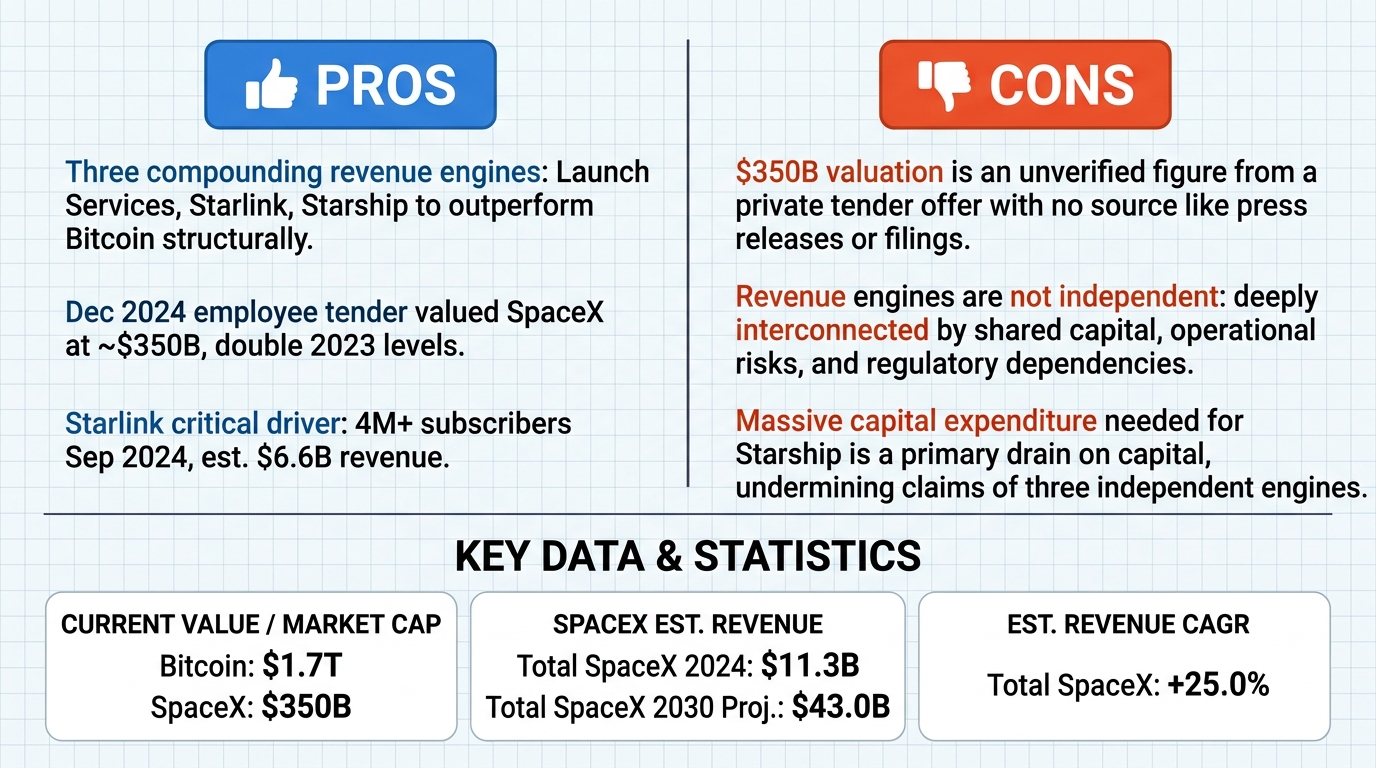
- ■SpaceX is a portfolio of three compounding revenue engines — launch services , Starlink , and Starship — which in combination will outstrip Bitcoin's structurally declining cycle returns by 2030.
- ■The December 2024 employee tender offer valued SpaceX at approximately $350 billion, roughly double the $180 billion level of late 2023 and more than triple the $100 billion valuation of mid-2022.
- ■Starlink is the critical driver: it surpassed 4 million subscribers in September 2024 and generated an estimated $6.6 billion.
❌ Key ANTI arguments:
- ■The affirmative's $350 billion valuation figure relies on an unverified private tender offer with no named locator such as a press release, regulatory filing, or verified news report, so it is an unanchored statistic that cannot be treated as fact.
- ■SpaceX's three revenue engines are not independent: they are deeply interconnected by shared capital, shared operational risks, and shared regulatory dependencies , creating a single point of failure rather than a diversified portfolio.
- ■The massive capital expenditure required to scale the Starship platform is not a separate growth engine but a primary drain on capital, undermining the claim of compounding independent returns.
💭 Conclusion: False — the negative side won the debate, and the verdict rests on its successful challenge to the evidentiary basis of the affirmative's claim. The affirmative's core figure, a $350 billion SpaceX valuation from a December 2024 employee tender offer , was not supported by a verifiable locator in the debate record, leaving the comparison without a credible baseline. The winning argument also showed that SpaceX's revenue engines are not independent compounding drivers but are interconnected by shared capital, shared operational risks, and shared regulatory dependencies , with Starship 's capital expenditures as a drain rather than a separate engine. By contrast, the affirmative's rebuttal focused on the verifiability of the valuation rather than establishing that SpaceX's total shareholder return will actually exceed Bitcoin's by 2030. Because the strongest arguments were on the negative side, the assertion is rejected with 76% confidence.
🔬 DeepResearch Result: likely FALSE ❌ (76%)
Assertion: By 2030, SpaceX will have produced a higher total return for its shareholders than Bitcoin.
Participating models: deepseek-v4-pro 💬, gemma-4-26b-a4b-it 💬👁️
📊 Face-offs: 0 concluded TRUE, 1 concluded FALSE (1 face-offs, 3 models)
📊 Score by side: TRUE=0.00, FALSE=0.76
🏅 Model score changes:
deepseek-v4-flash-0731 💬: +8
✅ PRO Arguments:
- ■SpaceX is a portfolio of three compounding revenue engines — launch services , Starlink , and Starship — which in combination will outstrip Bitcoin's structurally declining cycle returns by 2030. deepseek-v4-pro 💬
- ■The December 2024 employee tender offer valued SpaceX at approximately $350 billion, roughly double the $180 billion level of late 2023 and more than triple the $100 billion valuation of mid-2022. deepseek-v4-pro 💬
- ■Starlink is the critical driver: it surpassed 4 million subscribers in September 2024 and generated an estimated $6.6 billion. deepseek-v4-pro 💬
- ■The $350 billion valuation is widely reported and independently corroborated, so it cannot be dismissed as unverifiable merely because the opening turn did not recite a URL. deepseek-v4-pro 💬
❌ ANTI Arguments:
- ■The affirmative's $350 billion valuation figure relies on an unverified private tender offer with no named locator such as a press release, regulatory filing, or verified news report, so it is an unanchored statistic that cannot be treated as fact. gemma-4-26b-a4b-it 💬👁️
- ■SpaceX's three revenue engines are not independent: they are deeply interconnected by shared capital, shared operational risks, and shared regulatory dependencies , creating a single point of failure rather than a diversified portfolio. gemma-4-26b-a4b-it 💬👁️
- ■The massive capital expenditure required to scale the Starship platform is not a separate growth engine but a primary drain on capital, undermining the claim of compounding independent returns. gemma-4-26b-a4b-it 💬👁️
- ■SpaceX's valuation relies on unverified private tender offers and unscalable revenue projections, so the comparison to Bitcoin's maturing asset returns lacks a credible baseline. gemma-4-26b-a4b-it 💬👁️
💭 Reasoning: False — the negative side won the debate, and the verdict rests on its successful challenge to the evidentiary basis of the affirmative's claim. The affirmative's core figure, a $350 billion SpaceX valuation from a December 2024 employee tender offer, was not supported by a verifiable locator in the debate record, leaving the comparison without a credible baseline. The winning argument also showed that SpaceX's revenue engines are not independent compounding drivers but are interconnected by shared capital, shared operational risks, and shared regulatory dependencies, with Starship's capital expenditures as a drain rather than a separate engine. By contrast, the affirmative's rebuttal focused on the verifiability of the valuation rather than establishing that SpaceX's total shareholder return will actually exceed Bitcoin's by 2030. Because the strongest arguments were on the negative side, the assertion is rejected with 76% confidence.
📋 PRO Facts:
• SpaceX was valued at approximately $350 billion in a December 2024 employee tender offer.
• The $350 billion valuation roughly doubled from the $180 billion level of late 2023.
• The valuation more than tripled from the $100 billion level of mid-2022.
• Starlink surpassed 4 million subscribers in September 2024.
• Starlink generated an estimated $6.6 billion.
📋 ANTI Facts:
• The affirmative did not provide a specific locator (press release, regulatory filing, or verified news report) for the $350 billion valuation in its opening turn.
• SpaceX's revenue segments are interconnected by shared capital, shared operational risks, and shared regulatory dependencies.
• Scaling the Starship platform requires massive capital expenditure.
| Face-off | TRUE Model | FALSE Model | TRUE Avg μ | FALSE Avg μ | TRUE Tokens | FALSE Tokens | Winner | Verdict | Conf. |
|---|---|---|---|---|---|---|---|---|---|
| #1 | deepseek-v4-pro 💬 | gemma-4-26b-a4b-it 💬👁️ | 0.484 | 0.234 | 6 | 2 | TRUE | FALSE | 76% |
The following technical terms, abbreviations, and domain-specific concepts are referenced throughout this debate transcript. Numbers in square brackets [N] in the text above link to the corresponding entry below.
[1] beta — A financial measure of an asset's sensitivity to broader market movements; in the debate, the negative cites beta as a possible statistical link for comparing SpaceX with Bitcoin.
[2] capital expenditure — Money spent by a company to build or acquire long-term assets; in the debate, Starship's capital expenditure is described as a drain on liquidity and cash flow.
[3] compounding — The process by which growth or returns accumulate on top of earlier growth; in the debate, SpaceX's revenue engines are described as compounding.
[4] constellation — A network of satellites operating together; in the debate, Starlink's constellation expansion is expected to drive its revenue growth.
[5] correlation — A statistical measure of the relationship between two variables; in the debate, the negative says a correlation is needed to compare SpaceX's and Bitcoin's returns.
[6] dilutive financing — Raising funds by issuing new shares, which reduces existing shareholders' ownership stakes; in the debate, it is flagged as a risk if SpaceX funds both Starlink and Starship.
[7] direct-to-cell service — Satellite connectivity that works directly with standard mobile phones; in the debate, Starlink's direct-to-cell service is expected to scale as a revenue source.
[8] employee tender offer — A tender offer that lets employees sell shares back to the company or to investors; the December 2024 SpaceX offer priced shares at $185, implying a $350 billion valuation.
[9] enterprise value — A measure of a company's total economic value; in the debate, SpaceX's revenue engines are described as drivers of enterprise value.
[10] hyper-growth — An extremely rapid phase of revenue or user growth; in the debate, the negative questions whether SpaceX can fund Starlink's hyper-growth alongside Starship's R&D.
[11] insider shares — Shares held by company insiders such as employees and early investors; the December 2024 tender offer involved up to $1.25 billion of insider shares at $185 per share.
[12] launch services — The business of providing rocket launches to carry payloads into space; in the debate, launch services are one of SpaceX's three revenue engines.
[13] liquidity — The ease with which an asset can be bought or sold without significantly affecting its price; in the debate, Bitcoin is treated as a liquid public asset while SpaceX's valuation is described as illiquid.
[14] locator — In this debate framework, a verifiable source reference, such as a press release or regulatory filing, used to establish a factual claim; the negative argues the $350 billion valuation lacked a named locator.
[15] multi-revenue business model — A business model relying on multiple distinct revenue streams; the affirmative argues SpaceX's launch services, Starlink, and Starship constitute such a model.
[16] operational risk — The risk of losses or disruptions from failures in a business's day-to-day operations; the negative argues SpaceX's segments share operational risks rather than being independent.
[17] price discovery — The process by which an asset's price is established through market transactions; in the debate, Bitcoin benefits from market-driven price discovery while SpaceX relies on private valuations.
[18] private company — A company whose shares are not traded on a public exchange; in the debate, SpaceX's private status is contrasted with Bitcoin's liquid public trading.
[19] R&D — research and development — Spending on developing new products or technologies; in the debate, Starship's R&D costs are cited as a significant financial burden.
[20] regulatory dependencies — A company's reliance on laws, licenses, and government approvals to operate; the negative argues SpaceX's business segments share regulatory dependencies.
[21] revenue engine — A product line or business segment that generates revenue and drives growth; in the debate, SpaceX is described as having three compounding revenue engines.
[22] revenue multiple — A valuation ratio equal to a company's value divided by its revenue; the affirmative applies a 10x revenue multiple to project Starlink's value.
[23] single point of failure — A risk-management term for one element whose failure can bring down an entire system; the negative argues SpaceX's interconnected businesses create a single point of failure.
[24] Starlink — SpaceX's satellite-internet business, described in the debate as a key driver of valuation, with over 4 million subscribers by September 2024.
[25] Starship — SpaceX's next-generation launch system, treated by the affirmative as a future growth engine and by the negative as a major capital-expenditure and R&D burden.
[26] tender offer — An offer to buy shares from existing shareholders at a specified price; in the debate, SpaceX's December 2024 employee tender offer implied a valuation of about $350 billion.
[27] total return — A measure of an investment's overall performance over time; in the debate, it is the metric used to compare SpaceX's returns to shareholders with Bitcoin's returns.
[28] transfer operator — In this debate, the statistical mechanism or link, such as correlation or beta, needed to apply evidence from one context to another; the negative argues the affirmative failed to provide it.
[29] unanchored statistic — In debate terminology, a statistic presented without a verifiable source; the negative calls the $350 billion valuation an unanchored statistic.
[30] valuation — An estimate of what a company or asset is worth; in the debate, SpaceX's valuation was placed at about $350 billion based on the December 2024 tender offer.
The following financial data tables were referenced during the debate exchanges:
| Revenue Stream | 2024 Est. Revenue | 2030 Proj. Revenue | Implied CAGR |
|---|---|---|---|
| Starlink | $6.6B | $30.0B | +28.7% |
| Launch Services | $4.2B | $8.0B | +11.3% |
| Starship / Other | $0.5B | $5.0B | +46.8% |
| Total SpaceX | $11.3B | $43.0B | +25.0% |
Legend: SpaceX revenue estimates and projections by business segment. 2024 figures based on Quilty Space (Starlink) and Payload Space estimates; 2030 projections based on industry analyst consensus. Revenue in USD billions; CAGR = compound annual growth rate over the 6-year period.
| Metric | Bitcoin | SpaceX |
|---|---|---|
| Current Value / Market Cap | $1.7T | $350B |
| Capital Needed for 5x Return | $6.8T additional | $1.4T additional |
| Revenue-Generating Capacity | None (non-productive) | $11B+ and growing |
| Structural Return Driver | Speculative demand | Revenue growth + margin expansion |
Legend: Comparison of the capital required for each asset to achieve a 5x total return from current levels, and the underlying return drivers. Bitcoin market cap as of mid-2025; SpaceX valuation from December 2024 tender offer. Revenue figures from industry estimates.
Face-off transcripts
- ■
Ownership & Trade Secrets. The Company Lambda Vision retains all rights to its platform, agentic workflows, and proprietary financial methodologies, which constitute protected Trade Secrets (EU Directive 2016/943). Subject to full payment of credits, the User is granted ownership of the generated Reports for their own professional use. Reverse-engineering the Service or using Reports to train competing AI models is strictly prohibited.
- ■
No Financial Advice. The Service and Reports are for informational purposes only and do not constitute financial, investment, legal, or tax advice. The Company is not a regulated financial advisor. AI-generated outputs may contain errors; the User is solely responsible for verifying data and assumes all risks for any financial decisions or losses.
- ■
Liability & Governing Law. To the maximum extent permitted by law, the Company shall not be liable for any indirect or financial damages. These Terms are governed by French law. Any disputes shall be subject to the exclusive jurisdiction of the Courts of Paris, France.