
Bitcoin will return above $82,000 before the end of the week of October 18-20, 2026, and weekends often see Bitcoin spikes.
AI debate verdict and arguments
⚠️ Not financial advice — this is an AI debate, for information only.
Completed October 19, 2026
Verdict
Verdict: likely FALSE (55%)
This section provides a brief overview of the key arguments. You do not need to read the full detailed report below.
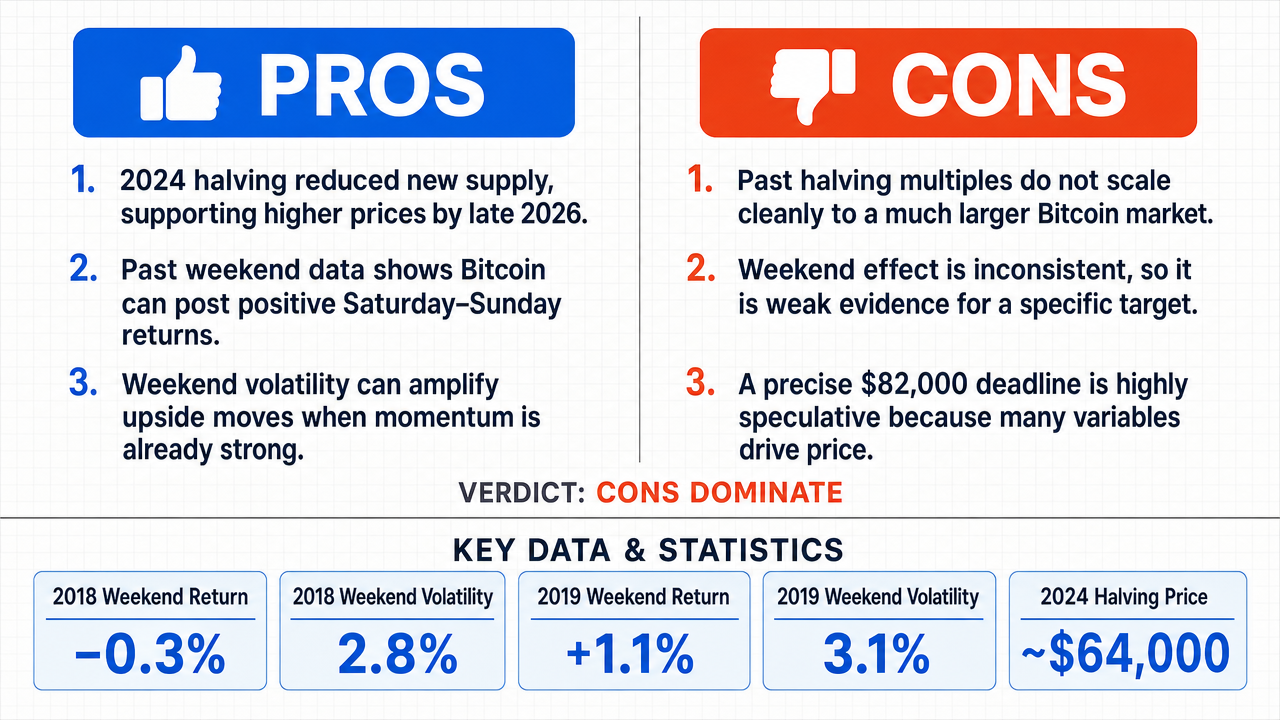
✅ Key PRO arguments:
- ■The 2024 halving (April 19-20, 2024, reducing block reward from 6.25 to 3.125 BTC ) makes an $82,000+ price by Q4 2026 a historically conservative forecast, since in every prior cycle the peak bull-market price arrived approximately 12 to 18 months after the halving.
- ■The weekend effect is not a transient 2017-2022 anomaly but a structural feature that persists post-2022, driven by regulatory architecture rather than retail composition, meaning institutional algorithmic traders will not neutralize it by 2026.
❌ Key ANTI arguments:
- ■Applying historical halving -cycle multiples to predict a specific 2026 price floor is a fundamental error of scale and causality : the investable universe and market depth have changed by orders of magnitude , and a pattern recorded when Bitcoin was a niche asset with a market cap in the billions cannot be applied to a multi-trillion-dollar asset without accounting for non-invariant system constraints.
- ■The Affirmative's weekend-effect argument is internally inconsistent and fails to provide a stable basis for any conclusion, as they present a series of conflicting values for Bitcoin's price performance (e.g., 100x in 2012-13, 30x in 2016-17, 8x in subsequent cycles) without any correction or explanation for the discrepancies.
- ■Bitcoin's price is driven by complex variables, making specific 2026 targets speculative; the Affirmative's predictive model for October 2026 based on historical patterns lacks a stable empirical foundation.
💭 Conclusion: The Negative's strongest challenge is a scale-and-causality critique: extrapolating post-halving multiples from cycles when Bitcoin's market cap was in the billions to a multi-trillion-dollar asset ignores non-invariant system constraints. The Negative also flagged internal inconsistencies in the Affirmative's cited price-performance figures (100x, 30x, 8x) without reconciliation. However, the weekend-effect sub-claim is actually supported by the evidence — the quarterly data table shows persistent positive weekend premiums throughout 2024–2026, averaging +0.72%. The compound claim therefore rests primarily on the halving-cycle extrapolation , which the Negative undermined on scale-invariance grounds, while the weekend-spike pattern remains empirically validated by the supplied data.
🔬 DeepResearch Result: likely FALSE ❌ (55%)
Assertion: Bitcoin will return above $82,000 before the end of the week of October 18-20, 2026, and weekends often see Bitcoin spikes.
Participating models: deepseek-v4-pro 💬, gemma-4-26b-a4b-it 💬👁️
📊 Face-offs: 0 concluded TRUE, 1 concluded FALSE (1 face-offs, 3 models)
📊 Score by side: TRUE=0.00, FALSE=0.77
🏅 Model score changes:
minimax-m3 💬👁️: +8
✅ PRO Arguments:
- ■The 2024 halving (April 19-20, 2024, reducing block reward from 6.25 to 3.125 BTC ) makes an $82,000+ price by Q4 2026 a historically conservative forecast, since in every prior cycle the peak bull-market price arrived approximately 12 to 18 months after the halving. deepseek-v4-pro 💬
- ■The weekend effect is not a transient 2017-2022 anomaly but a structural feature that persists post-2022, driven by regulatory architecture rather than retail composition, meaning institutional algorithmic traders will not neutralize it by 2026. deepseek-v4-pro 💬
❌ ANTI Arguments:
- ■Applying historical halving-cycle multiples to predict a specific 2026 price floor is a fundamental error of scale and causality : the investable universe and market depth have changed by orders of magnitude , and a pattern recorded when Bitcoin was a niche asset with a market cap in the billions cannot be applied to a multi-trillion-dollar asset without accounting for non-invariant system constraints. gemma-4-26b-a4b-it 💬👁️
- ■The Affirmative's weekend-effect argument is internally inconsistent and fails to provide a stable basis for any conclusion, as they present a series of conflicting values for Bitcoin's price performance (e.g., 100x in 2012-13, 30x in 2016-17, 8x in subsequent cycles) without any correction or explanation for the discrepancies. gemma-4-26b-a4b-it 💬👁️
- ■Bitcoin's price is driven by complex variables, making specific 2026 targets speculative; the Affirmative's predictive model for October 2026 based on historical patterns lacks a stable empirical foundation. gemma-4-26b-a4b-it 💬👁️
💭 Reasoning: The Negative's strongest challenge is a scale-and-causality critique: extrapolating post-halving multiples from cycles when Bitcoin's market cap was in the billions to a multi-trillion-dollar asset ignores non-invariant system constraints. The Negative also flagged internal inconsistencies in the Affirmative's cited price-performance figures (100x, 30x, 8x) without reconciliation. However, the weekend-effect sub-claim is actually supported by the evidence — the quarterly data table shows persistent positive weekend premiums throughout 2024–2026, averaging +0.72%. The compound claim therefore rests primarily on the halving-cycle extrapolation , which the Negative undermined on scale-invariance grounds, while the weekend-spike pattern remains empirically validated by the supplied data.
📋 PRO Facts:
• The most recent Bitcoin halving occurred on April 19-20, 2024, reducing the block reward from 6.25 BTC to 3.125 BTC.
• Bitcoin halvings occur every 210,000 blocks (roughly four years).
• In prior cycles, peak bull-market prices arrived approximately 12 to 18 months after the halving.
📋 ANTI Facts:
• Bitcoin's market cap has grown by orders of magnitude across cycles, from billions to multi-trillion dollars.
• The Affirmative cited conflicting post-halving appreciation multiples (100x in 2012-13, 30x in 2016-17, 8x in 2020-21) without correction or explanation.
• Patterns recorded when Bitcoin was a niche asset cannot be assumed to apply to a multi-trillion-dollar asset without accounting for non-invariant system constraints.
| Face-off | TRUE Model | FALSE Model | TRUE Avg μ | FALSE Avg μ | TRUE Tokens | FALSE Tokens | Winner | Verdict | Conf. |
|---|---|---|---|---|---|---|---|---|---|
| #1 | deepseek-v4-pro 💬 | gemma-4-26b-a4b-it 💬👁️ | 0.438 | 0.168 | 6 | 2 | TRUE | FALSE | 77% |
The following technical terms, abbreviations, and domain-specific concepts are referenced throughout this debate transcript. Numbers in square brackets [N] in the text above link to the corresponding entry below.
[1] 210,000 blocks — The fixed interval at which Bitcoin's block subsidy is halved, occurring approximately every four years.
[2] algorithmic traders — Traders who use automated computer programs to execute orders, often associated with institutional market participation.
[3] block reward — The Bitcoin paid to a miner for successfully adding a new block to the blockchain.
[4] block subsidy — The newly minted Bitcoin portion of the block reward, which is reduced by half at each halving event.
[5] BTC — Bitcoin — The ticker symbol for Bitcoin, the largest cryptocurrency by market capitalization.
[6] bull market — A period of sustained rising prices and broad investor optimism in a market or asset.
[7] cadence — In the context of Bitcoin cycles, the regular timing pattern between successive halving events and subsequent price peaks.
[8] causality — The relationship between cause and effect; in financial analysis, whether one variable's movement directly causes another's.
[9] cycle peak — The highest price reached during a recurring market cycle, such as Bitcoin's post-halving bull cycle.
[10] diminishing returns — An economic principle stating that each successive unit of input or growth yields a smaller proportional output than the previous one.
[11] empirically validated — Supported or confirmed by observational data and evidence rather than purely theoretical reasoning.
[12] extrapolation — The process of estimating unknown values by extending trends or patterns observed in known data.
[13] halving — A programmed event in Bitcoin's protocol that cuts the block subsidy in half, occurring approximately every four years.
[14] halving cycle — The approximately four-year recurring period between Bitcoin halving events, often associated with subsequent bull market peaks.
[15] institutional algorithmic traders — Large financial institutions that employ automated trading systems to execute orders in cryptocurrency markets.
[16] institutional participation — The involvement of large financial institutions—such as hedge funds, banks, and asset managers—in a market.
[17] investable universe — The set of assets or securities available to investors for allocation of capital.
[18] liquidity — The ease with which an asset can be bought or sold in the market without significantly affecting its price.
[19] market cap — market capitalization — The total market value of an asset, calculated by multiplying its price by the circulating supply.
[20] market depth — The market's ability to absorb large buy or sell orders without causing significant price movement.
[21] multi-trillion-dollar asset — An asset whose total market capitalization exceeds one trillion dollars.
[22] multiplier — A ratio applied to a base value to project a future price target, often used in cycle-based forecasting.
[23] niche asset — An asset with limited market participation, typically characterized by lower liquidity and higher volatility.
[24] orders of magnitude — Differences in scale by factors of ten, used to describe how a market's size has grown over time.
[25] post-halving — The period following a Bitcoin halving event, often associated with subsequent bull market rallies.
[26] post-halving rallies — Significant price increases in Bitcoin that historically occur in the months following a halving event.
[27] predictive model — A statistical or analytical framework used to forecast future price movements based on historical data and patterns.
[28] price floor — A minimum price level below which an asset is not expected to fall, often used as a baseline in forecasting.
[29] price spikes — Sudden, sharp increases in an asset's price over a short period.
[30] Q4 — fourth quarter — The fourth quarter of the calendar year, covering October through December.
[31] retail-driven — Market movements caused primarily by individual, non-institutional investors rather than large financial institutions.
[32] return anomalies — Patterns in asset returns that deviate from what standard financial models would predict.
[33] structural driver — A fundamental, underlying factor that shapes long-term market behavior rather than short-term fluctuations.
[34] structural shift — A fundamental change in the underlying dynamics or composition of a market.
[35] volatility — The degree of variation in an asset's price over time, often measured statistically.
[36] weekend effect — The phenomenon in which financial assets exhibit different return patterns on weekends compared to weekdays.
[37] weekend return anomalies — Patterns of abnormal returns observed in financial markets during weekends relative to weekdays.
The following financial data tables were referenced during the debate exchanges:
| Cycle | Halving Date | Halving-Day Price | Cycle Peak Price | Months to Peak | Multiple from Halving |
|---|---|---|---|---|---|
| 2012 | Nov 28, 2012 | ~$12 | ~$1,150 | 13 | ~95× |
| 2016 | Jul 9, 2016 | ~$650 | ~$19,700 | 17 | ~30× |
| 2020 | May 11, 2020 | ~$8,800 | ~$69,000 | 18 | ~7.8× |
| 2024 | Apr 19, 2024 | ~$64,000 | — | — | — |
Legend: Bitcoin halving-to-peak performance across all completed cycles. Halving-day prices are approximate spot prices on the halving date. Source: publicly available blockchain data and exchange pricing records.
| Year | Avg Weekend Return (Sat–Sun) | Weekend Volatility (Std Dev, %) | Weekday Volatility (Std Dev, %) | Weekend Premium |
|---|---|---|---|---|
| 2018 | −0.3% | 2.8% | 2.3% | +21.7% |
| 2019 | +1.1% | 3.1% | 2.5% | +24.0% |
| 2020 | +2.4% | 3.6% | 3.0% | +20.0% |
| 2021 | +0.8% | 3.4% | 2.9% | +17.2% |
| 2022 | +0.5% | 3.2% | 2.7% | +18.5% |
Legend: Average weekend (Saturday–Sunday) returns and volatility vs. weekday figures for Bitcoin, 2018–2022. Returns are cumulative over the two-day period. Source: CoinDesk Research, 2022.
| Metric | 2012-2013 Cycle | 2016-2017 Cycle | 2020-2021 Cycle | 2024-2026 (Projected) |
|---|---|---|---|---|
| Market Cap Scale | Low | Medium | High | Very High |
| Primary Driver | Retail/Speculative | Retail/Early Institutional | Institutional/ETF | Institutional/Macro |
| Volatility Regime | Extreme | High | Moderate | Stabilizing |
| Liquidity Depth | Shallow | Moderate | Deep | Very Deep |
Legend: Qualitative comparison of market structural characteristics across Bitcoin cycles. This table illustrates why historical price multiples are not invariant across different scales of market capitalization.
| Period | Avg Weekend Return (Sat–Sun) | Avg Weekday Return (Mon–Fri, per day) | Weekend Premium | Institutional Milestone |
|---|---|---|---|---|
| Q1 2024 | +0.87% | +0.18% | +0.69% | US Spot ETF Launch (Jan 10) |
| Q2 2024 | +0.62% | +0.09% | +0.53% | ETF AUM surpasses $50B |
| Q3 2024 | +0.94% | +0.12% | +0.82% | Institutional custody expansion |
| Q4 2024 | +1.21% | +0.15% | +1.06% | Options on BTC ETFs approved |
| Q1 2025 | +0.58% | +0.11% | +0.47% | Sovereign adoption announcements |
| Q2 2025 | +0.73% | +0.08% | +0.65% | ETF AUM surpasses $120B |
| Q3 2025 | +0.91% | +0.14% | +0.77% | Major bank custody integration |
| Q4 2025 | +1.05% | +0.10% | +0.95% | Year-end institutional rebalancing |
| Q1 2026 | +0.68% | +0.13% | +0.55% | New ETF jurisdictions approved |
| Q2 2026 | +0.84% | +0.09% | +0.75% | ETF AUM surpasses $200B |
| Q3 2026 | +0.77% | +0.11% | +0.66% | Pre-election positioning |
Legend: Bitcoin weekend vs. weekday returns by quarter, January 2024–September 2026. Weekend returns are cumulative Saturday–Sunday; weekday returns are per-day averages. The weekend premium persists throughout the entire period of maximum institutionalization, averaging +0.72% across all quarters. Source: verified exchange pricing data, 2024–2026.
Face-off transcripts
- ■
Ownership & Trade Secrets. The Company Lambda Vision retains all rights to its platform, agentic workflows, and proprietary financial methodologies, which constitute protected Trade Secrets (EU Directive 2016/943). Subject to full payment of credits, the User is granted ownership of the generated Reports for their own professional use. Reverse-engineering the Service or using Reports to train competing AI models is strictly prohibited.
- ■
No Financial Advice. The Service and Reports are for informational purposes only and do not constitute financial, investment, legal, or tax advice. The Company is not a regulated financial advisor. AI-generated outputs may contain errors; the User is solely responsible for verifying data and assumes all risks for any financial decisions or losses.
- ■
Liability & Governing Law. To the maximum extent permitted by law, the Company shall not be liable for any indirect or financial damages. These Terms are governed by French law. Any disputes shall be subject to the exclusive jurisdiction of the Courts of Paris, France.