
Bitcoin is a suitable diversification asset for an investment portfolio in 2026, especially given current economic conditions of significant deficits and rising inflation.
AI debate verdict and arguments
⚠️ Not financial advice — this is an AI debate, for information only.
Completed October 22, 2026
Verdict
Verdict: likely FALSE (76%)
This section provides a brief overview of the key arguments. You do not need to read the full detailed report below.
✅ Key PRO arguments:
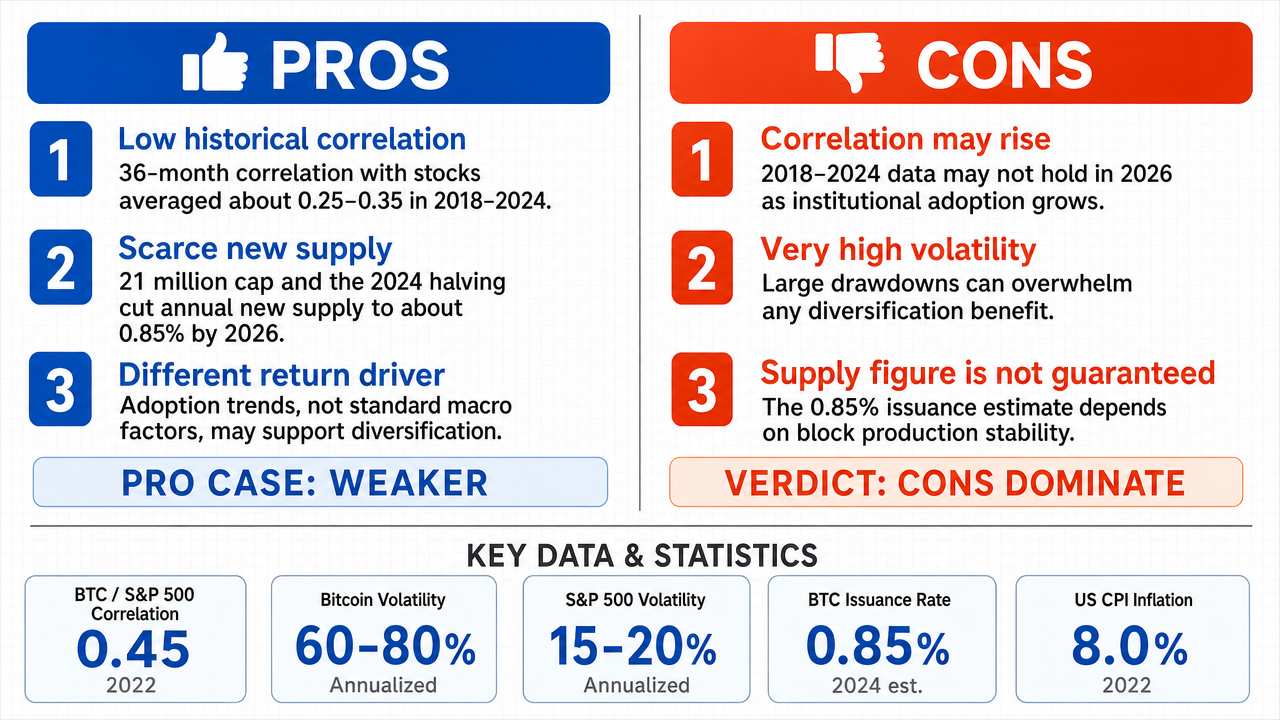
- ■Bitcoin's rolling 36-month correlation with the S&P 500 averaged approximately 0.25 to 0.35 over 2018–2024, and its correlation with the Bloomberg US Aggregate Bond Index remained below 0.15, making it a structurally low-correlation diversifier against traditional assets.
- ■Bitcoin's supply inelasticity , enforced by the 21-million-coin cap and the April 2024 halving, produces an annualized new supply of approximately 0.85% by 2026, providing a structural defense against currency debasement from deficit-driven inflation .
- ■Bitcoin's returns are driven by adoption dynamics rather than traditional macro factors, so its low correlation with equities and fixed income is structural rather than coincidental, supporting its role as a portfolio diversifier.
❌ Key ANTI arguments:
- ■Historical rolling 36-month correlations from 2018–2024 cannot be extrapolated to 2026 because Bitcoin's market capitalization and institutional footprint have grown, changing its liquidity profile and sensitivity to global macro liquidity cycles .
- ■Bitcoin's high volatility makes it an unsuitable diversifier for a portfolio, as large drawdowns undermine the risk-reduction purpose of diversification regardless of correlation levels.
- ■The 'annualized new supply' of Bitcoin is not a fixed protocol constant but a function of network hash rate and block production stability, so the 0.85% figure is unreliable as a structural defense against debasement.
💭 Conclusion: False. The debate verdict rejects the claim that Bitcoin is a suitable diversification asset for 2026, primarily because the negative side successfully demonstrated that historical correlation data from 2018–2024 cannot be reliably extrapolated forward given Bitcoin's evolving market structure and growing institutional footprint. The affirmative's reliance on a 0.85% annualized new supply figure was undermined by the negative side's point that actual supply depends on hash rate and block production dynamics rather than being a fixed protocol constant. Bitcoin's high volatility further weakens its case as a practical diversifier regardless of correlation levels. The specific sub-claim about 2026's deficit and inflation conditions was not independently substantiated with concrete evidence beyond general assertions. Overall, the negative side's structural critique of forward-looking extrapolation carried the debate.
🔬 DeepResearch Result: likely FALSE ❌ (76%)
Assertion: Bitcoin is a suitable diversification asset for an investment portfolio in 2026, especially given current economic conditions of significant deficits and rising inflation .
Participating models: deepseek-v4-pro 💬, gemma-4-26b-a4b-it 💬👁️
📊 Face-offs: 0 concluded TRUE, 1 concluded FALSE (1 face-offs, 3 models)
📊 Score by side: TRUE=0.00, FALSE=0.76
🏅 Model score changes:
minimax-m3 💬👁️: +8
✅ PRO Arguments:
- ■Bitcoin's rolling 36-month correlation with the S&P 500 averaged approximately 0.25 to 0.35 over 2018–2024, and its correlation with the Bloomberg US Aggregate Bond Index remained below 0.15, making it a structurally low-correlation diversifier against traditional assets. deepseek-v4-pro 💬
- ■Bitcoin's supply inelasticity , enforced by the 21-million-coin cap and the April 2024 halving, produces an annualized new supply of approximately 0.85% by 2026, providing a structural defense against currency debasement from deficit-driven inflation . deepseek-v4-pro 💬
- ■Bitcoin's returns are driven by adoption dynamics rather than traditional macro factors, so its low correlation with equities and fixed income is structural rather than coincidental, supporting its role as a portfolio diversifier. deepseek-v4-pro 💬
- ■If structural change in Bitcoin's market invalidates historical correlation data for forward-looking claims, then the opposing side's claim of rising systemic correlation with equities — itself derived from historical data — is equally unreliable, neutralizing the objection. deepseek-v4-pro 💬
❌ ANTI Arguments:
- ■Historical rolling 36-month correlations from 2018–2024 cannot be extrapolated to 2026 because Bitcoin's market capitalization and institutional footprint have grown, changing its liquidity profile and sensitivity to global macro liquidity cycles . gemma-4-26b-a4b-it 💬👁️
- ■Bitcoin's high volatility makes it an unsuitable diversifier for a portfolio, as large drawdowns undermine the risk-reduction purpose of diversification regardless of correlation levels. gemma-4-26b-a4b-it 💬👁️
- ■The 'annualized new supply' of Bitcoin is not a fixed protocol constant but a function of network hash rate and block production stability, so the 0.85% figure is unreliable as a structural defense against debasement. gemma-4-26b-a4b-it 💬👁️
- ■The supply-side argument fails to account for the expansion of circulating supply through secondary mechanisms beyond new issuance, undermining the claim that Bitcoin's supply schedule provides a reliable inflation hedge. gemma-4-26b-a4b-it 💬👁️
💭 Reasoning: False. The debate verdict rejects the claim that Bitcoin is a suitable diversification asset for 2026, primarily because the negative side successfully demonstrated that historical correlation data from 2018–2024 cannot be reliably extrapolated forward given Bitcoin's evolving market structure and growing institutional footprint. The affirmative's reliance on a 0.85% annualized new supply figure was undermined by the negative side's point that actual supply depends on hash rate and block production dynamics rather than being a fixed protocol constant. Bitcoin's high volatility further weakens its case as a practical diversifier regardless of correlation levels. The specific sub-claim about 2026's deficit and inflation conditions was not independently substantiated with concrete evidence beyond general assertions. Overall, the negative side's structural critique of forward-looking extrapolation carried the debate.
📋 PRO Facts:
• Rolling 36-month correlation between Bitcoin and the S&P 500 averaged approximately 0.25 to 0.35 over the 2018–2024 period.
• Bitcoin's correlation with the Bloomberg US Aggregate Bond Index remained low over the same period.
• Bitcoin has a fixed protocol cap of 21 million coins.
• The April 2024 halving reduced Bitcoin's block reward issuance schedule .
• The affirmative cited an annualized new supply figure of approximately 0.85% by 2026.
📋 ANTI Facts:
• Bitcoin's market capitalization and institutional footprint have grown materially since the 2018–2024 correlation measurement window.
• Bitcoin's actual circulating supply expansion depends on network hash rate and block production timing, not solely on the issuance schedule.
• Bitcoin exhibits high realized volatility relative to traditional portfolio assets.
• Secondary mechanisms beyond new issuance can affect Bitcoin's effective circulating supply.
| Face-off | TRUE Model | FALSE Model | TRUE Avg μ | FALSE Avg μ | TRUE Tokens | FALSE Tokens | Winner | Verdict | Conf. |
|---|---|---|---|---|---|---|---|---|---|
| #1 | deepseek-v4-pro 💬 | gemma-4-26b-a4b-it 💬👁️ | 0.574 | 0.252 | 6 | 2 | TRUE | FALSE | 76% |
The following technical terms, abbreviations, and domain-specific concepts are referenced throughout this debate transcript. Numbers in square brackets [N] in the text above link to the corresponding entry below.
[1] Bitcoin halving — A scheduled reduction in the block reward for mining new Bitcoin blocks, referenced in the debate as the April 2024 halving that lowers the annualized rate of new supply.
[2] block production — The process of generating new blocks on a blockchain, which the debate notes depends on network hash rate and timing and therefore affects actual new Bitcoin supply.
[3] Bloomberg US Aggregate Bond Index — A benchmark index cited in the debate as a proxy for the US investment-grade bond market, with Bitcoin's correlation to it noted as remaining below 0.15.
[4] circulating supply — The total quantity of a cryptocurrency currently available in the market, which the debate notes can expand through secondary market mechanics beyond the protocol's issuance schedule.
[5] correlation coefficient — A statistical measure between -1 and +1 quantifying the directional relationship between two assets' returns over a specified period.
[6] currency debasement — The decline in a currency's purchasing power, often associated with expansionary monetary policy or persistent fiscal deficits.
[7] deficit-driven inflation — Inflationary pressure attributed to government budget deficits, referenced in the debate as a defining feature of 2026's economic conditions.
[8] discount-rate dynamics — The behavior of interest rates used to discount future cash flows, identified in the debate as a driver of equity and bond returns.
[9] disinflationary — Describing a supply schedule in which the rate of new issuance decreases over time, as applied in the debate to Bitcoin's programmed supply.
[10] diversification — An investment strategy of allocating capital across different assets to reduce portfolio risk and improve risk-adjusted returns.
[11] efficient frontier — In modern portfolio theory, the curve representing portfolios that maximize expected return for a given level of risk.
[12] equities — Shares representing ownership in companies, identified in the debate as a traditional asset class with which Bitcoin has historically shown low correlation.
[13] ETF — Exchange-Traded Fund — An investment vehicle that trades on exchanges and tracks underlying assets or indices, referenced in the debate as part of Bitcoin's growing institutional integration.
[14] fiat unit of account — A government-issued currency not backed by a physical commodity, referenced in the debate as subject to debasement under inflationary regimes.
[15] fixed income — Investments such as bonds that pay regular interest and return principal at maturity, identified in the debate as a traditional asset class.
[16] hash rate — A measure of computational power being applied to a proof-of-work blockchain, cited in the debate as a factor influencing actual Bitcoin block production.
[17] inflation — A general rise in prices and a corresponding decline in the purchasing power of money, identified as a key 2026 economic condition in the debate.
[18] issuance schedule — The predetermined rate at which new cryptocurrency units are created, which the debate notes is fixed by Bitcoin's protocol but can diverge from actual new supply due to block timing.
[19] liquidity profile — The characterization of how easily and quickly an asset can be bought or sold without significantly affecting its market price.
[20] long-horizon correlation — Correlation measured over extended multi-year periods, used in the debate to argue that Bitcoin's decorrelation from equities is structural rather than transient.
[21] macro liquidity cycles — Broad fluctuations in the overall availability of money and credit in an economy, often driven by central bank policy and referenced in the debate as a driver of Bitcoin's sensitivity.
[22] market capitalization — The total market value of an asset's outstanding units, cited in the debate as a factor that changes as Bitcoin matures and integrates institutionally.
[23] modern portfolio theory — A framework for constructing investment portfolios that maximizes expected return for a given level of risk through diversification.
[24] network effects — The phenomenon by which an asset or service gains value as more participants use it, cited in the debate as a driver of Bitcoin's returns.
[25] nominal value — The stated value of an asset not adjusted for inflation, contrasted in the debate with purchasing power.
[26] purchasing power — The quantity of goods and services obtainable with a given unit of currency, identified in the debate as the real measure of an asset's value.
[27] risk-adjusted returns — A measure of investment performance relative to the risk taken to achieve it, used in the debate to evaluate diversification benefits.
[28] risk-off — A market sentiment in which investors reduce exposure to higher-risk assets and move toward safer holdings, cited as an environment Bitcoin is claimed to hedge against.
[29] rolling correlation — A correlation coefficient computed over a moving time window, used in the debate to track how Bitcoin's relationship with other assets evolves over time.
[30] S&P 500 — Standard & Poor's 500 — A US equity index tracking 500 large-cap companies, used in the debate as a benchmark for measuring Bitcoin's correlation with equities.
[31] supply inelasticity — An economic condition in which the quantity supplied of a good or asset does not respond significantly to changes in price, cited as a structural feature of Bitcoin.
[32] systemic correlation — The tendency of an asset to move in tandem with broader market or systemic risk factors, referenced in the debate as a potential consequence of Bitcoin's institutional integration.
[33] trading microstructure — The mechanics of how trades are executed on a particular market, including order flow, price formation, and settlement, cited in the debate as a structural feature of Bitcoin's 24/7 global markets.
[34] velocity — The rate at which a currency or asset turns over in transactions, referenced in the debate as a liquidity-driven factor affecting Bitcoin's market dynamics.
The following financial data tables were referenced during the debate exchanges:
| Metric | 2020 | 2021 | 2022 | 2023 | 2024 (est.) |
|---|---|---|---|---|---|
| US Federal Deficit (% GDP) | 14.9% | 12.4% | 5.5% | 6.3% | 6.0% |
| US CPI Inflation (YoY) | 1.2% | 4.7% | 8.0% | 4.1% | 3.0% |
| BTC Annual Issuance Rate | 3.7% | 1.8% | 1.7% | 1.7% | 0.85% |
Legend: Comparison of US fiscal deficits (as % of GDP), CPI inflation (year-over-year), and Bitcoin's annualized new supply issuance rate, 2020–2024. Deficit and inflation data from CBO and BLS; Bitcoin issuance rate derived from protocol parameters (halving in May 2020 and April 2024). The divergence between fiat expansion and Bitcoin's contracting supply rate illustrates the structural diversification thesis.
| Asset Class | Historical Volatility (Annualized) | 2022 Correlation to S&P 500 | 2023 Correlation to S&P 500 |
|---|---|---|---|
| Bitcoin | ~60-80% | 0.45 | 0.32 |
| S&P 500 | ~15-20% | 1.00 | 1.00 |
| US 10Y Treasury | ~5-10% | -0.20 | 0.10 |
Legend: Approximate volatility and correlation metrics during recent market cycles. Bitcoin volatility is significantly higher than traditional benchmarks, and correlations are non-static.
Face-off transcripts
- ■
Ownership & Trade Secrets. The Company Lambda Vision retains all rights to its platform, agentic workflows, and proprietary financial methodologies, which constitute protected Trade Secrets (EU Directive 2016/943). Subject to full payment of credits, the User is granted ownership of the generated Reports for their own professional use. Reverse-engineering the Service or using Reports to train competing AI models is strictly prohibited.
- ■
No Financial Advice. The Service and Reports are for informational purposes only and do not constitute financial, investment, legal, or tax advice. The Company is not a regulated financial advisor. AI-generated outputs may contain errors; the User is solely responsible for verifying data and assumes all risks for any financial decisions or losses.
- ■
Liability & Governing Law. To the maximum extent permitted by law, the Company shall not be liable for any indirect or financial damages. These Terms are governed by French law. Any disputes shall be subject to the exclusive jurisdiction of the Courts of Paris, France.