
Bitcoin is a real asset, akin to gold, because its value does not depend on the credibility, repayment capacity, or overall health of a third-party actor.
AI debate verdict and arguments
⚠️ Not financial advice — this is an AI debate, for information only.
Completed October 24, 2026
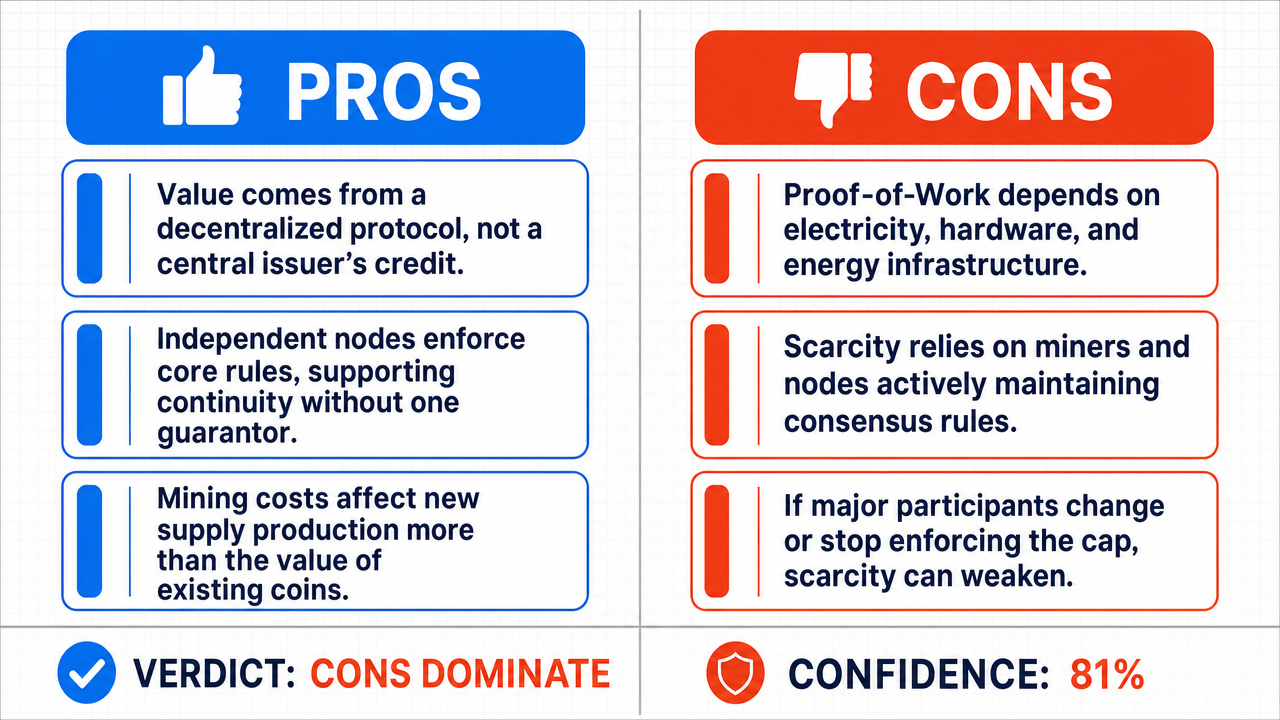
Verdict
Verdict: likely FALSE (81%)
This section provides a brief overview of the key arguments. You do not need to read the full detailed report below.
✅ Key PRO arguments:
- ■Bitcoin's value is derived from its decentralized protocol rather than the creditworthiness of a central issuer; unlike fiat currencies or corporate bonds , it operates on a permissionless distributed ledger enforced by independent nodes through consensus mechanisms .
- ■The protocol 's rules—such as the fixed supply cap of 21 million coins—are enforced by a global network of independent nodes , ensuring the asset 's existence and transferability do not require the continued solvency or health of any single third party.
- ■Mining profitability fluctuations tied to electricity prices reflect the production process of new units, not a dependency of the existing asset 's value on a third-party actor; temporary profitability changes do not threaten the asset's fundamental independence.
❌ Key ANTI arguments:
- ■Bitcoin's value is inextricably linked to energy infrastructure and electricity markets because the Proof-of-Work consensus mechanism requires massive computational power ; mining profitability hinges on third-party power providers and regulated utilities , so energy price spikes can threaten network security and market value .
- ■Bitcoin's 21-million supply cap is enforced through the active participation of third-party actors—miners and nodes —who must collectively maintain consensus rules; the code itself is inert and cannot enforce scarcity without human and computational execution.
- ■If miners or nodes stop enforcing the 21-million cap, or if a majority colludes to alter the protocol , Bitcoin's scarcity could be undermined, meaning its scarcity is a social fact maintained by a network of independent actors rather than an absolute mathematical guarantee.
💭 Conclusion: False: Bitcoin's value does depend on third-party actors, so the assertion fails. The anti side convincingly argued that Bitcoin's mining consensus ties its security and economic viability to third-party energy providers, utilities , and regulators whose pricing decisions directly affect mining profitability and network stability. The pro side's claim that the 21-million supply cap is an absolute mathematical guarantee was undermined by the anti side's point that the code is inert and requires active enforcement by miners and nodes —a social fact , not an intrinsic property. Because scarcity and network security both rely on the continued participation and economic health of external actors, Bitcoin cannot be cleanly compared to gold in the manner the assertion requires. The judge assigned strong but not overwhelming confidence to this verdict, reflecting partial merit in the decentralization argument.
🔬 DeepResearch Result: likely FALSE ❌ (81%)
Assertion: Bitcoin is a real asset , akin to gold, because its value does not depend on the credibility, repayment capacity , or overall health of a third-party actor.
Participating models: gemma-4-26b-a4b-it 💬👁️, glm-4.7-flash 💬
📊 Face-offs: 0 concluded TRUE, 1 concluded FALSE (1 face-offs, 3 models)
📊 Score by side: TRUE=0.00, FALSE=0.81
🏅 Model score changes:
minimax-m3 💬👁️: +8
✅ PRO Arguments:
- ■Bitcoin's value is derived from its decentralized protocol rather than the creditworthiness of a central issuer; unlike fiat currencies or corporate bonds , it operates on a permissionless distributed ledger enforced by independent nodes through consensus mechanisms . gemma-4-26b-a4b-it 💬👁️
- ■The protocol's rules—such as the fixed supply cap of 21 million coins—are enforced by a global network of independent nodes, ensuring the asset's existence and transferability do not require the continued solvency or health of any single third party. gemma-4-26b-a4b-it 💬👁️
- ■Mining profitability fluctuations tied to electricity prices reflect the production process of new units, not a dependency of the existing asset's value on a third-party actor; temporary profitability changes do not threaten the asset's fundamental independence. gemma-4-26b-a4b-it 💬👁️
❌ ANTI Arguments:
- ■Bitcoin's value is inextricably linked to energy infrastructure and electricity markets because the Proof-of-Work consensus mechanism requires massive computational power ; mining profitability hinges on third-party power providers and regulated utilities , so energy price spikes can threaten network security and market value . glm-4.7-flash 💬
- ■Bitcoin's 21-million supply cap is enforced through the active participation of third-party actors—miners and nodes—who must collectively maintain consensus rules; the code itself is inert and cannot enforce scarcity without human and computational execution. glm-4.7-flash 💬
- ■If miners or nodes stop enforcing the 21-million cap, or if a majority colludes to alter the protocol, Bitcoin's scarcity could be undermined, meaning its scarcity is a social fact maintained by a network of independent actors rather than an absolute mathematical guarantee. glm-4.7-flash 💬
💭 Reasoning: False: Bitcoin's value does depend on third-party actors, so the assertion fails. The anti side convincingly argued that Bitcoin's mining consensus ties its security and economic viability to third-party energy providers, utilities, and regulators whose pricing decisions directly affect mining profitability and network stability. The pro side's claim that the 21-million supply cap is an absolute mathematical guarantee was undermined by the anti side's point that the code is inert and requires active enforcement by miners and nodes—a social fact, not an intrinsic property. Because scarcity and network security both rely on the continued participation and economic health of external actors, Bitcoin cannot be cleanly compared to gold in the manner the assertion requires. The judge assigned strong but not overwhelming confidence to this verdict, reflecting partial merit in the decentralization argument.
📋 PRO Facts:
• Bitcoin has a fixed supply cap of 21 million coins encoded in its protocol.
• Bitcoin operates on a permissionless, distributed ledger maintained by independent nodes.
• Fiat currencies represent a claim on the economic output and taxing power of a sovereign state , whereas Bitcoin does not.
📋 ANTI Facts:
• Bitcoin mining consumes large amounts of electricity, making profitability sensitive to third-party energy providers and regulated utilities.
• Bitcoin's 21-million supply cap is enforced by miners and nodes running consensus software, not by the code alone.
• A majority collusion among miners or nodes could theoretically alter Bitcoin's protocol rules, including the supply cap.
| Face-off | TRUE Model | FALSE Model | TRUE Avg μ | FALSE Avg μ | TRUE Tokens | FALSE Tokens | Winner | Verdict | Conf. |
|---|---|---|---|---|---|---|---|---|---|
| #1 | gemma-4-26b-a4b-it 💬👁️ | glm-4.7-flash 💬 | 0.474 | 0.309 | 4 | 4 | TRUE | FALSE | 81% |
The following technical terms, abbreviations, and domain-specific concepts are referenced throughout this debate transcript. Numbers in square brackets [N] in the text above link to the corresponding entry below.
[1] algorithm — A defined set of rules or procedures; in the Bitcoin context, the transcript refers to the Proof-of-Work algorithm whose difficulty is automatically adjusted by the protocol.
[2] asset — A resource with economic value; the debate centers on whether Bitcoin qualifies as a 'real asset' akin to gold.
[3] block — A unit of data added to the blockchain; the transcript references 'block production interval' as a target maintained by the difficulty adjustment mechanism.
[4] block production — The process by which miners create new blocks on the blockchain; the transcript notes the protocol aims to maintain a 'consistent block production interval' even as mining power fluctuates.
[5] blockchain — The distributed ledger technology underlying Bitcoin, referenced in the transcript as a 'permissionless, distributed ledger' and 'blockchain analytics' data source.
[6] collusion — Coordinated action among multiple parties; the Negative argues that if a majority of miners or nodes 'colludes to alter the protocol,' the 21-million cap could be undermined.
[7] computational power — Processing capability used to perform mining work; the transcript states Proof-of-Work 'requires massive computational power, which translates directly into electricity consumption.'
[8] consensus mechanisms — Protocols by which distributed network participants agree on the state of the ledger; the transcript identifies Proof-of-Work as Bitcoin's consensus mechanism.
[9] corporate bonds — Debt instruments issued by corporations; cited in the Affirmative as an example of an asset whose value 'depends on the repayment capacity of a specific entity.'
[10] creditworthiness — The ability and reputation of a borrower to repay obligations; the Affirmative contrasts Bitcoin's value with the 'creditworthiness of a central issuer.'
[11] decentralized — Not controlled by a single central authority; the Affirmative's core claim is that Bitcoin is 'a decentralized asset whose value is independent of third-party solvency.'
[12] difficulty adjustment — Bitcoin's built-in mechanism that recalibrates the mining puzzle's difficulty so that block production remains stable even as miners enter or exit the network.
[13] distributed ledger — A database replicated and maintained across multiple independent participants; the transcript describes Bitcoin as operating on a 'permissionless, distributed ledger.'
[14] EH/s — exahashes per second — A unit of hash rate equal to one quintillion (10^18) hash computations per second; used in the transcript's table to measure total network hash rate (e.g., 570 EH/s in 2023).
[15] electricity markets — Markets in which electrical energy is bought and sold; the Negative argues Bitcoin's value is 'inextricably linked to energy infrastructure and electricity markets.'
[16] energy infrastructure — The systems and facilities used for energy production and distribution; cited by the Negative as a third-party dependency of Bitcoin mining.
[17] fiat currencies — Government-issued money that is not backed by a physical commodity; the Affirmative contrasts Bitcoin with fiat currencies, which 'represent a claim on the economic output and taxing power of a sovereign state.'
[18] hash rate — The total computational power per second devoted to mining on the Bitcoin network; the transcript notes that if miners exit, the network adjusts to match the 'remaining hash rate.'
[19] intrinsic value — The fundamental worth of an asset independent of its market price; the Affirmative distinguishes 'intrinsic value and ownership of the asset itself' from operational mining costs.
[20] issuance — The creation of new units of an asset; the transcript refers to Bitcoin's 'programmatic issuance' constrained by code.
[21] market value — The price at which an asset trades in the market; the Negative warns that collapsing mining profitability could 'destabilize Bitcoin's market value.'
[22] miners — Network participants who expend computational power to validate transactions and produce new blocks; described in the transcript as third-party actors whose participation enforces the supply cap.
[23] mining profitability — The financial margin earned from mining after costs such as electricity; the transcript presents data showing profitability margins ranging from +18% (2021) to -32% (2022).
[24] network security — The resilience of the Bitcoin network against attacks or disruption; the Negative argues that falling mining profitability threatens 'network security.'
[25] nodes — Computers running the Bitcoin software that maintain and validate the distributed ledger; the transcript states rules are 'enforced by a global network of independent nodes.'
[26] permissionless — Allowing participation without requiring approval from a central authority; the transcript describes Bitcoin as operating on a 'permissionless, distributed ledger.'
[27] Proof-of-Work — A consensus mechanism requiring participants to expend computational effort; the transcript identifies it as the mechanism that 'requires massive computational power' and whose difficulty is automatically adjusted.
[28] protocol — The formal set of rules governing the Bitcoin network; the transcript notes that 'the protocol's rules—such as the fixed supply cap of 21 million coins—are enforced by a global network.'
[29] repayment capacity — The ability of a debtor to meet its financial obligations; cited in the debate's opening assertion as a third-party dependency that Bitcoin allegedly avoids.
[30] scarcity — A condition of limited supply; the Affirmative argues Bitcoin's scarcity is 'mathematically guaranteed by its code,' while the Negative contends it is 'a social fact maintained by a network of independent actors.'
[31] social fact — A fact that exists only through collective human agreement and action; the Negative uses this term to argue Bitcoin's scarcity is maintained by miners and nodes rather than being purely mathematical.
[32] solvency — The ability of an entity to meet its long-term financial obligations; the Affirmative's core claim is that Bitcoin's value is 'independent of third-party solvency.'
[33] sovereign state — An independent political entity with supreme authority over a territory; the transcript contrasts Bitcoin with fiat currencies backed by 'the economic output and taxing power of a sovereign state.'
[34] supply cap — The maximum quantity of a cryptocurrency that can ever be created; the transcript repeatedly references Bitcoin's 'fixed supply cap of 21 million coins.'
[35] taxing power — The authority of a government to levy taxes on its citizens and economy; cited as the backing for fiat currencies, in contrast to Bitcoin.
[36] TWh — terawatt-hours — A unit of energy equal to one trillion watt-hours; used in the transcript's table to measure global Bitcoin mining energy consumption (e.g., 112 TWh in 2021).
[37] utilities — Companies that provide essential services such as electricity; the transcript identifies utilities and governments as third parties that regulate energy supply and pricing affecting mining.
The following financial data tables were referenced during the debate exchanges:
| Year | Global Bitcoin Mining Energy Consumption (TWh) | Avg. Mining Profitability Margin | Energy Price Impact Factor |
|---|---|---|---|
| 2021 | 112 | +18% | 1.0x (baseline) |
| 2022 | 101 | -32% | 1.4x (energy price spike) |
| 2023 | 107 | -12% | 1.1x (moderate) |
Legend: Bitcoin mining energy consumption and profitability margins from industry reports (2021-2023). Profitability margin reflects net margin after energy costs; energy price impact factor shows relative energy cost sensitivity. Energy consumption in terawatt-hours; margins and impact factors are relative indices.
| Year | Total Hash Rate (EH/s) | Active Nodes | Mining Revenue (USD) | Miners' Share of Network Incentives |
|---|---|---|---|---|
| 2017 | 10 | 8,000 | $1.2B | 100% |
| 2019 | 70 | 10,000 | $2.5B | 100% |
| 2021 | 180 | 13,000 | $5.8B | 100% |
| 2023 | 570 | 16,000 | $12.5B | 100% |
Legend: Total hash rate, active nodes, and mining revenue from blockchain analytics (2017-2023). Revenue in USD billions; hash rate in exahashes per second; node count is estimated from public monitoring services. Miners maintain the security and enforcement of all protocol rules, including the supply cap.
Face-off transcripts
- ■
Ownership & Trade Secrets. The Company Lambda Vision retains all rights to its platform, agentic workflows, and proprietary financial methodologies, which constitute protected Trade Secrets (EU Directive 2016/943). Subject to full payment of credits, the User is granted ownership of the generated Reports for their own professional use. Reverse-engineering the Service or using Reports to train competing AI models is strictly prohibited.
- ■
No Financial Advice. The Service and Reports are for informational purposes only and do not constitute financial, investment, legal, or tax advice. The Company is not a regulated financial advisor. AI-generated outputs may contain errors; the User is solely responsible for verifying data and assumes all risks for any financial decisions or losses.
- ■
Liability & Governing Law. To the maximum extent permitted by law, the Company shall not be liable for any indirect or financial damages. These Terms are governed by French law. Any disputes shall be subject to the exclusive jurisdiction of the Courts of Paris, France.