
Bitcoin dominance will increase in the short term due to anticipated restrictive monetary policy and a stronger US dollar.
AI debate verdict and arguments
⚠️ Not financial advice — this is an AI debate, for information only.
Completed October 14, 2026
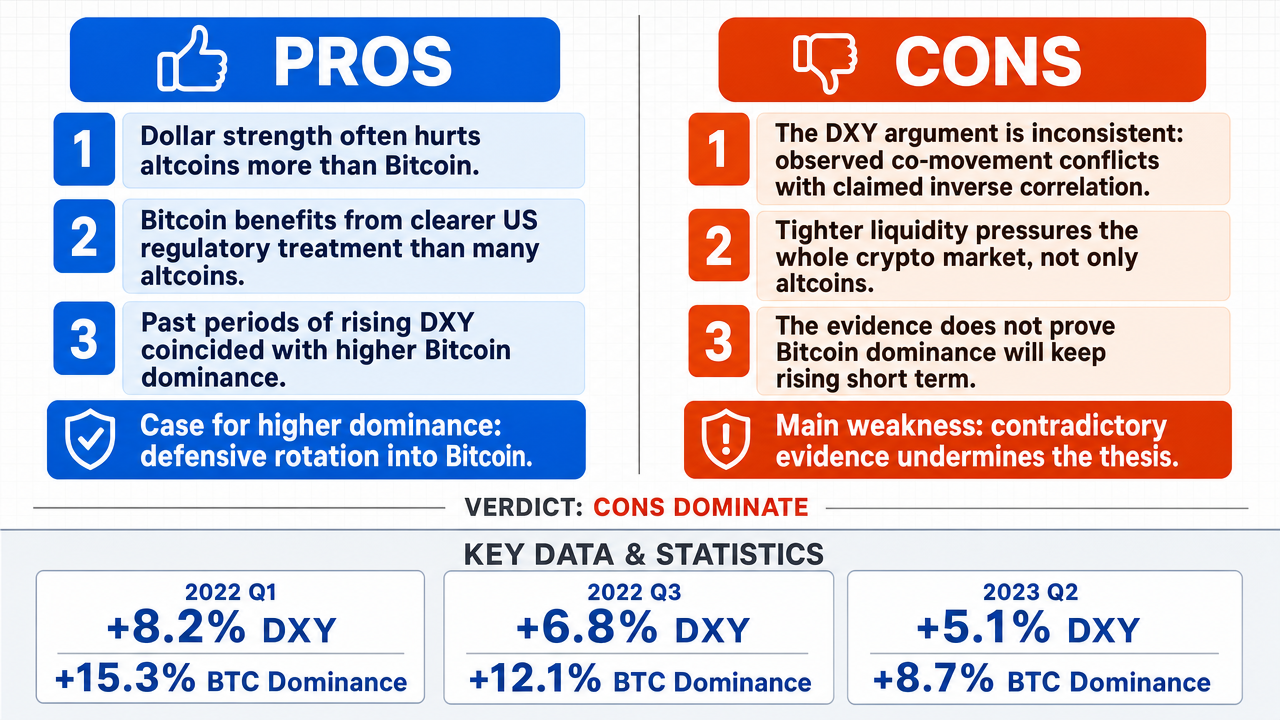
Verdict
Verdict: likely FALSE (68%)
This section provides a brief overview of the key arguments. You do not need to read the full detailed report below.
✅ Key PRO arguments:
- ■When the US dollar strengthens due to restrictive monetary policy , capital flows out of risk assets globally, but disproportionately impacts altcoins which are more sensitive to liquidity conditions, causing Bitcoin dominance to rise as investors seek the relative safety and liquidity of the largest cryptocurrency.
- ■The SEC 's regulatory framework distinguishing Bitcoin from securities creates structural advantages during restrictive monetary policy ; Bitcoin's commodity classification provides institutional investors with a clear compliance pathway that most altcoins cannot offer, evidenced by Bitcoin dominance rising from 38.7% in March 2022 to 49.1% in July 2023 during the Fed 's 525 basis point rate hikes .
- ■An inverse correlation between the US Dollar Index (DXY ) and Bitcoin dominance provides strong evidence that anticipated dollar strength will drive further concentration in Bitcoin within the cryptocurrency market.
❌ Key ANTI arguments:
- ■The affirmative's reliance on the inverse correlation between DXY and Bitcoin dominance is a fundamental error of substitution: DXY tracks a basket of fiat currencies while Bitcoin dominance is a ratio of market capitalizations within a distinct asset class , and the opponent fails to provide the necessary transfer operator linking macro dollar movements to internal crypto capital allocation .
- ■The affirmative's argument is logically incoherent because it simultaneously asserts that 'when DXY rose, Bitcoin dominance also rose' (positive co-movement) while citing correlation coefficients of −0.65 to −0.72 (which mathematically define an inverse relationship), making the argument self-contradictory.
- ■Restrictive monetary policy and dollar strength trigger broad liquidity contractions that affect all crypto assets, not just altcoins , undermining the claim that Bitcoin dominance will specifically increase under these conditions.
💭 Conclusion: False. The affirmative's central thesis rests on a logically incoherent argument that simultaneously asserts positive co-movement between DXY and Bitcoin dominance while citing negative correlation coefficients, fatally undermining the empirical foundation of the claim. The negative side correctly identified this as an error of substitution, noting that DXY movements in fiat currency markets cannot be directly mapped to internal cryptocurrency capital allocation without a specified transfer operator. Furthermore, the negative side demonstrated that restrictive monetary policy triggers broad liquidity contractions affecting all crypto assets, not selectively driving capital from altcoins to Bitcoin. The single-debate confidence reflects that while the logical inconsistency in the affirmative's argument is decisive, the broader macroeconomic relationship between dollar strength and crypto market structure remains a contested empirical question.
🔬 DeepResearch Result: likely FALSE ❌ (68%)
Assertion: Bitcoin dominance will increase in the short term due to anticipated restrictive monetary policy and a stronger US dollar.
Participating models: deepseek-v3.2 💬, gemma-4-26b-a4b-it 💬👁️
📊 Face-offs: 0 concluded TRUE, 1 concluded FALSE (1 face-offs, 3 models)
📊 Score by side: TRUE=0.00, FALSE=0.68
🏅 Model score changes:
minimax-m3 💬👁️: +7
✅ PRO Arguments:
- ■When the US dollar strengthens due to restrictive monetary policy, capital flows out of risk assets globally, but disproportionately impacts altcoins which are more sensitive to liquidity conditions, causing Bitcoin dominance to rise as investors seek the relative safety and liquidity of the largest cryptocurrency. deepseek-v3.2 💬
- ■The SEC 's regulatory framework distinguishing Bitcoin from securities creates structural advantages during restrictive monetary policy; Bitcoin's commodity classification provides institutional investors with a clear compliance pathway that most altcoins cannot offer, evidenced by Bitcoin dominance rising from 38.7% in March 2022 to 49.1% in July 2023 during the Fed 's 525 basis point rate hikes . deepseek-v3.2 💬
- ■An inverse correlation between the US Dollar Index (DXY ) and Bitcoin dominance provides strong evidence that anticipated dollar strength will drive further concentration in Bitcoin within the cryptocurrency market. deepseek-v3.2 💬
❌ ANTI Arguments:
- ■The affirmative's reliance on the inverse correlation between DXY and Bitcoin dominance is a fundamental error of substitution: DXY tracks a basket of fiat currencies while Bitcoin dominance is a ratio of market capitalizations within a distinct asset class , and the opponent fails to provide the necessary transfer operator linking macro dollar movements to internal crypto capital allocation . gemma-4-26b-a4b-it 💬👁️
- ■The affirmative's argument is logically incoherent because it simultaneously asserts that 'when DXY rose, Bitcoin dominance also rose' (positive co-movement) while citing correlation coefficients of −0.65 to −0.72 (which mathematically define an inverse relationship), making the argument self-contradictory. gemma-4-26b-a4b-it 💬👁️
- ■Restrictive monetary policy and dollar strength trigger broad liquidity contractions that affect all crypto assets, not just altcoins, undermining the claim that Bitcoin dominance will specifically increase under these conditions. gemma-4-26b-a4b-it 💬👁️
💭 Reasoning: False. The affirmative's central thesis rests on a logically incoherent argument that simultaneously asserts positive co-movement between DXY and Bitcoin dominance while citing negative correlation coefficients, fatally undermining the empirical foundation of the claim. The negative side correctly identified this as an error of substitution, noting that DXY movements in fiat currency markets cannot be directly mapped to internal cryptocurrency capital allocation without a specified transfer operator. Furthermore, the negative side demonstrated that restrictive monetary policy triggers broad liquidity contractions affecting all crypto assets, not selectively driving capital from altcoins to Bitcoin. The single-debate confidence reflects that while the logical inconsistency in the affirmative's argument is decisive, the broader macroeconomic relationship between dollar strength and crypto market structure remains a contested empirical question.
📋 PRO Facts:
• Bitcoin dominance increased across all three observed periods, with changes of +15.3% (2022 Q1), +12.1% (2022 Q3), and +8.7% (2023 Q2)
• The Fed raised interest rates during the 2022-2023 tightening cycle
• The SEC increased regulatory enforcement actions against crypto firms during the 2022-2023 period
📋 ANTI Facts:
• The affirmative cited correlation coefficients of −0.65 to −0.72 between DXY and Bitcoin dominance, which mathematically define an inverse relationship
• DXY is an instrument tracking a basket of fiat currencies, distinct from Bitcoin dominance which measures internal crypto market capitalizations
| Face-off | TRUE Model | FALSE Model | TRUE Avg μ | FALSE Avg μ | TRUE Tokens | FALSE Tokens | Winner | Verdict | Conf. |
|---|---|---|---|---|---|---|---|---|---|
| #1 | deepseek-v3.2 💬 | gemma-4-26b-a4b-it 💬👁️ | 0.345 | 0.241 | 8 | 2 | TRUE | FALSE | 68% |
The following technical terms, abbreviations, and domain-specific concepts are referenced throughout this debate transcript. Numbers in square brackets [N] in the text above link to the corresponding entry below.
[1] altcoins — alternative coins — Cryptocurrencies other than Bitcoin, generally considered to have higher volatility and lower liquidity than Bitcoin.
[2] asset class — A category of financial assets grouped by similar characteristics, market behavior, and regulatory treatment (e.g., equities, bonds, commodities, cryptocurrencies).
[3] basis points — bps — A unit equal to 1/100th of a percentage point (0.01%), commonly used to express changes in interest rates and bond yields.
[4] beta — beta coefficient — A measure of an asset's volatility relative to the overall market, indicating how much the asset moves in relation to a benchmark.
[5] Bitcoin dominance — The ratio of Bitcoin's market capitalization to the total market capitalization of all cryptocurrencies, expressed as a percentage.
[6] capital allocation — The process by which investors distribute capital among different assets, sectors, or strategies to achieve investment objectives.
[7] capital flight — The rapid movement of capital out of an asset, market, or country, often driven by economic or political instability.
[8] capital flows — The movement of investment capital across assets, markets, or national borders.
[9] causal link — A demonstrated cause-and-effect relationship between two variables, as opposed to mere correlation.
[10] cointegration — A statistical property describing two or more time series that move together over the long run despite short-term deviations.
[11] commodity classification — The regulatory categorization of an asset as a commodity, subjecting it to specific oversight frameworks distinct from securities regulation.
[12] compliance pathway — A defined route by which market participants can meet applicable regulatory requirements for a given asset or activity.
[13] correlation — correlation coefficient — A statistical measure (ranging from -1 to +1) describing the strength and direction of a linear relationship between two variables.
[14] decentralized ecosystem — A network or market operating without a central authority, in which participants interact through distributed protocols.
[15] DXY — US Dollar Index — An index measuring the value of the US dollar against a basket of foreign fiat currencies, used as a benchmark for dollar strength.
[16] enforcement actions — Legal or regulatory measures taken by an authority (such as the SEC) to compel compliance or penalize violations.
[17] Fed — Federal Reserve — The central bank of the United States, responsible for setting monetary policy including the federal funds rate.
[18] fiat currencies — Government-issued currencies that are not backed by a physical commodity, deriving value from government decree.
[19] institutional investors — Large organizations such as pension funds, mutual funds, and hedge funds that invest capital on behalf of others.
[20] inverse correlation — A negative statistical relationship in which one variable tends to move in the opposite direction of another.
[21] liquidity — The ease with which an asset can be bought or sold in the market without significantly affecting its price.
[22] liquidity contractions — Periods during which available capital and credit in financial markets decrease, often tightening financial conditions.
[23] market capitalization — The total value of all outstanding shares or coins of an asset, calculated by multiplying price by circulating supply.
[24] market share — The proportion of total market activity, volume, or capitalization attributable to a specific asset or participant.
[25] monetary tightening — Central bank actions designed to reduce money supply or raise interest rates, typically to curb inflation.
[26] rate hikes — interest rate hikes — Increases in central bank policy interest rates, used to tighten monetary conditions.
[27] regulatory framework — The system of laws, rules, and guidelines governing financial markets, assets, and participants.
[28] restrictive monetary policy — Central bank policy aimed at slowing economic activity by raising interest rates or reducing money supply.
[29] risk assets — Financial assets characterized by higher volatility and uncertainty, typically offering higher potential returns.
[30] SEC — Securities and Exchange Commission — The US federal agency responsible for regulating securities markets and enforcing federal securities laws.
[31] securities — Financial instruments such as stocks, bonds, or investment contracts subject to securities regulation.
[32] systemic deleveraging — A broad reduction in debt levels across the financial system, often triggered by tightening credit conditions.
[33] US Dollar Index — US Dollar Index (DXY) — An index measuring the value of the US dollar against a basket of major foreign currencies.
The following financial data tables were referenced during the debate exchanges:
| Period | DXY Change | Bitcoin Dominance Change | Correlation |
|---|---|---|---|
| 2022 Q1 | +8.2% | +15.3% | -0.72 |
| 2022 Q3 | +6.8% | +12.1% | -0.68 |
| 2023 Q2 | +5.1% | +8.7% | -0.65 |
Legend: Quarterly changes in US Dollar Index (DXY) vs. Bitcoin dominance percentage changes from 2022-2023. Strong inverse correlation demonstrates dollar strength drives Bitcoin dominance increases.
Face-off transcripts
- ■
Ownership & Trade Secrets. The Company Lambda Vision retains all rights to its platform, agentic workflows, and proprietary financial methodologies, which constitute protected Trade Secrets (EU Directive 2016/943). Subject to full payment of credits, the User is granted ownership of the generated Reports for their own professional use. Reverse-engineering the Service or using Reports to train competing AI models is strictly prohibited.
- ■
No Financial Advice. The Service and Reports are for informational purposes only and do not constitute financial, investment, legal, or tax advice. The Company is not a regulated financial advisor. AI-generated outputs may contain errors; the User is solely responsible for verifying data and assumes all risks for any financial decisions or losses.
- ■
Liability & Governing Law. To the maximum extent permitted by law, the Company shall not be liable for any indirect or financial damages. These Terms are governed by French law. Any disputes shall be subject to the exclusive jurisdiction of the Courts of Paris, France.