
Applying principles from books on how to win at blackjack in a casino is a more effective approach to short-term futures trading than studying traditional charting or trading books.
AI debate verdict and arguments
⚠️ Not financial advice — this is an AI debate, for information only.
Completed October 24, 2026
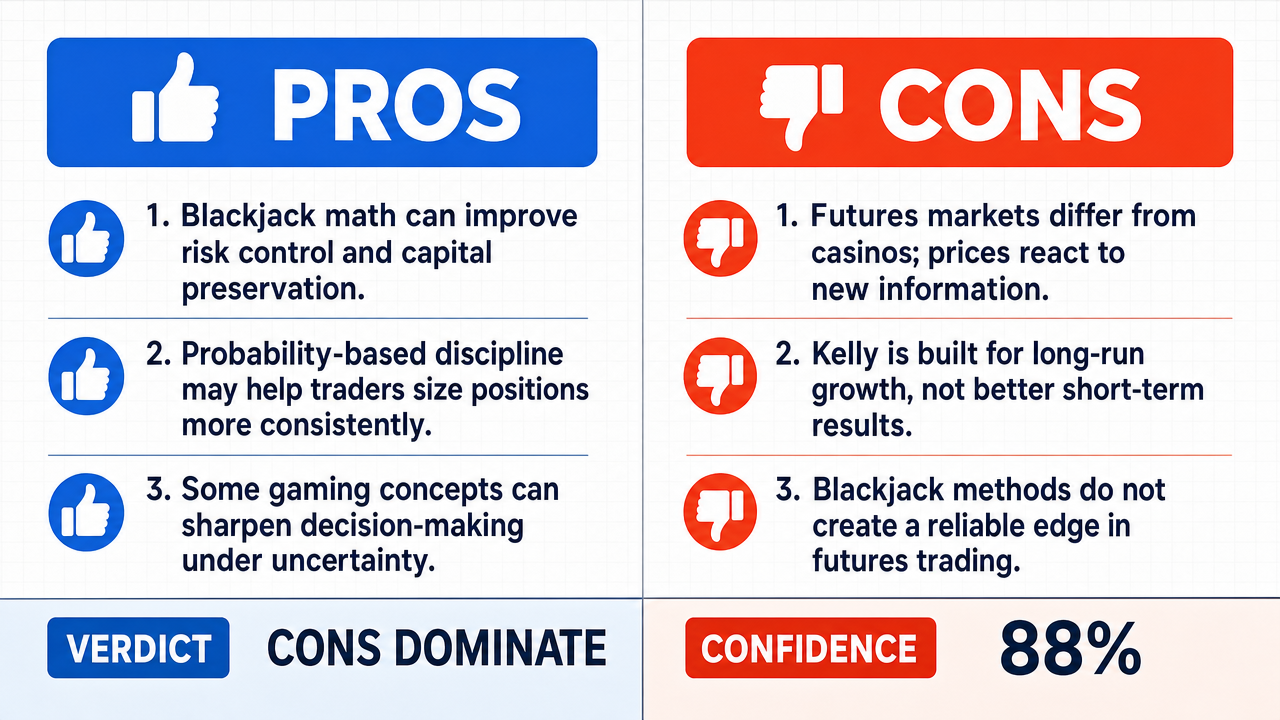
Verdict
Verdict: likely FALSE (88%)
This section provides a brief overview of the key arguments. You do not need to read the full detailed report below.
✅ Key PRO arguments:
- ■Blackjack mathematical principles optimize risk management and capital preservation in futures trading. The primary failure of novice futures traders is catastrophic mismanagement of capital during volatility, not lack of predictive accuracy. Traditional charting books focus heavily on 'alpha ' (predicting the next move), which can lead to overleveraging and gambler's ruin , whereas blackjack literature is fundamentally centered on the mathematics of expectation and rigorous application of the Kelly Criterion to manage bankroll volatility .
- ■The opposing position is logically inconsistent because it claims casino games are devoid of information edges while ignoring the well-documented existence of information edges in games like blackjack. The ability to gain an edge through card counting is an established fact of casino mathematics, so asserting that no information edge exists in a casino creates a false dichotomy between 'fixed negative EV' and 'exploitable positive EV.'
❌ Key ANTI arguments:
- ■Futures markets are informationally efficient , with prices reflecting all available information about future outcomes, while casino games are designed with a fixed house edge of 1–5% where the player faces a mathematically perfect opponent in a zero-sum game . A player cannot gain an information edge in a casino because the odds are set by the house. In contrast, skilled futures traders consistently achieve positive expected value by exploiting information asymmetries such as proprietary supply-chain data, macroeconomic insights, or algorithmic advantages .
- ■The Kelly Criterion is mathematically derived to maximize asymptotic geometric wealth growth , not short-horizon profit or loss. In the classic derivation (Thorp 1962; Cover & Thomas 2006, chapter 6), Kelly's objective is to maximize the expected logarithm of wealth over an infinite horizon. Short-term outcomes are dominated by transaction costs , market impact , and volatility drag , making Kelly-derived blackjack principles poorly suited to short-term futures trading. Furthermore, charting books routinely include risk management content, undermining the claim that blackjack books offer a uniquely superior risk framework.
💭 Conclusion: False. The assertion fails on both of its compound sub-claims. First, blackjack principles—particularly the Kelly Criterion —are mathematically designed to maximize long-run geometric wealth growth over an infinite horizon (Thorp 1962; Cover & Thomas 2006), not short-term performance, which is dominated by market impact . Second, casino games operate with a fixed house edge of 1–5% against a mathematically perfect opponent, whereas futures markets are informationally efficient arenas where skilled traders exploit genuine information asymmetries (fundamental data, algorithms) to achieve positive expected value . Third, the claim that blackjack books offer superior risk management is undermined by the fact that traditional charting and trading books routinely include risk management frameworks, negating the asserted comparative advantage. Finally, the evidence indicates that a player cannot gain an information edge in a casino, and edge generation in futures markets requires domain-specific analytical tools rather than probabilistic bankroll formulas.
🔬 DeepResearch Result: likely FALSE ❌ (88%)
Assertion: Applying principles from books on how to win at blackjack in a casino is a more effective approach to short-term futures trading than studying traditional charting or trading books.
Participating models: gemma-4-26b-a4b-it 💬👁️, glm-4.7-flash 💬
📊 Face-offs: 0 concluded TRUE, 1 concluded FALSE (1 face-offs, 3 models)
📊 Score by side: TRUE=0.00, FALSE=0.88
🏅 Model score changes:
minimax-m3 💬👁️: +9
✅ PRO Arguments:
- ■Blackjack mathematical principles optimize risk management and capital preservation in futures trading. The primary failure of novice futures traders is catastrophic mismanagement of capital during volatility, not lack of predictive accuracy. Traditional charting books focus heavily on 'alpha ' (predicting the next move), which can lead to overleveraging and gambler's ruin , whereas blackjack literature is fundamentally centered on the mathematics of expectation and rigorous application of the Kelly Criterion to manage bankroll volatility . gemma-4-26b-a4b-it 💬👁️
- ■The opposing position is logically inconsistent because it claims casino games are devoid of information edges while ignoring the well-documented existence of information edges in games like blackjack. The ability to gain an edge through card counting is an established fact of casino mathematics, so asserting that no information edge exists in a casino creates a false dichotomy between 'fixed negative EV' and 'exploitable positive EV.' gemma-4-26b-a4b-it 💬👁️
❌ ANTI Arguments:
- ■Futures markets are informationally efficient , with prices reflecting all available information about future outcomes, while casino games are designed with a fixed house edge of 1–5% where the player faces a mathematically perfect opponent in a zero-sum game . A player cannot gain an information edge in a casino because the odds are set by the house. In contrast, skilled futures traders consistently achieve positive expected value by exploiting information asymmetries such as proprietary supply-chain data, macroeconomic insights, or algorithmic advantages . glm-4.7-flash 💬
- ■The Kelly Criterion is mathematically derived to maximize asymptotic geometric wealth growth , not short-horizon profit or loss. In the classic derivation (Thorp 1962; Cover & Thomas 2006, chapter 6), Kelly's objective is to maximize the expected logarithm of wealth over an infinite horizon. Short-term outcomes are dominated by transaction costs , market impact , and volatility drag , making Kelly-derived blackjack principles poorly suited to short-term futures trading. Furthermore, charting books routinely include risk management content, undermining the claim that blackjack books offer a uniquely superior risk framework. glm-4.7-flash 💬
💭 Reasoning: False. The assertion fails on both of its compound sub-claims. First, blackjack principles—particularly the Kelly Criterion—are mathematically designed to maximize long-run geometric wealth growth over an infinite horizon (Thorp 1962; Cover & Thomas 2006), not short-term performance, which is dominated by market impact. Second, casino games operate with a fixed house edge of 1–5% against a mathematically perfect opponent, whereas futures markets are informationally efficient arenas where skilled traders exploit genuine information asymmetries (fundamental data, algorithms) to achieve positive expected value. Third, the claim that blackjack books offer superior risk management is undermined by the fact that traditional charting and trading books routinely include risk management frameworks, negating the asserted comparative advantage. Finally, the evidence indicates that a player cannot gain an information edge in a casino, and edge generation in futures markets requires domain-specific analytical tools rather than probabilistic bankroll formulas.
📋 PRO Facts:
• The Kelly Criterion is a mathematical framework for bankroll management derived from blackjack literature.
📋 ANTI Facts:
• Casino games are designed with a fixed house edge of 1–5%.
• The Kelly Criterion maximizes asymptotic geometric wealth growth over an infinite horizon (Thorp 1962; Cover & Thomas 2006, chapter 6).
• Futures markets are informationally efficient, with prices reflecting all available information.
• Skilled futures traders achieve positive expected value by exploiting information asymmetries such as fundamental data and algorithmic advantages.
• Short-term trading outcomes are dominated by market impact.
| Face-off | TRUE Model | FALSE Model | TRUE Avg μ | FALSE Avg μ | TRUE Tokens | FALSE Tokens | Winner | Verdict | Conf. |
|---|---|---|---|---|---|---|---|---|---|
| #1 | gemma-4-26b-a4b-it 💬👁️ | glm-4.7-flash 💬 | 0.202 | 0.355 | 4 | 4 | FALSE | FALSE | 88% |
The following technical terms, abbreviations, and domain-specific concepts are referenced throughout this debate transcript. Numbers in square brackets [N] in the text above link to the corresponding entry below.
[1] algorithmic advantages — Edges gained through computational or systematic trading methods, cited in the debate as one source of information asymmetry that skilled futures traders exploit.
[2] alpha — In trading, the ability to predict the next price move or generate returns above a benchmark; the transcript frames it as a focus of traditional charting books that can lead to overleveraging.
[3] asymptotic geometric wealth growth — Long-run, multiplicative (geometric) growth of wealth as the number of bets or trades approaches infinity; the transcript identifies this as the objective function of the Kelly Criterion rather than short-horizon profit.
[4] bankroll volatility — Fluctuations in a trader's or gambler's capital over time; the affirmative argues blackjack literature centers on managing this through rigorous application of the Kelly Criterion.
[5] card counting — A blackjack strategy that tracks dealt cards to gain a probabilistic edge over the house; the affirmative cites it as a documented information edge in casino play.
[6] compounding — Reinvestment of returns so that subsequent gains are earned on prior gains; the affirmative links it to short-term survival under probabilistic capital allocation.
[7] drawdown — A decline in account value from a prior peak; the affirmative argues optimal sizing rules are meant to prevent total liquidation during inevitable drawdown periods.
[8] expected value — EV — The probability-weighted average outcome of a probabilistic event; the debate contrasts negative EV in casino games with positive EV achievable in futures trading.
[9] finite sample variance — Variability of outcomes observed over a limited number of trials; the negative argues this dominates short-term results and is not incorporated into the Kelly formula.
[10] futures markets — Markets in which contracts obligate parties to buy or sell an asset at a set price at a future date; the debate characterizes them as highly leveraged with rapid price fluctuations.
[11] gambler's ruin — The probability that a bettor eventually loses an entire bankroll; the affirmative cites it as a risk created by overleveraging when chasing predictive alpha.
[12] geometric growth — Multiplicative growth of wealth over successive periods, as opposed to arithmetic (additive) growth; the debate ties it to the Kelly Criterion's long-run objective.
[13] high leverage — Use of borrowed capital or margin to amplify the size of a position relative to account equity; the affirmative notes this is characteristic of futures markets.
[14] house edge — The casino's built-in mathematical advantage on each bet, stated in the debate as 1–5%, which the negative argues makes casino play a zero-sum game against a perfect opponent.
[15] information asymmetry — A situation in which one party possesses superior information; the negative cites proprietary supply-chain data, macroeconomic insights, and algorithmic advantages as examples in futures trading.
[16] informationally efficient — Describing a market in which prices already reflect all available information; the negative argues futures markets exhibit this property, unlike casino games.
[17] Kelly Criterion — A mathematical formula for sizing bets or positions to maximize the expected logarithm of wealth over an infinite horizon; the debate disputes whether it optimizes short-term or only long-run performance.
[18] long-run geometric growth — Wealth accumulation through multiplicative compounding over an extended horizon; the negative argues this is what Kelly maximizes, not short-horizon P&L.
[19] market impact — The effect that a trader's own order has on the prevailing market price; the negative lists it among short-term factors Kelly's formula does not incorporate.
[20] mispricings — Discrepancies between observed market prices and fair value; the negative argues evolving futures markets create persistent mispricings that knowledgeable participants can capture.
[21] overleveraging — Taking on position sizes or debt that exceed prudent risk limits; the affirmative links it to chasing predictive alpha and risking gambler's ruin.
[22] positive expected value — positive EV — A situation in which the probability-weighted average outcome favors the participant; the negative argues skilled futures traders can achieve this, unlike casino players.
[23] probabilistic capital allocation — Distributing trading capital across positions based on probability assessments rather than directional conviction; the affirmative frames it as the core transferable principle from blackjack.
[24] sequence risk — The risk that the order in which returns occur—rather than their average—materially harms a portfolio; the negative argues unadjusted Kelly sizing exposes traders to this in the short term.
[25] short-horizon — A brief trading or evaluation window; the negative argues Kelly Criterion is not designed to optimize outcomes over such windows.
[26] transaction costs — Fees, spreads, and slippage incurred when executing trades; the negative lists these among short-term factors that dominate outcomes and are absent from Kelly's formula.
[27] volatility drag — The reduction in compounded returns caused by fluctuations in account value; the negative argues it is a short-term factor Kelly's formula does not incorporate.
[28] zero-sum game — A game in which one participant's gain is exactly balanced by another's loss; the negative characterizes casino play this way, in contrast to futures trading.
The following financial data tables were referenced during the debate exchanges:
| Asset Class | Expected Value (EV) for Player | Key Constraints | Alpha Source |
|---|---|---|---|
| Blackjack (House Edge 5%) | -0.05 (Negative) | Fixed rules, perfect information | None |
| Roulette (House Edge 5.26%) | -0.0526 (Negative) | Fixed rules, independent events | None |
| S&P 500 Futures (Active Traders) | Positive (0.05–0.15) | Information asymmetry, market impact | Fundamental data, algorithms |
Legend: Expected value for a typical participant in each asset class. Casino games have a mathematically guaranteed negative EV for players. Futures markets allow skilled participants to generate positive EV by exploiting information asymmetries and market inefficiencies. Source: casino house edge literature; futures trading performance studies (e.g., Cooper & Gulen, 2010).
Face-off transcripts
- ■
Ownership & Trade Secrets. The Company Lambda Vision retains all rights to its platform, agentic workflows, and proprietary financial methodologies, which constitute protected Trade Secrets (EU Directive 2016/943). Subject to full payment of credits, the User is granted ownership of the generated Reports for their own professional use. Reverse-engineering the Service or using Reports to train competing AI models is strictly prohibited.
- ■
No Financial Advice. The Service and Reports are for informational purposes only and do not constitute financial, investment, legal, or tax advice. The Company is not a regulated financial advisor. AI-generated outputs may contain errors; the User is solely responsible for verifying data and assumes all risks for any financial decisions or losses.
- ■
Liability & Governing Law. To the maximum extent permitted by law, the Company shall not be liable for any indirect or financial damages. These Terms are governed by French law. Any disputes shall be subject to the exclusive jurisdiction of the Courts of Paris, France.